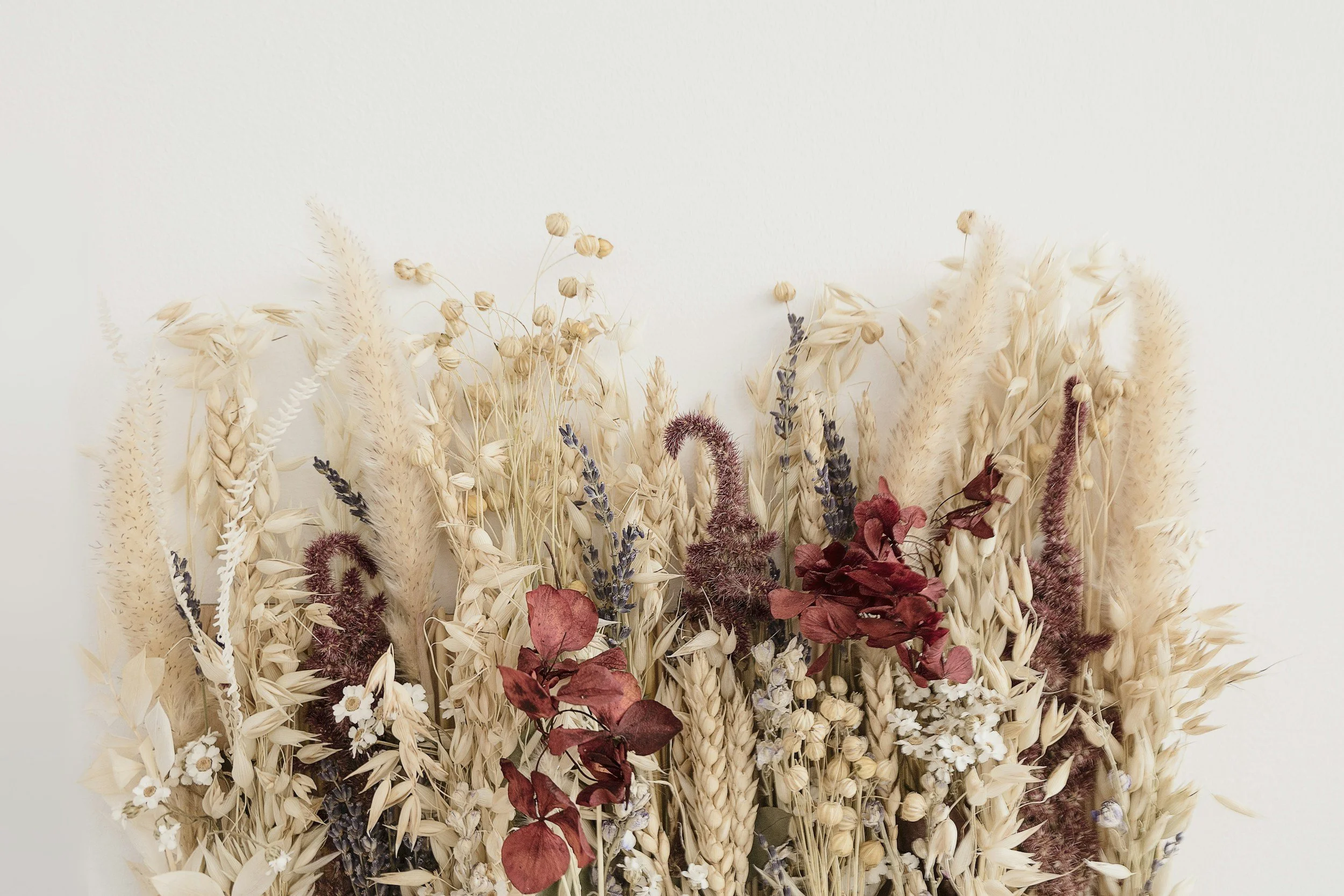
ALL FLORAL ALLIES
Flowers have accompanied humanity through nearly every threshold imaginable: birth beds, wedding aisles, funeral processions, sickrooms, shrines, battlefields, and graves. Some blooms symbolized devotion and rebirth. Others became tied to mourning, poison, seduction, death, or dangerous beauty hidden beneath soft petals.
This archive gathers floral folklore, funeral symbolism, sacred blossoms, poisonous gardens, and the old language people once spoke through bouquets and carefully chosen arrangements. Even now, flowers continue carrying messages most people no longer realize they are sending.
🜂 A
Amaranth (Amaranthus spp.)
Its name comes from the Greek amarantos, "unfading" — a reference to the flower's dried blooms, which hold their color long after cutting rather than wilting and browning like most cut flowers do. Sacred to the Aztecs, who used amaranth seed in both food and religious ceremony (sometimes mixed with human blood in effigies of their gods, a practice Spanish colonizers actively suppressed), the plant carried an entirely separate reputation in ancient Greece as a symbol of immortality, laid on tombs and woven into funeral wreaths for its refusal to fade. A flower that won't die convincingly enough has been trusted with the job of representing eternity on at least two continents independently.
full entry coming soon
Amaryllis (Hippeastrum spp.) ⚠️
Grown from a large bulb that produces a single dramatic, trumpet-shaped bloom on a tall bare stalk, amaryllis became a Victorian floriography symbol of pride, determination, and radiant beauty achieved through effort — a reading likely influenced by the flower's habit of pushing up a striking bloom seemingly out of nowhere, with no supporting foliage to soften the effect. The bulb contains lycorine and other alkaloids toxic if ingested, a danger easy to overlook given how commonly amaryllis is sold as a cheerful, low-maintenance holiday houseplant with no accompanying warning label.
full entry coming soon
Anemone (Windflower / Anemone coronaria)
In Greek myth, the anemone sprang from the blood of Adonis, killed by a wild boar while Aphrodite mourned him — a death myth that fixed the flower permanently to fragility, fleeting beauty, and grief cut short. Its folk name, windflower, comes from the belief that its delicate petals opened only when the wind blew, closing again at the first sign of its passing, which folklore read as a flower too sensitive and short-lived to be trusted to bloom on its own terms. Victorian floriography carried the myth forward almost unchanged, assigning anemone the meaning of "forsaken" or "abandonment" in grief-adjacent bouquets.
full entry coming soon
A close botanical relative of Kalmia and sharing its grayanotoxin content, azalea is toxic in every part despite being one of the most widely planted flowering shrubs in American and Asian gardens alike — a familiarity that, as with mountain laurel, has done little to raise public awareness of its danger to pets, livestock, and small children who might sample its blooms. In Chinese folklore, however, azalea (yingshanhong) is associated with womanhood, homesickness, and the passage of spring, appearing frequently in classical poetry as a symbol of longing rather than danger — a considerably gentler reputation than the plant's chemistry would suggest it's earned.
🜃 B
Belladonna Flower (Deadly Nightshade Bloom / Atropa belladonna) ⚠️
The flower gives no warning at all — small, drooping, purple-brown bells that look almost apologetic compared to the berries they'll become. In the Victorian language of flowers, belladonna signaled silence and falsehood, a fitting assignment for a plant whose entire reputation is built on things not being what they appear. Botanists and herbalists alike have long noted that belladonna's flower is the least dramatic part of an otherwise theatrical plant, as though it saves its intensity for later. See also: Herbarium.
🜄 C
Chrysanthemum (Mum / Chrysanthemum spp.)
Few flowers carry such contradictory meaning across cultures as the chrysanthemum. In France, Italy, and much of Southern Europe, it is almost exclusively a funeral flower, laid on graves for All Saints' Day and rarely given as a casual gift for fear of the association. In China and Japan, by contrast, the chrysanthemum is a symbol of longevity, nobility, and autumn celebration — the Japanese Imperial family's crest is a stylized chrysanthemum, and the flower has its own national holiday. The same bloom mourning in one hemisphere and celebrating in another is one of the clearest examples in floral folklore of meaning being entirely local.
full entry coming soon
🜁 D
Datura Flower (Moonflower, Thornapple / Datura stramonium) ⚠️
The datura's trumpet-shaped bloom opens only at dusk and closes again by mid-morning, a schedule that has earned it the folk name moonflower and tied it firmly to nocturnal and lunar magical associations. Large, pale, and heavily fragrant specifically to attract night-flying moths, the flower's beauty and its plant's danger have made it a favorite in gothic garden design for those who understand exactly what they're planting. Its spiked seed pod — the "thornapple" — is as visually striking and as toxic as the flower it follows. See also: Herbarium.
🜂 E
[no entries]
🜃 F
Foxglove (Dead Man's Bells, Fairy Thimbles / Digitalis purpurea) ⚠️
The spotted throat inside each bell-shaped bloom was, in British and Irish folklore, read as the mark of fairy fingers — a warning left behind by the fair folk for anyone tempted to pick the flower. Foxglove was said to grow wherever fairies had danced, and disturbing a patch was considered a genuine risk rather than a superstition to be dismissed lightly. The plant's folk names split cleanly along this line: names invoking fairies and the dead on one side, and the more clinical "digitalis," lent to the heart medication derived from it, on the other. See also: Herbarium.
🜄 G
[no entries]
🜁 H
Hemlock Flower (Poison Hemlock Bloom / Conium maculatum) ⚠️
Hemlock's delicate white umbels are, by design or accident of evolution, nearly indistinguishable at a glance from several edible members of the carrot family — Queen Anne's Lace chief among them — a resemblance responsible for a steady, ongoing trickle of accidental poisonings among foragers who trusted their eyes over more careful identification. The flower carries none of the ornate folklore attached to other toxic blooms in this archive; hemlock's cultural role has always been more practical than symbolic, a plant defined by what it does rather than what it means. See also: Herbarium.
Honeysuckle (Woodbine / Lonicera spp.)
Honeysuckle climbs by twining, wrapping clockwise around whatever structure it finds, a growth habit that folk tradition read directly into its symbolism: binding, devotion, and love that holds fast. Victorian floriography assigned it the meaning of "bonds of love," and in parts of the British countryside it was considered unlucky to bring the cut flower indoors, since doing so was said to bring dreams — sometimes prophetic, sometimes simply vivid — to whoever slept near it. Its sweet nectar, drawn directly from the flower by children across generations, gives the plant its most literal name.
full entry coming soon
Hyacinth (Hyacinthus orientalis)
In Greek myth, Hyacinthus was a beautiful youth beloved by Apollo, accidentally killed by a discus blown off course by a jealous Zephyrus, the west wind. From his blood, Apollo caused the hyacinth to grow, inscribing the petals with a mark of mourning still referenced in some readings of the flower's markings today. The myth ties the flower permanently to grief, beauty cut short, and — because Apollo vowed the flower would bloom again each spring — a promise of return. Its intensely sweet fragrance has made it a staple of both spring gardens and funeral arrangements.
full entry coming soon
🜂 I
Iris (Iris germanica)
Named for the Greek goddess of the rainbow, who carried messages between the mortal and divine realms along its arc, iris flowers were painted on Egyptian royal tombs and later planted on graves across parts of Europe as a guide for the soul's journey — the flower doing, symbolically, exactly what its namesake goddess did professionally. The fleur-de-lis, adopted by French monarchy as a heraldic symbol, is widely believed to derive from a stylized iris rather than a lily, despite the name.
full entry coming soon
🜃 J
Jasmine (Jasminum officinale)
Jasmine opens its most fragrant blooms at night, a trait that has tied it across multiple traditions to love, seduction, and prophetic dreaming — in parts of South and Southeast Asia, jasmine garlands are essential to both wedding ceremonies and temple offerings, doing sacred and romantic work simultaneously without apparent contradiction. In European folk magic, jasmine is associated with lunar energy and psychic dreaming, burned or worn to encourage prophetic visions during sleep. The flower's intensity — a fragrance strong enough to be extracted as one of perfumery's most prized absolutes — has made it as valuable culturally as it is agriculturally difficult to harvest.
full entry coming soon
🜄 K
[no entries]
🜁 L
Lily of the Valley (Convallaria majalis) ⚠️
Small, bell-shaped, and sweetly scented, lily of the valley became the flower of the French May Day tradition — muguet du premier mai — exchanged as a token of good fortune since the 16th century, a custom still observed with sprigs sold on Parisian street corners every spring. Its extraordinary popularity in Victorian bridal bouquets, prized for scent and delicate appearance, sits uneasily alongside its total toxicity; every part of the plant, including the water from a vase holding cut stems, is dangerous if ingested. The flower's folklore reads almost entirely as innocence and returning happiness, with no trace of the danger the plant itself carries.
🜂 M
Marigold (Calendula officinalis)
Marigold occupies sacred ground on two continents simultaneously: in Mexico, cempasúchil (Mexican marigold, a related species) is the central flower of Día de los Muertos, its bright orange petals scattered in paths believed to guide the spirits of the dead home for the night; in Hindu tradition, marigold garlands are essential to weddings, temple offerings, and festival decoration, symbolizing auspiciousness and the sun's energy. The same flower welcoming the dead in one tradition and blessing new marriages in another demonstrates, as clearly as any bloom in this archive, how differently two cultures can read an identical color and shape.
full entry coming soon
Morning Glory (Ipomoea spp.) ⚠️
The trumpet-shaped blooms of morning glory open at dawn and close by afternoon, a brief flowering window that gave the plant its name and its folk association with fleeting beauty. Its seeds contain lysergic acid amide (LSA), a naturally occurring compound related to LSD, and were used in divinatory and religious ceremony by the Aztec and other Mesoamerican peoples — under the name ololiuqui — long before the chemistry behind the visions was understood by anyone outside those traditions. Ornamental morning glory varieties sold commercially today are frequently unaware descendants of a plant with a considerably more serious spiritual resume.
full entry coming soon
🜃 N
[no entries]
🜄 O
Oleander's abundant pink, white, or red blooms have made it one of the most widely planted flowering shrubs in warm climates worldwide, prized for thriving in poor soil and relentless heat where little else will grow — a hardiness that sits in uneasy contrast with a toxicity serious enough that even the smoke from burning oleander trimmings can cause illness. Its cheerful, almost carefree appearance in public parks, highway medians, and school gardens across the American South and Mediterranean has done little to dampen its popularity, despite centuries of documented poisonings attached to the plant. See also: Herbarium.
🜁 P
Poppy (Opium Poppy / Papaver somniferum) ⚠️
The bright red field poppy became the flower of remembrance for the war dead of the First World War, popularized by John McCrae's 1915 poem "In Flanders Fields" after he observed poppies blooming across the disturbed, lime-rich soil of Belgian battlefields. This modern symbolism sits atop a much older one: Papaver somniferum's species name references Somnus, Roman god of sleep, and the flower appears in ancient Greek art held by Hypnos and Thanatos, gods of sleep and death respectively, a pairing that predates the war poppy by well over two thousand years. See also: Herbarium.
full entry coming soon
🜂 Q
[no entries]
🜃 R
Rose (Rosa spp.)
Few flowers carry as many contradictory meanings as the rose. It is the flower of romantic love in nearly every Western tradition, yet the Latin phrase sub rosa ("under the rose") refers to secrecy — a rose was historically hung above a council table to indicate that whatever was discussed beneath it must remain confidential. It is the flower most associated with the Virgin Mary in Catholic tradition, and simultaneously the flower most associated with earthly romantic pursuit. Its short bloom and inevitable decay made it a favorite memento mori symbol in Renaissance still-life painting — beauty, love, secrecy, sanctity, and mortality, all folded into the same five petals.
full entry coming soon
🜄 S
Snowdrop (Galanthus nivalis) ⚠️
Often the very first flower to bloom in the European calendar, sometimes pushing up through snow itself, the snowdrop's early appearance made it a natural folk symbol of hope, purity, and the returning year — though in some regions of Britain it was considered unlucky to bring a single snowdrop indoors, associated instead with death and shrouds, a contradiction the folklore never fully settled. Its bulb closely resembles a small onion or shallot, a resemblance that has led to accidental poisonings when foraged or mistakenly harvested from a garden bed.
full entry coming soon
Sunflower (Helianthus annuus)
The sunflower's habit of heliotropism — young flower heads tracking the sun's movement across the sky before settling into a fixed eastward orientation as they mature — gave the plant its folk reputation for loyalty, devotion, and unwavering attention long before botanists explained the mechanism behind it. Native to the Americas and cultivated by indigenous peoples for thousands of years before European contact, the sunflower was later adopted across Europe as a symbol of faith and adoration, its physical behavior doing the symbolic work almost entirely on its own.
full entry coming soon
🜁 T
[no entries]
🜂 U
[no entries]
🜃 V
Violet (Viola odorata)
Small, unassuming, and easily overlooked in the grass, the violet became a floral symbol of modesty and hidden or unspoken love precisely because of its own tendency to hide beneath larger plants. Ancient Greek and Roman funeral rites made frequent use of violets, strewn on graves and worn by mourners, a tradition that persisted well into the Victorian era, when violets became closely associated with remembrance and quiet grief. Napoleon's association with the flower — supporters wore violets as a coded symbol of loyalty during his exile — added a layer of political secrecy to an already quiet, private bloom.
full entry coming soon
🜄 W
Wolfsbane Flower (Monkshood Bloom / Aconitum napellus) ⚠️
The distinctive hooded shape of the aconite flower — resembling a monk's cowl from certain angles — gave the plant its most common folk name, monkshood, while its historic use in wolf-poison and predator-control baits earned it wolfsbane. Deep purple-blue and visually striking enough to be widely grown as an ornamental despite its extreme toxicity, the flower carries almost none of the ambiguity found in other toxic blooms in this archive; nearly every culture that encountered it arrived independently at the same conclusion about what it was for. See also: Herbarium.
🜁 X
[no entries]
🜂 Y
[no entries]
🜃 Z
[no entries]
Submit to the Archive
If you would like to suggest a topic or share a lead worth investigating, submit it to us for review. Click Here