Oleander: The Beautiful Poison
Every part of the oleander plant is toxic — leaves, flowers, stems, sap, even the smoke if it's burned — and a few chewed leaves have reportedly been enough to kill a child. It's also one of the most widely planted ornamental shrubs on earth, lining highways, medians, and gardens from California to the Mediterranean coast. Few plants hide in plainer sight while carrying this much danger.
Oleander doesn't have the occult pedigree of belladonna or henbane — it was never a star ingredient in a witch's flying ointment, never named after a Fate who cuts the thread of life. Its darkness is quieter and, in some ways, more unsettling: a plant trusted enough to plant beside playgrounds and parking lots, that has also been a recurring suspect in real deaths for over two thousand years.
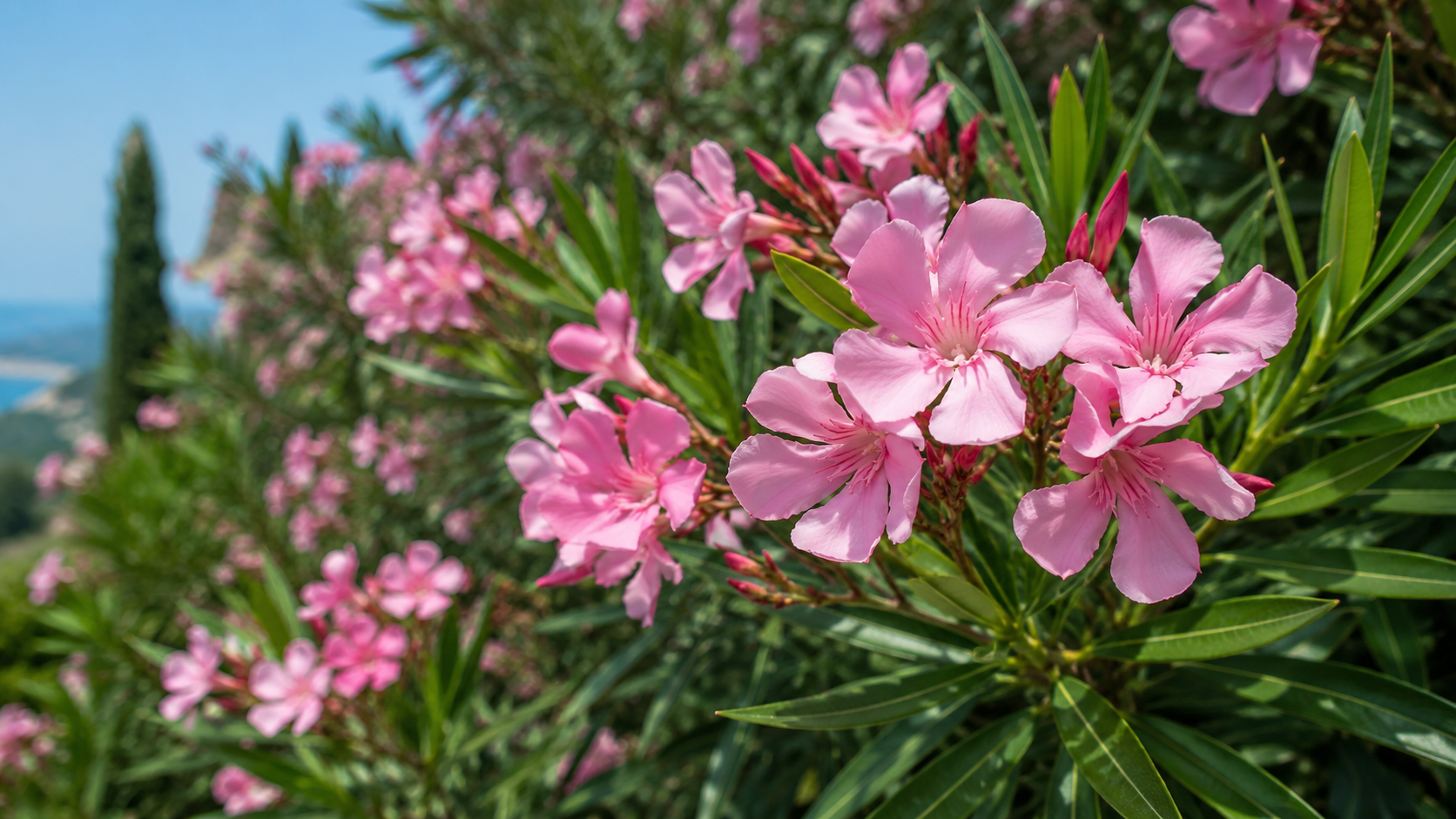
What Oleander Actually Does to the Body
Oleander's toxicity comes from a class of compounds called cardiac glycosides — most notably oleandrin — chemical cousins of the compounds found in foxglove, another famously poisonous garden plant. These compounds interfere directly with the heart's electrical rhythm, disrupting the signals that keep a heartbeat steady and predictable.
The plant doesn't try to disguise itself as harmless, exactly, but it doesn't broadcast danger either — there's no foul smell, no obviously alarming texture. Even the smoke from burning oleander wood or trimmings carries enough of the toxin to cause illness, which has made it dangerous in scenarios people wouldn't think to be cautious about, like clearing yard debris in a bonfire.
Early symptoms of oleander poisoning typically involve the digestive system and the heart together — nausea, vomiting, abdominal pain, an irregular or dangerously slowed heartbeat, dizziness, and in severe cases, seizures or cardiac arrest. Pets and livestock are highly susceptible as well; horses and grazing animals have died from eating clipped oleander branches tossed into a pasture.
Pliny the Elder Got It Backwards
Even ancient authorities struggled to pin oleander down correctly. The Roman naturalist Pliny the Elder, writing around 77 AD, described oleander as poisonous to livestock and beasts of burden — but also claimed it could function as an antidote to snake venom. He was right about the first part and completely wrong about the second; oleander offers no protection against venom whatsoever. It's a small, telling detail about how even careful ancient observers, working without any real toxicological framework, could correctly identify a plant as deadly and still misunderstand exactly how or why.
The Doomed Lovers Behind the Name
Oleander's most enduring myth has nothing to do with poison at all — it's a tragedy about devotion. According to Greek legend, Leander was a young man in love with Hero, a priestess of Aphrodite who lived across the Hellespont strait. Every night, Leander swam the dangerous crossing to see her, guided by a lamp she kept burning in her tower. One stormy night, the wind extinguished the lamp. Leander lost his bearings in the dark water and drowned.
The next morning, Hero searched the shoreline calling his name, and found his body washed up on the sand — a single flower clutched in his hand. She kept the flower as a relic of their love, and in some versions of the story, it took root and grew, becoming the first oleander. The name itself, in this telling, is a contraction of grief: a flower named for a drowned man, found in a dead lover's hand.
It's a strange pairing for a plant this lethal — a flower born from a love story, carrying enough poison to stop a heart. But oleander has always specialized in exactly this kind of contradiction.
Sentinel of Tombs, Guardian of Thresholds
Long before "true crime poisoning" was a genre, oleander had a quieter cultural role: a guardian. In Mediterranean regions where it grows wild and abundant, it was traditionally planted along property lines and boundaries, valued less for beauty and more as a kind of botanical warning system — a plant fierce enough to discourage anyone who might wander too close. Its evergreen leaves, holding color through every season, came to symbolize endurance and undying remembrance, which is part of why oleander shows up so often planted around ancient tombs and gravesites — not as a memento mori, but as a living symbol that something here doesn't fade.
That same duality shows up in funeral customs across the Mediterranean and Middle East, where oleander blossoms have been used in mourning arrangements, carrying both the weight of caution and a strange kind of comfort — beauty persisting at the edge of death.
There's an even more striking modern echo of this symbolism: in parts of the Middle East, oleander has been deliberately planted in landscapes scarred by conflict, partly because of its resilience in poor soil and partly as a quiet symbol — a poisonous plant standing in for hope and recovery in places that needed both.
The Campfire Legend That Won't Die
No discussion of oleander folklore is complete without its most persistent urban legend: the story of campers, scouts, or soldiers who unknowingly roast hot dogs or marshmallows on oleander branches and die from the toxin leaching into their food. Versions of this story have been attached to Napoleon's army, to Alexander the Great's soldiers, and to nameless modern campers — told, almost always, as something that happened to someone else, somewhere specific, but never quite verifiable.
Despite how often it circulates as true crime or survival-skills cautionary tale, there's no solid documented case behind it. That doesn't make oleander safe to burn — the smoke genuinely is toxic — but the specific "death by hot dog stick" story belongs more to the genre of folklore than to verified history. Which, in its own way, says something honest about how oleander is remembered: feared enough that an unverifiable legend about it spread for generations anyway.
A more specific, place-rooted legend comes from Charleston, South Carolina, where local lore holds that innkeepers John and Lavinia Fisher poisoned guests with oleander-laced tea before robbing them — a story repeated for generations in the city's true-crime folklore, though no contemporary record from their own era actually backs it up.
Quick Answers
Is oleander poisonous to touch? Handling the leaves and stems can cause skin irritation in sensitive individuals, but the far greater danger is ingestion — chewing or eating any part of the plant, or inhaling smoke from burned oleander wood.
Is oleander poisonous to dogs and cats? Yes — oleander is highly toxic to dogs, cats, and other pets, and even a small amount of chewed leaf or flower can cause serious cardiac symptoms requiring emergency veterinary care.
How much oleander is fatal to a human? There's no precise universal threshold, since toxicity varies by plant part and individual sensitivity, but as few as one or two leaves have been associated with serious poisoning in children, making any ingestion a medical emergency regardless of quantity.
Can you get sick from oleander smoke? Yes — burning oleander wood or trimmings releases its toxic compounds into the smoke, and inhaling it can cause illness; it should never be used as firewood or burned in an enclosed or food-preparation setting.
Why is such a poisonous plant so commonly used in landscaping? Oleander tolerates drought, poor soil, and pollution better than most ornamental shrubs, and produces months of vivid blooms with minimal care — making it a practical landscaping choice despite its toxicity, provided it's kept away from children, pets, and livestock.
Is the campfire/hot dog stick death story about oleander true? No verified case supports it — it's a persistent urban legend, attached over the centuries to soldiers, scouts, and campers alike, with no solid documentation behind any specific telling.