Monkshood: The Plant That Was Born From a Hellhound's Saliva
Monkshood has earned the title "queen of poisons," and unlike most royal titles, this one isn't an exaggeration. Every part of the plant is toxic, the toxin can kill through skin contact alone, and across at least three continents, completely unconnected cultures independently arrived at the exact same use for it: coating the tips of weapons meant to kill the most dangerous animals they hunted.
It also goes by a name most people know from a very different context — wolfsbane, the plant Western pop culture has spent the last century insisting can repel, cure, or kill a werewolf. That association is recent by the standards of monkshood's history, but it's not arbitrary. This is a plant that has been tangled up with wolves, hellhounds, and shapeshifting for longer than anyone can trace.
A Hood, a Helmet, and a Weapon
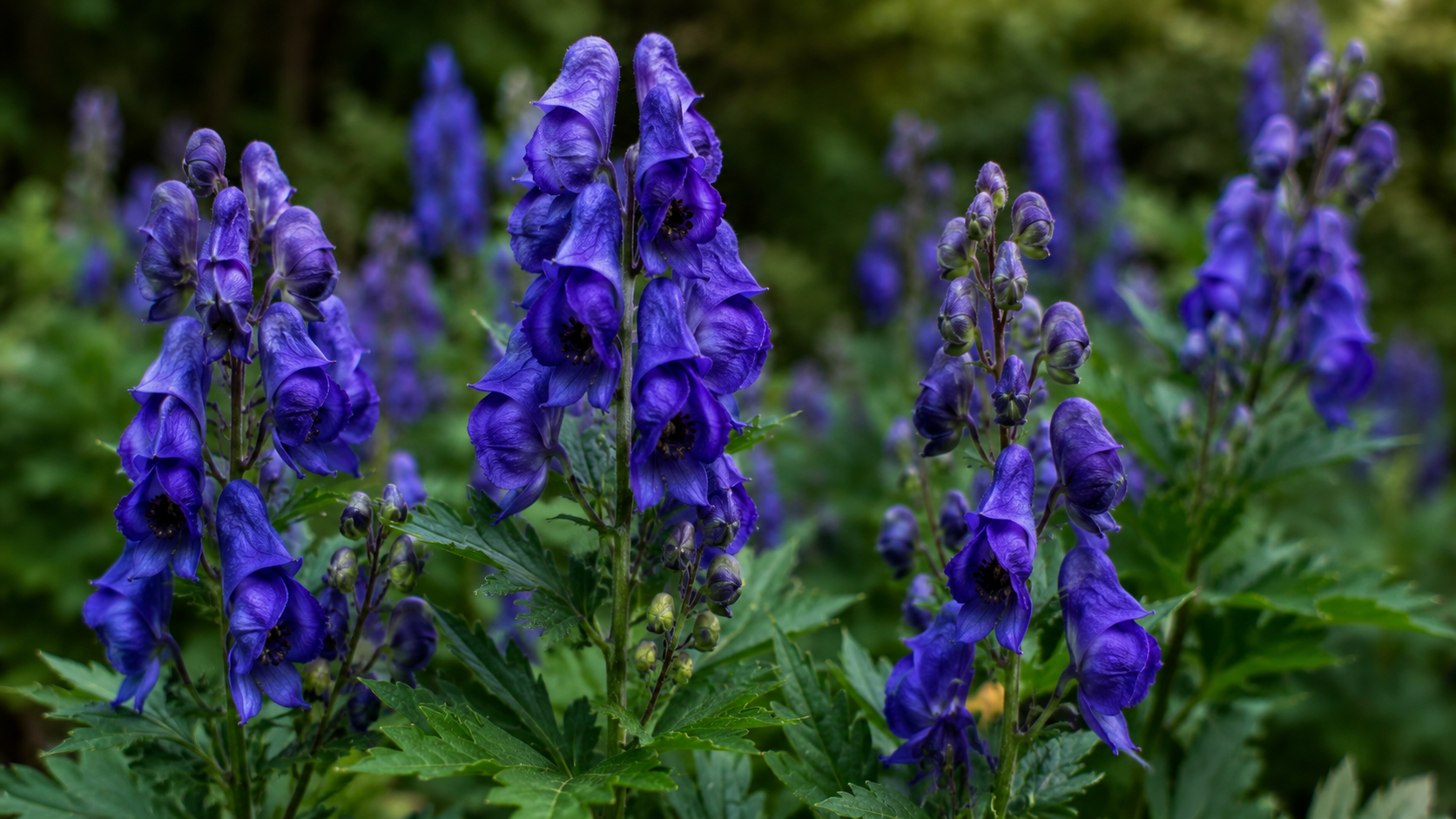
Monkshood's most recognizable feature is its flower — a tall spike of deep purple or blue blooms, each one shaped like a small, distinct hood or helmet. That silhouette gave the plant its English name directly: the curved petal forming the "hood" is technically called a galea, a term borrowed straight from the name of a Roman soldier's helmet.
Its other major name, wolfsbane, comes from function rather than appearance. Ancient Greek hunters used the plant's juice to poison bait and arrow tips specifically for killing wolves, and the practice was widespread and effective enough that the Greek name for one species, lycoctonum, translates literally to "wolf's bane" — wolf's destruction. The genus name Aconitum itself likely traces back to the Greek word for a dart or javelin, a fairly blunt acknowledgment of what the plant was primarily used for.
The toxin responsible for all of this is aconitine, alongside a family of related alkaloids concentrated most heavily in the roots and tubers. Skin contact alone can cause numbness; ingestion or deeper absorption leads to diarrhea, convulsions, and dangerous heart arrhythmias, progressing to death. Unlike many poisons that take time to act, aconitine can kill within minutes in a sufficient dose — a detail that made it both feared and, throughout history, quietly favored by anyone looking for an efficient method of murder.
Three Continents, One Idea
What's genuinely remarkable about monkshood isn't just its toxicity — it's how many unconnected cultures arrived at the same conclusion about what to do with it, independently, with no contact between them. Beyond the Greek use against wolves, the Ainu people of Japan used aconite-poisoned weapons to hunt bears. The Minaro people of Ladakh, in the high Himalayas, coated arrows with it to hunt ibex. The Aleut people of Alaska's Aleutian Islands applied the toxin to harpoons for hunting whales — adapting the same basic principle to one of the largest animals on earth.
Separated by oceans and mountain ranges, with no shared history or trade route connecting them, these cultures all looked at the same plant and reached an identical verdict: strong enough to bring down something far larger and more dangerous than the hunter wielding it.
Born From a Hellhound's Mouth
Monkshood's origin story in Greek mythology is one of the most vivid in the entire witch's garden. According to legend, when Hercules dragged Cerberus — the three-headed dog guarding the gates of the underworld — up into the world of the living as one of his twelve labors, the hound's saliva dripped onto the ground along the way. Wherever it fell, monkshood grew. The poet Ovid recorded the legend directly in his Metamorphoses, and even the famously methodical Pliny the Elder lent his authority to the same story in his Natural History — a plant literally born from the drool of a guardian of Hell.
The mythology doesn't stop there. The goddess Hecate — already established across this archive as the patron of the witch's garden generally — is credited in some traditions with having invented aconite outright, and her daughter Medea is said to have used it directly in a notorious attempted poisoning, lacing a cup of wine meant to kill Theseus before his father, King Aegeus, could recognize his own son. Athena, in a separate myth, used aconite to transform the weaver Arachne into a spider — punishment delivered through the same poison that, in other stories, simply killed outright.
Real history offers its own grim footnote: the Roman emperor Claudius is rumored to have been poisoned with aconite, allegedly by his own wife, Agrippina — mythology's favorite poison crossing over into an actual, if disputed, account of imperial murder.
The Plant That Made Men Wolves
Monkshood's connection to wolves didn't end when the hunting practices that gave it the name faded out of use. As actual wolf populations and the very real fear of wolf attacks persisted through medieval Europe, the plant's old name took on a new, stranger life — entangled now with the werewolf, rather than the wolf itself.
Frightened communities began growing wolfsbane specifically for protection, believing it could repel werewolves or even tame one back into human form. But the folklore cut both ways, in classic witch's-garden fashion: other traditions held that contact with the plant under a full moon could cause a person to transform into a wolf in the first place — the same plant serving simultaneously as cure, weapon, and curse, depending entirely on who was telling the story.
Medieval medicine added its own dark chapter to this. Physicians of the era who believed in lycanthropy as a genuine medical affliction — a delusion of being a wolf — reportedly prescribed regular doses of wolfsbane as treatment. Given the plant's actual toxicity, "regular doses" amounted to a slow, repeated poisoning of patients already suffering a severe mental health crisis, treated with one of the deadliest substances available rather than anything resembling care.
From Shakespeare to Sherlock to Hogwarts
Wolfsbane's literary trail runs remarkably long and consistent. Shakespeare reportedly used an aconite-coated blade as a murder weapon in Hamlet. John Keats opened his "Ode on Melancholy" by warning the reader away from "wolf's-bane, tight-rooted," comparing it directly to the mythological river of forgetfulness. Arthur Conan Doyle drew on real nineteenth-century aconite poisoning cases for one of Sherlock Holmes's investigations. Nathaniel Hawthorne wove it into the witchcraft atmosphere of "Young Goodman Brown."
The werewolf association proved the most durable of all. Dracula's 1931 film adaptation used wolfsbane in place of garlic as a vampire repellent, decades before werewolf fiction fully claimed the plant as its own. The Harry Potter series gave it a memorable modern role as the base of the Wolfsbane Potion, carefully brewed to let the werewolf Remus Lupin retain his human mind through his transformations. Even Marvel comics named a shapeshifting mutant character directly after the plant. Across a century of horror and fantasy storytelling, monkshood has rarely needed reintroducing — audiences already half-know what it means before a story tells them.
Quick Answers
Is monkshood actually dangerous to touch, or just to eat? Both — aconitine can be absorbed through skin contact alone, causing numbness, and handling the plant without gloves carries real risk even without ingestion.
Is monkshood the same plant as wolfsbane? Yes, generally — "monkshood" and "wolfsbane" both refer to plants in the genus Aconitum, though some sources distinguish the blue-flowered Aconitum napellus (monkshood) from the yellow-flowered Aconitum lycoctonum (the more "true" wolfsbane); both are similarly toxic.
Can wolfsbane actually repel or cure werewolves? That's folklore, not fact — though the legend is old and persistent, with some traditions even claiming the opposite, that contact with the plant under a full moon could cause transformation rather than prevent it.
How fast does aconite poisoning work? It can act within minutes in a sufficient dose, making it one of the faster-acting plant poisons, affecting both the heart and nervous system.
Why is it still sold as a garden plant if it's this toxic? Its striking purple-blue flowers and late-season bloom make it a popular ornamental despite the danger, though it requires careful handling — gloves are recommended even for routine gardening — and should be kept away from children and pets.
Is there a real connection between monkshood and the legend of Cerberus? The Cerberus origin story is purely mythological, but it reflects how seriously ancient cultures regarded the plant's danger — significant enough to need an explanation rooted in the literal mouth of a guardian of Hell.