Datura: The Devil's Trumpet That Drives You Mad Before It Kills You
Datura doesn't just poison you — it's said to take your mind first. Every part of the plant carries toxic tropane alkaloids capable of producing severe delirium, hallucinations, and a specific, well-documented kind of confused, agitated madness before the more dangerous physical symptoms even set in. There's an old folk warning attached to this plant that sounds almost too poetic to be literal: the toxins in datura can kill you, but you will lose your mind first.
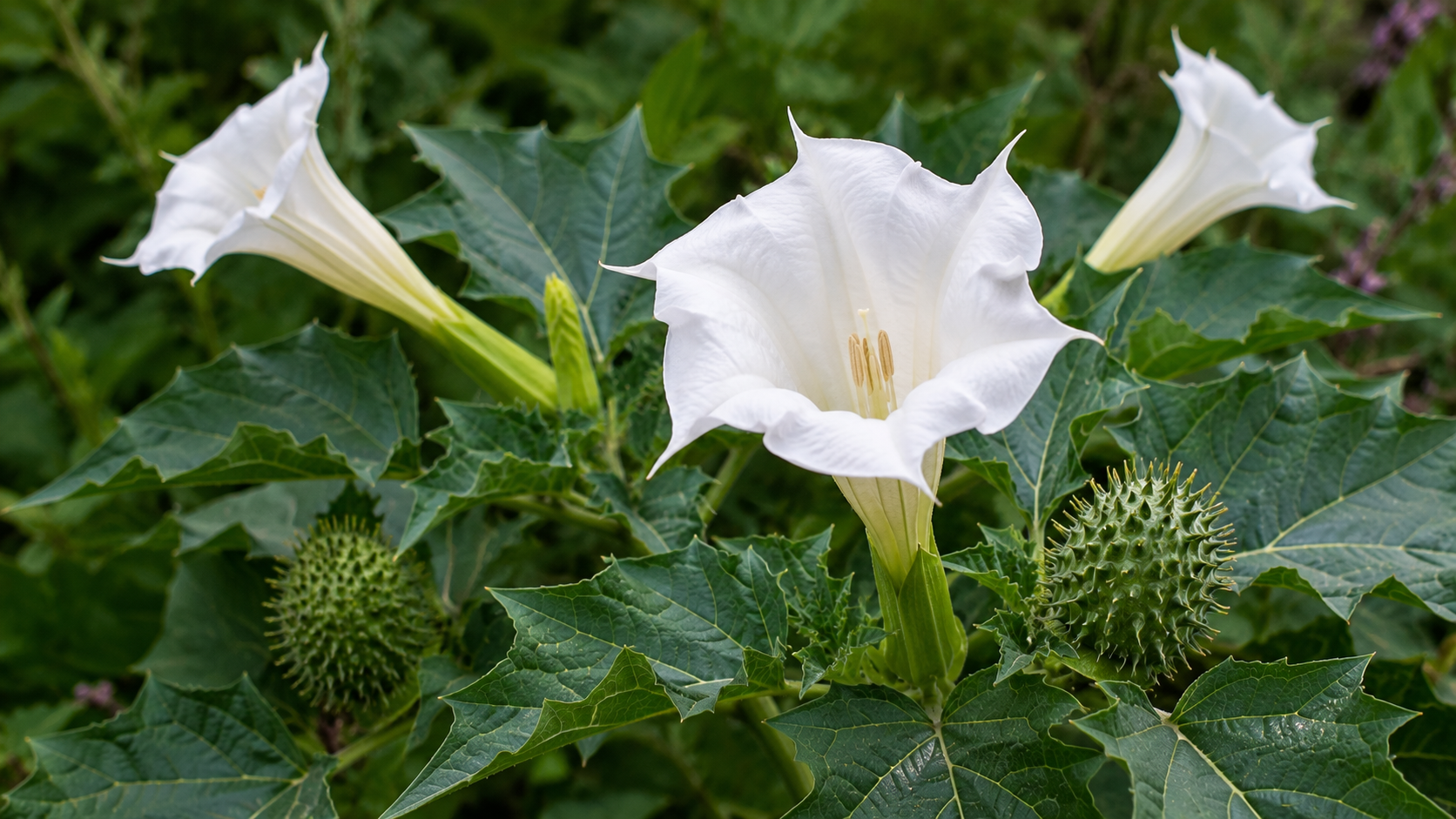
It's also breathtaking. Datura produces some of the most dramatic flowers in the plant world — enormous, trumpet-shaped blooms in white, lavender, or pale yellow that open at dusk and fill the night air with fragrance. Across at least four continents and several thousand years of human history, people have looked at this plant, recognized exactly how dangerous it was, and used it anyway — for visions, for warfare, for religion, and occasionally, for revenge.
A Name Earned the Hard Way
Datura goes by more aliases than almost any plant in the witch's garden: devil's trumpet, devil's weed, thorn apple, moonflower, hell's bells, mad apple. Each name comes from a different angle on the same plant — the shape of the flower, the texture of its spiny seed pods, the psychological effects of its poison, or simply the fear it generated.
One of its most distinctive common names has a very specific origin story. In 1676, British soldiers stationed near Jamestown, Virginia ate datura that had been mixed into a salad, and according to colonial accounts, spent the following days in a state of severe, sometimes violent delirium — laughing, behaving like animals, and acting with no memory of themselves, before eventually recovering. The plant became known as "Jamestown weed," which over time slurred into the name still used across much of the United States today: jimsonweed.
What Datura Actually Does
Datura's toxicity comes from the same broad family of tropane alkaloids found in belladonna and henbane — atropine, scopolamine, and hyoscyamine — but datura tends to carry them in a different balance, which is part of why its effects lean so heavily toward profound disorientation and hallucination rather than just physical collapse.
Early symptoms include dry mouth, intense thirst, dramatically dilated pupils, flushed and overheated skin, and a racing heart. From there, the plant earns its reputation: confusion, vivid and often frightening hallucinations, delirium, and a specific, dangerous kind of agitation in which a person may not recognize where they are or what's real. In severe cases, this progresses to seizures, coma, and death. Unlike some poisons that simply shut the body down, datura intoxication is often described by survivors and physicians alike as a genuinely terrifying psychological experience — which is exactly why it built a reputation as something more than just a poison.
The plant's seed pods alone can carry hundreds of seeds, and those seeds can remain viable in soil for decades, which means datura has a habit of reappearing in places long after anyone remembers planting it — one more way the plant seems to outlast and outwit the people who try to control it.
The Plant That Grew From a God's Throat
In Hindu mythology, datura's origin is tied directly to one of the tradition's most dramatic stories. During the churning of the cosmic ocean, a catastrophic poison called Halahala rose up, threatening to destroy the universe. To save creation, the god Shiva swallowed the poison himself, holding it in his throat rather than letting it pass further into his body — an act that turned his throat permanently blue. According to legend, the datura plant sprang directly from Shiva's chest in the aftermath, a living relic of the poison he contained.
Because of this origin, datura holds genuine sacred status in Hindu religious practice — its leaves and flowers are still offered to Shiva today, accepted specifically because he, uniquely among the gods, can tolerate what would harm anyone else. It's a rare case of a deeply poisonous plant being woven directly into devotional practice rather than only being feared.
The Inquisition's Favorite Confession
In European witch-trial history, datura sits alongside belladonna and henbane as one of the core ingredients attributed to the witches' "flying ointment." Renaissance-era accounts describe these green ointments being applied to sensitive areas of the body, absorbing quickly enough to produce vivid, dreamlike experiences that practitioners and observers alike interpreted as supernatural travel.
A physician to Pope Julius III in the sixteenth century actually investigated these ointments directly and concluded that they produced intense dream states rather than literal physical flight — a strikingly rational explanation for the era. It made little difference to the outcome. During the Spanish Inquisition, datura use could be treated as evidence of sorcery in its own right, and the accounts extracted from the accused — describing journeys to the witches' Sabbath, dancing with the devil — were often taken by prosecutors as confirmation of guilt rather than as the drug-induced hallucinations they almost certainly were. People were condemned to death, in other words, partly on the basis of visions that datura itself had produced.
A Plant Teacher, Still Working Today
Datura's reputation didn't end with the Inquisition. In the twentieth century, it became closely associated with Carlos Castaneda's enormously influential (and controversial) writings on Yaqui shamanism, where it's described as one of several plant teachers used in visionary practice. Long before Castaneda, Indigenous peoples across North and South America had their own established relationships with datura in ceremonial and medicinal contexts — relationships considerably older, and considerably more specific, than the popularized Western shamanism that later borrowed the plant's name.
Today, datura still shows up in modern witchcraft and "poison path" herbalism circles, associated with hex-breaking, protection, and visionary work — almost always discussed with a heavy, explicit warning attached. Unlike a plant you might keep at a respectful symbolic distance, datura is one that practitioners and foragers alike are warned, repeatedly and seriously, never to ingest or smoke casually. The line between visionary plant ally and emergency room admission is thinner here than with almost anything else in the witch's garden.
Quick Answers
What does datura poisoning actually feel like? It typically begins with dry mouth, dilated pupils, and a racing heart, then progresses to confusion, vivid hallucinations, and severe delirium — survivors often describe it as one of the most disorienting and frightening experiences of their lives.
Is jimsonweed the same plant as datura? Yes — jimsonweed (Datura stramonium) is one specific species within the datura genus, and the name most commonly used in the United States.
Why is datura considered sacred in Hinduism if it's poisonous? It's tied to a myth in which the god Shiva swallows a world-ending poison to protect creation, and the plant is said to have grown from his body afterward — its toxicity is part of why it's specifically offered to Shiva, who alone can tolerate it.
Is it dangerous to just smell or touch datura flowers? Casual contact with intact flowers carries lower risk than ingestion, but the plant's alkaloids can be absorbed through skin or mucous membranes, and the sap from broken stems or leaves should never be touched without caution.
Can datura really make you lose your mind permanently? Most documented cases of datura-induced delirium resolve once the toxin clears the system, but severe or repeated poisoning has been associated with lasting cognitive effects, and recreational use has resulted in documented deaths and permanent injury.
Is datura legal to grow? In most places, growing ornamental datura is legal, though some regions restrict it due to its toxicity and history of recreational misuse — always worth checking local regulations before cultivating it.