Belladonna: The Beautiful Death

Atropa belladonna — Toxic Botanical

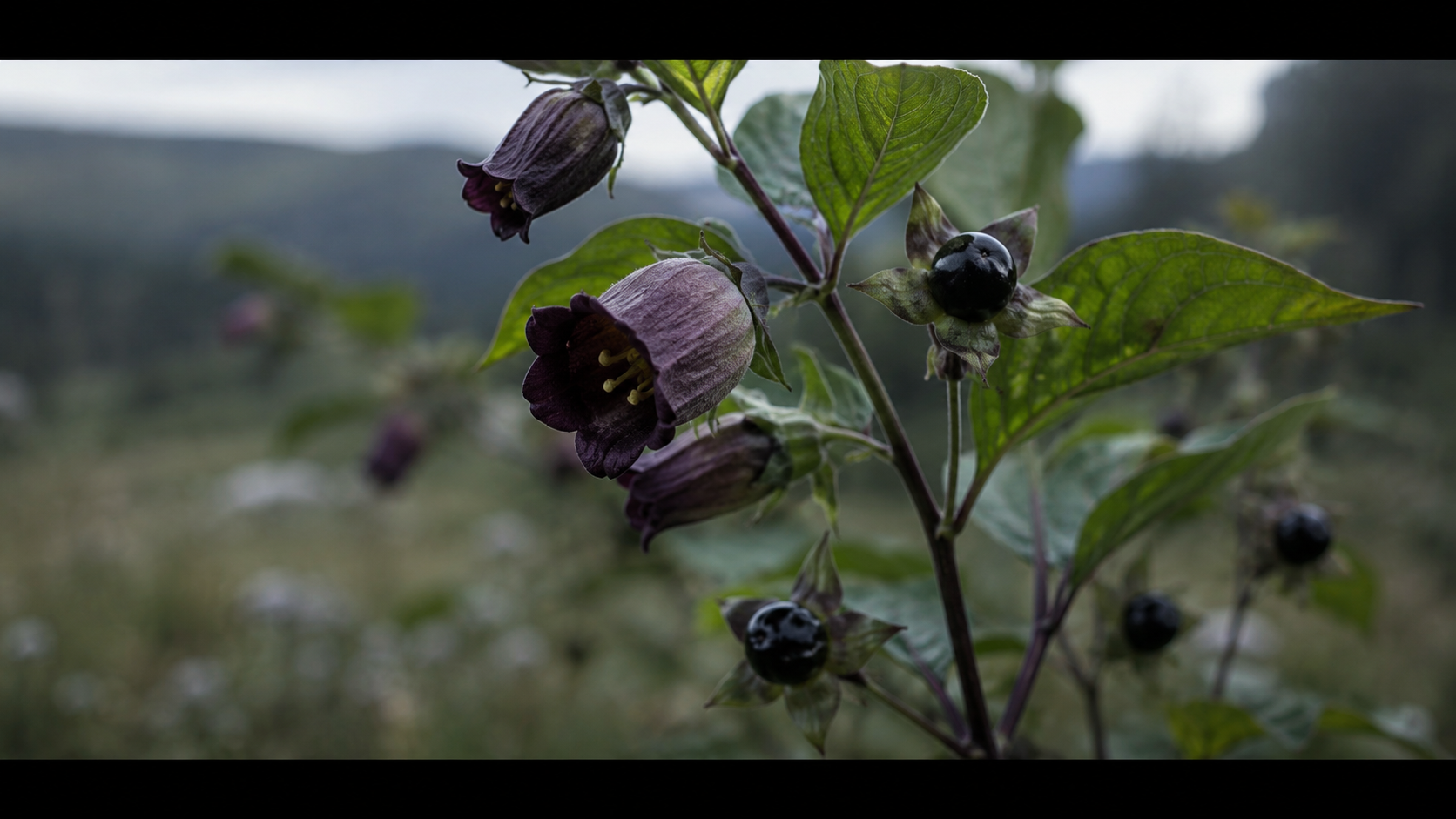
There is a plant that has dressed itself in the language of seduction for centuries. Its berries gleam like black pearls in the dimming autumn light. Its flowers hang like small violet bells, heavy and bowed, as though whispering something to the earth. Even its name is an act of enticement — bella donna, beautiful woman — and like many beautiful things that invite you closer, it carries death between its leaves.

Belladonna is not a plant you tend casually. It is a plant you study, approach with intention, and regard with the kind of respect that borders on reverence. It is one of the oldest allies of the witch, the poisoner, the healer, and the herbalist — and its history is as tangled and dark as a forest at midnight.

History & Origins

Belladonna's story begins, as so many do, with a name. Atropa belladonna takes its genus from Atropos — the eldest of the three Fates in Greek mythology, the one who held the shears and cut the thread of mortal life. It was a naming choice made with full intention. The botanist who formalized it understood what the plant could do.

Native to central and southern Europe, western Asia, and parts of North Africa, belladonna has grown in the shadowed understories of forests, along disturbed ground, and in the ruins of old buildings for millennia. The Romans knew it. The ancient Greeks knew it. Medieval Europeans knew it so well that it became woven into the very fabric of how they understood poison, magic, and feminine power.

The "beautiful woman" half of its name has two competing origin stories — both of them worth keeping. One holds that Italian noblewomen of the Renaissance used drops of belladonna extract in their eyes to dilate the pupils, creating an appearance of wide-eyed allure. This is historically documented. Atropine, the alkaloid responsible, causes mydriasis — pupil dilation — and the effect was considered beautiful in the fashion of the time. The cost was temporary blurred vision and, with repeated use, potential blindness.

The second story is darker and older: that the plant was named for a spirit who inhabited it — a beautiful, dangerous woman who would appear to those who consumed it in visions, beautiful and terrible, drawing them further into the poison's reach.

In medieval Europe, belladonna appeared in the infamous flying ointments said to be used by witches — fat-based preparations rubbed into the skin that were thought to allow shamanic flight, visionary states, or literal transformation. Modern pharmacological understanding suggests the transdermal absorption of tropane alkaloids could indeed produce vivid hallucinations. Whether it granted the power of flight or merely the experience of flight depends entirely on your framework.

By the early modern period, belladonna was catalogued in herbals alongside mandrake and henbane as one of the great Witches' Plants — so called not as condemnation but as acknowledgment of their use and reverence within cunning folk traditions. Nicholas Culpeper, writing in the seventeenth century, named it under the dominion of Saturn, cold and dry, governed by shadows.

Cultivation & Planting

Belladonna is not impossible to grow, but it is particular — and in most jurisdictions, it exists in a legal grey area that varies by country and region. Before cultivating belladonna, research the laws in your area. In the UK, it grows wild and cultivation is generally unregulated. In the United States, regulations vary by state; growing it for ornamental purposes is typically legal, but processing or selling any part of it may be another matter.

If you are growing belladonna as an ornamental or devotional plant in a region where it is permitted, keep the following in mind:

Climate and placement: Belladonna prefers temperate climates with partial shade. It dislikes harsh, direct afternoon sun and will thrive in the dappled light at the edge of a tree line or along a north-facing wall. It is hardy in USDA zones 5–9.

Soil: It prefers alkaline, well-drained, fertile soil with high lime content. Chalky or loamy soils suit it well. Poor drainage will rot the roots.

Germination: Seeds require cold stratification — twelve to sixteen weeks at refrigerator temperatures — before they will germinate. Surface sow after stratification, as the seeds need light to germinate. Germination is notoriously slow and erratic, sometimes taking several weeks after stratification. Patience is required.

Growth habit: A perennial in zones where it survives winter, belladonna can reach one to one and a half metres in height. In its first year it often remains modest and ground-hugging. By its second year it becomes the imposing, branching plant of its reputation, producing flowers in summer and berries by late summer through autumn.

Harvesting considerations: The entire plant — root, stem, leaf, flower, and berry — is toxic. The berries are the most acutely dangerous, particularly to children and animals, as they are sweet and attractive. If you grow belladonna, it must be in a space that is inaccessible to children, domestic animals, and foraging wildlife. Label it clearly. Wear gloves when handling any part of the plant, and wash hands thoroughly afterward. Do not rub your eyes.

Companion planting: Belladonna has traditionally been grown with other Solanaceae — it shares kinship with henbane, datura, and mandrake, the classical witching plants of the nightshade family. In a dedicated witches' garden, these make fitting companions.

Cautions & Poisoning

Let this section be read slowly, and remembered.

Belladonna contains tropane alkaloids — primarily atropine, scopolamine, and hyoscyamine — concentrated throughout every part of the plant. These compounds are not merely unpleasant; they are genuinely dangerous and can be fatal in sufficient quantity.

Symptoms of belladonna poisoning include:

  • Dry mouth and extreme thirst

  • Flushed, hot, dry skin

  • Dilated pupils and sensitivity to light

  • Elevated heart rate and palpitations

  • Confusion, disorientation, and delirium

  • Hallucinations, often described as dysphoric and chaotic rather than pleasant

  • In severe cases: convulsions, respiratory failure, and death

The berries are sweet. This is the plant's cruelest feature. A child or animal drawn to the shiny black fruit will not be warned away by bitterness. It takes as few as two to five berries to kill a small child. Adults require more, but not significantly more. There is no safe recreational dose. There is no way to prepare belladonna at home that produces a safe outcome. This is not fearmongering — it is the oldest and most consistent record that history gives us about this plant.

If you or someone else has consumed any part of belladonna, contact emergency services immediately. Do not wait for symptoms. Do not attempt home treatment.

When working with belladonna in any context — harvesting, drying, handling in ritual — wear nitrile gloves. Atropine can be absorbed through mucous membranes and broken skin. Do not burn dried belladonna indoors without significant ventilation. Do not prepare teas, tinctures, or any consumable preparation.

The medicine cabinet, not the kitchen, is where atropine belongs — and there it is used in carefully calibrated, pharmaceutical doses by medical professionals. In that context, it dilates pupils for eye examinations, counters organophosphate poisoning, and treats bradycardia. The difference between medicine and poison is always the dose. With belladonna, that margin is razor thin.

Mythology & Folklore

Belladonna is one of those plants that has accumulated so much folklore it becomes difficult to separate the historical from the legendary — and in practice, for the folk magical tradition, that separation matters very little.

The Three Fates & the naming of Atropos: The genus name connects belladonna directly to Atropos, "she who cannot be turned," the Fate responsible for ending life. This association made it sacred to death rites, liminal crossings, and any working concerned with fate, inevitability, and the ending of cycles. It was understood to be a plant that held the principle of death within it — not as something evil, but as something primordial and necessary.

Circe and the witching plants: In classical accounts, Circe — the witch of the Odyssey — is said to have kept a garden of transformation plants, including nightshades. While belladonna is not named explicitly in Homer, its inclusion in later classical herbals and its kinship with the Solanaceae family placed it firmly in the lineage of magical botanicals associated with transformation, enchantment, and the blurring of boundaries between human and animal, living and dead.

The flying ointment tradition: This is perhaps belladonna's most enduring folkloric association. Scattered across early modern witch trial records and herbal literature are references to an ointment — sometimes called unguentum sabbati — said to be rubbed on the skin, the broomstick, or the body to enable flight to the witches' sabbat. Ingredients varied by account, but belladonna, henbane, and mandrake appeared with consistency. Modern researchers have noted that transdermal absorption of tropane alkaloids does produce vivid dissociative hallucinations that could feel, phenomenologically, like flying.

The Church used these accounts as evidence of diabolism. Cunning folk and scholars of folk magic have interpreted them differently — as evidence of a shamanic practice, a genuine visionary tradition, in which the plant was a spirit ally and the sabbat a real experience of the otherworld, regardless of what the body was doing.

Saturn's plant: In the classical system of planetary correspondences used in Western occultism, belladonna falls under Saturn — the planet of restriction, endings, death, time, the shadow self, and the liminal. Saturn governs the cold and the dark, the dissolution of form, and the wisdom that comes only through loss. This correspondence gives belladonna a clear place in shadow work, ancestor veneration, Samhain observance, and workings that engage with grief, release, and transformation.

German folklore: In German-speaking regions, belladonna was associated with a spirit called the Tollkirsche — the mad-cherry witch — who was said to inhabit the plant. To harm the plant without cause was to invite her wrath. She was beautiful and capricious, and the warnings were clear: approach with respect, take only what you need, never be careless.

Protective and malefic uses: Historically, belladonna appeared on both sides of the magical tradition. In some accounts it was hung at thresholds to ward off evil spirits, its toxicity acting as a barrier. In others, it appeared in works of binding, cursing, and harm. Its role as a boundary plant — dangerous to approach, powerful to invoke — made it flexible in the hands of those who worked with it intentionally.

Rituals & Practices

Given the very real dangers of belladonna, any ritual or devotional work with this plant should operate on the level of presence rather than ingestion. You do not need to consume a plant to enter into relationship with its spirit. You do not need to ingest poison to access its medicine.

Working with belladonna spirit: Before beginning any work with belladonna, it is advisable to sit quietly in the presence of a living plant or its dried material and simply observe. Introduce yourself. State your intention. The folk magical tradition understood that plants have intelligences, and that the more potent the plant, the more care was required in establishing relationship before asking anything of it.

Saturn correspondences for ritual timing: Belladonna work is best aligned with Saturday (Saturn's day), the dark moon or new moon, the hours of Saturn (the first and eighth hour after sunset on Saturday), and the liminal festivals — particularly Samhain, when the veil thins and work concerning ancestors, death, and transformation carries particular potency.

Smoke and fumigation: Dried belladonna can be burned as an incense or used in smoke-based ritual, but this must be done with extreme care, outdoors or in very well-ventilated spaces, and in small quantities. The alkaloids in belladonna smoke can cause respiratory distress and dissociative effects even through inhalation. If you have any respiratory sensitivity or are pregnant, do not burn belladonna. This is a practice for the careful and experienced.

Scrying and visionary work: Belladonna has a long association with the opening of the inner eye and the blurring of the veil between worlds. Rather than working with the plant's alkaloids, a safer approach to tapping this energy is to use it as a focal object for scrying — place a sprig of dried belladonna beside your scrying mirror or bowl, state your intention to the plant, and begin your practice. The spirit of the plant can act as a helper at the threshold without any physical consumption.

Releasing and binding work: Because of its Saturnine quality and its role as a death-associated plant, belladonna is well suited to workings of release — letting go of old patterns, severing attachments that have become harmful, and working with grief. It can be used similarly in gentle bindings concerned with endings: the closing of chapters, the formal acknowledgment of what has passed.

Ancestor work: Place a few dried leaves (handled with gloves) on an ancestor altar. Belladonna's connection to the dead and to liminal states makes it a natural bridge between the worlds, and its presence on an ancestor altar acknowledges the plant's role as a spirit that stands at the threshold.

Altar Building with Belladonna

A belladonna-centred altar draws from the full weight of the plant's symbolism: darkness, beauty, danger, Saturnine power, and the liminal between life and death.

Color palette: Deep black, dark purple, midnight blue, and flashes of silver. Avoid white — belladonna is not a plant of purity or light. Dark red, the color of dried belladonna berries, can be incorporated as an accent.

Materials: Aged wood, tarnished silver, dark fabric with some weight to it — velvet or brocade. Stone surfaces suit belladonna altars well, particularly obsidian, jet, or dark slate.

Botanical elements: Dried belladonna sprigs or pressed leaves as a centrepiece, handled with gloves and sealed under glass if possible to contain any residue. Alongside belladonna, consider: dried henbane, mugwort, wormwood, and cypress — all plants with underworld, Saturnine, or boundary associations.

Symbolic objects: A pair of shears (for Atropos and the severing of threads). A small clock or hourglass (for Saturn's dominion over time). A hand mirror (for self-knowledge and the gaze turned inward). Black candles. A scrying mirror or obsidian sphere. Images of ancestors or figures who have passed.

Offerings: Saturn accepts offerings that acknowledge his nature — things that cost something. Dark bitter foods: black coffee, dark chocolate, wine poured and left. Tobacco. Written petitions burned rather than left.

Placement: Belladonna altars work well in the northward-facing corners of a space (north being the traditional direction of earth, the dead, and the liminal in many Western magical systems) or in spaces of transition — at doorways, in hallways, or in rooms associated with rest and sleep.

Recipes

A note before beginning: none of the following recipes involve ingesting belladonna. All recipes here either use the plant's energy symbolically, as a non-consumable ritual tool, or work with belladonna-safe botanical allies that share its spiritual associations.

Belladonna Ritual Oil (Non-Toxic, Spirit-Aligned)

This oil is for anointing candles, altar objects, and the outsides of ritual tools only — not the skin, not near eyes or mouth. It calls on belladonna's spirit through its associated scents rather than its physical alkaloids.

You will need:

  • 30ml carrier oil (jojoba or fractionated coconut oil)

  • 5 drops vetiver essential oil (earthy, Saturnine, deeply grounding)

  • 4 drops cypress essential oil (death, transition, the underworld)

  • 3 drops black pepper essential oil (protection, Saturnine intensity)

  • 2 drops violet leaf absolute or lavender essential oil (twilight, softness at the edges)

  • A small piece of obsidian or jet, cleansed

  • A single dried belladonna leaf sealed in wax or glass (optional — do not drop loose into the oil)

Method: Combine the carrier oil and essential oils in a dark glass bottle. Add the obsidian. If using the dried leaf, wrap it in beeswax or seal it in a small glass vial that can sit inside the bottle without contact with the oil. On a Saturday during the dark or new moon, hold the bottle and call on belladonna's spirit to align with the work — state its purpose clearly. Leave the oil on the altar for a full lunar cycle before first use.

Samhain Ancestor Incense Blend

Belladonna is too potent to burn in quantity, but this blend honors its energy through safer botanical allies with similar liminal associations, with a single small dried leaf included for presence rather than effect.

You will need:

  • 2 parts mugwort (dried)

  • 1 part wormwood (dried)

  • 1 part cypress (dried needles or chips)

  • ½ part myrrh resin

  • ¼ part copal resin

  • A pinch of dried belladonna leaf — small, used with gloves, for its spirit rather than its smoke

Method: Grind all ingredients together in a mortar dedicated to magical use. Use outdoors or in a very well-ventilated space on a charcoal disc. Burn slowly and in moderation. This blend is intended for use at ancestor altars, during Samhain rituals, or in any practice that works with the dead and the liminal.

Belladonna Black Moon Water

Moon water charged under a new (black) moon and aligned with belladonna's energy through sympathetic contact. This water can be used to anoint thresholds, sprinkle around an altar space, or add to ritual baths (not drunk).

You will need:

  • A dark glass bottle or jar with a lid

  • Spring or filtered water

  • A small dried sprig of belladonna, sealed in a small glass vial with a cork (so it is in the jar but not in contact with the water)

  • A piece of jet or black tourmaline

  • A strip of paper with your intention written in black ink

Method: On the night of the new moon, fill the jar with water. Add the sealed sprig inside its vial, the stone, and the rolled paper. Seal the jar. Place it outside or on a windowsill where the dark sky is visible. In the morning, retrieve the jar. Remove the sealed vial of belladonna (do not open it). The water is now charged. The vial can be returned to the altar or stored safely.

Saturn's Bitter Tea (Belladonna-Free)

A ritual tea for Saturnine workings — shadow journeys, release work, ancestor contact — that carries the same energetic intention as belladonna without the plant itself. Entirely safe to drink.

You will need:

  • 1 tsp dried mugwort

  • 1 tsp dried lemon balm

  • ½ tsp dried rosemary

  • A small strip of orange peel

  • Honey (optional — though leaving it unsweetened honors Saturn's nature)

  • Boiling water

Method: Steep in boiling water for seven minutes — seven being Saturn's number. Strain. Sit with the tea and your intention before beginning any working. Mugwort is a traditional visionary herb and dream-enhancer; lemon balm eases the spirit; rosemary is for remembrance and the dead; orange peel for the crossing of thresholds.

Note: Mugwort should be avoided during pregnancy.

Closing Words

Belladonna does not belong to everyone, and it does not offer itself freely. It is a plant that rewards patience, study, and genuine respect. It has healed and killed and walked alongside witches, healers, poisoners, and dreamers for thousands of years, and it carries all of that history in its leaves.

To work with belladonna — even symbolically, even at a distance — is to enter into relationship with one of the oldest and most complex spirits in the Western plant magic tradition. Approach it as you would any teacher who has earned their authority through centuries of consequence: with your attention fully given and your assumptions left at the door.

This article is part of the Undine Grimoires Toxic Botanicals series. For more on the plants that walk the edge between poison and medicine, magic and harm, return to The Apothecary.

Undine Grimoires does not advocate for the consumption of any toxic plant material. All ritual and recipe content involving belladonna in this article is non-consumable and designed for symbolic or spirit-based practice only. If you believe you or someone else has been poisoned by any plant, contact emergency services immediately.

Dryad Undine

Explore the mystical world of grimoires, paganism, and witchcraft. Dive into our insightful blog posts, discover unique merchandise, and access curated affiliate links that enrich your spiritual journey. We’re dedicated to sharing knowledge and offering enchanted treasures that resonate with the arcane and the magical. Join us in exploring the mysteries of the universe!

https://www.undinegrimoires.com
Next
Next

Yew (Taxus): The Evergreen of Death and Protection