Foxglove: The Fairy's Glove That Stops a Heart
Every part of the foxglove contains a toxin powerful enough to stop a human heart — and a carefully measured derivative of that same toxin has been saving human hearts in modern medicine for over two centuries. No plant in this archive embodies the line between poison and medicine more literally than this one. It doesn't just symbolize the duality of beauty and danger the way belladonna or oleander do. It actively performs both roles, depending entirely on the dose.
Foxglove also holds a folkloric record few plants can match: by some counts, it carries more than thirty recorded common names in English alone — more aliases than any other wildflower in Britain. Fairy gloves, witches' gloves, dead man's bells, goblin gloves, bloody fingers. A plant this thoroughly renamed by generations of frightened, fascinated people clearly meant something different to nearly everyone who encountered it.
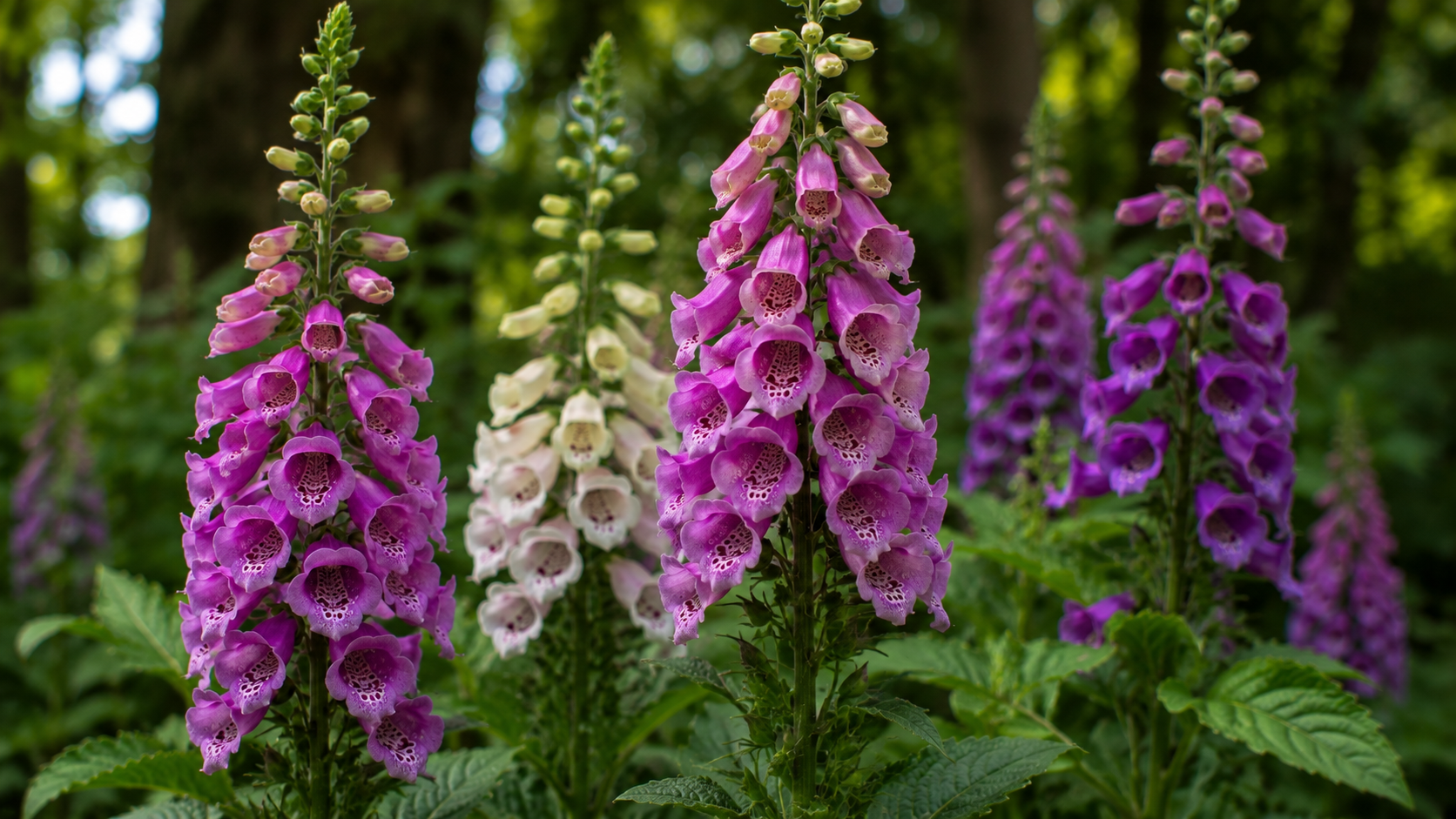
A Name Borrowed From Fairy Folklore
The most widely accepted theory traces "foxglove" back to "folk's glove" — and in this context, "folk" doesn't mean ordinary people. It means the fairy folk, the "good folk" of British and Scandinavian tradition that polite speakers avoided naming directly. A glove sized for a fairy's hand, in other words, not a fox's paw.
The competing fox-specific legends are almost more charming than the linguistic explanation. Norwegian folklore holds the name "Revbielde," or foxbell, and tells of fairies teaching foxes to ring the flower's bell-shaped blooms to warn one another when hunters approached. A related British tale claims mischievous fairies slipped the flowers onto a fox's paws specifically to muffle its footsteps while raiding henhouses — turning the plant into the fox's own burglary tool, courtesy of the fae.
Whichever origin is closer to the truth, the flower's connection to fairies runs far deeper than its name. The white-spotted markings inside each bell-shaped bloom were said to be left behind by fairies who used the flowers as gloves, thimbles, or hiding places — though just as often, those same spots were read as a warning, a visible mark of the plant's lethal nature rather than a decorative fairy fingerprint. Scottish tradition went further still, describing fairies seen gathering nectar from foxglove blooms specifically by moonlight, reinforcing the sense that this was a plant tied to the world just beneath or beside our own.
Dead Man's Bells
For every gentle, whimsical name foxglove acquired, an equally dark one followed close behind. "Dead man's bells" and "witches' gloves" weren't poetic flourishes — they were warnings, plainly stated. According to one piece of folk belief, if you actually heard a foxglove's bell-shaped flowers ring, your own death was said to follow soon after.
European folklore occasionally placed foxgloves growing near the entrances to the realm of the dead, and the plant maintained a long, loose association with the underworld and the supernatural more broadly — fitting company for a plant capable of killing quietly and quickly through every part of itself. "Witches' gloves" carried a more specific, sadder history: it reflected the real persecution of village wise women, herbalists whose knowledge of plants like foxglove represented the only medical care available to the rural poor, and who were nonetheless swept up in medieval witchcraft panics precisely because that knowledge looked like sorcery to frightened neighbors.
A Flower for the Virgin, a Flower for the Devil
Foxglove's symbolism split sharply depending on who was doing the naming. Some traditions linked it explicitly to the sacred and the protective — "Our Lady's Gloves" and "Virgin's Glove" tied the plant to the Virgin Mary, and it was deliberately planted in medieval "Mary Gardens," spaces set aside for prayer and quiet devotion. Roman mythology offered an even more specific divine connection: in one telling, Flora, goddess of flowers, used a foxglove blossom to help Juno conceive without a male partner, tying the plant directly to fertility and a kind of sacred feminine mystery.
Other traditions swung in the opposite direction entirely, associating the plant with the Devil's entry and with dark magic rather than divine grace. It's a contradiction the plant never bothered resolving — sacred enough for a saint's garden, sinister enough to summon the Devil, depending entirely on which storyteller you believed.
The Secret a Gypsy Healer Kept
Foxglove's most consequential story isn't a myth at all — it's a documented turning point in the history of medicine. In 1775, the Scottish physician William Withering became aware of a folk remedy, passed down through a local healer, that was apparently treating dropsy — a condition now understood as a symptom of heart failure — with real, visible success in patients that formal medicine had failed.
Withering persuaded the healer to reveal the secret ingredient in her closely guarded family recipe: foxglove. He spent the following decade methodically studying the plant's effects, working out dosing, and documenting its risks alongside its benefits, before formally publishing his findings and introducing digitalis into official medical use. The active compounds he isolated — what we now know as cardiac glycosides — remain the basis of modern heart medications like digoxin and digitoxin, still prescribed today for certain heart conditions, derived from the exact plant generations of folklore had already marked as deadly.
It's a quietly remarkable historical moment: a formally trained physician's most important cardiac discovery traced directly back to the kind of folk healer his own era was, in many villages, still capable of persecuting as a witch.
A Flower That Outlived Its Reputation in Art
Foxglove's striking, towering form has made it a recurring subject well beyond folklore and medicine. Vincent van Gogh painted his physician Dr. Paul Gachet holding a sprig of foxglove — a detail some historians read as a quiet nod to the plant's medical use in treating heart and nervous conditions during van Gogh's own era. Romantic poets including Wordsworth and Keats wrote it into verse as a symbol of nature's dual capacity for delicate beauty and real danger, and Tennyson named it directly in "In Memoriam." The plant has carried its contradiction — gorgeous, deadly, medicinal, mythological — into nearly every form of storytelling that's encountered it.
Quick Answers
Is foxglove poisonous to touch? Direct skin contact poses lower risk than ingestion, but sensitive individuals can experience irritation, and hands should always be washed after handling the plant, particularly before touching the face or eyes.
Is foxglove poisonous to pets? Yes — foxglove is highly toxic to dogs, cats, and livestock, and ingestion of any part of the plant can cause serious cardiac symptoms requiring emergency veterinary treatment.
What does foxglove poisoning do to the body? It disrupts the heart's normal rhythm, and symptoms can include nausea, vomiting, irregular or dangerously slowed heartbeat, dizziness, confusion, and in severe cases, cardiac arrest.
Is digitalis the same thing as foxglove? Digitalis is both the scientific genus name for foxglove and the common name for the cardiac glycoside compounds derived from it — the plant and the medicine share a name because one comes directly from the other.
Why was foxglove linked to fairies specifically? Its bell-shaped flowers, found growing in shaded woodland and hedgerow settings long associated with fairy folklore in British and Scandinavian tradition, made it a natural fit for stories about the fae, and the plant's name may derive directly from "folk's glove" — a glove for the fairy folk.
Can you really die from foxglove poisoning? Yes — ingesting foxglove leaves, flowers, or seeds can be fatal, and historically, accidental poisonings have occurred from mistaking foxglove leaves for comfrey or other edible garden plants.