Toxic Trees: Why the Garden's Tallest Plants Are Often Its Most Dangerous
There's a logical reason toxic trees and large shrubs show up so consistently across this archive, and it has nothing to do with mythology: trees are slow, expensive investments. A perennial herb that gets eaten to the ground can regrow next season. A tree that took twenty years to reach a usable size cannot. Evolution has responded to that math with some of the most aggressive, long-lasting chemical defenses found anywhere in the plant kingdom — and six of the toxic woody plants already covered in this archive, from a Pacific Northwest cancer-drug source to a Christmas mainstay, demonstrate just how many different forms that defense can take.
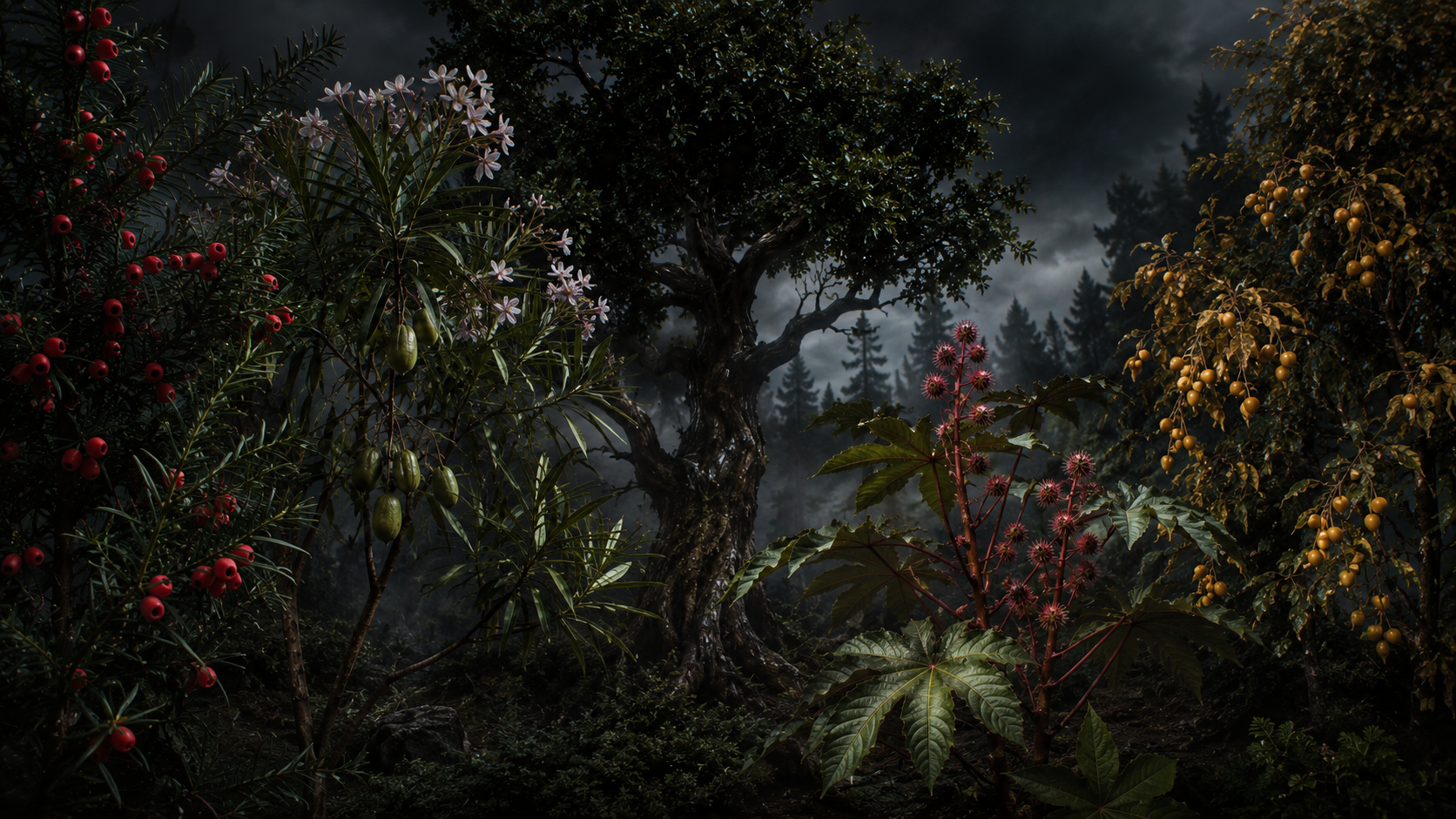
This piece pulls those six together — Pacific Yew, Laburnum, Daphne, Rhododendron, Holly, and Castor Bean — to look at what they share, and what makes each one's particular strategy distinct.
A Shared Logic, Six Different Chemical Solutions
Despite covering wildly different toxic mechanisms, every tree and large shrub in this archive's collection follows the same basic evolutionary logic: invest heavily in chemical defense precisely because the plant itself represents too much accumulated biological investment to simply regrow after damage.
Pacific Yew invests its defense in nearly every tissue — needles, bark, and seeds all carry toxic taxine alkaloids — protecting a tree that can take decades to reach a usable size in the deep forest understory it favors.
Laburnum concentrates its defense specifically in its seed pods, the plant's actual reproductive investment, disguising danger inside something that looks deceptively like an edible pea pod.
Daphne front-loads its defense into its earliest, most vulnerable structures — bark, flowers, and especially the berries that ripen just as the plant's reproductive cycle completes.
Rhododendron took its defense in an unusually indirect direction, weaponizing its nectar itself, filtering out all but the most tolerant pollinators while incidentally producing one of history's strangest natural toxins by proxy, through honey.
Holly opted for the mildest chemical defense of this group, instead supplementing toxicity with a second physical defense entirely — sharp, adjustable spines, deployed selectively based on real, present grazing pressure.
Castor Bean, technically a fast-growing shrub or small tree depending on climate, broke from the slow-investment pattern entirely, instead producing one of the most acutely lethal toxins in the plant kingdom in a plant that can complete its life cycle in a single growing season — proof that the "slow investment" logic, while common, isn't universal.
The Pattern That Keeps Repeating: Beauty as Camouflage
Every tree in this collection pairs its toxicity with genuine ornamental appeal, and that pairing isn't a coincidence worth dismissing as mere folklore romanticism — it's a real, recurring evolutionary and horticultural pattern. Laburnum's golden cascade, Daphne's fragrant late-winter bloom, Rhododendron's enormous flower clusters, Holly's bright winter berries, Castor Bean's architectural red-leaved foliage — all six have been deliberately, repeatedly chosen by gardeners specifically for the visual qualities that have nothing to do with, and often actively distract from, their genuine danger.
This is part of why this group of plants causes such consistent, low-grade public concern decade after decade. Laburnum triggered a genuine British hospital-admission panic through the 1970s. Daphne berries have sent children to emergency rooms because their bright red color reads as edible. Holly berries remain a recurring winter hazard precisely because they're deliberately brought into homes as decoration every December. The trees aren't hiding in remote, unvisited places. They're standing in the front yard, on purpose, because someone planted them there for exactly the qualities that make them risky.
From Forest Obscurity to Global Significance
Two trees in this collection demonstrate something the others don't: a complete transformation in human estimation, from background scenery to global significance, within living memory. Pacific Yew spent centuries as logging waste before becoming the original source of one of modern oncology's most important drugs. Castor Bean's oil moved from ancient Egyptian lamp fuel to a household laxative to critical wartime aircraft lubricant to a notorious Cold War assassination weapon, all within the same plant's product line.
Both stories carry the same underlying lesson: chemical compounds with no obvious value to the casual observer can turn out, on closer scientific inspection, to be extraordinarily significant — and a tree dismissed for centuries as unremarkable can become the subject of intense pharmaceutical or security interest almost overnight, once the right researcher finally looks closely enough.
Mythology Took a Lighter Touch With Trees Than With Herbs
One genuine difference worth noting between this archive's toxic trees and its toxic herbs (the nightshade family especially): the trees generally carry less elaborate witchcraft mythology. There's no flying ointment built around laburnum or daphne. Holly and rhododendron lean toward protective and ceremonial folklore — Druidic reverence, Saturnalia gift-wrapping, ancient battlefield honey — rather than the witch's-Sabbath narrative dominating the herbaceous nightshades. Trees, on the whole, seem to have been mythologized more as guardians, calendar markers, and symbols of endurance through winter than as tools of transformation or supernatural travel — perhaps because a tree's defining trait, to ancient observers, was its permanence and longevity rather than any dramatic, sudden psychoactive effect.
Quick Answers
Why do so many toxic plants happen to be trees and large shrubs specifically? Trees represent a much larger biological investment than annual or perennial herbs, since they often take years or decades to reach maturity, which has driven the evolution of unusually persistent and aggressive chemical defenses to protect that investment from being destroyed by grazing or browsing.
Are toxic trees more or less dangerous than toxic herbs covered elsewhere in this archive? It varies significantly by species rather than by category — Castor Bean, technically a fast-growing shrub, produces one of the most lethal toxins in this entire archive, while Holly is comparatively mild, so toxicity depends on the specific plant rather than whether it's classified as a tree.
Why are so many of these toxic trees still commonly planted in gardens? Their genuine ornamental appeal — flowers, foliage, berries, fragrance — has consistently outweighed public awareness of their danger, a pattern that shows up repeatedly across unrelated tree species and unrelated cultures and eras.
Do toxic trees carry the same witchcraft folklore as toxic herbs like belladonna or henbane? Generally less so — toxic trees in this archive tend to carry protective, ceremonial, or calendar-based folklore (Druidic reverence, Saturnalia traditions) rather than the witch's-Sabbath and flying-ointment narratives associated with the nightshade family.
Which toxic tree in this archive has had the biggest real-world modern impact? Pacific Yew and Castor Bean stand out specifically — one as the original source of a major cancer chemotherapy drug, the other for both its critical historical industrial uses and its infamous role in a Cold War assassination.