Castor Bean: The Hand of Christ That Hides the Deadliest Toxin in This Archive
A single castor bean seed, in sufficient quantity, can kill an adult human — and the toxin responsible, ricin, is estimated to be roughly 380 times more potent than the nerve agent VX. It's also a plant whose oil has been burned in Egyptian lamps, packed into Tutankhamun's actual tomb, prescribed by ancient physicians, smeared on babies' bellies by worried mothers for generations, and sold today in nearly every drugstore beauty aisle as a hair and skin treatment. No other plant in this entire archive holds a wider gap between "household product" and "deadliest known toxin," and somehow, against every odd, it's the same plant doing both jobs at once.
This entry will treat ricin's lethality the way this archive treats every genuinely dangerous mechanism: honestly, historically, and without any procedural detail about extraction or use. The history alone is more than enough to carry the story.
A Name Borrowed From a Bloodsucking Pest
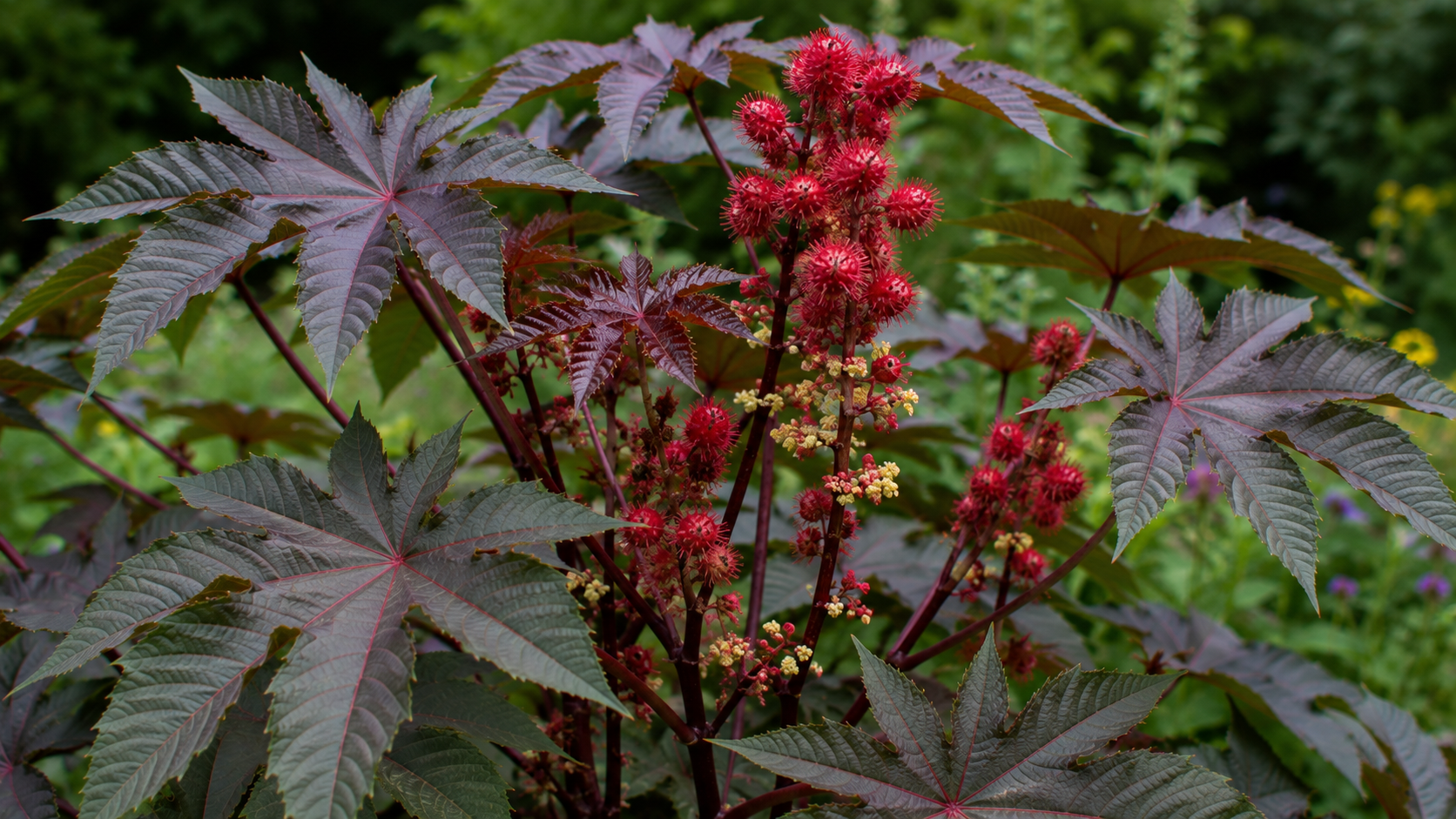
Castor bean's scientific name, Ricinus, is Latin for "tick" — a strikingly unglamorous origin for a plant otherwise associated with grandeur. The name comes directly from the seed's mottled, bean-like appearance, which early observers thought closely resembled an engorged tick. It's a small, almost comic detail sitting underneath a plant that would go on to acquire a far more dignified nickname entirely separately: Palma Christi, the "Palm of Christ" or "Hand of Christ," bestowed because the plant's broad, deeply lobed leaves were thought to resemble an open human hand — a name serious enough that Thomas Jefferson knew and grew the plant by it, planting castor bean in the nursery grounds at Monticello in the early nineteenth century.
Possibly the Plant That Shaded a Reluctant Prophet
Castor bean carries a genuinely compelling, if unconfirmed, biblical connection. In the Book of Jonah, after the prophet's confrontation with Nineveh, God causes a fast-growing plant called a "kikayon" to spring up overnight, providing Jonah shade — only to have it wither just as quickly soon after. The exact identity of the kikayon has been debated by scholars and translators for centuries, but castor bean is among the strongest candidates proposed, owing to its genuinely rapid growth habit and broad, shade-giving leaves, qualities that match the biblical plant's description closely enough that the connection has persisted as a serious scholarly possibility rather than mere folk speculation.
Medicine Older Than Most Civilizations Currently in Existence
Castor bean's medicinal history is staggeringly old, with archaeological evidence suggesting human use stretching back tens of thousands of years — researchers examining a wooden applicator stick found at South Africa's Border Cave site identified traces of castor-derived compounds dating back roughly 24,000 years, in a context suggesting the substance may have been used as a poison applicator even at that extraordinary remove.
By the time ancient Egyptian medicine was being formally recorded, castor bean already had a settled, well-understood place in the pharmacy. The Ebers Papyrus, predating 1500 BCE, dedicates an entire chapter to the plant, recommending it as a laxative, an abortifacient, and a remedy for abscesses and baldness among other uses. Crucially, ancient Egyptian physicians were already aware of the seed's genuine danger, and historical evidence suggests their preparations were deliberately limited to the oil-bearing pulp rather than the more toxic whole seed — an early, practical understanding of exactly where a plant's medicine ends and its poison begins, worked out entirely without any modern chemistry to confirm it.
The Umbrella That Made Ricin Famous
Castor bean's modern reputation owes almost entirely to a single, internationally notorious 1978 assassination. Georgi Markov, a Bulgarian dissident writer living in exile in London, felt a sharp sting while waiting for a bus on Waterloo Bridge — he turned just in time to see a stranger retrieve a dropped umbrella and hurry into a waiting car. By that evening Markov had developed a fever; three days later, he was dead. An autopsy recovered a tiny pellet from the site of the sting, later determined to have been fired from a modified umbrella device, and found to contain ricin.
The case became one of the defining Cold War-era assassination stories specifically because of how the weapon worked: a household plant's seed, refined into something capable of killing a healthy adult within days, delivered through an object as mundane and unremarkable as an umbrella on a London street. It cemented ricin's reputation in the public imagination in a way no amount of toxicology literature alone ever could have.
That reputation isn't purely historical, either. Ricin's accessibility and lethality have made it a recurring subject of government and military research and concern across the twentieth century, including documented historical interest from chemical warfare programs during the World War I era, and it remains, today, a substance with no available antidote — a genuinely sobering fact for a toxin derived from a plant municipal gardeners still plant in public flower beds for its dramatic, architectural foliage.
The Same Plant, Doing the Opposite Job
And yet, despite all of this, castor oil — the genuinely useful, comparatively benign product extracted from the same seeds before the toxic protein-rich solids are separated out — has had one of the longest, most consistently mundane industrial and medicinal runs of any plant product in this archive. It lubricated aircraft engines during both World Wars, valued for remaining stable across extreme temperatures. It's been used for centuries across multiple continents as a laxative, a skin and hair treatment, and a base ingredient in everything from nylon production to modern biodegradable plastics. Generations of mothers have applied it to soothe a baby's stomach. It sits, largely unremarked upon, on millions of bathroom shelves today as an ordinary beauty product.
It's a genuinely strange final note for this archive's most lethal entry: the same seed responsible for one of history's most infamous assassinations is processed, in vastly larger quantities, into something gentle enough for an infant's skin — separated not by mythology or magic, but by a single, careful manufacturing step distinguishing the useful oil from the deadly protein it leaves behind.
Quick Answers
How dangerous is a single castor bean if eaten? Genuinely dangerous — ingesting just a few chewed seeds has been associated with serious poisoning and death in adults, and the whole, unchewed seed's hard outer coating provides some natural protection, though this should never be relied upon.
Is castor oil itself dangerous, since it comes from such a toxic plant? No — commercially produced castor oil has the toxic protein ricin removed during processing and is generally considered safe for its common cosmetic and medicinal uses.
Is there an antidote for ricin poisoning? No — there is currently no approved antidote for ricin poisoning, which is part of why it remains a substance of ongoing concern to public health and security agencies.
Why do cities still plant castor bean in public gardens if it's this dangerous? The intact plant and its oil pose minimal risk through casual contact; the real danger comes specifically from deliberately processing and ingesting the seeds, which isn't a risk from simply viewing or touching the growing plant.
Was castor bean really the plant that gave Jonah shade in the Bible? It's one of the leading scholarly candidates for the unidentified "kikayon" plant described in the Book of Jonah, based on its fast growth and broad leaves, though the exact identity remains genuinely debated rather than confirmed.
How was ricin used in the 1978 Georgi Markov assassination? A tiny pellet containing ricin was fired into Markov's leg using a modified umbrella device while he waited at a bus stop in London; he died three days later, and the case remains one of the most notorious Cold War-era assassinations.