Poison Witches: The Nightshade Family Behind the Flying Ointment
Five plants in this archive belong to the same botanical family, share the same general class of toxic alkaloids, and were named, across centuries and countries, as ingredients in essentially the same piece of folklore: a salve, rubbed onto the skin, said to send a witch flying through the night sky to a Sabbath she could never have reached on foot. Belladonna, henbane, datura, mandrake, and bittersweet nightshade — the nightshade family's most notorious members — didn't just happen to end up in the same garden. They ended up there because they all do, chemically, almost the same thing to the human nervous system, and pre-modern observers without any concept of pharmacology kept independently arriving at the same conclusion about what that effect meant.
This is the story of why that happened, and how one plant family became inseparable from the entire Western idea of witchcraft.
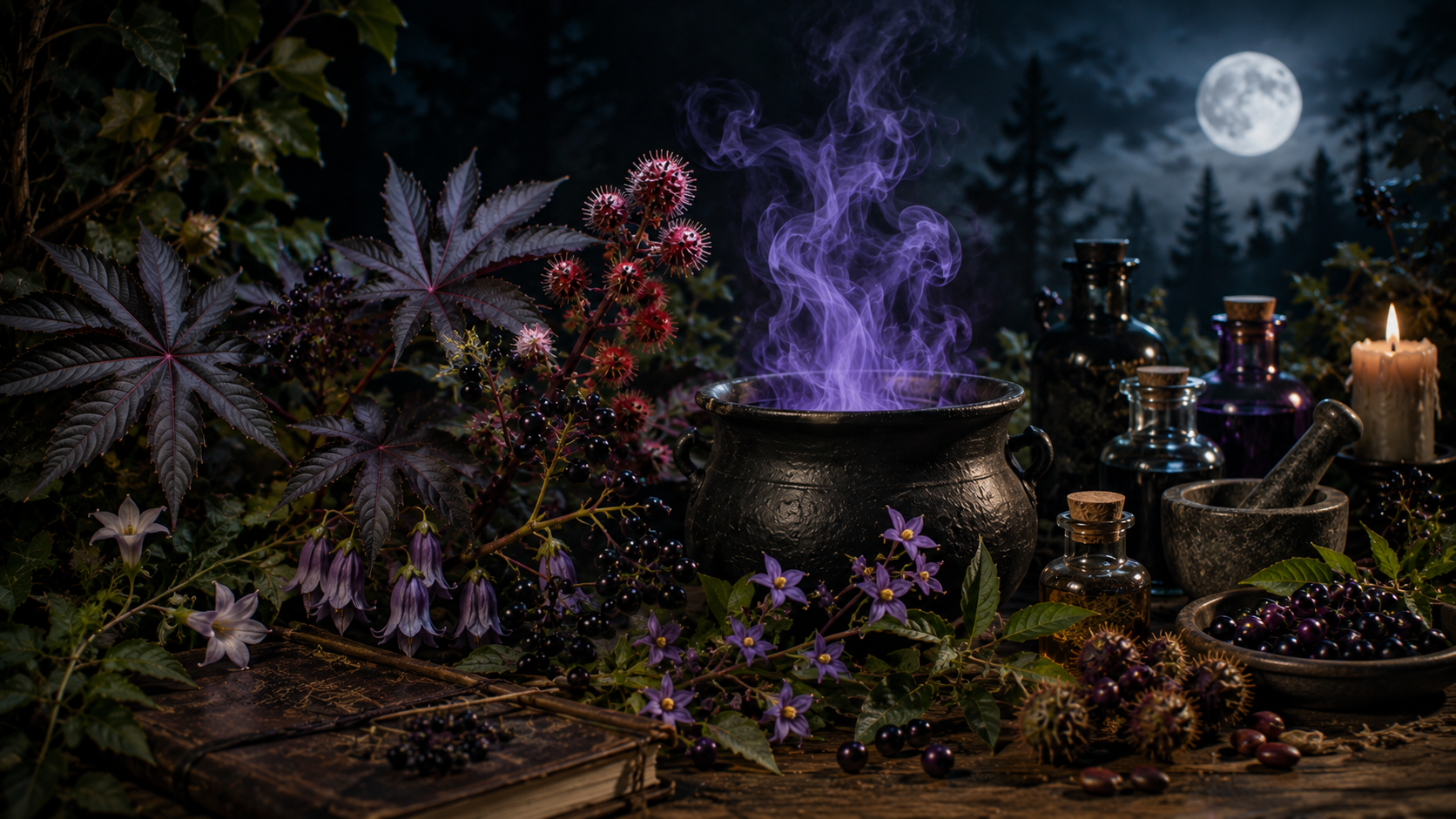
A Family United by One Class of Chemistry
Belladonna, henbane, datura, and mandrage all share a closely related group of tropane alkaloids — atropine, hyoscyamine, and scopolamine chief among them — compounds that interfere with the nervous system's ability to regulate itself. Bittersweet nightshade carries a different, generally milder toxic profile (primarily solanine), making it something of a gentler cousin within the same family rather than a full member of the tropane-alkaloid core group. But the resemblance in name, appearance, and family lineage was enough that folk tradition rarely bothered distinguishing it as carefully as modern toxicology now does.
What unites the tropane-alkaloid plants specifically is the experience they produce when absorbed through skin or ingested: disorientation, vivid and often realistic hallucination, a sense of bodily displacement or floating, and confusion severe enough that the boundary between dream and waking life genuinely collapses for the person experiencing it. Modern pharmacology can explain this mechanism precisely. Medieval and Renaissance Europe could not — and into that explanatory gap, the witch's flying ointment was born.
One Recipe, Repeated Across Centuries and Borders
The core legend is remarkably consistent regardless of which country's witch trial records you read: a green or dark ointment, rendered in fat, combining some mixture of belladonna, henbane, datura, and mandrake, applied to the skin — sometimes the armpits, sometimes more sensitive areas, occasionally smeared directly onto the handle of a broomstick. As the alkaloids absorbed through the skin, the user reportedly experienced vivid sensations of flight, journeying to a witches' Sabbath where dancing, feasting, and communion with the Devil were said to take place.
A sixteenth-century physician to Pope Julius III actually investigated these ointments directly and concluded, with striking rationality for his era, that they produced intense dream states rather than genuine physical flight. It made essentially no difference to the outcome. During witch trials across Europe, confessions describing these exact sensations — flight, Sabbath attendance, encounters with the Devil — were treated by inquisitors and prosecutors as evidence of real supernatural activity rather than as the drug-induced hallucinations they almost certainly were. People were convicted and executed, in significant numbers, partly on the strength of visions these very plants had produced in their own bodies.
A Family Claimed by the Same Goddess
Greek mythology had already prepared the ground for this association centuries before the European witch trials began. Hecate, goddess of magic, crossroads, and the boundary between the living and the dead, was associated specifically with this cluster of plants — belladonna, henbane, and mandrake among them — said in some traditions to have cultivated them herself or even invented their use. Her mythological household extended the connection directly into the world of intentional poisoning: her daughter Circe, the sorceress of the Odyssey, is traditionally linked to mandrake specifically as the active ingredient in the potion that transforms Odysseus's men into swine, and her other daughter, Medea, is credited in myth with a notorious poisoning attempt using a related toxic plant.
This is, in other words, a mythology that had already organized these plants into a single magical taxonomy long before any inquisitor wrote down a single witch trial confession — meaning the witch's garden wasn't invented by medieval fear. It was inherited, fully formed, from a much older story about a goddess who already owned every plant in it.
Five Plants, One Family, Five Different Specialties
Within this shared chemical and mythological framework, each plant in this archive carved out its own specific reputation:
Belladonna became most associated with beauty and cosmetic use — Renaissance women dilating their pupils with it — alongside its underworld connection through Hecate and its etymological link to Atropos, the Fate who cuts the thread of life.
Henbane earned the specific title "Witches' Herb" in medieval tradition and carries the heaviest documented body count in real historical poisoning, real or legendary, from Hamlet to Cleopatra's reported suicide testing.
Datura carries the widest global reach of any plant in this family, sacred to Shiva in Hindu tradition while simultaneously serving as evidence of sorcery in Spanish Inquisition trials — the same plant venerated and persecuted on opposite sides of the world.
Mandrake stands apart through its human-shaped root, generating an entirely separate body of folklore (the screaming root, the gallows legend) layered on top of the same flying ointment reputation shared with its cousins.
Bittersweet nightshade, the family's comparatively gentle member, picked up entirely different folklore — tied to Judas's betrayal in one tradition and to marital fidelity in another — demonstrating that even the "safe" member of this family still attracted serious symbolic weight.
Why This Particular Family, and Not Some Other
It's worth asking why nightshades specifically became witchcraft's signature plant family, rather than some other group of toxic plants covered elsewhere in this archive. The answer seems to lie specifically in the psychoactive nature of tropane alkaloids, as opposed to the purely physical toxicity of, say, foxglove or oleander's cardiac glycosides. A plant that simply kills you doesn't generate witch trial confessions. A plant that produces vivid, convincing hallucinations of flight and supernatural encounter — and does so reliably enough that completely unconnected cultures across centuries kept describing nearly identical experiences — generates exactly the kind of "evidence" a frightened, pre-scientific society would mistake for genuine supernatural activity. The nightshades didn't just poison people. They showed people something that felt real enough to die for.
Quick Answers
Why are nightshades specifically associated with witches, rather than other toxic plants? Their shared tropane alkaloids produce vivid hallucinations and a sensation of bodily displacement or flight when absorbed, an effect pre-modern societies had no way to explain except through supernatural belief — unlike purely physically toxic plants, which don't produce this kind of convincing psychoactive experience.
Did the witches' flying ointment actually work, in the sense of producing real effects? Yes, in the sense that the plants genuinely produce hallucinations and dissociation when absorbed through skin — but no, in the sense that the "flight" was a drug-induced sensation rather than literal physical travel, a conclusion even some contemporary physicians reached at the time.
Which nightshade in this archive is the most dangerous? Belladonna and henbane are generally considered the most acutely toxic of this group; bittersweet nightshade is comparatively milder, though all five should be treated as genuinely dangerous.
Were real historical witch trial confessions actually based on these plants? Many confessions describing flight, Sabbath attendance, and encounters with supernatural figures are believed by modern historians to reflect genuine drug-induced hallucinations from these plants, extracted, however, under conditions of torture and severe coercion.
Is it true that all of these plants are linked to the same Greek goddess? Yes — Hecate's mythological association with belladonna, henbane, and mandrake specifically predates the European witch trials by well over a thousand years, suggesting the witch's garden concept has genuinely ancient roots.