Daphne: The Borrowed Name of a Nymph Who Was Never Actually This Plant
There's a quiet irony sitting at the center of this plant's entire identity: it's named after one of Greek mythology's most famous transformation myths, and it isn't actually the plant from that myth at all. The nymph Daphne, fleeing Apollo's pursuit, transformed into a laurel tree — specifically Laurus nobilis, true bay laurel, the source of victors' wreaths at the ancient Pythian Games. Centuries later, Carl Linnaeus encountered a genus of nearly ninety evergreen shrubs with leaves that merely resembled laurel, and borrowed the nymph's name for them anyway. The plants covered here carry a goddess's myth secondhand, attached by a taxonomist who simply liked the resemblance.
What those plants actually are, beneath the borrowed name, is a small, deceptively pretty, genuinely dangerous family of shrubs — fragrant, early-blooming, and capable of causing real harm to anyone who mistakes their bright berries for something edible.
A Desperate Escape, Immortalized in the Wrong Plant
The myth itself, as recorded most famously by the Roman poet Ovid, follows a fairly devastating arc. Daphne, a nymph devoted to her independence and freedom, caught Apollo's obsessive attention — in some versions, the result of Eros striking the god with a love-inducing arrow specifically to torment him. Apollo pursued her relentlessly; Daphne fled until exhaustion left her with no options left, and in desperation, called out to her father, a river god, or to the earth goddess Gaia, begging for rescue. Her plea was answered by transformation: her body became wood and bark, her hair became leaves, and she rooted into the earth as a laurel tree, escaping Apollo's grasp permanently by ceasing to be reachable as a person at all.
Apollo, the myth continues, accepted this transformation as a kind of consolation, declaring the laurel his sacred tree from that point forward and wearing its leaves as a wreath — a gesture some versions of the myth interpret as Apollo finally respecting, in death, the autonomy Daphne couldn't secure from him while alive. That sacred status outlived the myth itself by millennia: laurel wreaths crowned victors at the Pythian Games, and the practice of honoring achievement with laurel persists today in words like "laureate," a linguistic fossil of a story about a woman who would rather become a tree than be caught.
A Name Transplanted Onto an Unrelated Family
The actual genus called Daphne today — including species like Daphne mezereum, also known as mezereon or February daphne, and Daphne laureola, the spurge-laurel — belongs to an entirely different plant family, Thymelaeaceae, with no botanical relationship to true laurel whatsoever. The resemblance that earned them the borrowed name is mostly superficial: similarly shaped, glossy evergreen or semi-evergreen leaves, nothing more. Linnaeus's naming choice has left this archive, and gardeners more broadly, with centuries of mild confusion between a real, ancient mythological plant and a genuinely unrelated genus that simply looked enough like it on a casual glance.
Even the species name of the most notable member, mezereum, carries its own separate linguistic journey — tracing back through medieval Latin to an Arabic term borrowed in turn from Persian, a word some sources suggest may itself mean something close to "to kill," a far more direct and honest piece of naming than the borrowed Greek myth attached to the genus as a whole.
A Beautiful Late-Winter Bloom With a Genuine Bite
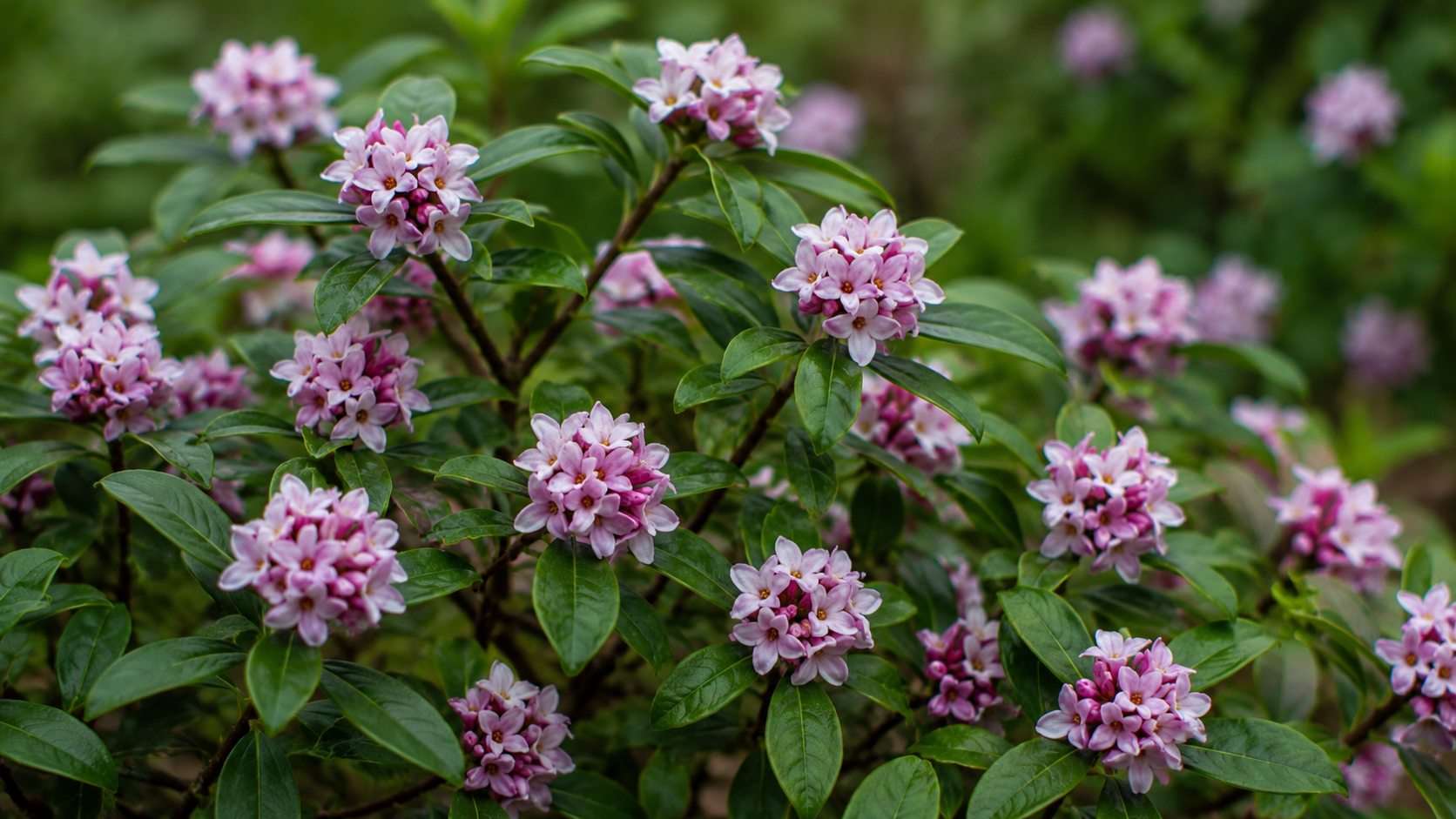
Daphne mezereum is a modest deciduous shrub, typically reaching three to five feet, prized specifically for blooming shockingly early — clusters of fragrant, lilac to rosy-purple flowers appearing directly on bare, leafless stems in late winter, often as early as February in temperate climates, well before most of the garden has woken up. By early summer, those flowers give way to bright red, ovoid berries that look, by every visual cue available to a curious child or forager, like something good to eat.
They are not. Every part of the plant — bark, berries, and flowers especially — contains irritant diterpenoid compounds including mezerein and daphnin, and ingestion produces a severe, fast-acting reaction: burning sensation and swelling in the mouth and lips beginning within hours, increased salivation, hoarseness, and difficulty swallowing, sometimes escalating to a genuinely frightening choking sensation. Even simple handling of fresh twigs has caused skin rashes and eczema in sensitive individuals, without any ingestion at all.
One documented pediatric case illustrates just how serious a reaction can become: a seven-year-old admitted to a university hospital after eating several Daphne mezereum flowers initially presented with symptoms closely resembling acute appendicitis — abdominal pain and headache — before developing alarming neurological symptoms in the hours that followed, including periods of complete disorientation, severe motor agitation, and episodes of intense, tetanus-like fearfulness alternating with moments of full clarity. It's a genuinely unsettling case precisely because the early symptoms gave so little indication of what the plant was actually doing.
Protected, and Still Planted Anyway
Despite — or perhaps entirely because of — its real danger, Daphne mezereum remains a popular ornamental garden plant, prized for that early, fragrant burst of color when almost nothing else in the garden is blooming. In the United Kingdom, the wild native population gained formal legal protection in 1975 specifically due to habitat loss, a conservation status that sits in a genuinely strange position alongside the plant's reputation as a household hazard — simultaneously rare and protected in the wild, and common enough as a cultivated garden plant to remain a real concern for anyone with young children or pets.
Quick Answers
Is the Daphne plant the same as the laurel tree from Greek mythology? No — the mythological transformation involves true bay laurel (Laurus nobilis), a botanically unrelated plant. Carl Linnaeus later named the unrelated Daphne genus after the nymph simply because the leaves bore a superficial resemblance to laurel.
Are Daphne berries dangerous to children? Yes, significantly — the bright red berries are attractive to children but contain irritant toxins that cause severe mouth and throat burning, swelling, and difficulty swallowing within hours of ingestion.
Is Daphne dangerous to just touch? Yes, to a real degree — handling fresh twigs and stems has caused skin rashes and eczema-like reactions in sensitive individuals, even without any ingestion.
Is Daphne mezereum an endangered plant? In the United Kingdom, the wild native population is legally protected due to habitat loss, even though the plant remains commonly available and widely planted as a cultivated garden ornamental.
What does Daphne poisoning actually feel like? Symptoms typically begin with burning and swelling in the mouth and lips, excessive salivation, hoarseness, and difficulty swallowing, and in serious cases can progress to disorientation and severe agitation.
Why does Daphne bloom so early in the year? Daphne mezereum is specifically valued by gardeners for flowering directly on bare stems in late winter, often as early as February, providing color and fragrance before most other garden plants have begun growing for the season.