Pacific Yew: The Overlooked Tree That Became a Cancer Cure
For most of its existence, the Pacific yew was treated as something close to forest debris — a slow-growing, scraggly understory tree, easily overshadowed by the towering Douglas firs and western redcedars it grows beneath, with wood foresters sometimes burned as waste during logging operations. Its needles, bark, and seeds are genuinely toxic, capable of causing fatal heart arrhythmias if ingested. And in the second half of the twentieth century, this same overlooked tree became the unlikely source of one of the most important cancer drugs ever developed.
Few plants in this archive have a more dramatic before-and-after story. Pacific yew spent centuries as a tree nobody paid much attention to, and then, almost overnight by botanical timescales, became something international pharmaceutical demand threatened to wipe out entirely.
A Quiet Tree With a Dangerous Secret
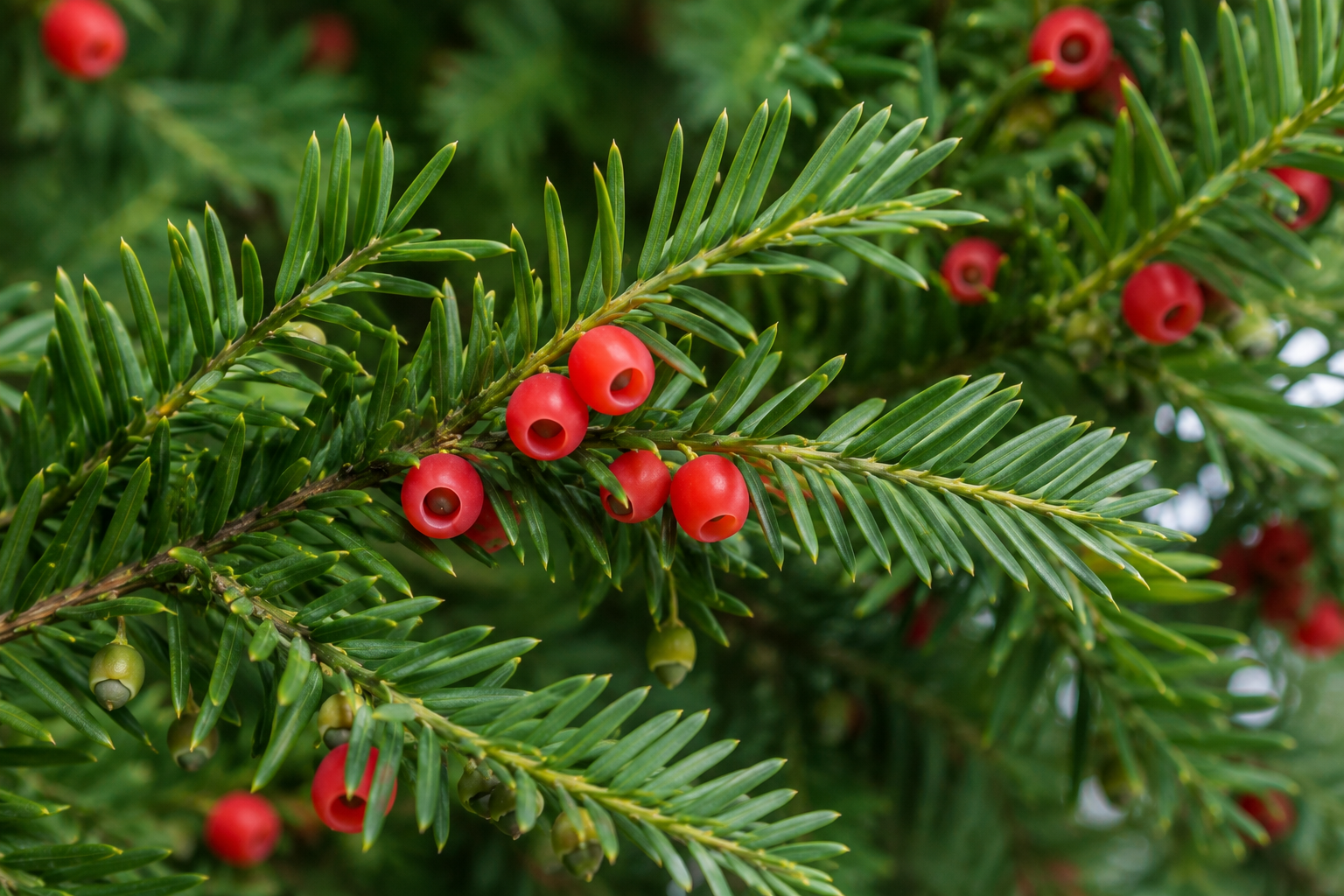
Pacific yew is a shade-loving evergreen native to coastal forests from southern Alaska down through northern California, typically growing as a modest tree or large shrub rather than the dominant canopy giants around it. Its needles are flat and arranged in a distinctive spiral pattern, and female trees produce small, bright red, berry-like seed cups in autumn — visually appealing, frequently eaten by birds, and genuinely dangerous to humans if the wrong part is consumed.
The juicy red aril surrounding the seed is reportedly mild and edible on its own, with something close to a cherry-gelatin flavor. The seed itself, sitting at the center of that aril, is a different story entirely — along with the needles and bark, it contains toxic alkaloids, primarily taxine, capable of causing severe cardiac arrhythmias and death if ingested. It's a strange, specific kind of danger: a fruit that's genuinely safe to taste, wrapped directly around a seed that genuinely isn't, with no obvious visual signal separating the two.
A Tree Already Respected Before Anyone Knew Why
Long before Western science extracted a single compound from Pacific yew, Indigenous peoples across its range — from coastal British Columbia down through Northern California — had already identified it as a tree requiring real respect and careful handling. Traditional healers prepared infusions and decoctions from the bark and needles to treat conditions like rheumatism and chronic aches, using exactly the kind of careful, narrow-dose knowledge seen elsewhere across this entire toxic botanicals archive — full awareness of danger paired with specific, hard-won expertise in working around it.
The wood itself carried its own separate value entirely apart from medicine. Its dense, fine grain made it prized for archery bows, and some Indigenous peoples ground the wood and mixed it with fish oil to create a red pigment used in traditional paint. Centuries later, the wood would also find use in furniture, musical instruments, and even in components of traditional Japanese tea-room architecture — a tree valued in entirely unrelated ways across multiple, unconnected cultures, long before its most famous use was even imagined.
The Discovery That Changed Oncology
The modern story of Pacific yew begins almost by accident, on a hot August day in 1962, when a Harvard-trained botanist named Arthur Barclay was collecting plant samples in Washington's Gifford Pinchot National Forest as part of a broad, somewhat random federal screening program looking for new compounds with medical potential. He noted an unremarkable twenty-five-foot Pacific yew tree, collected a sample, and logged it simply as the 1,645th specimen in his collection — with no particular reason to think it would matter more than any other tree on his list.
That sample eventually made its way to researchers who identified meaningful anticancer activity in the bark extract. The compound responsible — eventually named paclitaxel, and marketed under the name Taxol — went on to become one of the most significant chemotherapy drugs in modern oncology, eventually approved by the FDA in 1992 for ovarian cancer and later extended to breast and lung cancer treatment as well.
The discovery came with an immediate, brutal problem. Extracting useful quantities of Taxol required stripping and destroying the bark, which killed the tree outright — and Pacific yew grows slowly, often taking decades to reach a usable size. Estimates from the era suggested that treating a single cancer patient with bark-derived Taxol could require killing roughly eight sixty-year-old yew trees. An effective cancer treatment had been found inside a tree that simply could not be harvested at the scale global demand was about to require.
From Forest Crisis to Lab Bench
The sustainability crisis that followed became its own significant chapter in pharmaceutical history. Researchers raced, in parallel with clinical trials, to find a way to produce Taxol without depending on wild Pacific yew bark at all. By the early 2000s, a semisynthetic production pathway had been developed, using compounds extracted from the needles — a renewable part of the tree — of faster-growing, cultivated yew species, removing the need to harvest Pacific yew from wild forests at scale entirely.
The Pacific yew's IUCN conservation status remains listed as Near Threatened today, a lingering mark of how close commercial demand came to seriously damaging the species before alternative production methods were developed in time. It stands as a genuinely important cautionary case study in modern conservation and pharmacology alike — proof of how quickly a slow-growing, previously ignored wild species can go from forest obscurity to global medical urgency, and how easily that urgency can become its own kind of threat.
An Old World Shadow Worth Knowing
Pacific yew isn't the species most steeped in ancient mythology — that distinction belongs to its European relative, Taxus baccata, which has been planted in churchyards and associated with death, immortality, and the underworld across British and European folklore for centuries, owing partly to its own toxic alkaloid (also called taxine) and its remarkable longevity, with some individual trees living for many centuries. Pacific yew doesn't carry that same accumulated weight of folklore directly, simply because it belongs to a different continent's storytelling tradition — but the shared genus, the shared toxicity, and the shared association between an ancient, slow-growing tree and the subject of death and longevity make an interesting throughline worth knowing, even if the legends themselves belong to yew's Old World cousin rather than this Pacific Northwest native specifically.
Quick Answers
Is Pacific yew poisonous to touch? Handling the foliage casually carries lower risk than ingestion, but the needles, bark, and seeds all contain toxic alkaloids, and caution is still recommended, particularly avoiding contact with broken or cut plant material.
Can you eat the red berries on a Pacific yew? The fleshy red aril surrounding the seed is reportedly mild and edible, but the seed itself at the center is highly toxic and should never be chewed or swallowed — making the berry a genuinely risky thing to eat casually.
Is Pacific yew the source of all Taxol used in chemotherapy today? No longer — while it was the original source, modern Taxol (paclitaxel) production has largely shifted to semisynthetic methods using needles from faster-growing, cultivated yew species, reducing pressure on wild Pacific yew populations.
Why was Pacific yew almost wiped out by its own medical discovery? Because extracting Taxol originally required stripping and killing the bark of slow-growing wild trees, and the volume needed for widespread cancer treatment far outpaced how quickly the species could naturally regenerate.
Did Indigenous peoples use Pacific yew before its cancer-fighting properties were discovered? Yes — Indigenous peoples across the Pacific Northwest used the bark and needles in traditional medicine for ailments like rheumatism, and the wood for bows, tools, and pigment, long before Western science identified paclitaxel.
Is Pacific yew related to the yew trees found in old European churchyards? Yes — they're related species within the same genus, Taxus, sharing a similar toxic alkaloid profile, though the extensive death-and-immortality folklore associated with yew trees specifically developed around the European species.