Holly: The Plant That Outlived Every Religion That Claimed It
Holly has been sacred to Druids, dedicated to a Roman god, woven into a battle between two mythological kings, reinterpreted as a Christian symbol of the crucifixion, and finally compressed into pure secular shorthand — spiky green leaves plus red berries equals Christmas, no further explanation required by most people hanging a wreath today. Few plants in this archive have been claimed, abandoned, and reclaimed by quite this many unrelated belief systems across quite so many centuries, all drawn to the same simple, stubborn fact: holly stays green and produces bright berries precisely when everything else in the landscape has gone bare and brown.
It's also, beneath all that accumulated meaning, a genuinely toxic plant — mildly so by the standards of this archive, but real enough that its berries send children to emergency rooms every winter, drawn in by exactly the same bright red color that made the plant sacred in the first place.
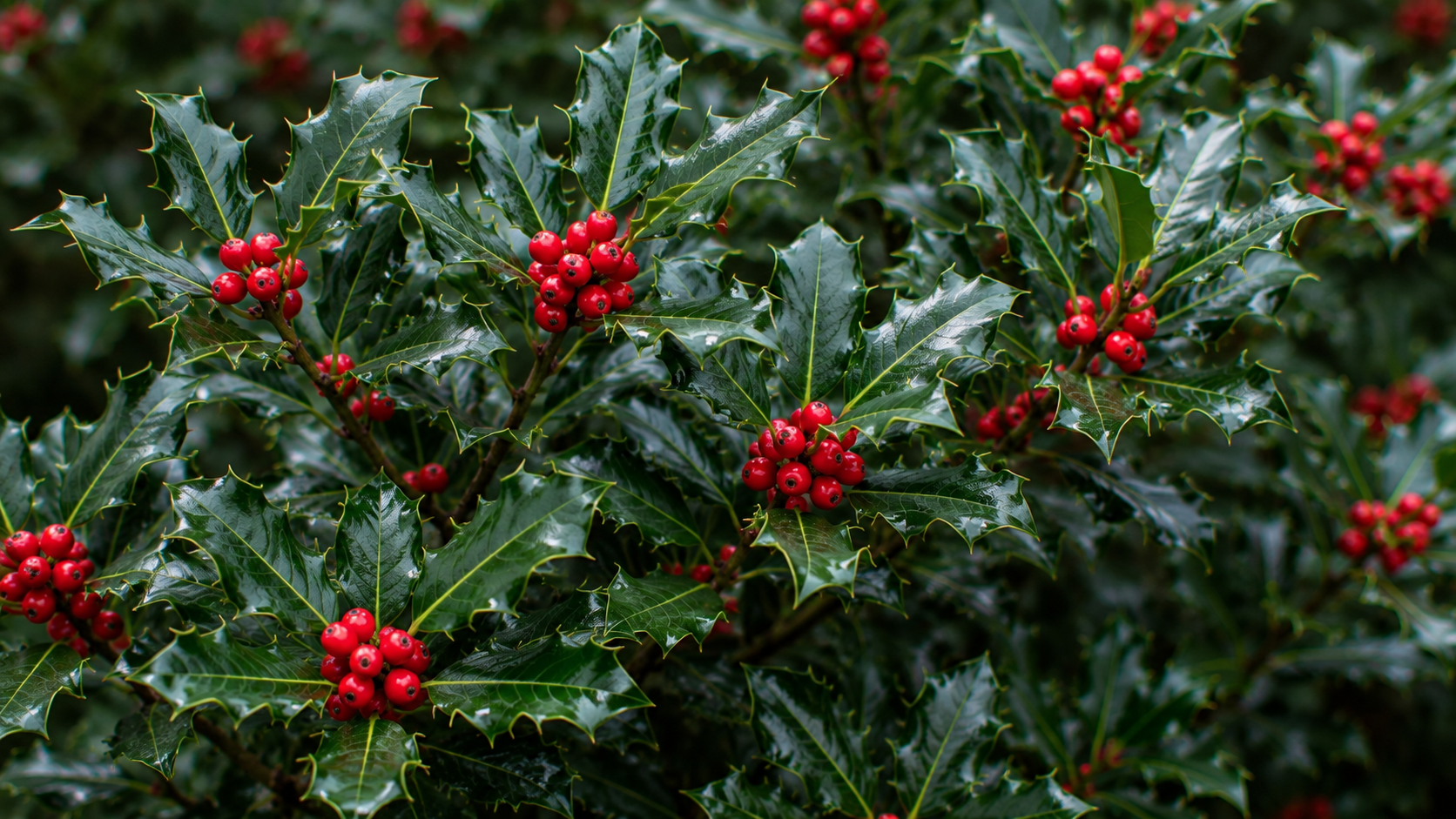
A Tree That Refused to Die in Winter
Long before any of holly's religious symbolism existed, its appeal was almost entirely practical and observational. Ancient peoples watching the landscape empty out every autumn noticed one plant that simply didn't follow the pattern — glossy, evergreen leaves holding their color, bright berries ripening in autumn and persisting straight through the coldest months, when virtually nothing else in the forest offered any color at all. That single, stubborn fact of holly's biology is the seed every later myth, ritual, and symbol grew from.
The Celtic Druids took this resilience as evidence of sacred power, considering holly capable of warding off evil spirits and protecting against witches and even mad dogs — a belief sturdy enough to persist across the medieval period, with people keeping holly in their homes or wearing it as a personal charm against witchcraft long after Druidic religion itself had faded from common practice.
A God's Plant, a King's Battle
Roman tradition gave holly an equally serious mythological assignment: it was sacred to Saturn, god of agriculture and time, and central to Saturnalia, the raucous, norm-suspending midwinter festival held in his honor. Wreaths and boughs of holly decorated homes throughout the celebration, and a small sprig was tied to nearly every gift exchanged — a detail that makes today's holly-trimmed Christmas wrapping paper a remarkably direct, if largely forgotten, continuation of a two-thousand-year-old Roman gift-wrapping habit.
A separate, distinctly Celtic mythological framework cast holly in an even more dramatic role: the Holly King, ruler of the dark half of the year, locked in eternal combat with his seasonal counterpart, the Oak King. In most tellings, the Holly King reigns triumphant from the autumn equinox through midwinter, only to be defeated by the Oak King each spring — a recurring, cyclical battle for the seasons themselves, with the actual plant serving as one half of the year's living mascot.
Borrowed by the Religion That Replaced It
When Christianity spread through the Roman Empire, it inherited a population already deeply attached to decorating with holly every midwinter — and rather than fighting that attachment directly, the Church largely absorbed and reinterpreted it. The plant's sharp, spiny leaf margins became a symbol of Christ's crown of thorns; its bright red berries became symbolic drops of his blood; its evergreen persistence through winter became a symbol of eternal life. The traditional carol "The Holly and the Ivy" preserves this reinterpretation directly, tracing the symbolism of holly's white flowers, red berries, and bitter bark across the stages of Christ's life from birth to crucifixion.
This wasn't a universally smooth transition. At least one early Church edict, from the Council of Bracara, attempted to forbid Christians from decorating homes with holly specifically because of its obvious pagan origins — a prohibition that ultimately failed against centuries of deeply rooted seasonal habit. By the time Emperor Constantine formally established December 25th as the date of Christ's birth in the fourth century, holly had already shifted from a plant explicitly honoring Saturn into one explicitly honoring an entirely different god, with most of its outward appearance and seasonal placement left completely unchanged.
The Folklore Got the Mechanism Wrong, But Not the Conclusion
Here's where holly's story takes a genuinely interesting modern scientific turn. Researchers studying holly trees have discovered that the plant adjusts how spiny its own leaves grow through epigenetic modification, depending on real, present danger — leaves on lower branches, within easy reach of browsing deer and other animals, grow noticeably spikier, while leaves higher up, beyond what grazing animals can reach, often grow smooth-edged instead. The tree is, quite literally, arming itself selectively, exactly where the threat actually exists.
The Druids who attributed holly's hardiness to defensive magic were responding to something genuinely real about the plant — they simply had the mechanism wrong. There was no enchantment making holly dangerous to touch in the right places. There was a tree actively defending its own most vulnerable leaves, in a way ancient observers without any concept of plant epigenetics had no way to correctly explain, but had clearly, correctly noticed.
A Mild Poison, and One Genuinely Strange Exception
Despite millennia of reverence, holly carries a real, if comparatively mild, toxicity. Its berries — technically drupes, related more closely in structure to cherries or olives than to true berries — cause vomiting and diarrhea if eaten, rarely fatal in adults but a genuine medical concern for children specifically, since ingestion of as few as twenty berries has been associated with potentially fatal outcomes in a child. The bright red color that made holly sacred for thousands of years is the exact same visual cue that draws curious children toward it today.
One member of the genus breaks from the rest of this pattern in a genuinely strange way. Yaupon holly, Ilex vomitoria, native to the southeastern United States, is the only North American plant known to naturally contain caffeine — and despite a scientific name suggesting otherwise, the plant itself isn't actually an emetic; the misleading name stems from its historical use by Indigenous peoples in ceremonial "black drink" purification rituals, in which the brewed tea was deliberately consumed in large quantities specifically to induce vomiting as part of the ritual itself, a use that attached its dramatic effect to the plant's name rather than to any inherent toxic property of the leaves.
Quick Answers
Are holly berries actually dangerous? Yes, to a real degree — they cause vomiting and diarrhea if eaten and are rarely fatal in adults, but ingestion of as few as twenty berries has been linked to potentially fatal outcomes in children specifically.
Why does holly have spiky leaves only on some branches? Research has found that holly trees adjust leaf spininess through epigenetic modification based on real grazing pressure — lower leaves within reach of browsing animals tend to grow spikier, while higher leaves often grow smooth-edged.
Is the "Holly King" a real ancient mythological figure? The Holly King appears primarily in Celtic-derived and modern Neopagan/Wiccan tradition, representing the dark half of the year in a cyclical, ongoing battle against the Oak King, who represents the year's lighter half.
Why does holly symbolize Christmas specifically? Its association predates Christianity by centuries, originating in Roman Saturnalia and Druidic midwinter customs; early Christians largely adopted rather than replaced the existing tradition, reinterpreting holly's thorns and berries as symbols of Christ's crown of thorns and blood.
Is Yaupon holly actually an emetic, as its scientific name suggests? No — the plant itself isn't inherently an emetic; the name comes from its historical ceremonial use in Indigenous "black drink" purification rituals, where large quantities were intentionally consumed to induce vomiting as part of the ritual itself.
Is holly dangerous to pets? Yes — holly berries and leaves can cause gastrointestinal upset in pets and livestock as well as humans, and should be kept out of reach of curious animals.