Mandrake: The Root That Screams
According to centuries of European legend, pulling a mandrake root from the ground releases a scream loud enough to kill anyone who hears it — which meant that for hundreds of years, the people who harvested this plant didn't dare touch it with their own hands. They tied a rope around the root, attached the other end to a dog, and ran.
The dog, presumably, did not run fast enough.
Mandrake doesn't just look unsettling for a plant — its forked, often human-shaped root has been read for thousands of years as a tiny, buried body, limbs and all, and that single visual detail launched more folklore, more superstition, and more outright fraud than almost any other plant in the witch's garden. It's also a real, working anesthetic, a Biblical fertility aid, and one of the only plants ever recorded as appearing in both Egyptian pharaoh's tombs and a Hogwarts greenhouse.
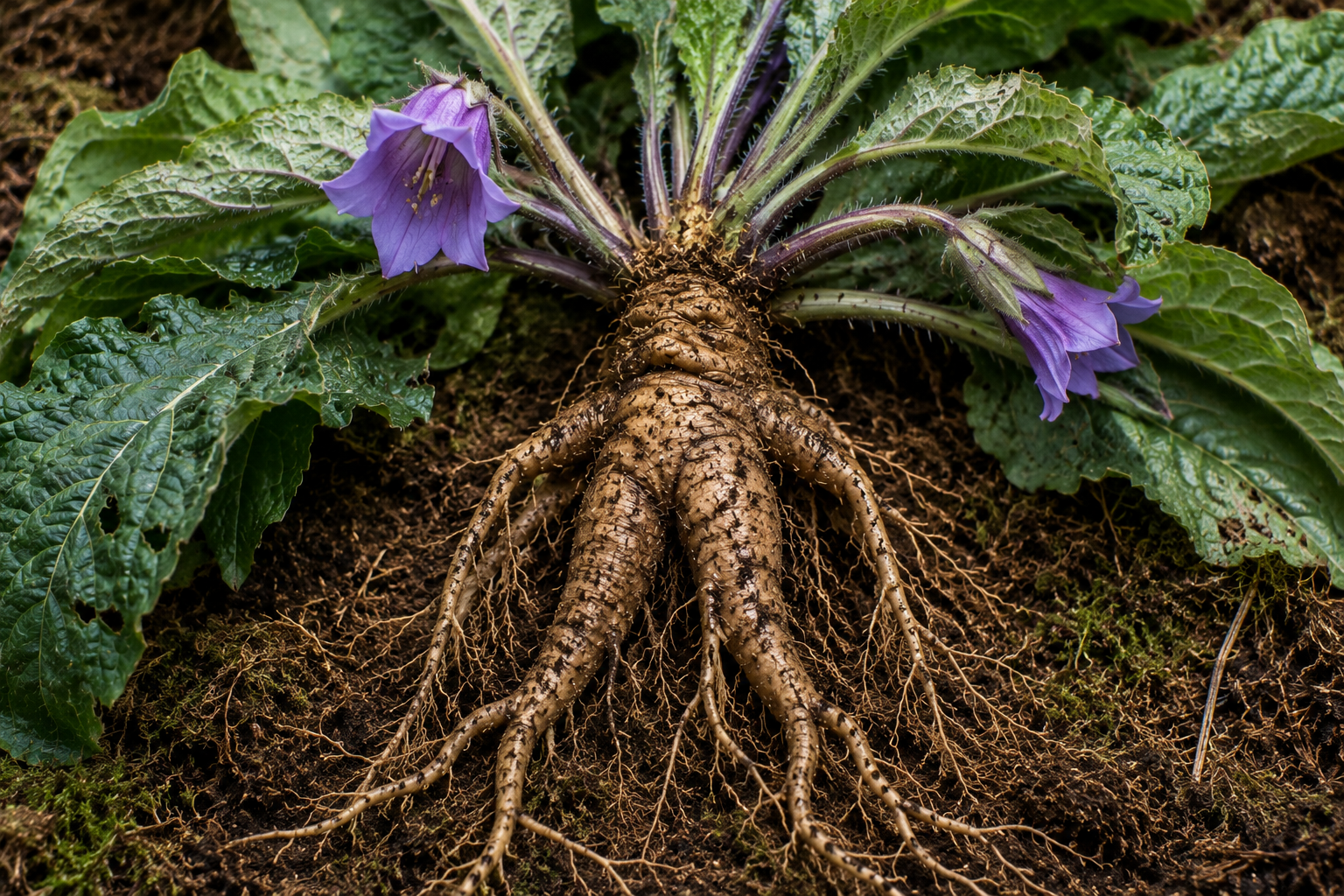
A Plant Shaped Like a Person
Mandrake belongs to the nightshade family, and its toxicity comes from the now-familiar lineup of tropane alkaloids — scopolamine, hyoscyamine, atropine, and a compound unique enough to be named directly after the plant itself, mandragorine. Ingested in sufficient quantity, these compounds produce hallucinations, delirium, and — particularly through their anticholinergic effects — can lead to asphyxiation and death. Accidental poisoning from the root has historically produced vomiting, diarrhea, dizziness, and blurred vision, the same general anticholinergic cluster that shows up across the entire nightshade family.
But mandrake's real claim to fame has always been its shape. The thick, often forked taproot frequently splits into two or more "legs," and with a little imagination — and medieval audiences had plenty — it reads unmistakably as a small human figure. This single coincidence of botany shaped almost everything that followed.
The Doctrine That a Plant Could Be a Person
Medieval European medicine operated under something called the doctrine of signatures — the belief that a plant's physical resemblance to a part of the human body was a divine hint about what that plant was meant to treat or control. A plant shaped like a human body, by that logic, wasn't just useful for treating one ailment. It was a plant with power over the body entire — fertility, love, fortune, protection, all of it.
This is why mandrake became Europe's go-to charm for almost every desperate human want. A root shaped like an infant, tucked under a pillow, was believed to help a woman conceive. A root shaped like a woman, carried in a man's pocket, was supposed to help him win the lover he desired. People across Europe sought these roots out so desperately and paid so much for them that an entire counterfeit industry sprang up — carvers shaping ordinary bryony root into convincing human figures, sometimes adding wheat or grass for hair, and selling the fakes as the real, far more expensive thing. One physician of the era, unimpressed, wrote that buyers of these charms were being relieved of both their wits and their money in equal measure. It didn't slow sales down at all.
Six Thousand Years of Reaching for the Same Root
Mandrake's medicinal résumé predates almost every other plant in the apothecary by a wide margin. Egyptian tombs at Luxor-Thebes carry carved depictions of mandrake dating back over three thousand years, and the root itself was discovered among the burial goods in King Tutankhamun's tomb, apparently imported specifically for the purpose. The Egyptians called it "the water of life," used it to promote vigor and longevity, and treated it with enough reverence to set it in a place of honor in the home, lighting candles and making vows before it.
The plant's medical use as an anesthetic is just as old. The Greek physician Dioscorides, writing in the first century AD, documented mandrake wine as a genuine surgical anesthetic, and Pliny the Elder recommended giving patients a piece of the root to chew before operations specifically to "dull the sense." Centuries before modern anesthesia existed, mandrake was the closest thing available — a real, working sedative wrapped in a plant so strange-looking that people couldn't help but mythologize it at the same time they were using it clinically.
It even made it into scripture. In the Book of Genesis, mandrake root is the device that helps Rachel conceive the child who becomes Jacob — one of the oldest written references to the plant's reputation as a fertility aid, and proof that this exact superstition was already old by the time it was being written down.
Circe's Poison of Choice
Greek mythology gave mandrake one of its most memorable literary appearances. In Homer's Odyssey, the enchantress Circe brews a potion that transforms Odysseus's men into swine — and while Homer never names the ingredients directly, classical tradition and later scholars have repeatedly pointed to mandrake as the plant behind Circe's transformative magic, sometimes calling it outright "the drug of Circe." A plant capable of producing genuine hallucination and altered consciousness, filtered through an ancient audience with no chemical vocabulary to explain what they were witnessing, became sorcery instead of pharmacology — the same pattern that shows up again and again across the witch's garden.
The Scream, the Dog, and the Gallows
The screaming-root legend is old enough to predate medieval Europe by over a thousand years. The first-century historian Josephus described a nearly identical ritual for harvesting a plant called "baaras" — tying it to a dog, sacrificing the animal to pull the root free rather than risk a human life. Medieval Europe inherited and embellished the idea considerably: the root didn't just endanger whoever pulled it, it screamed loud enough to kill outright, and the only safe method was to attach a dog to the root by rope, retreat to a safe distance, and let the animal take the fatal risk instead.
Where the root supposedly grew added another disturbing layer. English and German folklore both placed mandrake specifically beneath gallows, claiming it sprang from the bodily fluids of hanged men as they died — semen or urine seeping into the soil and taking root as something between plant and person. German tradition calls this figure the Galgenmännlein, the "little man of the gallows," and built an elaborate set of conditions around exactly which hanged man's remains could produce one: he had to have been a hereditary thief, his mother had to have stolen (or considered stealing) while pregnant with him, and he had to have died a virgin. Welsh folklore took a related but distinct route, locating mandrakes specifically at crossroads — already considered supernaturally charged sites, frequently used for executions and the burial of those denied consecrated ground.
There's a far less supernatural explanation sitting underneath all of this, and it's almost funny by comparison: mandrake's thick, fleshy root makes a distinct squelching sound when pulled from damp earth — a sound that may simply have been mistaken, by frightened or superstitious ears, for a scream.
Into the Flying Ointment, and Into Hogwarts
Like belladonna, henbane, and datura, mandrake earned a standing place in the witches' flying ointment recipes of medieval and Renaissance Europe — applied to the skin, absorbed through it, producing the dreamlike sensations that practitioners and accusers alike interpreted as supernatural flight. Mandrake's human shape only deepened its reputation in this context; a plant already believed capable of love magic, fortune, and protection was a natural fit for a witch's working kit, prized as something closer to a familiar spirit than an ordinary herb.
The legend never fully died — it just changed audiences. Most modern readers know the screaming mandrake not from grimoires but from a school greenhouse: the mandrakes of the Harry Potter series, shrieking and squirming as students repot them in protective earmuffs, are a fairly direct lift from centuries-old European folklore, simply moved from a moonlit forest to a magical classroom. The plant's oldest and strangest legend turned out to be durable enough to survive completely intact into twenty-first-century children's fiction.
Quick Answers
Is mandrake root actually dangerous? Yes — the root and leaves contain toxic tropane alkaloids capable of causing hallucinations, severe delirium, and in sufficient quantity, death; accidental poisoning has also caused vomiting, dizziness, and blurred vision.
Did mandrake roots really scream when pulled from the ground? No — there's no scientific basis for the legend, though the root's dense, fleshy texture does make an audible squelching sound when removed from damp soil, which may be the origin of the myth.
Why does mandrake root look like a human body? The root naturally grows thick and often forks into two or more sections, which medieval observers interpreted as resembling human legs or limbs — a coincidence of botany that fueled centuries of folklore about the plant having a humanlike spirit.
Is the mandrake in Harry Potter based on real folklore? Yes — the screaming, squirming mandrakes in the series draw directly from genuine medieval European legend about the plant's dangerous, fatal scream when uprooted.
What's the difference between mandrake and American mandrake? They're unrelated plants despite sharing a name — true mandrake (genus Mandragora) is a toxic nightshade-family plant from the Mediterranean and Middle East, while American mandrake (Podophyllum peltatum, also called mayapple) belongs to an entirely different plant family and is used differently in herbal medicine.
Was mandrake actually used as medicine, or only in magic? Both — it had a genuine, well-documented history as a surgical anesthetic and sedative in the ancient world, alongside its much larger reputation as a magical and superstitious charm.