Henbane: The Witch's Herb That Fed Oracles, Murderers, and Pigs
Henbane will kill you, make you hallucinate, convince you that you're flying, or — if you happen to be a pig — barely affect you at all. Few plants have been put to a wider, stranger range of uses by a wider range of species, and almost none of them end well for the humans involved.
For thousands of years, people have known exactly how dangerous this plant is and kept using it anyway: as medicine, as a battlefield weapon, as a beer additive, and as the single most repeated ingredient in the legend of the flying witch. Henbane doesn't have belladonna's elegant, single contradiction of beauty and death. It has a dozen contradictions stacked on top of each other, and somehow all of them are true at once.
A Plant That Announces Itself Before You Touch It
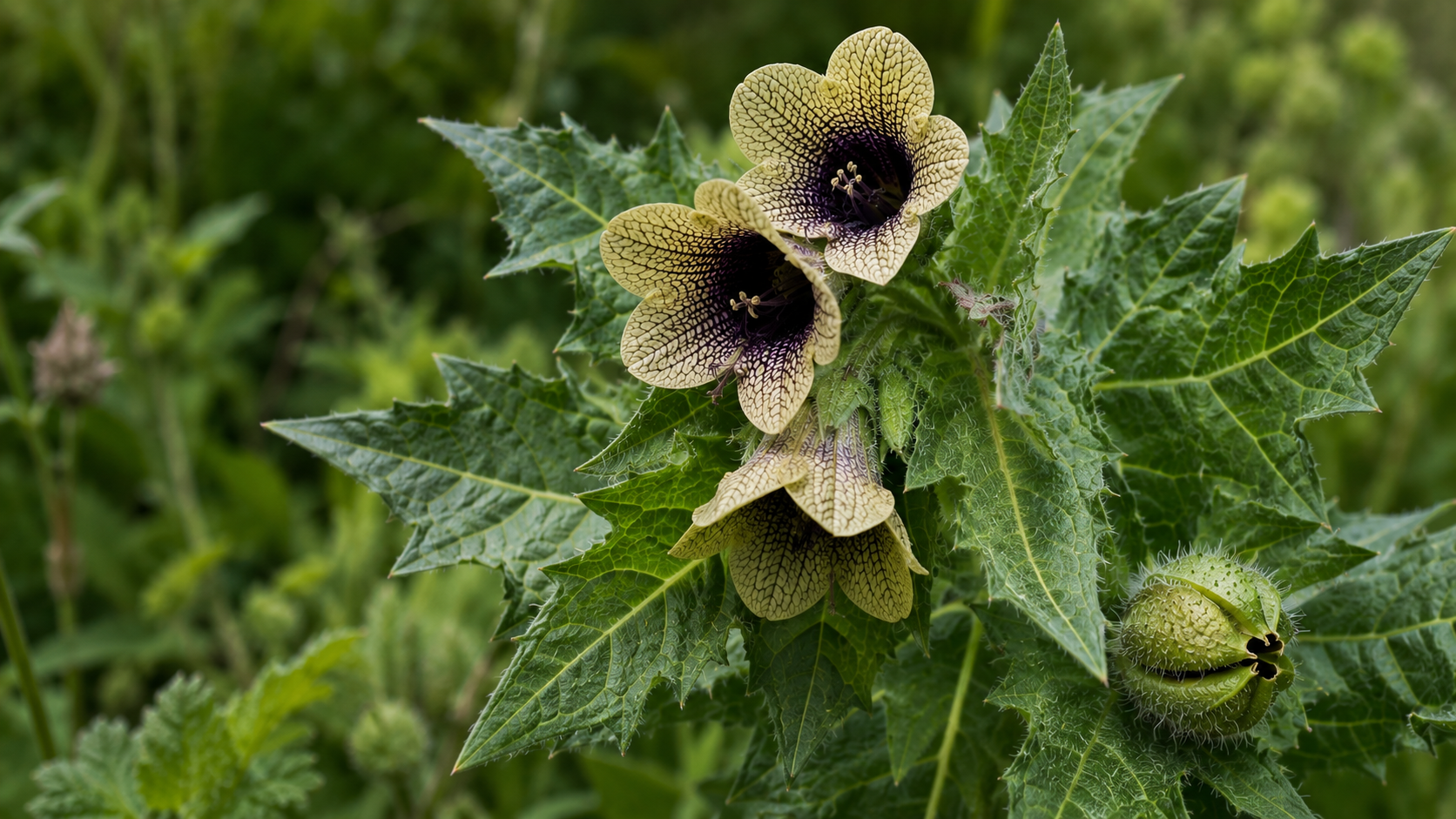
Henbane doesn't try to charm you the way belladonna does. It's a coarse, sticky, foul-smelling plant covered in glandular hairs, with dull greenish leaves and pale, veined, faintly sickly-looking flowers — the kind of plant that looks like it knows exactly what it is. Native to Eurasia, it's been part of human ritual and medicine for an almost unbelievable stretch of time: ritual use of henbane has been traced back roughly ten thousand years, to the Neolithic period, making it one of the oldest psychoactive plants humans have a documented relationship with.
The toxicity lives in the same family of compounds you'd find in belladonna and datura — hyoscyamine, scopolamine, and atropine, among a wider cocktail of alkaloids. The effects are correspondingly similar: blocked nerve signals, a body that stops regulating itself properly. Dilated pupils. A racing heart. Dry mouth and skin, a creeping fever, and in serious cases, delirium, convulsions, coma, and death through respiratory failure.
It's toxic to most things that eat it — cattle, birds, fish, wild animals all suffer for it. And then, almost as a private joke from nature, pigs are essentially immune, and reportedly seem to enjoy the effects. Of everything strange about henbane, the fact that a pig can wander through a patch of one of history's most feared poisons and walk away happy might be the strangest detail of all.
The Plant That Crowned the Dead
In Greek belief, the dead who crossed into the underworld and walked the banks of the river Styx were said to wear wreaths of henbane flowers — not as decoration, but as a kind of mechanism. The plant was thought to strip away memory, so the dead would forget the lives they'd left behind. It's a small, specific, almost bureaucratic piece of underworld mythology: this is the plant that processes you out of your old life.
That detail tracks disturbingly well with what henbane's alkaloids actually do to a living mind — disorientation, confusion, a fogging of memory and awareness that ancient observers had no chemical vocabulary for, but plenty of mythological vocabulary to describe.
Poison as a Weapon, Poison as a Way Out
Henbane's body count in recorded history is long and specific. Both the ancient Greeks and the Gauls are said to have coated arrows and spear tips with henbane preparations, turning an already-dangerous weapon into something that killed twice — once from the wound, again from what was on the blade.
It shows up in literature's most famous poisoning, too. Shakespeare scholars have long pointed to henbane as a likely candidate for the substance Claudius pours into the ear of Hamlet's sleeping father — a death that needed to be quiet, fast, and undetectable, which lines up uncomfortably well with what this plant can do.
And then there's Cleopatra. According to one persistent historical account, facing the prospect of being paraded through Rome as a captive after her defeat, she considered henbane as a method of suicide and tested it on two of her servants first. The results were apparently grim enough — described in some retellings simply as "ghastly" — that she chose death by snakebite instead. Even by the standards of ancient poisons, henbane earned a reputation as one of the uglier ways to go.
The Witches' Herb
If belladonna shares the spotlight in flying-ointment folklore, henbane arguably owns it. Through the Middle Ages it earned the common name "Witches' Herb," and the legend is consistent across regions: an ointment, often rendered in fat, mixing henbane with other tropane-alkaloid plants, applied to the skin — sometimes the armpits, sometimes smeared directly onto the handle of a broomstick. As the body warmed and the alkaloids absorbed, the user reportedly experienced a sensation of flight.
This isn't folklore floating free of any real mechanism. Atropine and its relatives are genuinely absorbed through skin, genuinely capable of producing dissociation, hallucination, and a sense of bodily displacement that could easily register, to someone living centuries before pharmacology existed, as flying. The image of a witch on a broomstick may be one of the rare pieces of folk magic with an almost literal physiological explanation underneath it.
The court records of the era treated this knowledge as confession, not craft. In one Pomeranian witchcraft trial from 1538, a woman confessed under interrogation to giving a man henbane seeds specifically to make him act "crazy" with desire. In another inquisitorial record, an accused witch described scattering henbane seeds between two lovers while invoking a curse to set them against each other. These aren't recipes preserved with admiration — they're confessions extracted by force, on trial for their lives. But underneath the violence of how they were recorded, they preserve a genuine working knowledge: people who understood, with real precision, what this plant could do to the human mind and body, long before any of it had a chemical name.
Beer, Medicine, and a Drought Ritual
Henbane's resume isn't limited to poison and witchcraft. Before hops became the standard bittering agent in beer, northern European brewers used henbane as a flavoring and intensifier in gruit-style ales — a practice eventually outlawed as purity laws standardized what beer was allowed to contain. Greek and Roman physicians prescribed it as a sedative, and later medicine reached for it against earaches, toothaches, rheumatism, asthma, and nervous disorders, sometimes blended with opium into pastes for topical relief.
There's even a small, strange piece of folk-weather-magic attached to it: in parts of medieval Germany, it was believed that dipping a henbane stalk into a spring during a drought could summon rain. A plant associated with death, hallucination, and the underworld, pressed into service as a rainmaker — one more contradiction henbane never bothered to resolve.
Quick Answers
Is henbane the same as belladonna? No — they're closely related (both nightshade-family plants sharing similar tropane alkaloids), but they're different species: henbane is Hyoscyamus niger, belladonna is Atropa belladonna. Their effects and folklore overlap heavily, but they aren't the same plant.
What does henbane poisoning feel like? Early symptoms include dry mouth, dilated pupils, blurred vision, flushed warm skin, and a racing heart, progressing in serious cases to confusion, hallucination, delirium, and potentially coma or death.
Why are pigs immune to henbane? Pigs metabolize the plant's alkaloids differently than most mammals, and are reportedly unaffected by — or even drawn to — its intoxicating effects, unlike cattle, birds, and fish, which are seriously harmed by it.
Is henbane still used in medicine today? Compounds derived from it, particularly hyoscyamine and scopolamine, are still used in modern medicine for digestive and motion-sickness treatments, though the raw plant itself is far too unpredictable and dangerous for casual use.
Did henbane actually make witches think they could fly? The folklore is consistent across regions, and it lines up with real pharmacology — tropane alkaloids absorbed through skin can cause dissociation and a sensation of floating or flying, which may be the genuine physiological root of the witch-on-a-broomstick image.