Bittersweet Nightshade: The Vine That Took Its Name From a Taste
Bittersweet nightshade is, by most toxicological measures, one of the gentler members of a genuinely dangerous family — and it still kills children almost every year through nothing more complicated than an attractive red berry and an unsupervised moment. Its name isn't a metaphor for danger and beauty the way so many other plants in this archive are described. It's literally about taste: chew the root or stem, and you'll experience bitterness first, followed by an unexpected, lingering sweetness.
It also shares a name, confusingly and consequentially, with a much more famous and far more dangerous relative — a mix-up worth clearing up directly, since it's almost certainly part of why people search for this plant in the first place.
Not the Same Plant as Deadly Nightshade
This is worth stating plainly: bittersweet nightshade (Solanum dulcamara) is a different species entirely from deadly nightshade, or belladonna (Atropa belladonna), already covered elsewhere in this archive. They're related — both nightshade-family plants — but bittersweet nightshade is considered one of the less potently toxic members of the family, while belladonna remains one of the most lethal plants in existence. The shared "nightshade" name and some genuine overlap in folk terminology have blurred the two together for centuries, in casual conversation and even occasionally in older medical literature, but they are not interchangeable, and the danger level is not remotely the same.
A Climbing Vine With a Striking Autumn Display
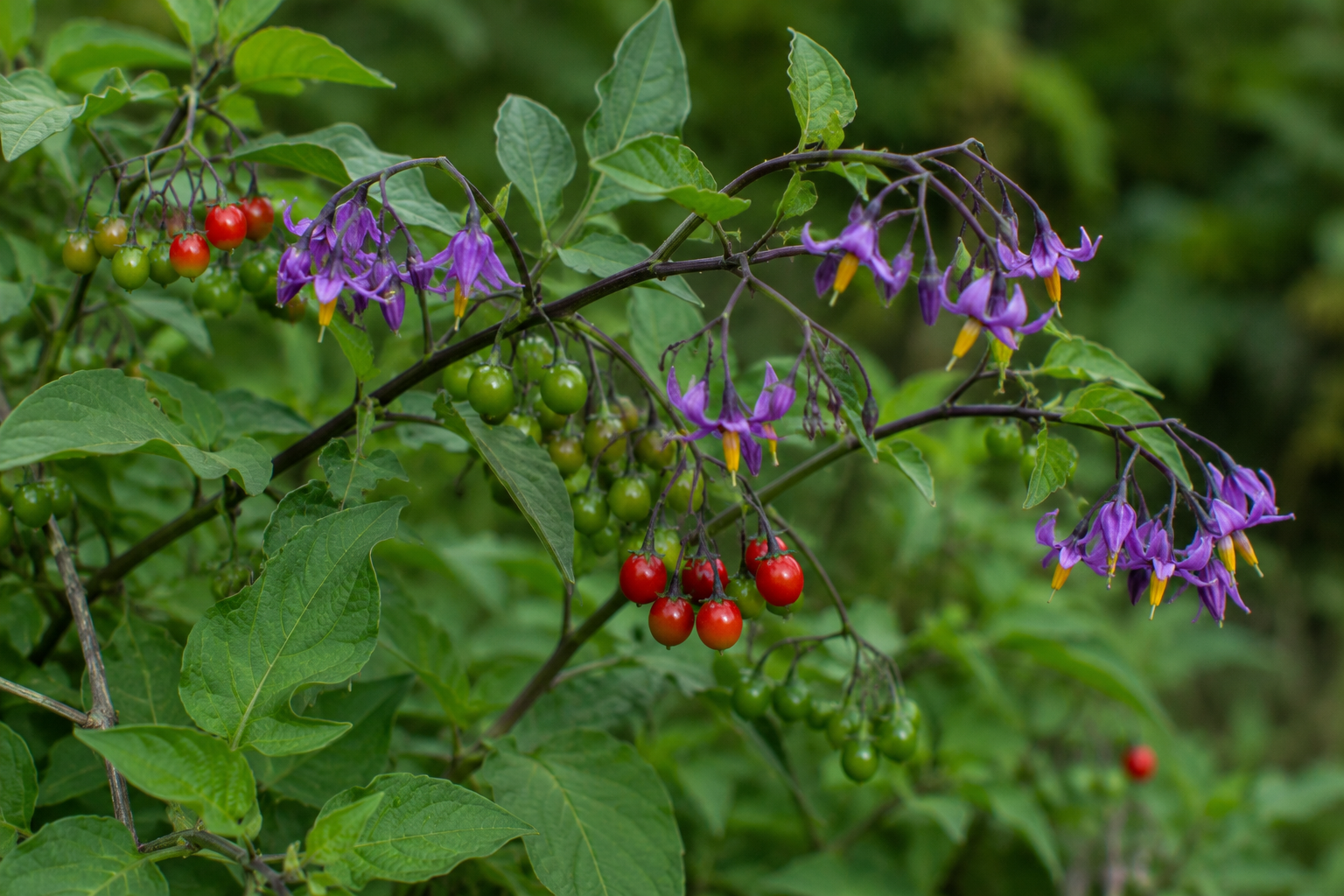
Bittersweet nightshade is a semi-woody, climbing perennial vine, native to Eurasia but now widely naturalized — and in several U.S. states, formally classified as invasive — across North America. Its star-shaped purple flowers, with backward-curving petals and a protruding bright yellow column of stamens, give way to clusters of berries that ripen through a strikingly photogenic progression from green to yellow to a glossy, vivid red.
That fall display is genuinely beautiful, which is precisely the problem. The ripe red berries look enticing, taste mildly sweet rather than unpleasantly bitter the way many toxic plant fruits do, and have been responsible for documented child poisonings specifically because nothing about their appearance signals danger the way a genuinely foul-tasting plant might. The lethal dose has been estimated at roughly 200 berries for an adult — a comparatively high threshold that places it well below belladonna's danger level — but children require far less to experience serious symptoms, and fatalities, while uncommon, are documented.
A Name Built on Sacred Disapproval
Among bittersweet nightshade's many regional folk names, a cluster of them point toward a darker, more specifically religious unease: Herbe de Judas and Herbe de Judée — "Judas's herb" and "Judea's herb" — names that tie the plant directly to betrayal and to the geography most associated, in European Christian tradition, with the story of Christ's crucifixion. It's a strikingly different kind of folkloric weight than the witch's-garden plants covered elsewhere in this archive — not tied to Hecate or flying ointments, but to a specific, loaded act of betrayal within Christian narrative.
Its more common English name, by contrast, carries an entirely different symbolic charge. "Bittersweet" became a recognized symbol of fidelity in medieval Christian art and in bridal wreath traditions, precisely because of its dual nature — bitter first, then unexpectedly sweet, read as a metaphor for love or devotion that endures something difficult before resolving into something good. Few plants in this entire archive carry two folk meanings as far apart as "Judas's herb" and "symbol of marital fidelity," attached to the exact same vine.
Felonwort: A Plant Named for What It Treated
One of bittersweet nightshade's stranger old names is "felonwort," or "felonwood" — not a reference to crime, but to an old medical term: a "felon" once referred to a painful infection or abscess, often around a fingertip or nail bed. The plant's stem was historically used externally, in poultices and salves, specifically to treat these infections, along with broader use for psoriasis and other skin conditions. Small internal doses, mixed carefully with other herbs, were also used historically as a diuretic or purgative.
This narrow, externally focused medicinal tradition has carried, cautiously, into the present. The stem is still considered the only part of the plant with any real safety margin, used in some traditional and modern herbal preparations for inflammatory skin conditions — though regulatory bodies in multiple countries explicitly advise against its use during pregnancy or in children, and the leaves and berries remain firmly off-limits in any context.
Toxic to Nearly Everyone, Except the Birds Who Need It
The toxin responsible for bittersweet nightshade's danger is primarily solanine, the same general class of compound found across much of the nightshade family, alongside a related compound called dulcamarine. Symptoms of poisoning include nausea, vomiting, diarrhea, and in more severe cases, convulsions and slowed breathing.
And once again, the same evolutionary pattern that shows up repeatedly across this archive's berry-producing toxic plants holds true here too: birds appear largely unaffected by the plant's toxins and eat the ripe berries freely, serving as the primary method of seed dispersal. The plant's survival strategy depends on exactly the same asymmetry seen in baneberry and several other entries in this collection — a toxin fine-tuned, evolutionarily, to deter the animals that would damage the plant without consuming it whole, while leaving its actual reproductive partners untouched.
Quick Answers
Is bittersweet nightshade the same as deadly nightshade? No — they're different, related species. Bittersweet nightshade (Solanum dulcamara) is considerably less toxic than deadly nightshade/belladonna (Atropa belladonna), though both should be treated as genuinely dangerous and kept away from children and pets.
How many bittersweet nightshade berries are dangerous? The estimated lethal dose for an adult is around 200 berries, though children can experience serious poisoning symptoms from far fewer, and fatalities in children have been documented.
Is bittersweet nightshade dangerous to touch? Handling the plant can cause skin irritation or dermatitis in some people, and gloves are recommended when working with it, though the greater danger by far is ingestion of the leaves or berries.
Is bittersweet nightshade invasive? Yes — it's native to Eurasia but has become naturalized and is classified as an invasive species in several U.S. states and parts of Canada.
Is any part of bittersweet nightshade actually used in modern medicine? The stem has a documented traditional and limited modern use for skin conditions like eczema and acne, generally considered possibly safe in topical preparations, while the leaves and berries remain unsafe in any context.
Why is it called "bittersweet" if it's poisonous? The name describes its actual taste — bitter at first, with a distinct lingering sweetness afterward — rather than referring metaphorically to beauty and danger the way some other toxic plant names do.