The Wild Hunt & the Spirits of Yule: What Rides the Winter Sky
The wind that comes in from the north in December is not ordinary wind.
This is something the people of Northern Europe knew for a very long time — not as metaphor, not as poetic flourish, but as a genuine article of belief embedded in the way they understood the world. The north was the direction of cold, of death, of the supernatural. The wind that came from there during the darkest weeks of the year carried things with it. Not always malevolent things. Not always things you could name. But things that were present in winter in a way they were not present in the warmth, that moved through the bare trees and the empty fields with a purposefulness that felt, to the people who huddled close to their fires, distinctly intentional.
The Wild Hunt is the name that Northern European tradition gave to this presence. But it is not the only name winter's spirits have been given. In the dark weeks around the solstice, the spirit world did not merely thin, as at Samhain — it moved. It arrived. It rode. And the people who lived beneath the winter sky developed, over centuries of encounter, a detailed and surprisingly consistent account of who was out there in the dark and what they wanted.
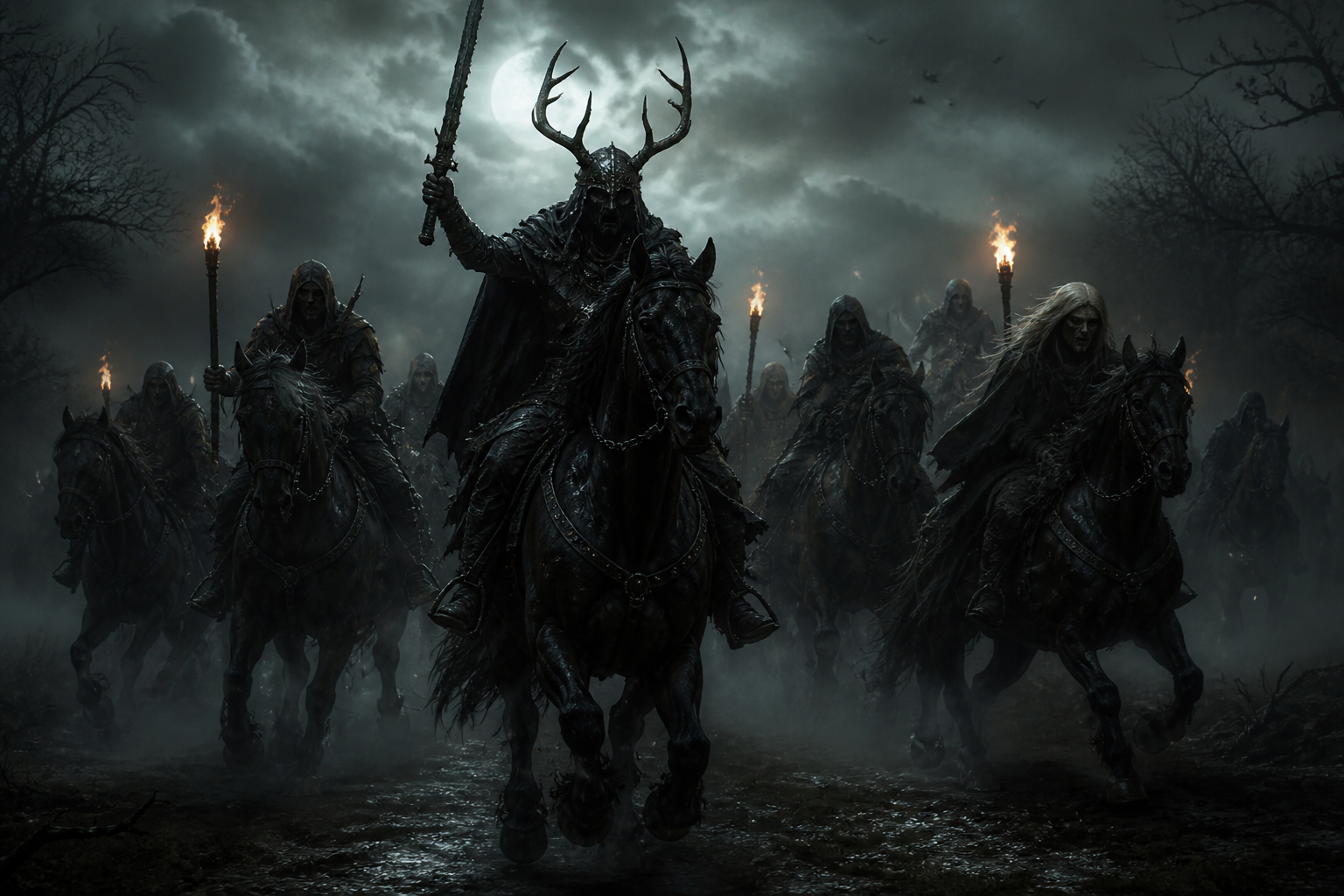
Odin and the Norse Wild Hunt
The Wild Hunt at Yule belongs, in its most fully realized form, to the Norse tradition — and at its center rides a figure who is anything but the cheerful gift-giver his distant descendant has become.
Odin — Allfather, god of wisdom, war, death, and magic — was understood to lead the Wild Hunt through the winter sky. He rode his eight-legged horse Sleipnir, the fastest of all horses, born of Loki's shapeshifting and capable of traveling between all nine worlds. He was accompanied by a host: the einherjar, the honored dead who trained in Valhalla for the final battle of Ragnarök; his wolves Geri and Freki; his ravens Huginn and Muninn. Some traditions add the valkyries, those fierce choosers of the slain, riding alongside their lord through the winter dark.
This was not the wholesome Norse mythology of popular imagination. Odin was not a comfortable god. He was the god who had hung himself from Yggdrasil for nine days to gain the knowledge of the runes. He was the god who traded one eye for a drink from the well of wisdom. He traveled in disguise through the human world, testing, measuring, collecting. He was associated with death — not merely the deaths of heroes but the quiet deaths of winter, the ones that came for the old and the weak and the unlucky when the cold settled in and the stores ran low.
"Odin did not lead the Hunt because he enjoyed riding. He led it because winter was his season — the season of the dead, of wisdom purchased at enormous cost, of the long dark that preceded the return of light. The Hunt was not chaos. It was purpose. His purpose."
The Hunt rode primarily through the twelve nights of Yule — the period from approximately December 21st to January 1st, the liminal time between the solstice and the new year, when the old year was dying and the new one had not yet fully arrived. During these nights, the veil between the living world and the dead was understood to be at its most permeable. The sound of the Hunt passing overhead — the howling of spectral hounds, the thunder of hooves above the clouds, the horn calls that sounded like no earthly horn — was heard in the winter storms, in the shrieking of wind through bare trees, in the sounds that every northern winter night produces and that the human ear, pressed against the inside of a warm wall, could choose to hear or not hear.
Most people chose not to look. The advice in virtually every tradition that records the Wild Hunt is consistent: stay inside, stay close to the fire, do not look up at the sky, do not call out, do not stand at crossroads, and above all do not follow the Hunt even if some impulse tells you to. Those who followed were not necessarily harmed. But they were taken, one way or another, and did not always come back the same.
Imagine a farmstead in Norway sometime in the tenth century, deep in the twelve nights of Yule. The family has been inside since dark, which came mid-afternoon. The fire is high. Someone is telling a story, though their voice has gotten quieter as the night deepened. Outside, the wind has been building for an hour — not ordinary wind. This wind has a sound in it that is almost voices. The youngest child has fallen asleep against their mother and the older children are very still, listening. The father banks the fire higher. Nobody goes to the window. They all know what is passing overhead. They know to let it pass.
Frau Perchta: The Belly-Ripper of Yule
If Odin is the most famous of the Yule spirit riders, Frau Perchta is perhaps the most feared — and the least remembered in popular culture, which has done her a considerable disservice by obscuring just how strange and significant she was.
Perchta — known by many names across the Alpine and Southern Germanic regions: Berchta, Berta, Percht — was a spirit associated with the twelve nights of Yule, the period between Christmas and Epiphany (January 6th) in the Christianized calendar. She was understood to walk through the houses of the region during this liminal time, inspecting the work of the household.
Her particular domain was spinning. During the twelve nights, tradition held that no spinning should be done — the spindles should be empty, the flax put away, the work of the year properly concluded before the new one began. Perchta came to check. If she found work left unfinished, if she found a household that had been idle when it should have worked or working when it should have rested, she acted on this knowledge with a thoroughness that the folklore records with unnerving specificity.
For the obedient — those who had worked well through the year, who had kept the proper customs, who had finished their spinning before the twelve nights began — Perchta was a gift-giver, leaving silver coins in shoes or bowls. For the disobedient, she was something considerably more alarming: she would slit open the belly of the offending person, remove whatever they had eaten for supper, and replace it with straw and stones before sewing them back up. The German sources on this are not squeamish. They mean it literally.
"Perchta was not a metaphor for diligence. She was the supernatural enforcement of the social contract — the spirit who ensured that the agreements a community made about work, rest, and proper observance were not merely suggestions."
She appeared in two forms: the White Perchta, beautiful, associated with blessings and gifts, the aspect that rewarded the obedient; and the Black Perchta, iron-beaked, iron-toothed, dragging behind her a retinue of the souls of unbaptized children. The dual nature was not contradictory — it was instructive. The same figure who rewarded virtue could punish transgression. The same night that brought gifts could bring worse things. Whether you encountered the white aspect or the black one depended entirely on how you had lived.
Modern iterations of Perchta often appear in Austrian and Bavarian Krampus festivals, where the dark winter spirits of the Alpine tradition are celebrated in elaborate costumed processions. The Perchtenlauf — the running of the Perchten — preserves in folk custom the old understanding that winter's spirits were not gentle, that they walked among the living during the twelve nights, and that the appropriate response was a mixture of appeasement and demonstration: we know you are here. We are not afraid. We have done what we were supposed to do.
The Yule Lads and the Icelandic Tradition
Iceland produced its own remarkable winter spirit tradition — one that is both thoroughly Norse in its roots and distinctly, almost delightfully, Icelandic in its character.
The Yule Lads, known in Icelandic as Jólasveinar, are thirteen troll-like figures who descend from the mountains in the thirteen days before Christmas, arriving one by one to torment Icelandic households in ways that are oddly specific and oddly petty. There is Stekkjastaur, the Sheep-Cote Clod, who harasses sheep. Giljagaur, the Gully Gawk, who hides in gullies to steal milk. Stúfur, the Stubby, who steals pans to eat their crusted remains. Þvörusleikir, the Spoon-Licker, who steals wooden spoons. And so on, through thirteen increasingly specific figures, each with their own particular domain of mischief.
Their mother is Grýla — an enormous, terrifying giantess who has been eating disobedient children since at least the thirteenth century, when she is first mentioned in written sources. Their companion is the Yule Cat, Jólakötturinn, a massive and ferocious feline that prowls the snowy landscape during Yule and eats those who have not received new clothing before Christmas Eve. The Yule Cat's origin in the tradition of incentivizing workers to finish their autumn wool processing before winter — those who worked hard received new clothes; those who did not might not — links it to the same logic as Perchta's spinning checks.
What is remarkable about the Yule Lads is how deeply specific they are. Someone, at some point, looked at the winter dark and saw not a single terrifying presence but thirteen distinct, petty, almost comic ones — each with a name, a behavior, a particular category of household mischief they preferred. This specificity is the signature of genuine folk belief: the supernatural, when it is truly believed in, becomes particular. It has habits. You know what it will do, and when, and to whom. The Yule Lads feel true in this way. Too specific to be invented.
Kallikantzaroi: The Goblins of the Twelve Days
The Wild Hunt and its companions are primarily Northern European, but the concept of dangerous spirits active during the twelve days of winter is not exclusively so. The Greek tradition offers the Kallikantzaroi — underground goblins who, for most of the year, spend their time underground sawing at the World Tree that supports the earth. At the winter solstice, they surface to cause mischief among the living during the twelve days that correspond to the old twelve-night Yule period. When Christmas (or Epiphany, depending on the tradition) arrives and the world is blessed with holy water, they are driven back underground — only to resume their sawing until next year.
The Kallikantzaroi are mischievous rather than deadly: they enter houses through the chimney, put out fires, spoil food, ride people's backs through the night. Protection against them was practical and specific: keeping a fire burning through the twelve nights (fire again, always fire), burning old shoes or incense to drive away the smell they found offensive, and hanging a colander at the door — the Kallikantzaroi, being compelled to count any holes they found, would spend all night counting the colander's holes and be caught by dawn before they could enter.
"Across the northern hemisphere, from Iceland to Greece, the twelve days of winter were understood as a time when the ordinary rules were suspended and the supernatural moved freely among the living. The specific spirits varied. The logic was the same: something is out there in the dark, and wisdom lies in knowing what it is."
What the Winter Spirits Were For
The spirits of Yule — Odin's Hunt, Perchta, the Yule Lads, the Kallikantzaroi — are not merely monsters invented to frighten children into good behavior, though some of them served that function too. They are something more interesting: they are the winter dark given character, given intent, given the dignity of being treated as real.
To live in a pre-industrial northern winter was to live with genuine danger, genuine darkness, genuine uncertainty about survival. The people who developed these traditions were not inventing threats for the pleasure of frightening themselves. They were acknowledging that the dark was real and that something had to be done with that reality — had to be named, had to be given a relationship to the human world, had to be understood rather than simply endured.
The Wild Hunt rides through December because December is when the dark is real. Perchta inspects the household because the household needs inspecting — because the agreements a community makes about how to live together need supernatural enforcement when human enforcement is insufficient. The Yule Lads' pettiness is almost reassuring: if the worst the winter spirits do is steal your spoons, you can survive them.
The fire you keep burning through the twelve nights of Yule is not only for warmth. It is a declaration to everything that moves in the winter sky: this household is lit. This household is awake. Whatever rides the dark tonight — ride past.
Keep the fire high. Set the colander at the door if you must. Leave an offering at the threshold for whatever passes.
The twelve nights are long. But they end. They always end.