Evergreens, Wreaths & the Living Symbols of Yule
In the depths of winter, when everything has gone grey and bare and the trees stand stripped of everything they spent the warm months building, the evergreen does something remarkable: it refuses.
It does not drop its needles. It does not retreat into dormancy. It holds its color through the worst of the cold, staying green while everything around it surrenders to the season. To a people who watched the natural world with the intimate attention that survival required — who read the landscape the way we read text, looking for information, for signs, for meaning — this refusal was not merely botanical. It was a statement. Life persisting where life had no apparent reason to persist.
This is why the evergreen became the central plant symbol of midwinter across so many cultures and so many centuries. Not because someone decided it looked festive. Because it demonstrated something that the darkest days most needed demonstrating: that living through the dark was possible. That green was still in the world, even when the world had apparently abandoned it.
The evergreens hung in the halls at Yule were not decoration. They were proof.
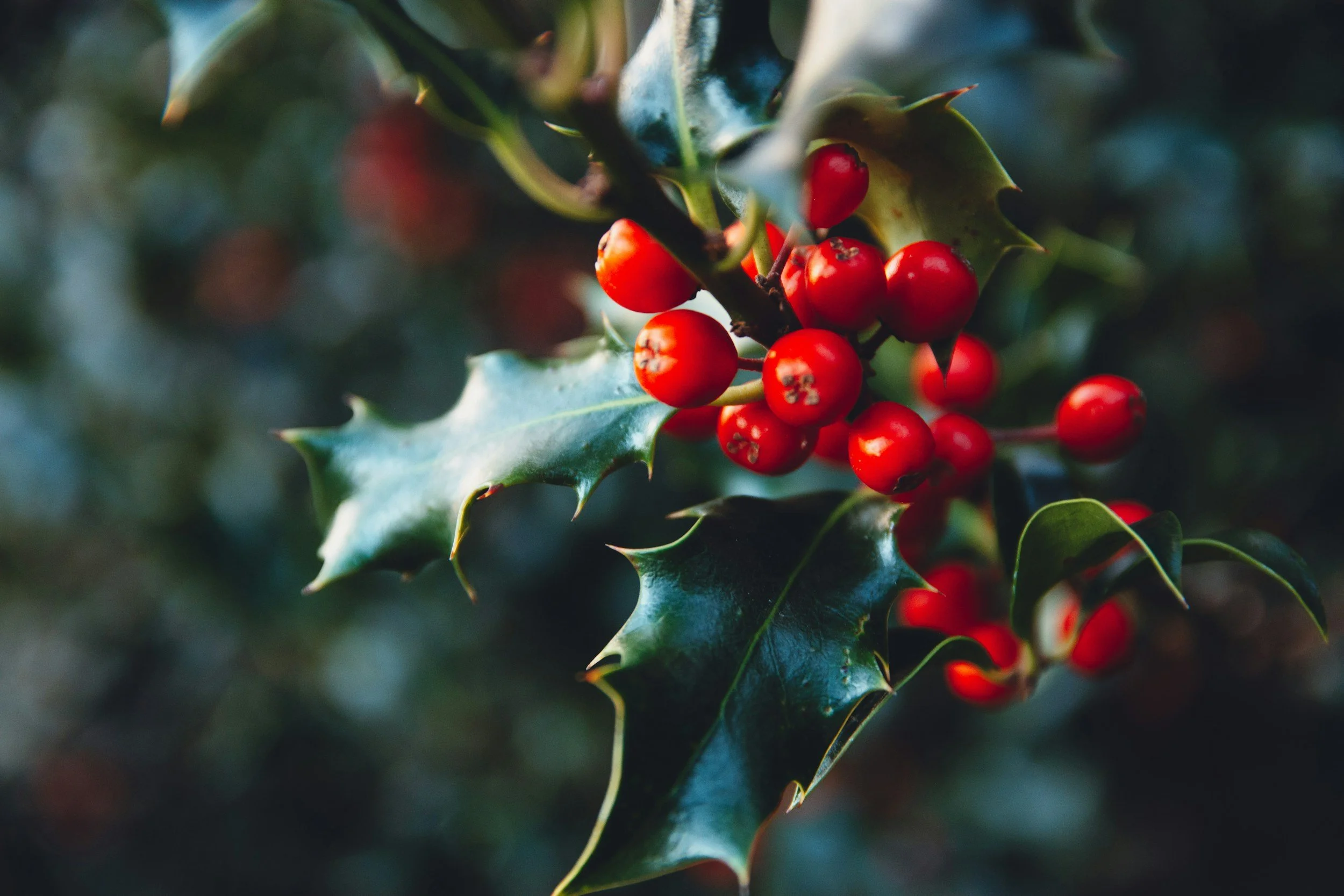
Holly: The King of the Waning Year
Of all the winter plants, holly carries the oldest mythological weight — and the most complicated story.
Holly is one of only a handful of native British and Irish trees that holds its leaves through winter. Its red berries appear precisely when the landscape is most bare, providing color against grey sky and frost-white ground that is visually arresting even to a modern eye. To the ancient eye, trained to read the natural world as a system of meaning, the holly's winter fruiting was significant: it bore fruit when nothing else would, feeding birds through the months when other food had vanished. It sustained life through the dark.
In Celtic mythology, the year was divided between the Oak King and the Holly King — two aspects of the divine masculine locked in eternal alternation. The Oak King ruled the waxing year, from the winter solstice to the summer solstice, when light and growth dominated. The Holly King ruled the waning year, from midsummer to midwinter, the time of diminishing light and increasing cold. At each solstice, they fought — the defeated king dying to be reborn as his own successor, the wheel turning, neither ever permanently victorious.
"The Holly King did not lose at Yule. He retreated. He had done what he was meant to do — carried the world through the long dark — and now he stepped aside, as he always did, to let the light return. His was not a defeat but a completion."
This mythology, reconstructed and elaborated by twentieth-century scholars including Robert Graves and later neo-pagan writers, has uncertain direct connections to specific ancient sources. But the sacred status of holly in Celtic tradition is well-documented. The druids were recorded keeping holly indoors through winter, its greenery a protection and a link to the life force of the natural world during the months when the outdoors offered little of either. Holly was understood to repel lightning, to ward off malevolent spirits, to offer protection to the household that kept it.
The protective folklore of holly is remarkably consistent across British and Irish sources: planted near a house, it guards against witchcraft. Hung above doorways, it keeps bad luck from entering. The prickled varieties were considered more powerfully protective than the smooth-leaved ones — the thorns themselves carrying warding power, perhaps because they mirrored the botanical defenses of a plant that had refused to soften itself for the winter.
Holly in the Christian tradition became a symbol of the passion — its prickled leaves representing the crown of thorns, its red berries representing blood. This is part of why it survived so successfully into the post-pagan winter landscape: it could carry two mythologies at once, the old and the new, without contradiction. The plant that protected the household at Yule became the plant that decorated the church at Christmas. The meaning shifted, but the plant remained.
Ivy: The Shadow's Plant
Holly rarely appears alone in the winter iconography of the British Isles. Its traditional companion is ivy — and the pairing is older and stranger than the cheerful Christmas carol suggests.
Where holly is upright, martial, protective — a plant that bears weapons — ivy is creeping, clinging, patient. It grows over and through things. It covers ruins. It outlasts the structures it climbs, sometimes pulling them apart by the sheer insistence of its growth. In the old plant symbolism, ivy was associated with the feminine principle, with the underworld, with the cyclical nature of death and return. It was the shadow companion to holly's light.
Picture a churchyard in northern England in December, sometime in the fourteenth century. The church is stone and old. Around its base, ivy has grown for so long that it has become structural — the stone and the plant are nearly indistinguishable. Inside, someone has hung a spray of holly over the door. The berries are bright against the grey. Outside, the ivy moves very slightly in a wind that has no obvious source. The two plants have been growing in each other's company here for longer than anyone in the parish can remember. They are not the same thing. But they need each other.
The pairing of holly and ivy in medieval English carols — the most famous being The Holly and the Ivy, which dates at least to the fifteenth century though its roots are likely older — preserves something of this older dual symbolism even in its Christianized form. The carol ostensibly gives all the symbolic power to holly (associated with Christ) and relegates ivy to a secondary role. But ivy's persistence in the pairing at all suggests that the older understanding of the two plants as complementary forces — masculine and feminine, sun and shadow, protection and growth — had not entirely faded.
In Celtic tree lore, ivy was associated with the Ogham letter Gort and with themes of wandering, persistence, and the seeking of spiritual truth through difficult terrain. The plant that grows through obstacles rather than around them was understood as a model for a particular kind of spiritual tenacity — not the holly's bold defense but the ivy's patient insistence.
Mistletoe: The Plant That Lives Between
Mistletoe occupies a singular position in the symbolic world of Yule. It is, botanically speaking, a parasite — a hemiparasite, to be precise, capable of some photosynthesis but dependent on its host tree for water and minerals. It grows in the branches of trees, high above the ground, never touching the earth. It is neither fully of the tree it inhabits nor independent of it. It exists, in the most literal botanical sense, between.
For the ancient Celts, this in-between status was precisely the source of mistletoe's power.
The druids held mistletoe — particularly mistletoe growing on oak trees, which is relatively rare and therefore especially significant — in the highest regard. The Roman writer Pliny the Elder recorded in the first century CE a druidic ceremony of mistletoe harvesting: on the sixth night of the moon, a white-robed druid climbed the oak and cut the mistletoe with a golden sickle, catching it in a white cloth so that it never touched the ground. Two white bulls were then sacrificed. The ceremony was precise, elaborate, and clearly understood as a moment of extraordinary power.
"Mistletoe that had never touched the earth held the power of both worlds — the world of the tree above and the world below — without belonging entirely to either. It was, in the Celtic understanding, the most liminal of plants. Which made it the most powerful."
Mistletoe was understood to cure disease, to protect against poison, to ensure fertility, and to promote peace — which may be the origin of the custom of enemies laying down their arms when they met beneath it. From the peace truce comes the kissing custom: a place of peace became a place of goodwill, of affection, of connection between people who might otherwise be at odds. The plant that lived between worlds became the plant that brought people together across the distances between them.
In Norse mythology, mistletoe carries a darker story. It was the plant that killed Baldr — the most beloved of the gods, the bright one, the beautiful — when Loki fashioned a dart from its wood and guided the blind god Höðr's hand. Mistletoe had been overlooked when Frigg extracted promises from every living thing that it would not harm her son. It seemed too young, too small, too insignificant to matter. This was the lesson Loki exploited. The thing that seems too small to matter is sometimes the only thing that can.
Baldr's death plunged the Norse cosmos into grief. His resurrection — which in some versions does not occur until after Ragnarök, the end of the world — makes him a solar figure in the Norse tradition: the bright god who dies and will return, whose death is the darkness of winter and whose return is the light of spring.
The Wreath: The Circle That Has No End
✦ ✦ ✦
The wreath is perhaps the most conceptually elegant of all Yule's symbols — and the one whose original meaning is most completely preserved in its form.
A circle has no beginning and no end. In the context of the winter solstice, this is the essential message: the wheel turns, always, without stopping. The darkness is real and the darkness is deep and the darkness is not permanent. The circle makes this visible. It is the year in its entirety, held in your hands, a reminder that the low point of the wheel is still part of the wheel, that the turning has already begun.
Wreaths made of evergreens — holly, ivy, pine, juniper, rosemary — preserved the green of living plants through the dead of winter, bringing life indoors when the outdoor world had apparently abandoned it. They were hung at the entrance to homes: at the door, the threshold, the liminal point where the interior world met the exterior one. Protection and welcome simultaneously — the living wreath saying to whatever approached: there is life here. There is green here. The dark has not won this house.
The addition of candles to the wreath — the Advent wreath in Christian tradition, four candles lit progressively through the weeks before Christmas — has pre-Christian roots in the practice of lighting fires at the threshold to welcome the returning sun and to ward the home through the darkest weeks. Each candle added was another declaration of increasing light. By the time the solstice arrived, the wreath blazed.
For contemporary practitioners, the wreath is one of the simplest and most complete Yule symbols to work with precisely because its meaning is entirely in its form. You do not need to explain the circle. You do not need to decode the evergreen. The wreath says what it has always said, as clearly now as it did when the first midwinter hands bound the first winter branches together and hung them at a door.
Pine, Fir, and the World Tree
The bringing of an entire tree indoors at midwinter — the Christmas tree in its modern form — is often attributed to German Lutheran tradition of the sixteenth century and to the particular enthusiasm of Prince Albert, who popularized the practice in Victorian Britain. These origins are real. But the practice of bringing living tree branches indoors at midwinter, and the reverence for the great evergreen trees of the northern forest, runs considerably deeper.
The Norse World Tree, Yggdrasil, is described as an ash in most sources — but the concept of a great cosmic tree connecting the nine worlds, evergreen and eternal, whose roots ran into the realm of the dead and whose branches reached into the realm of the gods, permeated Norse and Germanic cosmology. The decorated tree at midwinter may preserve, in domesticated form, something of this older reverence — the great tree brought small, the cosmic made manageable, the axis mundi carried indoors to stand at the center of the household for the twelve nights of Yule.
Pine and fir trees, specifically, held particular significance in the winter traditions of Northern Europe. Their scent — resinous, sharp, clean — was associated with purification. Their cones, dropped at the end of the growing season but carrying within them the seeds of future trees, made them symbols of regeneration and continuity. The cone contains the tree. The darkest point of the year contains the seed of its own return.
"When you bring an evergreen indoors at midwinter, you are carrying a piece of the forest's refusal into your home. The tree that would not go bare. The green that stayed green. Set it at the center of your space and let it remind you what you already know: life is stubborn. Even in the dark, something is still growing."
The evergreens are still in the world. They held their color through everything the season threw at them.
That is the oldest Yule message. That is still the one worth hearing.