Brigid, Fire & Sacred Flame: The Goddess Who Became a Saint and Never Stopped Being a Goddess
There is a flame that has been burning in Kildare, Ireland, for over a thousand years.
It was extinguished once — by a bishop in the thirteenth century who found the practice of women tending a perpetual fire suspiciously pagan, which was, of course, because it was. The flame had been burning since before the monastery existed, tended by the priestesses of a goddess, and when the monastery absorbed the sacred site, the nuns simply continued what the priestesses had been doing. Nineteen women, each tending the flame for one day in rotation. On the twentieth day, the flame tended itself — kept by the goddess whose fire it had always been.
The bishop put it out. The nuns relit it, and eventually the practice died entirely, swallowed by the reformations and suppressions of the centuries that followed.
In 1993, the Brigidine Sisters relit the flame in Kildare's town square.
It is still burning.
This is who Brigid is. She does not extinguish. She persists — through conversion, suppression, reformulation, absorption — the way a flame persists through wind, bending but not going out. She is perhaps the most complete example in the Celtic world of a goddess so powerful, so deeply embedded in the lives of the people who loved her, that no theological shift could dislodge her. The Church did not eliminate Brigid. It put her name on a saint and kept her feast day and let her keep her fire, because to do otherwise was to lose the people entirely.
She is older than the Church. She is older than the name Brigid, probably, though we have no older name for her. She is the fire at the center of the home, the first warmth after the longest cold, the forge that makes the useful thing, the word that makes the beautiful thing. She is Imbolc, which means she is the first breath of spring — and everything about her reflects that: the persistence of life before it should be possible, the warmth before the warmth has arrived.
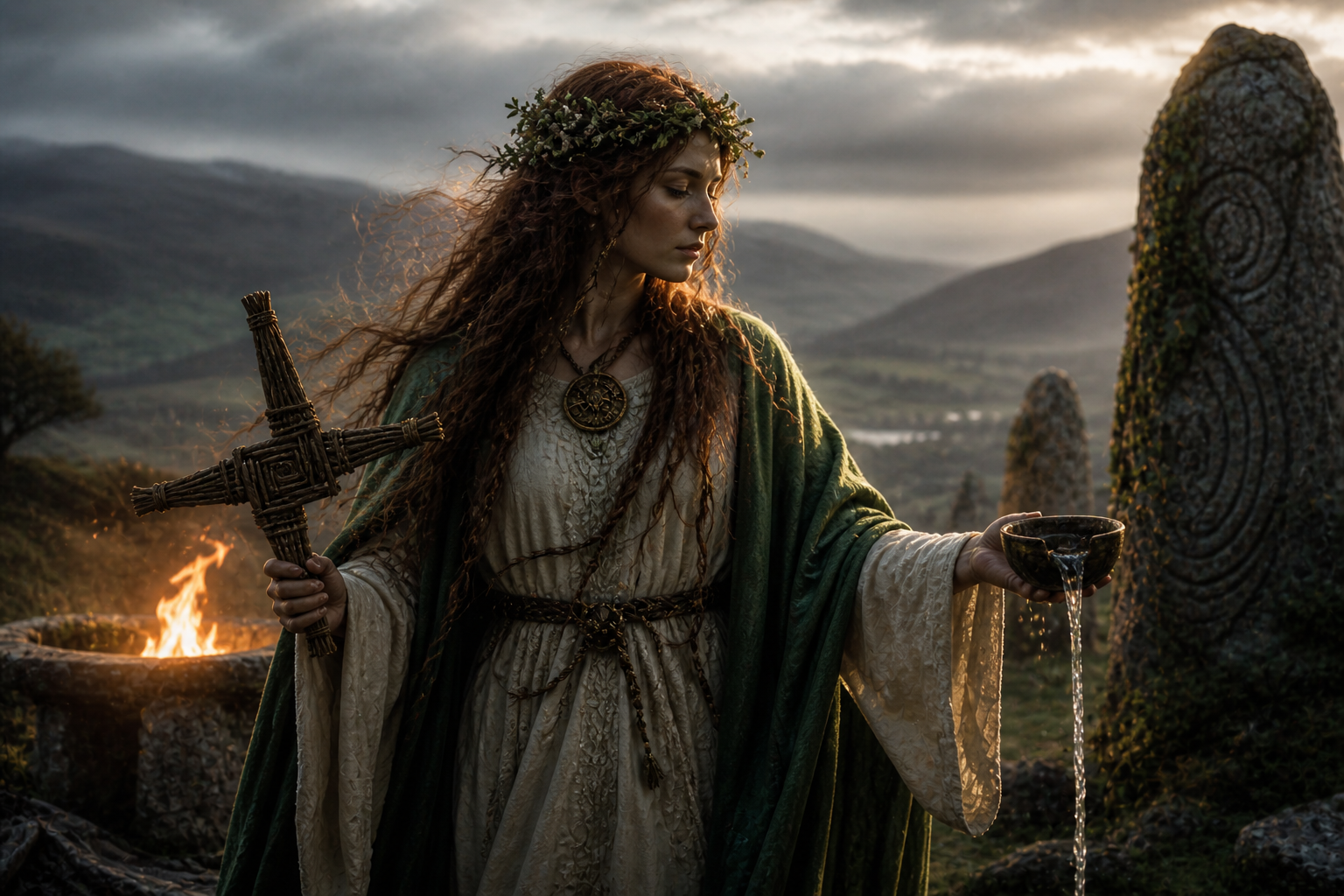
The Goddess: Triple Fire
Brigid the goddess was understood in Irish tradition as a triple figure — not three separate deities but three aspects of a single power, each governing a distinct domain of fire.
The first was the fire of the hearth and healing: Brigid as the keeper of the home flame, the goddess of medicine and the sacred wells whose waters cured what ordinary medicine could not. Her holy wells — still present across Ireland and much of Britain, still visited, still hung with offerings — were understood as her tears fallen to earth, each one containing some fraction of her healing power. The tradition of leaving offerings at Brigid's wells, tying strips of cloth to the trees that overhang them, is continuous from pre-Christian practice to the present day. The cloth is called a clootie in the Scottish tradition, a rag or rib in the Irish — and the logic is the same across centuries: you leave something of yourself with the sacred water, and in exchange you carry something of the healing away.
The second was the fire of the forge: Brigid as patroness of smithcraft, of metalworking, of the transformation of raw material into useful and beautiful things through the application of intense heat. In a culture where the blacksmith held a position both economically essential and slightly uncanny — working with fire and metal, producing the tools that shaped daily life, the weapons that determined survival — the patronage of a goddess connected metalworking to sacred power. The smith's fire was not merely industrial. It was ritual. And Brigid stood behind it.
"The forge and the hearth are the same fire. The fire that warms and the fire that transforms — Brigid held both, which is to say she held the full range of what fire does: it comforts and it changes, it preserves and it destroys, it illuminates what was hidden in the dark."
The third was the fire of inspiration: Brigid as the patroness of poetry, of the bardic arts, of the imbas — the divine creative fire that descended on the poet and allowed them to speak true things in beautiful language. In Celtic culture, the poet was not a decorative figure. The filid — the professional poets of early Irish society — held legal status equivalent to that of a noble, could travel freely between territories in conflict, and were understood to wield genuine power through their words. A poet's praise could elevate a king; a poet's satire could raise blisters on their skin. Brigid's patronage of this power connected creativity to the sacred, made the act of making something beautiful an act of devotion.
These three fires are not unrelated. They are expressions of the same principle: the transformative power of intense energy applied with skill and intention. Heat melts metal. Heat heals. Heat illuminates the mind. Brigid is what happens when you bring the fire close enough to change something.
The Eternal Flame at Kildare
The monastery at Kildare — Cill Dara, "the church of the oak" — was built on a site that had been sacred long before it became Christian. The oak itself was sacred in Celtic tradition, the king of the forest, the tree most likely to be struck by lightning and therefore most associated with divine fire from above. A sacred oak grove — a nemeton, one of the open-air temples of the druids — stood at the site that became Kildare. The flame that burned there was old before the nuns arrived to tend it.
In the tradition that persisted into the medieval period, nineteen nuns of St. Brigid's monastery tended the eternal flame on a rotating schedule — each woman responsible for the fire for one full day before passing the duty to the next. On the twentieth day, the fire was left untended, kept alive by Brigid herself. The structure of this rotation — nineteen human women and one divine presence, completing a cycle of twenty — has its own internal mathematics that scholars have debated, some connecting it to lunar cycles, others to older druidic practice, still others to the specific numerology of the monastery's community size.
Picture the monastery at Kildare sometime in the ninth century. It is February, Brigid's season. The fire burns in its enclosure — a circular hedge, the flamula Brigidae, within which no man was permitted to enter. The nun on duty has been with the fire since dawn. It is a specific kind of attendance: not passive, not decorative. The fire requires feeding, requires adjustment, requires the knowledge of how much fuel and how much air and how much attention to keep it burning at the precise level that it has burned for — the nuns would say — always. There is a continuity here that predates the monastery, predates the saint, predates the name. The fire does not know what century it is. It only knows to burn.
The flame at Kildare was understood as Brigid's own fire — her presence made perpetual, her warmth made available to anyone who came to the monastery seeking healing, seeking blessing, seeking the specific grace that Brigid carried. Pilgrims came from across Ireland and beyond. The monastery grew wealthy and influential. And through all of it, the fire burned.
Until the bishop extinguished it. And then, because Brigid cannot be extinguished, it burned again.
The Saint: Absorption Without Erasure
St. Brigid of Kildare is one of three patron saints of Ireland — alongside Patrick and Columba — and her feast day falls on February 1st, the date of Imbolc. This is not coincidence. The Church assigned the feast day it did because February 1st already belonged to Brigid, and attempting to place the saint on any other date would have meant competing with a festival that an entire people kept with or without theological sanction.
The historical St. Brigid is elusive. She is said to have been born around 450 CE and to have died around 525 CE — early enough that she would have known, or known of, St. Patrick. The biographical accounts of her life are extraordinary to the point of obvious mythologization: she turns water into ale, she hangs her wet cloak on a sunbeam, she gives away so much of her father's wealth to the poor that he tries to sell her and she responds by giving away the sword he intended to use in the transaction. These are not the stories of a historical woman. They are the stories of a goddess wearing a saint's name, performing miracles that map onto the domains she had always governed — generosity, transformation, the disregarding of ordinary limits.
"The Church gave her a biography. The people gave her a fire. The biography has become scholarship. The fire is still burning."
What is striking about the Christianization of Brigid is how little of her actual character was changed in the process. She remained the goddess of the hearth and the forge and the creative word — those domains simply became the patronage of a saint rather than the portfolio of a goddess. The holy wells remained holy. The eternal flame remained burning. The feast day remained February 1st. The Brigid's cross remained in the thatch above the door. The form changed. The substance persisted.
The Brigid's Cross: Woven Protection
The Brigid's cross — a four-armed equal cross woven from rushes, distinct from the Christian cross in its equal proportions and its material — is made on Imbolc eve and hung above the door of the home to protect the household for the coming year. The previous year's cross is burned, or buried, or placed in the thatch — depending on regional tradition — and the new one takes its place.
The origin story of the first Brigid's cross varies by telling. In the most common version, Brigid sits at the bedside of a dying chieftain — sometimes identified as her father, sometimes as a pagan lord she was attempting to convert — and weaves the cross from rushes on the floor as she explains the story of Christ's death. The chieftain, moved by her explanation or by the object itself, asks to be baptized before he dies. The cross was born from an act of storytelling at the threshold of death — which is very Brigid, who has always lived at thresholds.
The four-armed form has pre-Christian precedents: equal-armed crosses appear in the archaeological record of Iron Age Ireland and Britain, associated with solar symbolism, with the four directions, with the four seasons of the wheel. The Brigid's cross may be a Christian frame placed over an older protective symbol — or the two traditions may have always lived comfortably alongside each other, the way Brigid herself has always lived comfortably in multiple frameworks at once.
The Brat Bríde: The Mantle That Heals
✦ ✦ ✦
On Imbolc eve, across Ireland and parts of Scotland, a cloth was placed on the windowsill or the doorstep before dark — left outside overnight so that Brigid could touch it as she made her rounds of the countryside. This cloth, called the Brat Bríde — Brigid's mantle — was understood to absorb some of Brigid's healing power in its contact with her passing, and to retain that power for the coming year.
The Brat could be any cloth — a strip of linen, a ribbon, a piece of wool. What mattered was the leaving of it, the deliberate exposure to the night of Brigid's feast, the invitation implicit in placing it at the threshold: she is welcome here. Let her pass close. Let some of what she carries remain when she moves on.
The cloths were kept through the year and used when they were needed: pressed against a sick child's forehead, bound around an injured wrist, held by a woman in labor. The cloth's healing power was Brigid's healing power, stored and made available — a portable version of the holy well, the sacred flame carried into the domestic sphere.
This practice is among the most durable of Imbolc's traditions, surviving in living memory in parts of rural Ireland and appearing in oral history collections from the early twentieth century. People who kept the Brat Bríde as children remember their grandmothers placing the cloth outside, retrieving it in the morning with the particular care reserved for sacred objects. The goddess was not abstract to these people. She passed by every February 1st, and the cloth that had touched the hem of her mantle was real.
Brigid in Practice: The Living Flame
For contemporary practitioners, Brigid is one of the most accessible of the Celtic deities — accessible not because she is simple but because she is present. She has not retreated into mythology. She has remained, through every historical disruption, close to the daily human things she has always governed: the warmth of home, the work of the hands, the word that comes when you need it, the healing that arrives when the medicine runs out.
To honor Brigid at Imbolc does not require elaborate ritual. Light a candle at dawn on February 1st — or at dusk on the eve, which is when the festival begins in the Celtic reckoning. Leave a cloth outside overnight. Weave a Brigid's cross from any plant material available to you and hang it somewhere that matters. Tend something: a flame, a creative project, a relationship, a skill. These are Brigid's domains. Attention paid to them, especially in her season, is attention paid to her.
The eternal flame at Kildare is still burning.
You can keep yours burning too.