Sun, Fire & Solar Power: The Gods of the Solstice and the Architecture of the Longest Day
The sun at the solstice is not the sun of any other day.
It is higher. It stays longer. It rises in a position so far north of its ordinary path that anyone who has watched the sky through the year knows immediately that something extraordinary is happening — that the sun has reached a place it will not return to for another twelve months, a point of such extreme inclination that the earth itself seems to be straining toward it, offering itself upward into the light as completely as it can. At the summer solstice, the northern hemisphere is not merely tilted toward the sun. It is pressing its face against it.
The ancient world noticed this. The ancient world built monuments to it, named gods for it, lit fires on the hilltops to mirror it, organized entire agricultural and ritual calendars around the single question of what the sun was doing and what that meant for the people who depended on it. The solar mythologies of the world are not primitive attempts to explain a phenomenon that science has since demystified. They are sophisticated responses to the most important single fact of life in the northern hemisphere: the sun gives everything, and at midsummer it gives its most. To name that power, to celebrate it, to build a relationship with it through ritual and story — this was not superstition. This was attention paid at the appropriate scale.
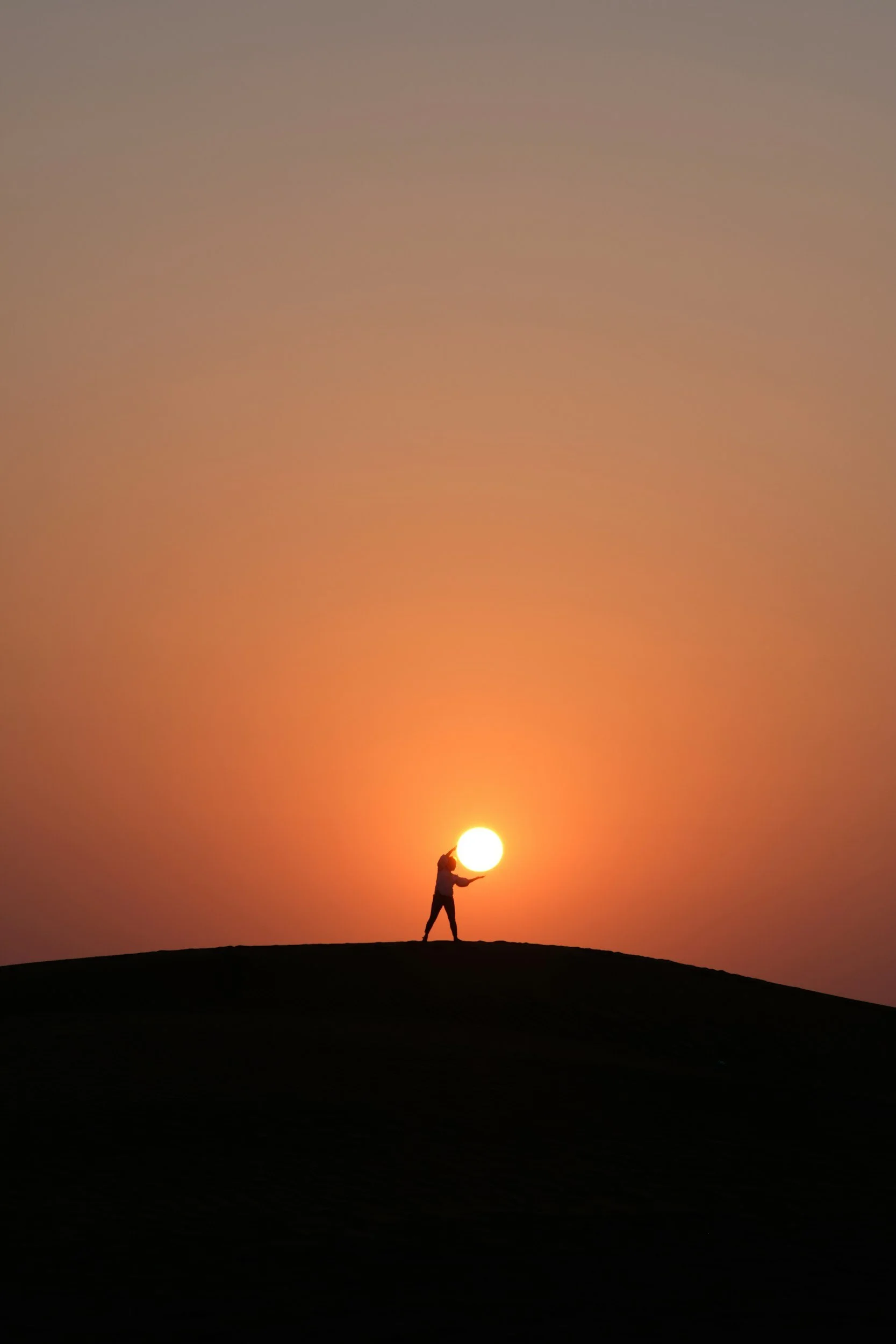
Lugh of the Long Arm: The Celtic Solar King
The Celtic solar tradition at midsummer centers on a figure who does not always appear in simplified accounts of Litha but who belongs to it as completely as any deity belongs to any festival: Lugh — Lugh Lámhfhada, Lugh of the Long Arm, the Shining One, the master of all skills.
Lugh is one of the great gods of the Irish mythological tradition, a member of the Tuatha Dé Danann whose arrival among the divine community was so extraordinary that the gatekeeper of the divine hall initially refused him entry — not because he lacked credentials but because every skill he claimed was already possessed by someone inside. Carpenter? We have one. Smith? We have one. Champion, harper, poet, sorcerer, healer, cup-bearer? All present. And Lugh's answer to this litany of refusals became his definition: do you have one who possesses all of these things at once? The door opened.
Lugh's solar associations are not always explicitly stated in the oldest sources but are woven through everything he touches. His name connects to the Proto-Celtic *lugus, associated with light, with the gleaming, with the quality of radiance. His epithet — the Long Arm — refers both to his skill with the spear and to the reach of sunlight, which touches everything at the height of summer in a way it does not at any other time. His festival, Lughnasadh, falls at the first of August — the beginning of the harvest — and is explicitly named for him, but his power is most fully felt at midsummer, when the light his name embodies is at its absolute peak.
"Lugh does not merely carry light. He is composed of it. The sun at midsummer is not an object he governs from a distance — it is the expression of what he is, the world's most complete rendering of the quality that defines him. At the solstice, the sky is Lugh's self-portrait."
In the mythological texts, Lugh defeats Balor of the Evil Eye — his own grandfather, the leader of the Fomorians, whose single eye could destroy armies — with a sling stone that drives the eye back through Balor's head, turning its destructive power onto Balor's own forces. This is a solar myth in the deepest sense: the light that had been weaponized against life is defeated by a concentrated burst of directed radiance. The eye that destroys is overcome by the eye that sees clearly. Midsummer's light, at its most powerful, does not merely illuminate. It penetrates. It resolves what was hidden. It makes it impossible to look away.
Ra, Helios, and the Solar Pantheon: Minds That Thought the Same
The Celtic Lugh is one node in a vast network of solar deities whose essential character — radiant, powerful, life-giving, potentially consuming — is consistent across cultures so geographically separated that direct influence cannot account for the similarities. The solar deity is not a cultural artifact. It is a human response to an astronomical reality, and the response turns out to be remarkably consistent regardless of where on earth the human is standing.
Ra — the Egyptian sun god, arguably the most elaborately developed solar deity in any historical tradition — traveled across the sky each day in his solar barque, descended into the underworld each night to do battle with Apep the chaos serpent, and rose again each dawn in an act of cosmic renewal that sustained all life. At the summer solstice — when the Nile flood was imminent, when Ra's power was translated into the agricultural abundance that made Egyptian civilization possible — his temples were oriented to catch the solstice light. The great temple of Abu Simbel, constructed for Ramesses II, was aligned so that twice a year the rising sun penetrated the full length of the inner sanctuary and illuminated the statues of the gods — an engineering feat of such precision that it was almost lost when the temple was relocated in the 1960s, and was painstakingly recalculated to preserve it.
Helios — the Greek solar deity who drove his chariot across the sky, distinct from Apollo (who was associated with light and reason but was not the sun itself) — was honored at Rhodes with a statue so enormous that it became one of the Seven Wonders of the Ancient World. The Colossus of Rhodes, built to commemorate a military victory, was in the form of Helios because Helios was the patron deity of the island — and the island's relationship with the sun, in a Mediterranean climate where solar power was both life and death depending on its management, was genuinely devotional. The statue did not survive an earthquake, but the devotion it expressed has.
Picture the sanctuary at Delphi on the morning of the summer solstice, sometime in the fifth century BCE. The sun has cleared the mountains to the east, and its light is moving down the Sacred Way toward the temple of Apollo. The priests have been at their work since before dawn. The smoke of offerings has been rising since the first light touched the peaks. Around the sanctuary, the games have been running for days — the Pythian Games, held in Apollo's honor, in which athletic excellence was understood as devotion, as the human body's most complete expression of the god's qualities: precision, strength, the ability to perform with grace under conditions of maximum intensity. The athletes are resting between events. The priests are not. At the solstice, the work does not pause. The sun does not pause. Something must be here to greet it.
Aten — the solar deity elevated to sole divinity by the Egyptian pharaoh Akhenaten in the fourteenth century BCE in history's first recorded experiment with monotheism — was understood not as a being with a personality but as the sun disk itself, its rays terminating in human hands that offered the ankh of life to those they touched. The Aten was the pure, abstract power of solar energy made divine: not a story about the sun but the sun itself, worshipped directly. Akhenaten's religious revolution did not survive him — the priests of the older gods dismantled it within decades — but the theological instinct it expressed, the sense that the sun's power was too fundamental and too total to be mediated through mythology, is not without its own sophistication.
The Rolling Wheel: Fire's Solar Imitation
The fire traditions of Litha, like those of Beltane, were not merely celebratory. They were cosmological acts — the human world imitating the sun at the precise moment of its greatest power, using the most complete imitation available: fire.
One of the most specifically midsummer fire customs across Northern and Western Europe was the burning wheel — a large wooden wheel wrapped in straw and set alight, then rolled downhill or hung on a pole and spun. The wheel in motion, burning, was the sun made terrestrial: circular, radiant, moving through the landscape with the same apparent trajectory as the sun moved through the sky. To roll a burning wheel down a hillside was to bring the sun to earth for a moment, to make its power local and immediate, to participate in its motion rather than simply observe it.
The practice is documented in Germany, in the Rhineland, in parts of France and Switzerland, and in scattered records from the British Isles. The specific form varied: in some traditions the wheel was rolled into a river at the bottom of the hill, the fire extinguished by water in a meeting of the season's two great elemental forces. In others it was allowed to burn itself out. In the chronicles of the medieval church, which documented the custom primarily to condemn it, the burning wheel appears repeatedly across several centuries — evidence that it was widespread, persistent, and sufficiently meaningful to the people who practiced it that no amount of ecclesiastical disapproval could quickly eradicate it.
"The burning wheel does not symbolize the sun. It is the sun, brought down from the sky and given to the hillside for a moment. This is the logic of sympathetic magic at its most direct: if you cannot touch the thing itself, you make the thing itself and touch that. The sun cannot be held. But fire can."
The bonfire on the hilltop at midsummer was the same gesture at larger scale. The highest available point of the landscape, the point closest to the sky, the point where the human world approached the solar world most nearly — this was where the fire was built, where the community gathered, where the correspondence between the human fire and the solar fire was enacted. From a distance, the hilltop fires of midsummer night would have looked, to anyone watching from the valley, like stars that had descended to the ridgelines. The sky replicated on earth. The earth reaching up to meet it.
Stonehenge and the Solar Monuments: Stone as Calendar
✦ ✦ ✦
The existing Litha guide covers Stonehenge as a solstice monument — but the full picture of the solar alignment tradition is considerably wider, and worth examining in depth because it demonstrates something important: the investment of the ancient world in marking the solstice was not occasional or casual. It was architectural. It was permanent. It was the work of generations.
Stonehenge's solstice alignment — the rising sun on midsummer morning entering the monument through the northeastern entrance and striking the Altar Stone at the center — is the most famous, but it is far from alone. Newgrange in Ireland, which we noted in the Yule article as a winter solstice monument, has a sibling: the nearby passage tomb of Knowth, whose main passage is oriented to the equinox sunrises and sunsets, and whose satellite structures include at least one solstice alignment. The entire Boyne Valley complex — Newgrange, Knowth, Dowth — constitutes a solar observatory constructed in stone by people who lived five thousand years ago and who understood the sun's movement well enough to engineer permanent structures around its most significant moments.
In Orkney, the Ring of Brodgar and the Stones of Stenness — both older than Stonehenge — are positioned in a landscape whose solar alignments have been the subject of ongoing archaeological investigation. The Maeshowe passage tomb at Orkney, like Newgrange, is aligned to the winter solstice sunset, its interior illuminated by the dying year's last long light. The same people who built Maeshowe were building the stone circles, and the stone circles were their solar infrastructure — the permanent, collective record of where the sun stood at the moments that mattered most.
What this means for Litha is this: the festival is not a modern invention dressed in ancient clothes. The solstice is the most archaeologically documented moment of the entire year. The people of the Neolithic, the Bronze Age, the Iron Age — the people who came long before the Celts who gave the wheel of the year its specific form — were already organized around this day. The celebration of midsummer is older than any named culture, older than any named god, as old as the first person who watched the sun stand still and understood that they were watching something that deserved to be remembered.
The sun has reached its height. It will not be higher than this today, or any day this year.
Stand in it while it lasts. Turn your face up to it. Feel the specific quality of midsummer light on your skin — warmer than any other day, more direct, less filtered, the sun as close as it gets.
This is what the monuments were built for. This is what the wheels were burned for. This is what the fires on the hilltops were saying to the sky:
We see you. We know what you are. And we are here.