Herbs, Blooms & Summer Abundance: The Green Pharmacy of Midsummer
There is a moment in June when the hedgerows stop looking like hedgerows and start looking like something else entirely — something almost excessive, something that has abandoned the restraint of spring and committed fully to a kind of botanical extravagance that has no precedent in the other months. The elder is in flower, its flat white heads heavy enough to bend the branches. The meadowsweet fills the low places with a scent so thick it is almost audible. The St. John's wort has opened its gold along every sunny bank, and the vervain has come into its quiet, serious bloom in the places you have to know to look.
Midsummer is the peak of the herbal year. Not the beginning — that was Imbolc and Ostara, when the first green returned and the first roots became useful again. Not the harvest — that is Lughnasadh and Mabon, when the plants have given their full yield and are beginning their retreat. Litha is the apex: the moment when the maximum amount of sunlight the year will provide has been concentrating in the living tissue of every plant for months, when the essential oils and medicinal compounds and magical correspondences are at their most potent, when what is gathered now carries more of whatever the plant is than what is gathered at any other time.
The herbalists of the ancient and medieval world knew this precisely. They gathered at midsummer not because it was convenient but because the plants were most powerful then — and the accumulated observation of generations confirmed what the theory predicted. To harvest at the solstice was to harvest at the peak. This is where the Litha herb traditions come from. Not from symbolism alone but from the practical knowledge of people who depended on what plants could do and who paid close enough attention to know when they could do it best.
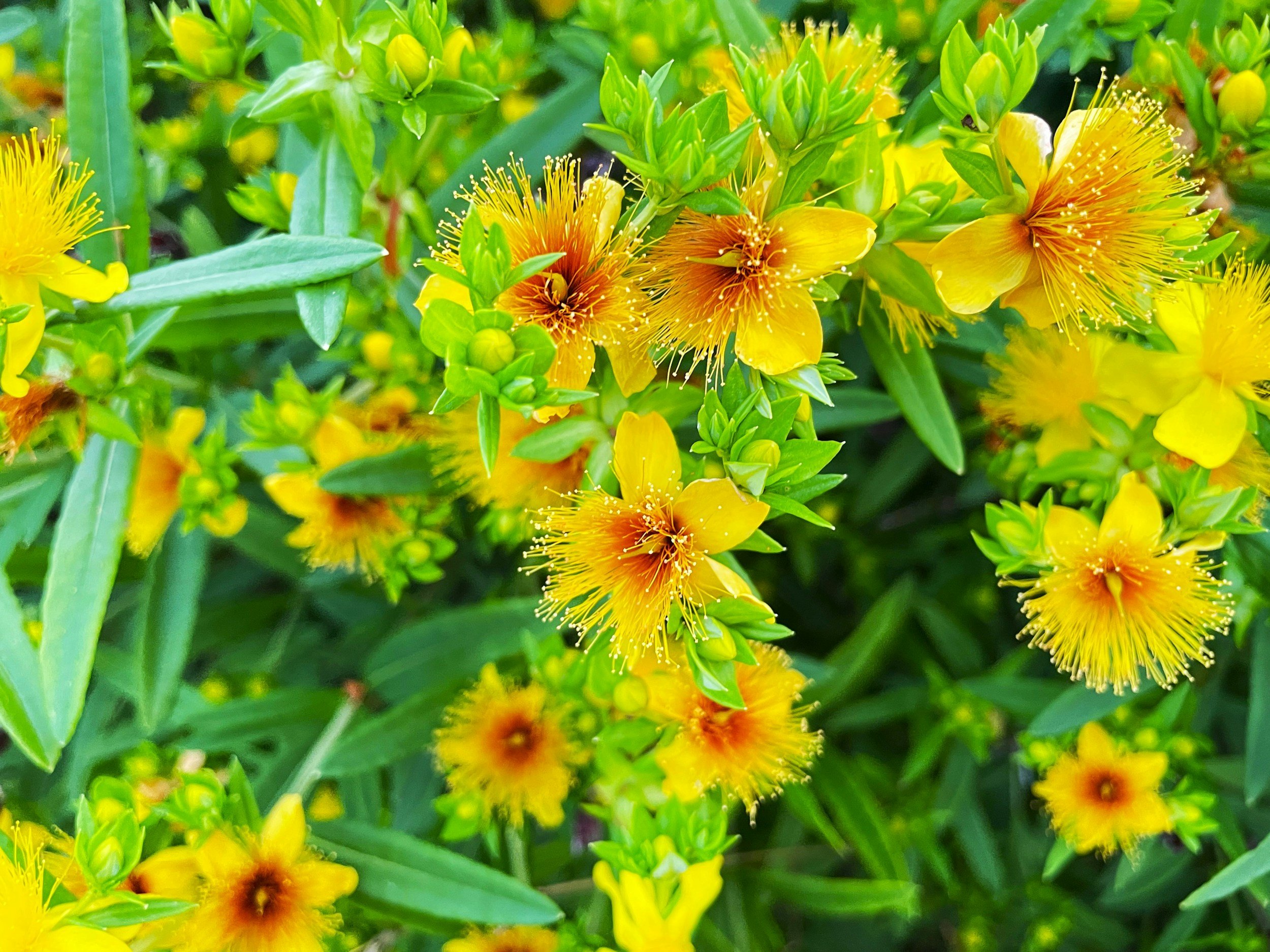
St. John's Wort: The Sun in a Flower
No plant is more completely Litha than Hypericum perforatum — St. John's Wort, named for John the Baptist whose feast day falls on June 24th, three days after the solstice, and whose identification with the plant is a Christianization of something much older. The plant was sacred to midsummer before it was sacred to any saint, and its properties — both medicinal and magical — are the properties of the solar peak embodied in botanical form.
St. John's Wort blooms precisely at midsummer: bright yellow, five-petaled, with stamens so numerous they give the flower a sun-burst quality that is not accidental in the symbolic vocabulary of the season. Hold a leaf up to the light and you will see the small oil glands scattered through it like stars — the perforatum of its scientific name, the perforations that let the light through. The plant is designed, it seems, to be held up to the midsummer sun.
The oil extracted from St. John's Wort flowers — collected when the buds are just opening, infused in olive oil over several weeks of sun exposure — turns a deep, blood red. Not orange, not amber — red, the color of the sun at the horizon, of fire at its heart, of the living blood that the plant was associated with in folk medicine across Europe. The red oil was used for burns, for wounds, for the nerve pain that the plant has a genuinely documented effect on. Its modern medicinal use as an antidepressant — now supported by clinical research that finds it comparable to pharmaceutical antidepressants for mild to moderate depression — aligns with its traditional characterization as a plant of light: what it does, both literally and spiritually, is bring light into the dark.
"St. John's Wort was gathered at midsummer because midsummer was when it was most itself — most fully expressing the solar quality that made it useful. The plant that brings light into depression was gathered at the year's most luminous moment. This is not coincidence. It is the logic of the living world knowing its own nature."
In magical practice: St. John's Wort gathered at the solstice was hung above doorways for protection — specifically protection against the supernatural interference that midsummer, like all threshold moments, invited. It was carried on the person to ward against depression and to strengthen courage. Burned as incense, its smoke was understood to clear spaces of accumulated spiritual weight. Its association with fire made it appropriate for any working that required illumination — of a question, of a path, of a situation that had been too long in darkness.
Harvesting note: Gathered at the solstice or as close to it as the specific year's bloom timing allows. The buds just opening are more potent than the fully open flowers. Harvested in full sun, in the middle of the day when the plant's oils are most concentrated.
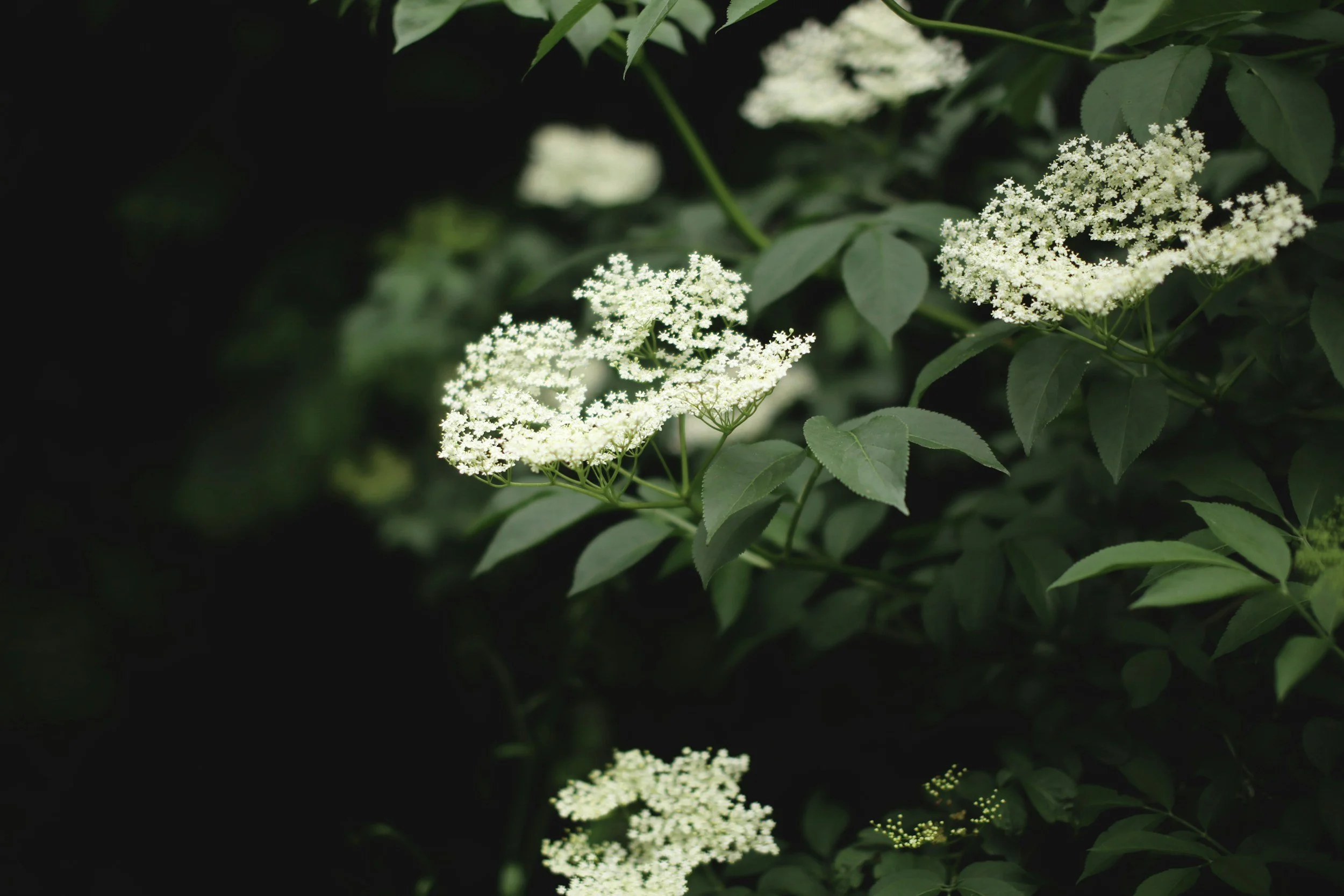
Elderflower: The Fairy Queen's Midsummer Gift
The elder — Sambucus nigra — is Litha's most complex plant, combining extraordinary practical utility with a mythological weight that makes it one of the most deeply ambivalent herbs in the Northern European tradition. Its flowers are midsummer's most lavish sensory offering: flat-topped umbels of tiny cream-colored flowers covering the entire tree simultaneously, their scent sweet and slightly medicinal, their visual effect of a tree wrapped in lace.
The elder was a fairy tree — as at Beltane with the hawthorn, as with the rowan in the protective tradition. The Elder Mother, Hyldemor in Danish tradition, inhabited the tree and required acknowledgment before any part of the tree was used. To cut elder without asking her permission was to invite her retribution. To burn elder wood in the hearth was considered actively dangerous — you had brought the fairy presence directly into your home fire, and she would not be pleased. Even gathering the flowers required a respectful acknowledgment, a spoken or internal recognition that you were taking something that was not only yours.
This is not merely charming folk superstition. The elder is a tree of genuine power in every practical sense: its flowers are medicinally active (elderflower has demonstrated antiviral properties, particularly against influenza), its berries are among the most nutritionally dense of any European wild fruit (elderberry syrup is a documented immune system support), and its leaves, bark, and roots contain compounds that are toxic in the wrong doses. The folk tradition that said you should approach this tree carefully was not wrong. The elder rewards knowledge and punishes carelessness, which is the behavioral signature the fairy tradition consistently attributed to it.
Picture a midsummer morning in rural Scandinavia, sometime in the eighteenth century. A woman has come to the elder at the edge of the garden before anyone else in the household is awake. The flowers are at their peak — they will be past their best in three days, the petals beginning to brown at the edges, the scent shifting from floral to something more fermented. She stands at the tree's edge for a moment before she touches it. She says something — a few words, traditional words, the words her mother taught her for this. Then she begins to gather, carefully, cutting the heads at the stem, laying them in her basket without crushing. She will make cordial with these, and perhaps wine, and perhaps a wash for the skin that has been proven over generations to soften and heal. She knows what this tree is. She treats it accordingly.
Elderflower in practice: Made into cordial (flowers, sugar, lemon, citric acid, cold water infused for 24 hours) — a Litha drink with genuine tradition behind it. Infused in oil for a skin treatment. Dried and added to tea blends for their antiviral properties. Used in Litha altar decoration for the specific visual quality of their bloom — lace-white, abundant, the midsummer tree at its most generous.
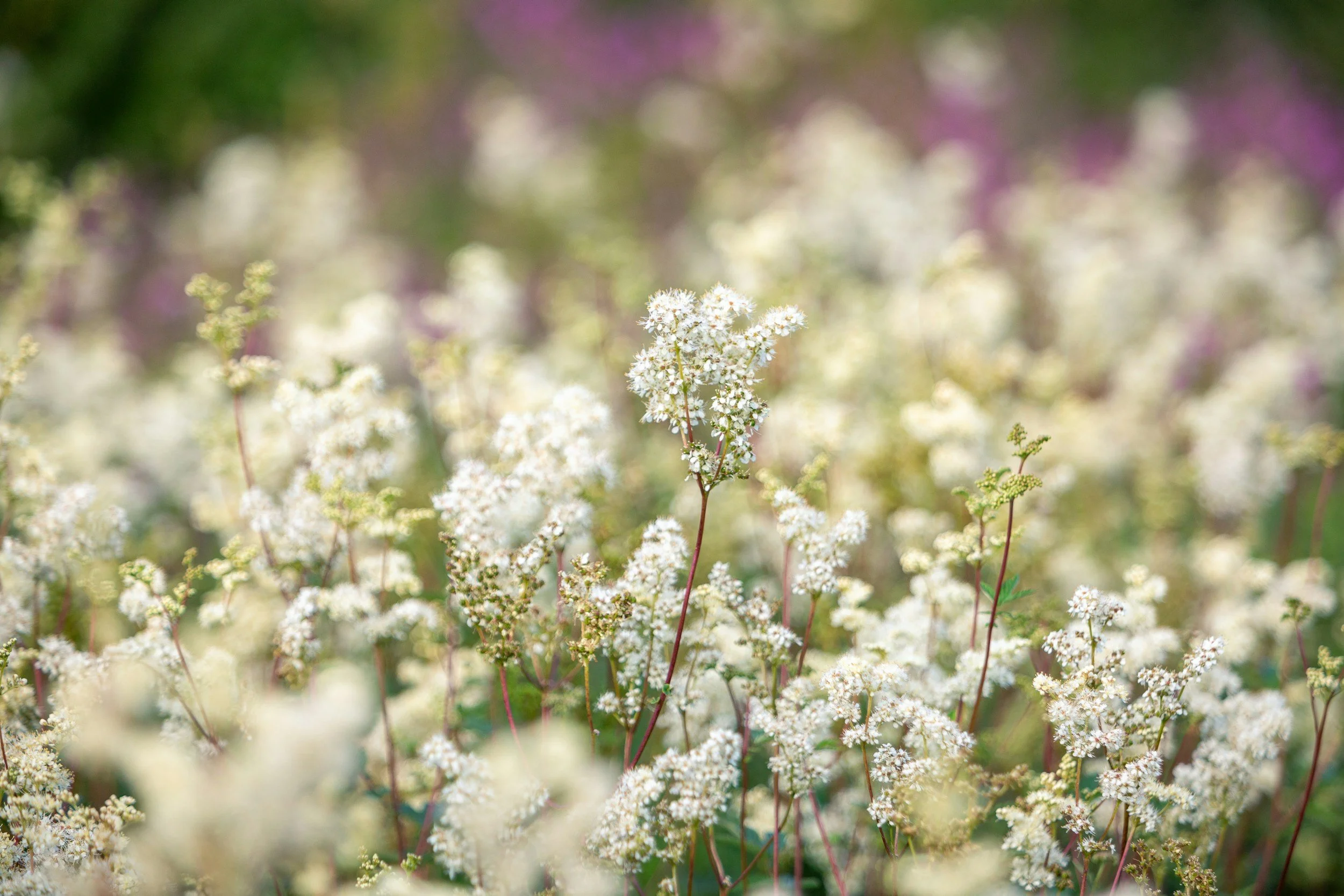
Meadowsweet: The Queen of the Meadow
Filipendula ulmaria — meadowsweet — blooms in the low, damp places of midsummer: along riverbanks, at the edges of marshes, in the wet corners of meadows where the ground holds water from the spring rains and releases it slowly through the hot weeks of June and July. It is not a shy plant. Its cream-colored flower heads are large and frothy, its scent unmistakable — sweet but complex, with a note of something almost medicinal underneath the floral surface. The scent is almond, and honey, and the specific greenness of plants that grow near water. It fills the air of midsummer damp places completely.
Meadowsweet was one of three sacred herbs of the druids — alongside vervain and water mint — according to sources that are later but consistent. Its sacred status is not hard to understand: it is beautiful, it is medicinal (salicylic acid, the compound from which aspirin was synthesized, was first isolated from meadowsweet in the nineteenth century — the plant had been used for pain and fever relief for centuries before the chemistry explained why), and it blooms at the exact peak of the herbal year.
In Celtic mythology, the goddess Blodeuwedd — the flower bride of Welsh myth, created from flowers by the magicians Math and Gwydion to be a wife for the hero Lleu — was made partly from meadowsweet, along with oak blossom and broom. The flower that goes into the composition of a woman made entirely from flowers is not chosen casually. Meadowsweet at midsummer is the meadow at its most fully itself — abundant, scented, soft, and possessed of a hidden medicinal power that its appearance does not announce.
In magical practice: Meadowsweet is associated with love, peace, and happiness — qualities aligned with the emotional tone of Litha, the festival of abundance rather than endurance. Strewn on the floor or placed in water as a room scent, it brings lightness. Added to ritual baths at midsummer, it connects the bather to the season's generous quality. Dried and added to sachets or placed in the home, it promotes the easy emotional warmth that the long midsummer days make naturally available.
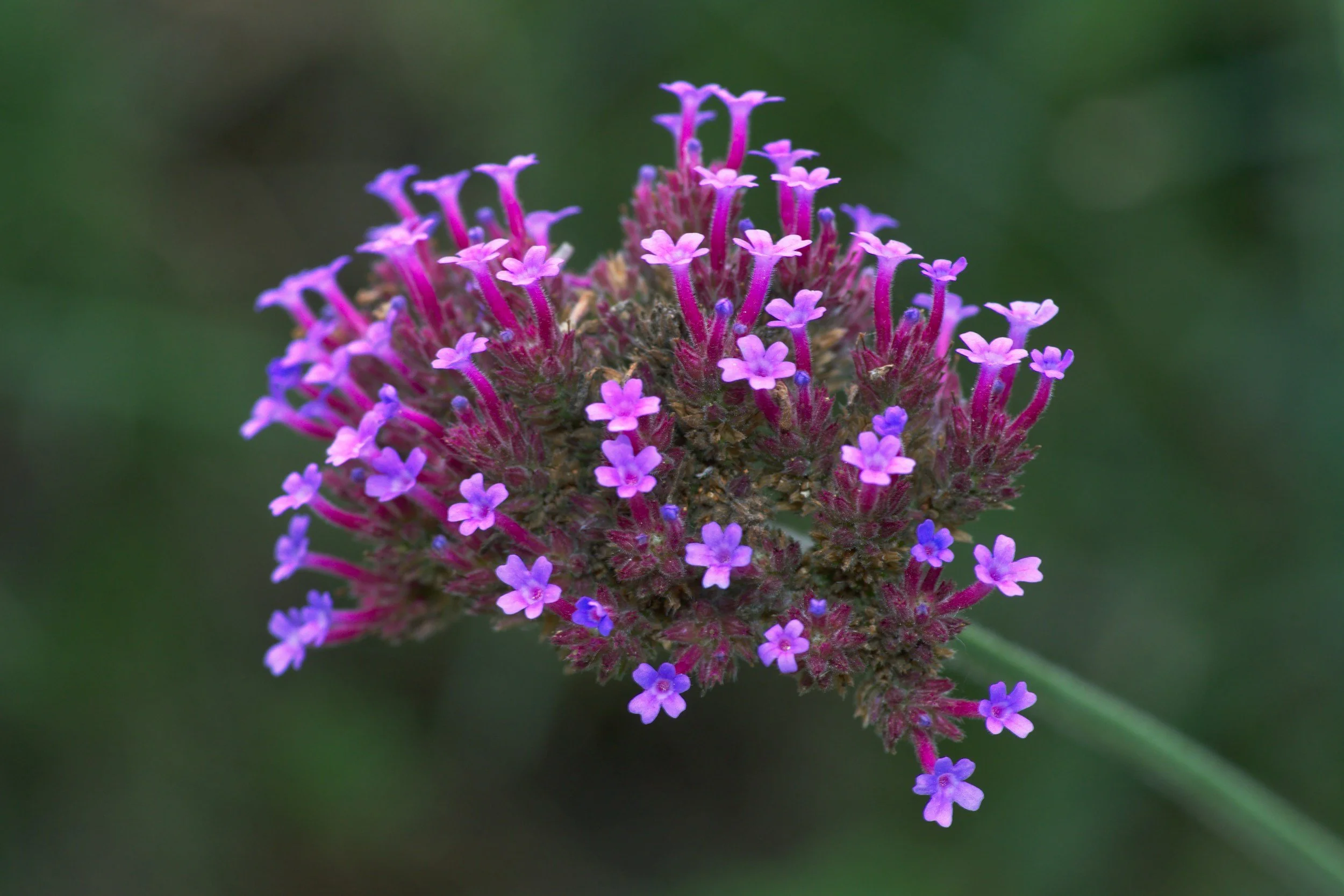
Vervain: The Herb of Grace
✦ ✦ ✦
Vervain — Verbena officinalis — is the most understated of the midsummer herbs and, in many traditions, the most powerful. It blooms in small, pale lilac flowers on slender spikes in waste ground and roadsides — not a showy plant, not one that announces itself. You find vervain because you know where to look, not because it draws the eye.
This modesty is part of its character. Vervain was the sacred herb of the druids — mentioned consistently across Roman sources as the plant used in their ritual preparations — and of the classical tradition, where it appeared in Roman ceremonies of peace and in the augury rites of the priests. It was called herba sacra, sacred herb, and herba Veneris, herb of Venus. The Romans gathered it with specific ceremony: kneeling, using the left hand (the hand of the supernatural world), making an offering of honeycomb to the earth before taking anything from it.
In the British Isles, vervain was considered so powerful that it was gathered at Litha with corresponding ceremony: at the rising of the dog star Sirius, while neither sun nor moon was above the horizon (the liminal moment between the day that was the solstice and the night that preceded it), as an offering of honey and water was made to the earth. The precision of these requirements was not decorative. It reflected the understanding that a plant of this level of potency demanded to be approached with corresponding seriousness.
"Vervain was never a plant you used casually. Its power was specific, directional, earned by the person who took the trouble to understand what they were working with. The herb that the druids carried was not a lucky charm. It was a tool — and like all serious tools, it required knowledge to use safely."
Vervain in magical practice: Associated with protection, purification, and the enhancement of ritual work broadly. Burned as incense in midsummer workings to clear the space and increase the potency of whatever follows. Carried on the person as a protective herb — specifically protective against supernatural interference, making it appropriate for the midsummer period when the fae are active. Used in washes of ritual tools and sacred spaces. A small amount placed in the bath before important ritual work.
The Midsummer Harvest: Timing, Method, and What It Means
The tradition of gathering herbs at midsummer was not limited to the specific plants above. The summer solstice was understood as the optimal gathering point for the annual herb harvest because the concentration of medicinal and magical compounds in plants peaks at precisely this moment — the result of months of sunlight accumulation that will begin to decline the day after the solstice.
The methods of the traditional harvest were specific in ways that reflect both practical knowledge and ritual awareness. Early morning collection — after the dew had dried but before the heat of midday — was preferred for most aerial plant parts, when the essential oils had not yet volatilized in the heat. The solstice itself, the longest day, was gathered at noon for sun-ruled plants like St. John's Wort, when the solar energy in the plant was at its daily peak as well as its annual one.
Plants were not torn or carelessly cut. They were harvested with acknowledgment — a spoken recognition of what was being taken, sometimes a small offering left in exchange, always a deliberate harvest that left enough behind for the plant to continue. This was not ceremony for ceremony's sake. It was sustainable wild harvesting practice preserved in ritual language: if you take everything, there is nothing next year. If you take with intention and attention, there is always more.
For contemporary practice, the midsummer herb harvest is one of the most accessible and most grounded of Litha's traditions. You do not need a field or a hedgerow — a windowsill of potted herbs, harvested at the solstice with intention, connects the act to its full tradition. What you harvest at Litha and dry carefully will carry the quality of the solstice through the darker months — the concentrated light of the year's peak made available in winter when the light is most needed.
This is what the green pharmacy of midsummer has always been for: storing the light in a form you can use when the sun has retreated. Every dried herb is a letter from June, held in a jar on a winter shelf, waiting to be opened.