Spring Symbols & Correspondences: The Full Sensory Language of Beltane
Every festival on the wheel has a sensory signature — a specific combination of color, scent, plant, stone, and elemental quality that makes it immediately recognizable to the body before the mind has named it. Walk into a room dressed for Samhain and something in you knows it before you can say why. The same is true of Beltane, and the knowing is immediate and physical: the smell of hawthorn blossom, the specific green of new leaves against a blue May sky, the warmth that is finally warm rather than merely less cold. The body has been waiting for this particular combination for months. When it arrives, something releases.
The correspondences of Beltane are not assigned arbitrarily by modern practitioners looking for a thematic scheme. They are derived — as all the most durable festival correspondences are — from what is actually present in the landscape and the body at this moment in the year, and from the accumulated observation of what that presence means. The hawthorn blooms at Beltane because that is when it blooms. The colors are green and gold and red because those are the colors of the May landscape. The element is fire because fire is what the festival is. The correspondences are descriptions before they are prescriptions — the world telling you what it is, and the practice using that information.
The Hawthorn: Beltane's Sacred Tree
No plant is more completely Beltane than the hawthorn — and no plant in the entire Celtic tradition carries more complexity, more contradiction, or more concentrated power.
The hawthorn (Crataegus monogyna) blooms in May with a foam of small white flowers whose scent is extraordinary and difficult to describe: sweet, yes, but with an undertone of something animal, something that the Victorians found sufficiently alarming that hawthorn blossoms were traditionally kept outside the house rather than brought in. Modern analysis has identified the compound trimethylamine in hawthorn flowers — the same chemical produced in the early stages of animal decomposition. The hawthorn smells of life and death simultaneously. It smells of the thing that Beltane actually is: the living world at its most fully alive, which is also the living world at its most mortal.
In Celtic tradition, the hawthorn was a fairy tree above almost all others. A lone hawthorn standing in a field — the sceach, in Irish — was understood to be under fairy protection, its roots reaching into the Otherworld, its branches an antenna for supernatural presence. To cut one down was to court catastrophe. To shelter under one on May Eve was to place yourself directly in the path of the fairy court's Beltane traffic. The hawthorn was not a tree you used carelessly. It was a tree you approached with knowledge and respect, because what lived in it and around it was not always well-disposed toward humans who blundered in without understanding.
"The hawthorn smells of what Beltane actually is — the living world at its most fully alive, which is also the living world at its most mortal. The blossom and the thorn together. That has always been the festival's honest character."
And yet the hawthorn was also the May tree — the tree whose blooming announced that Beltane had arrived, whose branches were used to decorate the maypole, whose flowers were woven into the garlands that crowned the May Queen. Going a-Maying — the practice of going into the woods at dawn on May morning to gather flowering hawthorn branches — was among the most beloved of the season's customs in the British Isles, persisting into the nineteenth century and referenced in English literature from Chaucer onward. The gathered branches were brought back to decorate the houses and the village green, the scent of them filling the rooms, the white flowers dropping their petals onto the windowsills.
The contradiction is the point. The hawthorn is both the fairy tree and the May tree — both the danger and the decoration, both the warning to stay back and the signal that summer has arrived. Beltane has always held this tension without resolving it. The beautiful thing and the dangerous thing are not different things. They are the same thing, viewed from different angles.
Hawthorn in Practice: Used in protective charms around the perimeter of a property — planted at boundaries, woven into protective wreaths. Associated with the heart in herbal medicine: hawthorn berry is a documented cardiac tonic, its association with the emotional heart in folk tradition aligning with its medical properties in a way that appears throughout plant lore. At Beltane specifically: used in garlands, altar decoration, and the blessing of doorways — but never cut carelessly, and never brought fully indoors without acknowledgment of what it carries.
The Colors of Beltane: Green, Gold, Red, and White
Green — the green of Beltane is not the soft green of early spring. By May, the green is aggressive, saturated, the green of a world that has fully committed to the season and is producing chlorophyll at maximum capacity. It is the color of life operating without apology, without qualification, without the hesitation that characterized March and April. In Beltane's symbolic vocabulary, green is the living world itself — the generative force of the earth at full power.
Gold — the gold of Beltane is sunlight and fire simultaneously, the two dominant forces of the festival given a shared color. Gold is warmth made visible, summer made tangible. It appears in the flowers of the season — the broom, the gorse, the buttercup, the primrose at the end of its run — and in the Beltane fire itself, whose flames at their height shift from orange into the deep gold that is the hottest part of a clean burn. In altar work and ritual decoration, gold is the color of the festival's solar dimension: the sun's return to dominance, the light winning, the warmth that is now abundant rather than rationed.
Red — Beltane red is the red of fire at its base, of blood in the veins, of desire in the body. It is the color of the living, moving, insistent force that drives the season: the same force that pushes growth through soil, that drives the cattle to the summer pastures, that pulls people toward each other in the warmth of the May night. Red at Beltane is not the red of blood spilled in sacrifice — that is Samhain's red. This is the red of blood moving, of the living body fully occupied with the business of being alive.
White — the white of Beltane is hawthorn blossom, May Queen's dress, the foam of flowering hedgerows. It is the color of threshold — the same liminal white that appears at Samhain in the burial shroud, but here expressed in the direction of life rather than death. White at Beltane is purity in the oldest sense: not moral purity but essential purity, the undyed, the unwritten-upon, the potential that has not yet declared itself as any particular thing.
Flowers, Herbs & the Green Pharmacy of May
✦ ✦ ✦
Hawthorn — see above. The primary Beltane plant in every dimension: protective, liminal, medicinal, fairy-associated, joyful, and dangerous.
Rowan — carried forward from Imbolc as a protective plant but at Beltane specifically deployed against the fae who are most active at this threshold. Rowan tied with red thread above doorways and in the tails of cattle being driven to summer pastures.
Elderflower — the elder blooms in late May, sometimes early enough to be gathered at Beltane in warmer years, its cream-colored flower clusters heavy with a scent that is simultaneously floral and faintly medicinal. The elder was another fairy tree in Celtic tradition — cutting one without asking permission of the Elder Mother who inhabited it was considered deeply unwise. Its flowers, made into cordial or wine, were a Beltane celebratory drink in many parts of the British Isles. The elder sits at the boundary between the herbal and the supernatural in a way that makes it entirely appropriate to a festival organized around the same boundary.
Clover — particularly the four-leafed variety, whose rarity made it a powerful protective and luck charm. Beltane was the time to search for four-leafed clover in the new-grown fields, and finding one conferred the ability to see the fae in their true form — a gift that came with its own complications, since being able to see the fae and being able to avoid them were not the same thing.
St. John's Wort — (Hypericum perforatum) blooms a little later in the year but begins its growth in earnest at Beltane, and its protective associations make it appropriate to the festival even before it blooms. One of the great protective herbs of Northern European folk tradition, hung above doors and worn on the person to ward against supernatural harm. Its modern medical use as an antidepressant — the plant that brings light into the dark — aligns with its traditional solar associations: this is a plant of the sun, of the warm half of the year, of light as medicine.
Woodruff — a small, white-flowered woodland plant that was traditionally used to make Maibowle — May Bowl — in the German tradition: white wine infused with sweet woodruff, served at May Day celebrations. Its vanilla-hay scent when dried or crushed made it a strewing herb, scattered on floors for its fragrance. Its inclusion in May wine connects the German Walpurgisnacht tradition to the broader May Day complex in a way that suggests shared roots deeper than any specific cultural history.
Stones, Metals & the Material Correspondences
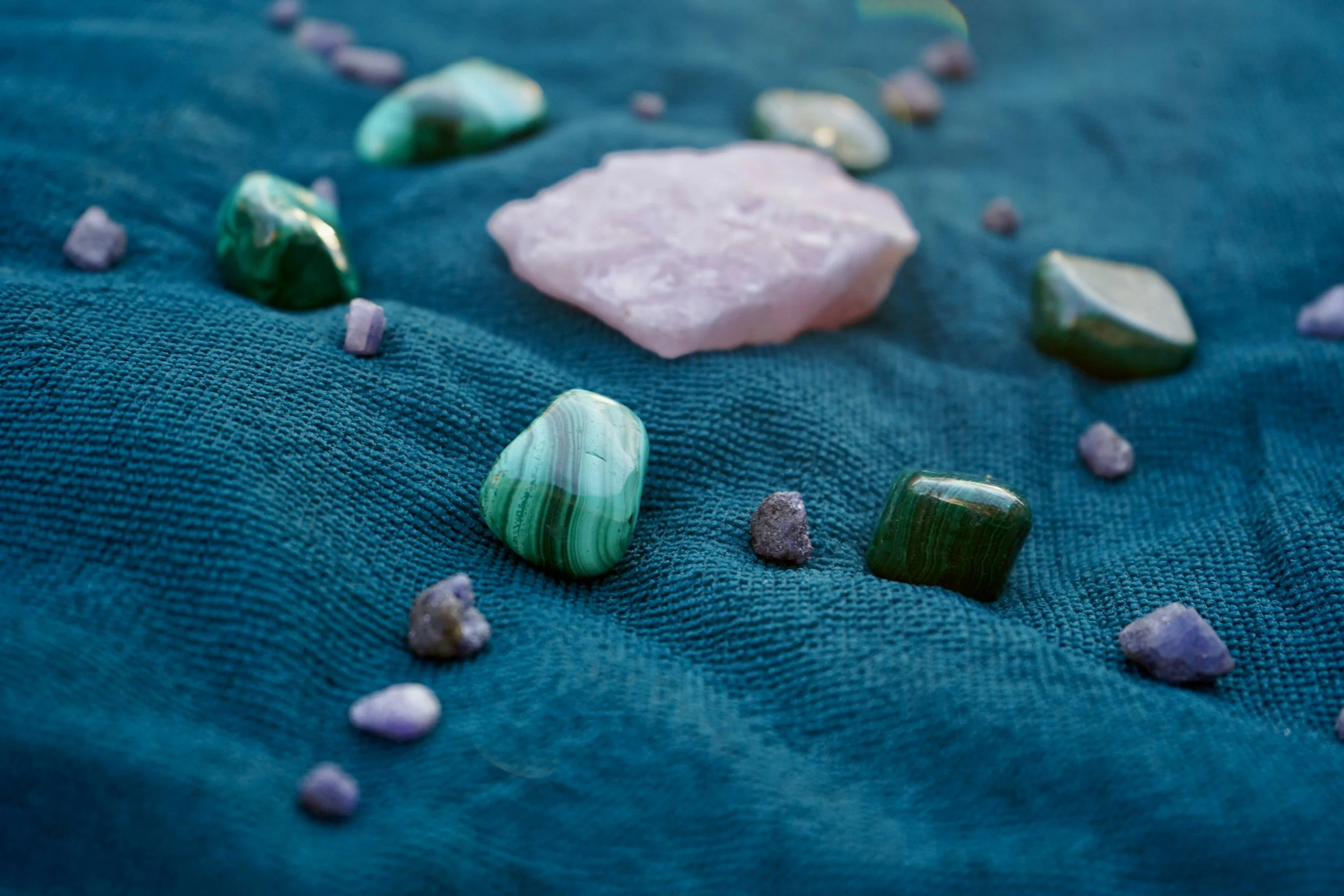
Emerald — the stone most directly associated with Beltane, its deep green the color of the May landscape at full power. Emerald in the folk tradition of Ireland and Britain was associated with vision — specifically the enhanced vision that allowed one to see the fae in their true form, to perceive what was hidden beneath the ordinary surface of the world. An emerald set in a ring or worn close to the skin was understood to sharpen this perception. At Beltane, when the Otherworld was at its most present and most active, this sharpened perception was both a gift and a responsibility.
Rose Quartz — associated with the festival's dimension of love, desire, and union. Beltane was historically a time of handfasting — the Celtic form of betrothal, in which couples bound themselves to each other for a year and a day, renewable at the following Beltane. Rose quartz carried in the pocket or worn against the heart at Beltane was understood to amplify the qualities the festival celebrated: openness to connection, willingness to desire, the particular courage required to commit to another person.
Malachite — green-banded, deeply saturated, its color the exact green of the Beltane landscape. Malachite was associated with transformation and with protection during periods of significant change. Beltane is the festival of the year's greatest single transformation — the crossing from cold to warm, from the contained world of winter to the expansive world of summer — and malachite's transformative associations make it fitting for this threshold moment.
Gold — the metal as well as the color. Gold jewelry worn at Beltane carried the solar energy of the festival — the warmth of the sun made wearable, carried on the body through the activities of the day and the fire-lit night.
The Elements: Fire First, Earth Close Behind
Beltane is unambiguously a fire festival — the name declares it, the practices center it, the entire ritual architecture is organized around it. But the element of earth is inseparable from Beltane's fire in a way that distinguishes it from the other fire festivals of the wheel.
The fires of Samhain are fires lit against the dark. The fires of Yule are fires lit to invite the returning light. The fires of Imbolc are Brigid's sacred flame, tended and passed from hand to hand. The fires of Beltane are fires lit from the earth's own urgency — they are the expression, in human-made flame, of the same energy that is driving the hawthorn into bloom and the cattle to the summer pastures and the entire living world into its loudest and most extravagant moment of the year. Beltane fire does not stand against what the earth is doing. It participates in it.
This is why the earth is Beltane's second element even though fire is its first. The fire is the expression; the earth is the source. The warmth is the result; the ground that has finally absorbed enough heat to support what is growing in it is the cause. To honor both elements at Beltane is to honor the full system: not just the visible, dramatic expression of the season but the deep, invisible, underground process that made it possible.
"Beltane fire comes from the earth. It goes back to the earth in ash and heat. The maypole is planted in the earth. The flowers are grown from the earth. The cattle that walk between the fires will return to earth eventually, as everything does. The festival that feels most purely of the air and the light is rooted, as deeply as any, in the ground."
A Beltane Altar: Assembling the Season
A Beltane altar does not need to be elaborate. It needs to be full — full in the way that May is full, the way the hedgerows are full, the way the bird noise in the morning is full. Beltane does not do minimalism. It does abundance.
The fire — a candle at minimum, ideally multiple candles, ideally red and gold and white. If you have access to outdoor space, a small fire. The fire is the center. Everything else is organized around it.
The hawthorn — if you can access a blooming hawthorn, a small branch in water. If not, any white May flower. The scent is part of the altar as much as the appearance.
The green — living plants on the altar, not dried ones. Beltane is the festival of the living world, and a Beltane altar should contain living things: potted herbs, a vase of fresh flowers, moss from the garden if nothing else.
The colors — red, gold, green, white, in whatever form is available. Ribbons, cloth squares, stones, flowers, candles.
Something of iron — a key, a nail, a small iron piece. The protection against the fae who move at Beltane is not incompatible with celebrating the festival. You can welcome the season and keep your household safe. The iron sits at the edge of the altar, at the threshold. It is not the altar's heart. But it is present.
An offering — milk, honey, the first bite of food from the Beltane feast, a handful of flowers. Left at the threshold rather than on the altar itself. For whatever passes on Beltane night. Given freely, without resentment, in the ancient understanding that the Otherworld and the human world share this moment, and that sharing requires contribution from both sides.
The hawthorn is in bloom. The fire is lit. The altar is full of what the season has made available.
This is Beltane. This is the world at the full height of what it can do.
Stand in it. Let it be as loud as it wants to be. This is what winter was for.