Samhain & the Death Rites: When the Harvest Ended and the Slaughter Began
There is a moment in late October when the year begins to smell different. The sweetness of harvest gives way to something older — cold earth, wood smoke, the iron note of blood. For the ancient Celts, this was not an accident of season. It was the smell of a world doing what it was supposed to do: dying, deliberately, so that something could survive.
Samhain was never only a festival of ghosts and spirits, though the spirits were real and present and not to be taken lightly. Before it was a night of the uncanny, it was a night of the knife. A night of fire. A night of accounting between the living and the dead that was rooted not in mysticism but in the brutal arithmetic of survival. How much food do we have? How many animals can we keep through winter? What must be killed so that the rest may live?
The death rites of Samhain grew from this ground — from blood in the mud, from bone in the fire, from the understanding that death and sustenance were not opposites but partners, and that to eat was always, in some sense, to take a life.
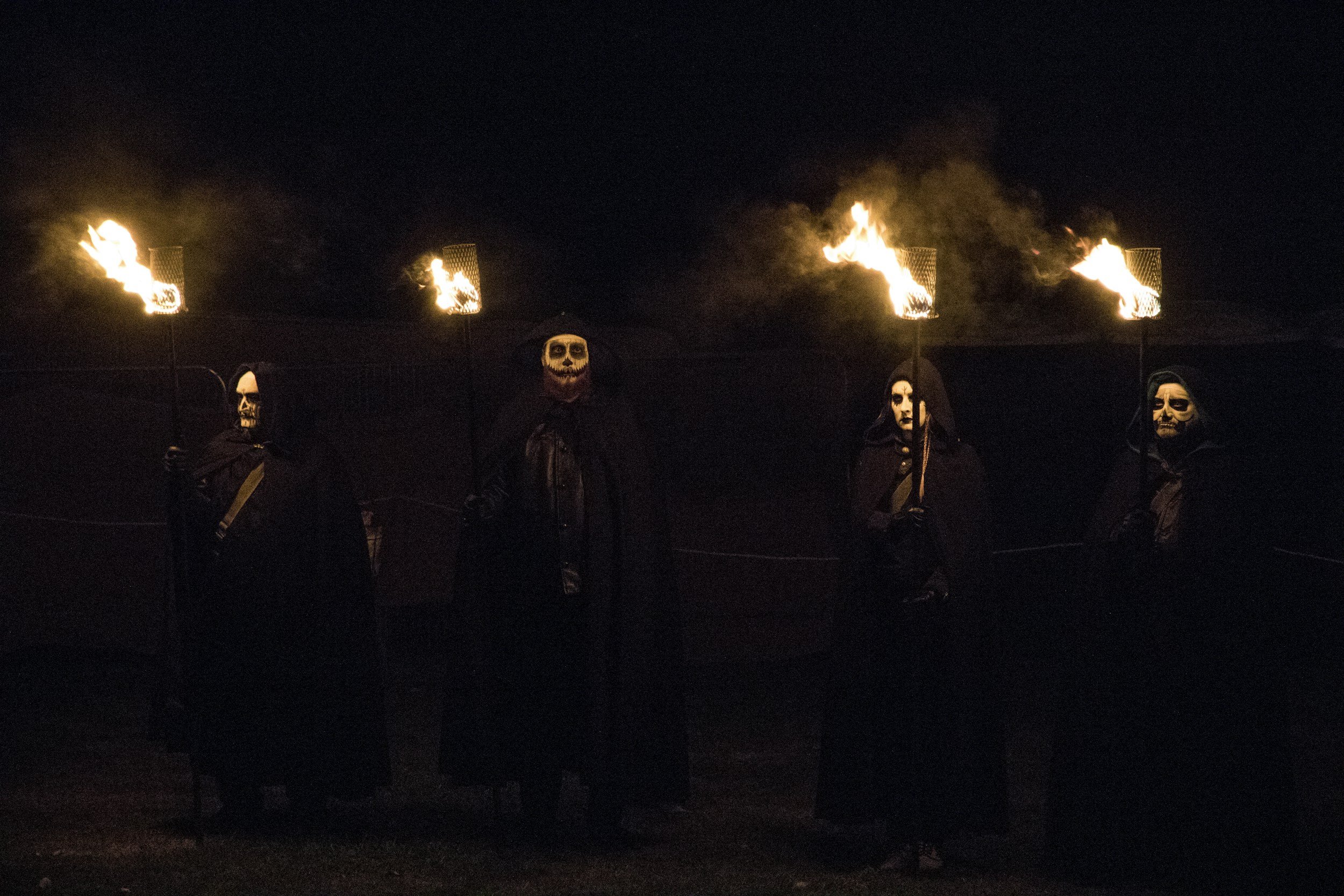
The Final Harvest and the Calculus of Winter
By Samhain, the agricultural season was over. Whatever had been grown was in — or was lost. The grain had been threshed. The root vegetables had been stored. The apple orchards had given their last yield. In the farming communities of ancient Ireland, Scotland, and Britain, this was the moment when the ledger closed and the household faced what it actually had, rather than what it had hoped for.
The cattle and livestock presented the central dilemma. Grazing land was exhausted. Feed was finite. Keeping an animal through winter meant feeding it through four or five months of cold, which required resources that might otherwise keep a family alive. Every household made hard choices: which animals were strong enough to breed in spring and worth the cost of keeping, and which would go to slaughter now, their meat preserved by salting and smoking, their bones rendered for fuel and oil, their hides cured for warmth.
This was not cruelty. This was knowledge. The people who made these calculations had been making them for generations, had been taught by parents who had learned from their own parents the specific, local arithmetic of who survived winter and how.
Samhain was the traditional time of this slaughter — not because it was chosen arbitrarily, but because the timing was dictated by the land itself. Before the killing cold set in and before the ground became unworkable, animals were killed, processed, and preserved. The Samhain feast was, in practical terms, a feast of fresh meat at the precise moment when fresh meat would otherwise disappear for months.
But it was never merely practical. Nothing at Samhain was merely practical.
The Sacred Slaughter: Bone Fires and Ritual Blood
The fires of Samhain — those great communal blazes kindled on hilltops and at sacred sites across the Celtic world — were fed, at least in part, by bones. The bones of the slaughtered animals were cast into the flames. Whether the word "bonfire" genuinely derives from "bone-fire" remains debated among etymologists, but the practice itself is well-attested in early Irish sources and later folklore records from Scotland and Wales.
This was not waste disposal. It was transformation. Fire was the great converter — of darkness to light, of cold to warmth, of raw to cooked, of animal to something released. To place the bones of a slaughtered animal into a sacred fire was to complete the circle of the act, to acknowledge that the death had occurred within a ritual frame, that the animal's life was not simply taken but offered within a context of meaning.
"The fire received what the knife had released. Between them, nothing was wasted — not the flesh, not the bone, not the life itself."
Cattle, in particular, held a position in Celtic culture that went far beyond their economic value. They were a measure of wealth, a means of social exchange, a symbol of prosperity and divine favor. The cattle goddess Bó Find appears in Irish mythology; cows feature in the great epic cycles as prizes, causes of wars, gifts between heroes and gods. To slaughter cattle at Samhain was an act with weight behind it — not lightly done, and not done without ritual acknowledgment.
The practice of driving cattle between two bonfires on Samhain night is recorded in multiple early Irish sources. The smoke and heat were understood to purify the animals — to burn off disease, to ward malevolent spirits, to protect the beasts that would be kept through winter. This was both veterinary practice and magic at once, as so much of ancient knowledge was. The distinction between medicine and ritual was one the Celts did not make.
The Feast of the Dead: Feeding Two Worlds at Once
Once the slaughter was done and the meat had been prepared, the feast began. And this feast was not only for the living.
Across the Celtic world — and in the broader Indo-European traditions that Celtic culture was part of — the feast of the dead was a distinct and ancient ritual. The dead, it was understood, had needs not entirely different from the living. They hungered. They thirsted. They returned, especially at the great threshold moments of the year, to the places they had known in life. And if they were welcomed and fed, they would bring their protection with them. If they were ignored or insulted, their hunger could curdle into harm.
At Samhain, places were set at the table for the absent dead. The best of the food — whatever the household had — was laid out for ancestors whose hands would not reach for it, whose mouths would not taste it in any way the living could see, but who were present nonetheless. A cup of ale. A portion of meat. Bread made for the feast, broken and left untouched.
Picture the kitchen of a farmstead in ancient Connacht on Samhain night. The fire blazes high. The smell of roasting meat fills the low-ceilinged room. Around the table, a family sits — grandmother, parents, children, perhaps a servant or two. But at one end of the table, plates are laid that no living hand will use tonight. A grandfather dead three years. A child taken by fever the winter before. An uncle lost in a raid. They are here, by invitation, by the thinning of the veil, by the ancient agreement between the living and the dead that says: you fed us in life, and we will not forget it. We come back to the table because the table remembers us.
This tradition — the feast with a place set for the dead — survived in many forms long after the explicitly Celtic or pagan context had been overlaid by Christian practice. The Irish practice of the dumb supper, observed well into the nineteenth century and in some communities into the twentieth, was its descendant: a meal eaten in complete silence on Halloween night, with a place set for the spirits of the departed, during which the souls of the dead were believed to come and sit among their families one last time before winter closed the door.
The silence was deliberate. Speech belonged to the living. The dead communicated differently — in the flicker of a candle, in a sudden chill, in the inexplicable movement of a door. To hold silence was to make space for a different kind of presence. It was also a form of respect: the recognition that you did not know what the dead might say if you gave them the chance to say it, and that wisdom lay in listening rather than talking.
Ancestral Memory as Living Practice
✦ ✦ ✦
The thread connecting the ancient slaughter feast to the dumb supper to contemporary ancestor altars is not interrupted — it is continuous, if sometimes thin. The human need to mark the dead, to acknowledge them as still present in some meaningful sense, to create a ritual moment in which the grief and love of bereavement can be expressed rather than suppressed, does not expire with any particular theology or culture. It only changes its clothing.
The Día de los Muertos of Mexican and broader Latin American tradition — with its elaborate altars, its marigold paths laid to guide the dead home, its photographs and favorite foods and personal objects arranged for the returning spirits — is not Celtic in origin but carries the same understanding: the dead are not gone. They are elsewhere. And at the right moment, in the right way, they can be invited back.
Contemporary practitioners observing Samhain as part of the Wheel of the Year often build ancestor altars in this same spirit. Photographs of the departed, placed at the center. Objects they loved, or objects that call them by association. A candle lit to mark their presence. Food left out — the same food that was set on Celtic tables two thousand years ago, for the same reason. Not as superstition. As relationship. As the refusal to let love end simply because a body has.
What the Death Rites Were For
It would be easy, from the distance of centuries and the comfort of modern food systems, to look at Samhain's death rites as primitive — as belonging to a worldview that has been superseded by the clean separation between slaughterhouse and dinner table that industrial society maintains. But this interpretation misses what the rites were actually doing.
The death rites of Samhain were a technology for surviving grief. Not only the grief of winter and privation, though that was real and serious. The grief of mortality itself — the constant, grinding fact that everything living dies, that the people you love will leave, that you will leave, that the world continues its turning regardless. In a culture without the pharmaceutical or theological buffers modern society offers against this knowledge, ritual was the primary tool for living with what could not be changed.
By placing death inside a ritual frame — by giving it a specific night, specific fires, specific foods, specific gestures of acknowledgment — Samhain prevented death from being merely terrible. It became terrible and sacred. It became the thing that connected you to your ancestors, to the land, to the cycle that had been turning long before your birth and would continue long after. The slaughtered animal fed your family. Its bones fed the sacred fire. The dead returned to the table. And the living who sat at that table understood, in a way that is difficult to replicate without the ritual, that they were part of something that did not end with them.
"The knife that ended one life preserved another. This was not contradiction. This was the oldest understanding of all: that nothing is lost, only changed, only moved from one form into the next, in the great turning that Samhain marked but did not cause."
The harvest is over. The slaughter has been done. The feast is laid and the candle lit for the ones who are not here in any way the living can see, but who are here nonetheless.
Set a place at the table. Leave the best of what you have.
They remember the way home.