Sacrifice, Gratitude & Seasonal Turning: The Reckoning at the Heart of Abundance
Gratitude, honestly practiced, is one of the most difficult things a human being can do.
Not the gratitude of the social script — the thank you offered automatically, the appreciation expressed because manners require it, the acknowledgment given without looking directly at what is being acknowledged. That gratitude is easy precisely because it is not real gratitude. It is the form of gratitude without its content. Real gratitude — the kind that Lughnasadh requires and the harvest tradition was built around — demands that you look clearly at what you have received and at what it cost. Both things, simultaneously. The abundance and the price. The feast and the blade.
This is why Lughnasadh is not simply a harvest celebration. It is a reckoning. And the reckoning begins with an honest accounting of what the year has required.
The Wicker Man and the Question of Sacrifice
The sacrificial tradition associated with the Celtic harvest festivals — and with Lughnasadh in particular as the first harvest — is one of the most contested and most persistently misunderstood topics in the entire field of Celtic studies. The Wicker Man, in particular, has accumulated more mythology than the Celts ever put into it, most of it derived from Julius Caesar's account in De Bello Gallico of human sacrifice conducted by the druids in a large wicker figure.
Caesar's account is a Roman military commander's description of an enemy people, written to justify conquest, filtered through the biases of a culture that considered its own gladiatorial games and mass executions civilized entertainment while categorizing the religious practices of the people they were invading as barbarism. This does not mean Caesar invented the Wicker Man — some corroborating evidence for large wicker or wooden structures in Celtic religious contexts exists in other sources. It means his account requires the same critical distance as any source produced by someone with a clear interest in a particular conclusion.
What the archaeological and literary record actually shows is more nuanced and considerably more interesting than the Roman caricature. Human sacrifice in Celtic cultures, where it occurred, appears to have been rare, specific in its context, and associated with moments of extreme communal crisis — prolonged drought, military catastrophe, plague — rather than annual festival practice. The bog bodies of Northern Europe — Tollund Man, Lindow Man, Grauballe Man and others — show evidence of ritual killing, but their interpretation is genuinely complex and scholars continue to debate whether they represent sacrifice, execution, or a combination of both.
"The Celtic tradition understood sacrifice in a way that the modern world has largely lost: as the necessary condition of abundance rather than the punishment for failure. What you give in exchange for what you receive is not a penalty. It is the structure of the relationship between the human world and the powers that sustain it."
The voluntary dimension of Celtic sacrificial ideology — preserved most clearly in the mythology rather than the history — is the more important aspect for understanding Lughnasadh. Tailtiu's death in clearing the forest was not imposed on her. She worked until she died because the work was necessary and she was the one capable of doing it. The grain that gives itself to the blade does not resist. The sacrifice at Lughnasadh is not taken. It is given — and what distinguishes it as sacred rather than merely violent is precisely this quality of voluntary offering.
The Wheel Turns: What Changes at Lughnasadh
Lughnasadh is the first festival of the wheel that announces the dark's return — not dramatically, not with the cold wind and thinning veil of Samhain, but quietly, in the quality of the August light and the mathematical fact of the shortening days.
The light at Lughnasadh is, as noted in the existing archive, a different light than June's. It falls at a lower angle. The days are perceptibly shorter than they were at the solstice, even if they are still long. The nights, which at midsummer barely existed, have returned to a meaningful duration. The first leaves — on the trees that turn earliest, the horse chestnuts and the rowans — are beginning to show the first traces of colour change at their edges. Nothing is over. The summer is still present, still warm, still green in most of the landscape. But the information has changed. The direction has changed. The wheel has tipped.
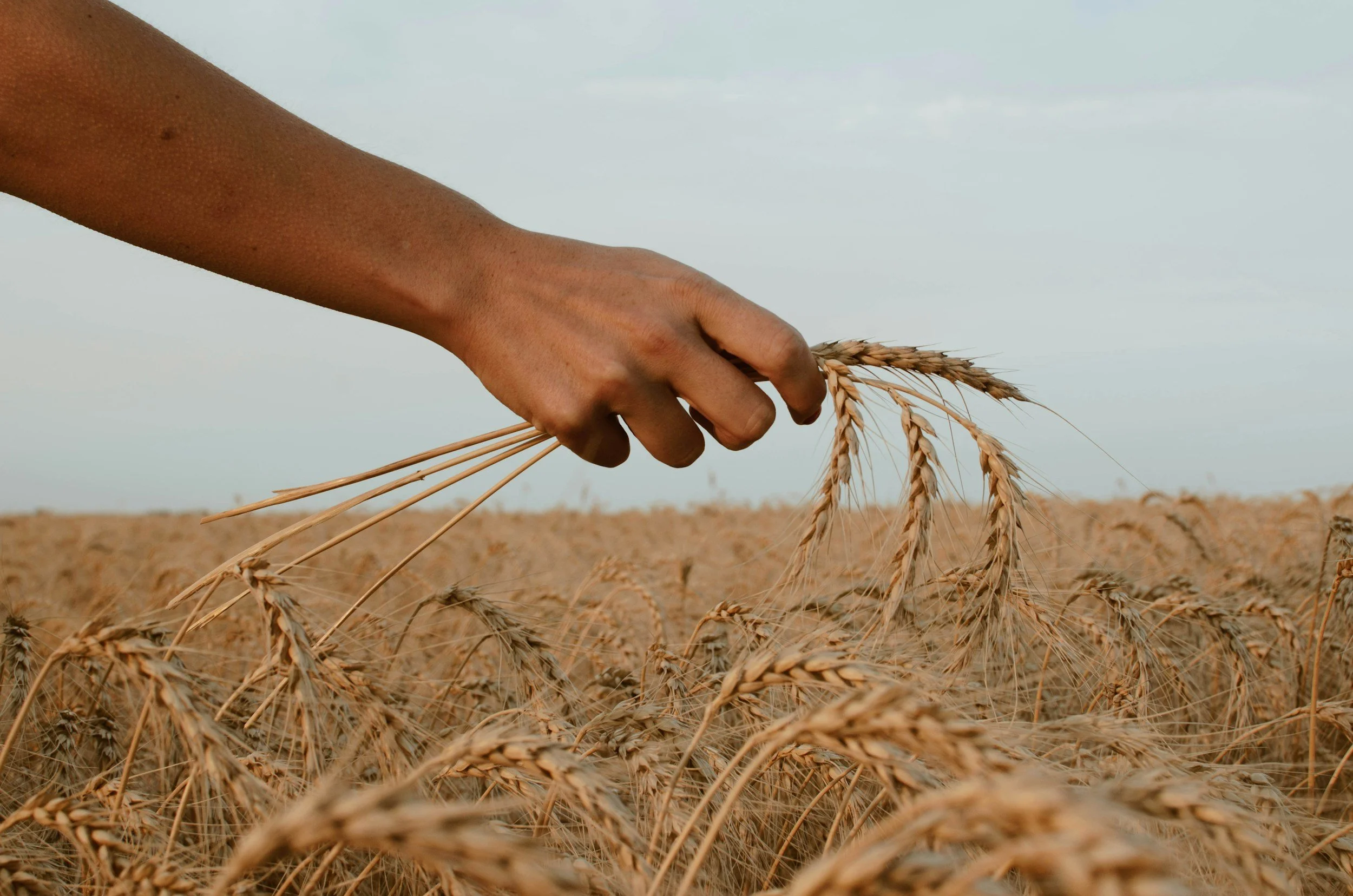
Picture the fields at Lughnasadh — late July or early August, depending on the year and the latitude. The grain is gold, the specific heavy gold of grain fully ripe, and the sound the wind makes moving through it is different from the sound it made a month ago when the stalks were still green and flexible. This is the sound of something ready. Something that has finished becoming what it was going to be and is now waiting for the acknowledgment of that completion. The sun is still warm on your face but it's at a different angle than it was in June. The shadows in the afternoon are longer. You would not be able to say precisely when it changed, but something in you knows it has. The peak has passed. What comes next is different.
The seasonal turning of Lughnasadh is not Samhain's dramatic plunge into darkness. It is subtler and, in some ways, more demanding because of its subtlety. It asks you to hold two things at once: the genuine abundance of the harvest — real food, real warmth, real beauty in the golden fields — and the awareness that the wheel is moving and that what comes next will require something different from you. The feast is real. The feast is also farewell.
This is the emotional register that distinguishes Lughnasadh from the other harvest festivals of the wheel. Mabon's gratitude at the autumn equinox is tinged with melancholy because the balance has tipped unambiguously toward dark. Samhain's gratitude is retrospective, offered across the threshold of the year's end to what has been. Lughnasadh's gratitude is offered at the moment when summer is still present enough to be genuinely, physically felt — which makes the awareness of its passing more acute, not less.
The Agricultural Contract: What the Earth Expects
The harvest traditions of the Celtic and broader Northern European world were built on an understanding that is difficult to translate into modern terms but that was axiomatic to the people who lived by it: the relationship between the human community and the earth was a contract, and contracts have terms on both sides.
The earth's terms were consistent and specific: the first fruits of every harvest — the first grain, the first bread, the first ale — were returned to the earth before the community consumed anything. Poured on the ground, buried at the field's edge, cast into the sacred well, burned in the sacred fire. This was not ceremony for ceremony's sake. It was the payment of a debt. The earth had provided; the appropriate response was acknowledgment of that provision in a form that the earth could receive.
The logic underlying this is more sophisticated than it appears. In an agricultural system where soil fertility was the limiting factor of production — where a field that had been overworked would fail, where a community that took everything without returning anything would eventually face the collapse of the system it depended on — the ritual return of first fruits to the earth was also a practical acknowledgment of that limit. You did not take everything. You left something. The act of leaving something was simultaneously devotion and sustainable land management, as so many of the practices at the intersection of the ritual and the agricultural turned out to be.
"To give back a portion of what the earth had given was not generosity. It was recognition — the acknowledgment that the community was not the source of its own abundance, that it existed within a system it had not created and could not fully control, and that the appropriate response to that position was not ownership but gratitude expressed in material form."
The specific form of the offering varied by culture, by location, by the specific crops involved. In Ireland, the first sheaf of the Lughnasadh harvest was traditionally buried at the field's boundary. In the Germanic tradition, the last sheaf was left standing in the field through winter — shelter for the field spirit, food for the birds, a visible acknowledgment that the harvest had not taken everything. In both cases, something was left. The ledger was kept.
Gratitude as Practice: What Lughnasadh Actually Asks
✦ ✦ ✦
Contemporary life has made genuine gratitude harder, not easier, despite the cultural emphasis placed on it. The distance between the food on the table and the conditions of its production is now so great that the direct acknowledgment of what abundance costs — of who grew the grain, how it was harvested, what the soil required, what the weather permitted or denied — requires deliberate effort that previous generations were spared because they were in direct contact with the system at every stage.
This is what Lughnasadh restores, if you let it.
The act of baking bread from scratch at Lughnasadh — not for efficiency, not for convenience, but for the specific purpose of engaging with every stage of the transformation from grain to loaf — puts you in contact with what bread actually is. The flour in your hands was a plant. The plant grew from soil that required specific conditions. The conditions were not guaranteed. The harvest that produced this flour was contingent on weather that could have failed, on ground that could have been exhausted, on a thousand variables that resolved in the direction of abundance this year and might not next year.
This is not pessimism. It is the specific quality of attention that makes genuine gratitude possible — the awareness that what you have was not inevitable, that it cost something, that the appropriate response to receiving it is not assumption but acknowledgment.
The Lughnasadh practice of gratitude is material and specific. It is not the generalized feeling of thankfulness encouraged by the modern wellness industry. It is the counting of what has been given — this year specifically, in this life specifically — and the honest acknowledgment of what it cost. The labor that grew the food. The luck that kept the weather fair enough. The health that allowed the work. The community that shared the harvest.
And then: the offering. Something returned. Something given back. Not because it earns you future abundance — that is not the structure of the relationship — but because the contract requires it. Because to receive without acknowledgment is to break the oldest agreement there is.
The earth keeps its ledger.
Lughnasadh is the day you bring yours into balance.
Bake the bread. Eat it slowly. Know what it took.
Leave something at the threshold.
The field is listening.