Omens, Protection & Threshold Magic: The Hidden Architecture of Samhain Night
Every culture that has ever lived with winter has developed a technology for surviving it. The Celts developed something extraordinary: a single night, once a year, in which the future could be glimpsed, the home could be armored against what walked in the dark, and the boundary between safety and danger could be actively managed by those who knew how.
This was not superstition in the dismissive modern sense — belief without basis, comfort without function. This was a systematic body of knowledge built up over generations of observation, shaped by the understanding that the world contained forces both visible and invisible, and that wisdom lay in relating to all of them rather than pretending some of them did not exist.
Omens told you what was coming. Protection kept what was coming from reaching you. And the threshold — the doorway, the crossroads, the edge of the fire's light — was the place where both of these practices converged, because the threshold was where the seen and unseen worlds met.
Samhain was the night when all three of these became most urgent, most powerful, and most possible.
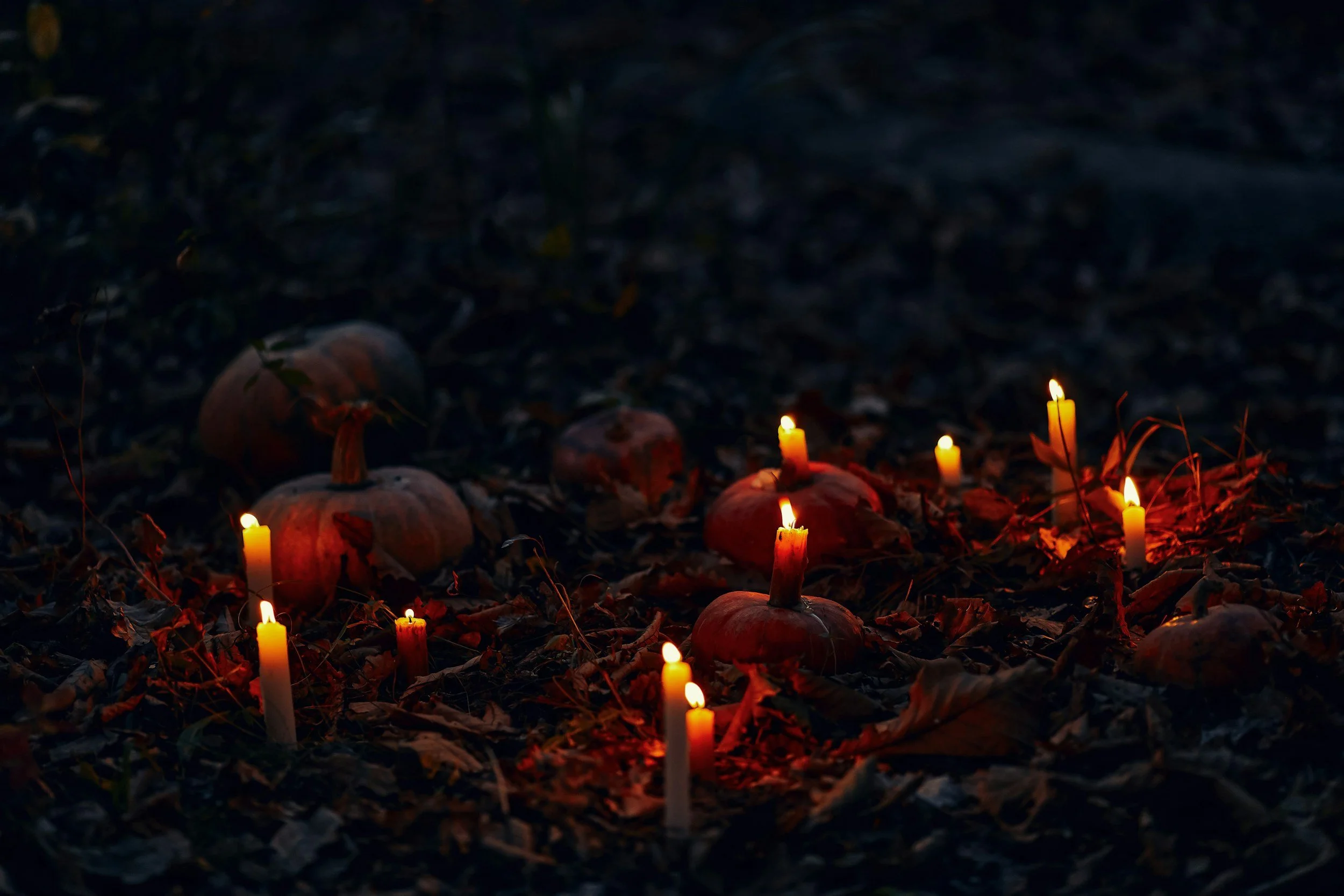
The Threshold: Where Two Worlds Touch
Before divination and before protection, there is the threshold itself — the concept that underlies everything that Samhain's magic was built upon.
In Celtic cosmology, there was no single barrier between the living world and the Otherworld. There were, instead, countless points of intersection — places where the two worlds came closest together and where movement between them was most possible. Water was one such threshold: the surface of a river or lake was a door that could open in both directions. Dawn and dusk were thresholds in time: the in-between moments, neither one thing nor the other, that fell outside the ordinary rules of both day and night.
Doorways were thresholds in the most literal sense. The lintel and frame of a door marked the border between the protected interior world and the uncontrolled exterior one — between the domestic and the wild, the known and the unknown. This is why so much apotropaic magic — magic designed to ward off harm — was concentrated at the physical thresholds of homes: the doorposts, the hearth, the windowsill, the space beneath the front step.
"A threshold is not just a door. It is a declaration: here, the ordinary rules still hold. Step outside, and they may not."
At Samhain, the cosmic threshold between the living world and the dead one reached its annual low point — its thinnest, most permeable state. This meant that all other thresholds were amplified. A crossroads on an ordinary night was liminal. A crossroads on Samhain night was a place of genuine power and genuine danger, a spot where the worlds pressed so close together that divination was easy and encounter with the supernatural was almost inevitable.
The ancient Celts did not find this alarming so much as they found it actionable. If the threshold was where power concentrated, then the threshold was where you worked. You placed your wards at the door. You did your divination at the well or the crossroads. You lit your fire at the highest point of the land, where the worlds came closest. You went to the place of power. That was always the first move.
Divination: Reading the Future at the Thinning
Because the veil was thin at Samhain, the future — normally opaque — became briefly, partially visible. Divination practices clustered around the festival in extraordinary numbers, almost all of them oriented around the questions that mattered most in the material world of the ancient Celts: Will I survive the winter? Will I marry? Will I have children? Will the coming year bring life or death?
These were not idle questions. They were the questions of people living close enough to scarcity that the answers had immediate consequence. Divination at Samhain was not a parlor game. It was intelligence gathering at the moment when intelligence was most available.
Fire Divination
The Samhain bonfire was not only protective and purifying — it was oracular. Nuts, particularly hazelnuts and walnuts, were cast into the flames and their behavior observed. A nut that burned steadily indicated a good year ahead for the person who had thrown it. A nut that cracked and spat, or that rolled away from the fire, indicated trouble or disappointment. In some traditions, pairs of nuts were cast together by young people to determine whether a partnership would thrive: if the nuts burned side by side, the couple would marry; if they popped apart, the relationship would fail.
The hazel, in particular, was sacred in Celtic tradition — a tree of wisdom, its nuts understood to contain concentrated knowledge and prophetic power. The hazelnuts of the nine sacred hazel trees in Irish mythology were said to fall into the well of Segais, where they were eaten by the salmon of knowledge. To cast a hazelnut into the Samhain fire was to bring two sources of prophetic power into contact with each other.
Picture a group of young women gathered around the edge of the Samhain bonfire, each holding a nut. Their names scratched or simply held in mind, matched to the nuts they hold. The fire is enormous — it has been burning for hours, and its heart is the color of a forge. One by one, they cast the nuts in. Some watch; some close their eyes. The fire takes each nut in turn and does what it does. Tomorrow they will talk about what they saw. Tonight they only watch, their faces lit from below, their backs in the dark.
Apple Magic
The apple was the other great Samhain divination tool — and it survived, barely transformed, into Halloween traditions that persist today.
Apple peel divination was performed by taking a single long, unbroken peel from an apple — which required both skill and patience — and casting it over the left shoulder. The shape it formed when it landed on the floor was said to reveal the initial of a future spouse. The left shoulder was significant: it was the side associated with the unseen world, the direction from which supernatural communication arrived.
Bobbing for apples — a staple of modern Halloween parties, reduced now to a children's game — was originally a form of divination about marriage and fortune. The apple was sacred: in Celtic tradition, it was the fruit of the Otherworld, the food of immortality, the offering carried by the gods. To catch one in the teeth at Samhain was to capture something of the future, to bring the Otherworld's knowledge momentarily into your mouth.
Mirror and Water Scrying
The thinning of the veil made reflective surfaces into potential windows. Mirror divination performed at Samhain midnight — the deepest point of the liminal night — was among the more daring practices: a young woman alone in a darkened room, a candle in one hand and a mirror in the other, looking for the face of the person she would marry reflected behind her own. The candle was essential. The darkness was essential. And the aloneness was essential — this was not a practice to be done with company, because what you might see in the mirror was not always the face you were hoping for.
Water scrying used the same principle: a bowl or a still pool or a well, the surface regarded in firelight or moonlight until images formed. Samhain wells were considered particularly powerful, places where the watery threshold and the temporal threshold combined. In Irish tradition, certain holy wells were associated with the dead and with second sight, and Samhain night was when their prophetic power peaked.
"The mirror showed you what the ordinary day refused to. Not always the future you wanted. Sometimes simply the truth — which was more useful, and more unsettling, than any comfortable lie."
Protection: Armoring the Home Against the Dark
If divination was the art of knowing what was coming, protection was the art of managing what arrived. The ancient Celts were not passive in the face of Samhain's supernatural traffic. They acted. They prepared. They built a system of defensive practice that covered everything from the hearth to the field boundary to the body itself.
Fire as Ward
The hearth fire was the center of the home's spiritual as well as physical warmth. At Samhain, it was essential that the hearth fire burn through the night — not only for warmth but because fire was the primary barrier against malevolent spirits. Light repelled the dark, literally and symbolically. A cold hearth on Samhain night was an undefended hearth.
The practice of carrying an ember from the community bonfire home to rekindle the domestic hearth was both practical — ensuring the fire would burn — and deeply symbolic. The household fire became an extension of the sacred community fire, connected to its power, sharing in its protective function. Every hearth in the community, on Samhain night, burned with the same flame.
Carved turnips — the predecessors of the American jack-o'-lantern, made from the large turnips that were abundant in Ireland and Scotland — were lit and placed at the thresholds of homes and carried by those who had to travel at night. The carved face served a double function: the light inside repelled spirits, and the grotesque face on the outside confused and frightened them. To confuse a malevolent spirit was to buy time. To frighten it was to turn it away from the door.
The Rowan, Iron, and Salt
Three materials held particular protective power in Celtic tradition, and all three were deployed at Samhain.
Rowan — the mountain ash — was perhaps the most widely recognized protective plant in the Celtic and broader Northern European tradition. Its red berries, resembling drops of blood, were associated with protective power. Branches of rowan were hung over doorways and in barns, particularly at Samhain, when the things that rowan guarded against were most active. Red thread was tied around rowan twigs to amplify their power. Red was the color of life and blood, the color that the dead could not easily see.
Iron was anathema to the Aos Sí and to the fairy folk more broadly — a piece of folk belief so persistent and so widespread that its origins are genuinely unclear. A cold iron nail driven into the door frame, an iron horseshoe hung above the entrance, an iron knife laid across the threshold: all of these created a barrier that the supernatural beings of the Celtic world could not easily cross. The practical explanation — that iron was a newer metal than the bronze associated with the ancient world, and that its protective power was a folk memory of technological change — is interesting but insufficient. The belief itself was what mattered.
Salt was the third. A line of salt at the threshold, salt scattered in the corners of a room, salt dissolved in water and sprinkled around the perimeter of a home: these were protective acts that crossed cultural lines so broadly that their origin is effectively prehistoric. Salt preserved meat against decay. It purified. It marked a boundary that the world of rot and dissolution — which was also, at its edges, the world of the dead — could not easily enter.
You are preparing your home for Samhain. You have lit the hearth from the community fire. You have placed a carved turnip at the door, its face pushed inward in an expression that might be ferocious or might be comic — either way, it will do the job. You have hung a rowan branch above the lintel, tied with the red thread your grandmother showed you how to use. You have swept the threshold with salt water and laid the cold iron nail in the doorpost groove. The fire is high. The table is set, with one extra place at the end. You have done what can be done. Now you wait for the night to do what it will. And you know, with the particular confidence of someone who has prepared well, that what is inside this door is protected. That the warmth here will hold. That the dead who come tonight are the ones you have invited. Not everything that knocks will get an answer.
Threshold Practices for the Living Tradition
✦ ✦ ✦
The practices above are historical. They belong to people who lived in a world where winter was genuinely dangerous and the spirit world was genuinely present and the overlap between those two facts was simply the texture of daily life. You are not those people. But you are their descendants — in culture and mythology if not in blood — and the threshold intelligence they built is available to you.
What does it mean to work with thresholds in a contemporary practice?
It means taking seriously the idea that liminal times and liminal spaces are different from ordinary ones — that dawn and dusk, full moon and new, doorways and crossroads and the space between sleep and waking, carry a quality of attention and openness that ordinary moments do not. It means bringing some form of intentionality to the transitions in your life rather than letting them pass unremarked.
It means, at Samhain, considering what protection looks like for you. Not necessarily rowan and cold iron — though neither of those would hurt — but what it means to set boundaries around what you welcome in and what you turn away. To tend your fire. To clear your space. To mark your threshold and mean it.
It means doing your divination not because you believe a nut in a fire will tell you your exact future, but because the act of asking the question — seriously, deliberately, in a ritual frame — forces you to articulate what you actually want, what you are actually afraid of, what you need to know about the year ahead. The nut in the fire is less important than the willingness to look at what the nut represents.
And it means, at the deepest level, treating the thinning of the veil as a genuine invitation to attend to what is usually background: the presence of the dead in your life, the ways they shaped you, the questions you would ask them if you could, the unfinished conversations that hover just at the edge of hearing.
"You do not need to believe in spirits to understand that Samhain is a threshold. You only need to be willing to stand at it — and to look, carefully, in both directions."
The night is thinning. The ordinary rules are loosening at their edges.
Tend your fire. Set your wards. Ask what you need to know.
The threshold is open. It always is, on this night.
Step carefully. What you find may be exactly what you came for.