Litha: The Summer Solstice, Sacred Fire, and the Crown of the Sun
Midsummer arrives the way royalty arrives — without apology, filling every available space with its presence. The days have been lengthening since December, and by June the accumulation of light has become almost overwhelming: the sky still bright at ten in the evening, the birdsong beginning again at three in the morning, the darkness reduced to a narrow, provisional corridor of a few short hours between one luminous dusk and the next. The world has been moving steadily toward this moment for six months, building its case for the sun with every degree of tilt, every extra minute of daylight, and now here it is — the zenith, the summit, the longest day. The sun has climbed as high as it can climb, and for one suspended, golden, almost unbearable moment, it stays.
This is Litha. The summer solstice festival, observed on or around the twenty-first of June, is the crown of the solar year — the moment when the sun's power is at its absolute peak, when the world is most thoroughly saturated with light and heat and the riotous productivity of summer in full stride. It is a festival of abundance so complete it contains, already, the first intimation of its own ending — for the moment the solstice passes, the days begin to shorten. The peak is also the turning point. The crown is also the beginning of the descent.
This paradox — that the sun is most powerful at the very moment it begins to retreat — gives Litha its particular emotional texture: at once triumphant and elegiac, celebratory and aware, the joy of midsummer shot through with the knowledge that this, precisely this, is the moment the year tips. To celebrate the solstice fully is to hold both things at once: the blaze of the crown and the shadow behind it.
The Longest Day: What the Sun Does at Its Height
The summer solstice occurs when the earth's axial tilt is oriented most directly toward the sun — when the northern hemisphere is leaning in as close as it ever gets, and the sun traces its longest possible arc across the sky. At the Arctic Circle, the sun does not set at all. In Britain and Ireland, it barely grazes the horizon before climbing again. In the south of England, the solstice day lasts more than sixteen hours. The sun rises in the north-northeast and sets in the north-northwest, and at its midday height it reaches an elevation that it touches at no other time of the year.
The effect on the living world is total. Plants reach their maximum growth rate in the weeks around the solstice. The wildflowers of midsummer — St John's wort, elder, meadowsweet, vervain — bloom at precisely this time, many of them associated in folk tradition with the magical properties of the solstice light. The insects are at their most abundant. The birds are feeding their second broods. The grass in the uncut meadows is waist-high and dotted with colour. Everything alive is doing, at this moment, the most living it will do all year.
"The sun at the solstice is not merely bright. It is sovereign — the unchallenged ruler of the sky, the uncontested centre of the living world, burning at a height it will not reach again for another year."
For the ancient peoples of northern Europe, for whom the relationship between sunlight and survival was immediate and practical — crops needed light to grow, animals needed warmth to thrive, the entire agricultural enterprise depended on the sun doing its work — midsummer was not an occasion for abstract appreciation. It was the peak of the year's promise. Everything the planting season had been working toward was now visible, growing, on its way to the harvest. The anxiety of spring — would the warmth arrive? would the seeds take? would the cattle survive the transition? — had resolved into the profound, physical satisfaction of a world in full production. The sun had delivered on its promise. It was worth celebrating with fire.
Litha: The Name and Its Mysteries
The name Litha is both ancient and, in its current usage, surprisingly recent. The Venerable Bede, in his eighth-century treatise on the reckoning of time, named the Anglo-Saxon months of June and July Ærra Liða and Æftera Liða — the earlier Litha and the later Litha — indicating that the word referred to the midsummer period broadly rather than to a single day. The etymology of liða is debated: some scholars connect it to a word for gentle or navigable, reflecting the calm seas and favourable winds of the summer months; others link it to a root meaning to go or to travel, the season when movement and trade were easiest.
The name Litha was revived and popularized by the mid-twentieth century neo-pagan movement, particularly through the work of Aidan Kelly, who coined the eight-sabbat Wheel of the Year that most contemporary Wiccans and pagans follow. In this context, Litha sits at the solar zenith of the wheel, directly opposite Yule, as the two solstices face each other across the year: one the longest night, one the longest day, each defining the other by contrast. You cannot fully understand the summer solstice without the winter one behind it. The crown of the sun is brightest against the memory of the darkest night.
The festival is known by many names across cultures. In Scandinavia it is Midsommar or Midsummer, one of the most important holidays of the Nordic year. In the Christian calendar it was absorbed as the Feast of St John the Baptist, celebrated on June 24th — the midsummer feast displaced by three days in the same way Christmas displaced the winter solstice, the Church's calendar laid carefully over the older one. In Slavic tradition it is Kupala Night, a festival of fire and water and the midsummer herbs that will be most potent, gathered at the peak of the sun's power. The names differ. The fires are always the same.
Stonehenge: A Monument to the Moment
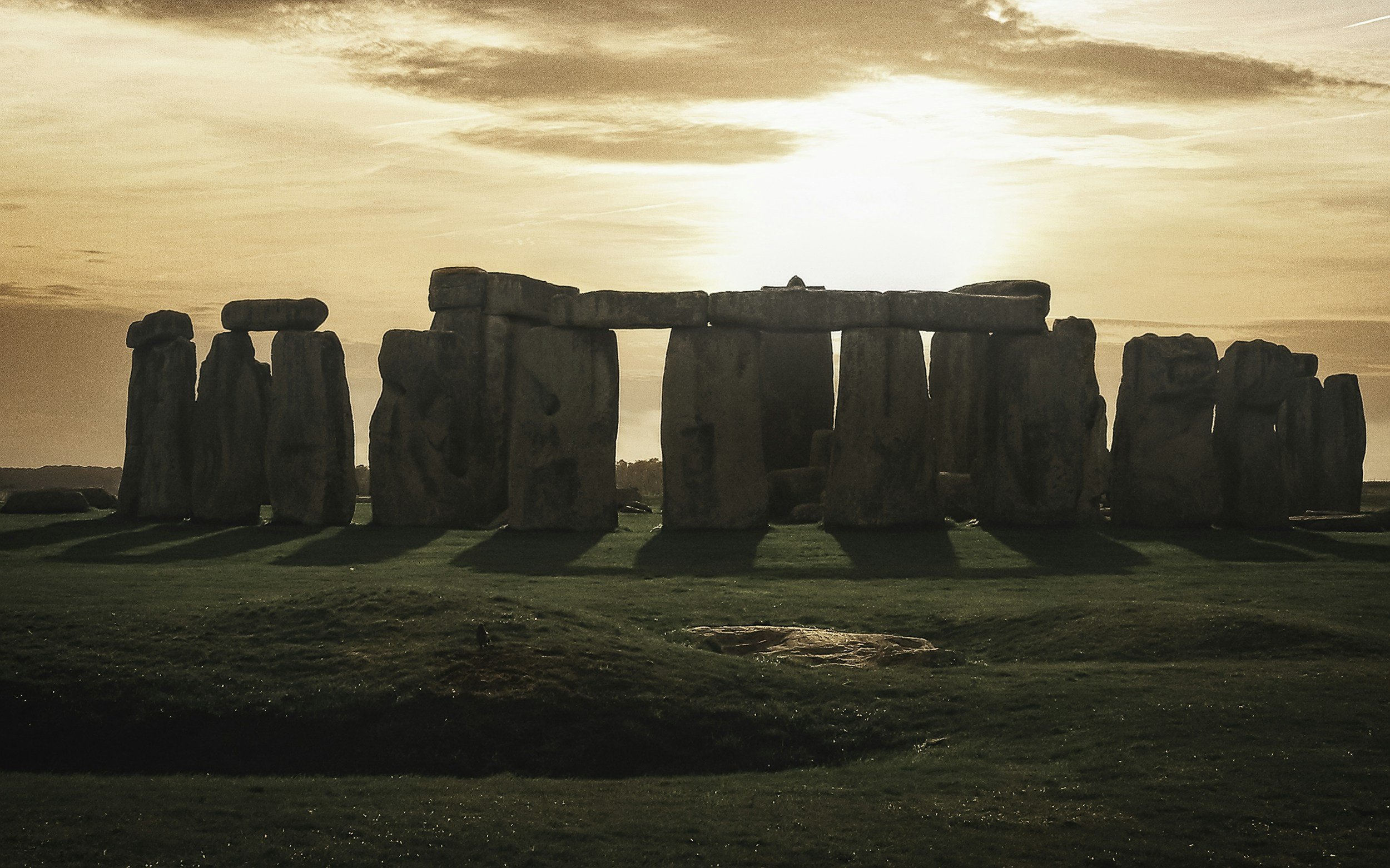
Thirty-two miles north of Salisbury, on the open chalk downland of Wiltshire, stands one of the most extraordinary human constructions ever attempted: a ring of massive standing stones, some weighing twenty-five tons, arranged with a precision that has fascinated and baffled observers for centuries. Stonehenge was built in several phases between approximately 3000 and 1500 BCE, its construction representing an investment of labor so vast it is almost impossible to comprehend from our own perspective of powered machinery and industrial logistics. And at its heart, embedded in its design from the earliest phases, is the summer solstice.
The axis of Stonehenge is oriented precisely toward the sunrise on the summer solstice. Standing at the centre of the monument on the longest morning of the year and looking northeast through the great trilithon archways, you see the sun rise directly over the Heel Stone — a single upright stone positioned outside the main circle — in a alignment so exact that it can only be deliberate, and so spectacular that it has drawn crowds of solstice observers to Wiltshire every June for five thousand years, with only a few decades of interruption.
It is 4:52 in the morning on the twenty-first of June. The sky above Salisbury Plain is already pale, a luminous grey-blue that is not quite dark and not yet day. Around Stonehenge, forty thousand people have gathered through the night — some in sleeping bags, some in elaborate costumes, some in white robes, some in jeans and wellington boots, some carrying drums and some carrying thermoses of tea. The drums have been sounding since midnight. The crowd shifts and murmurs. And then: the first sliver of the sun, rising exactly over the Heel Stone, throwing a shaft of gold directly through the heart of the monument. The drums become a roar. People weep. It is the same sun, rising at the same point, that it has risen at for fifty centuries. Something about this is not merely beautiful. It is necessary.
Stonehenge is the most famous but by no means the only Neolithic monument oriented to the midsummer sunrise. The great stone circles and megalithic structures of the British Isles, Brittany, and Scandinavia show a consistent preoccupation with the solar calendar — with marking, in stone that would outlast any individual or dynasty, the turning points of the year. These monuments are the physical expression of a conviction that the sun's movements mattered enough to organize an entire civilization around: that the moment of the solstice was not merely an astronomical event but the axis on which the world of meaning turned.
The Midsummer Fires: Burning at the Peak
The midsummer bonfire is one of the most geographically widespread customs in European folk tradition. From the Irish St John's Eve fires to the Spanish Noche de San Juan bonfires along every beach of the peninsula, from the Swedish Midsommar to the Latvian Jāņi, from the Norwegian Sankthansaften to the Breton Fest Sant Yann — the pattern recurs with a consistency that points to deep common roots. On or around the summer solstice, communities gathered at height — on hilltops, on clifftops, beside rivers and lakes — and lit fires that blazed through what was left of the brief midsummer night.
This seems, at first, paradoxical. Why build fires at the moment of maximum sunlight? Why add human flame to the peak of solar power? The medieval Church explained the custom as a tribute to St John, born six months before Christ just as the Baptist's ministry preceded the Saviour's. But the fires are far older than the Christian explanation, and their logic is deeper. The midsummer fire was sympathetic magic: fire calling to fire, the human flame reaching toward the solar one, the community participating in the sun's own power rather than merely receiving it passively. You did not watch the sun at its height. You matched it.
Across the tradition, the midsummer fires share a cluster of associated practices. Wheels of fire — great cartwheels wrapped in straw and set alight — were rolled down hillsides toward rivers, the arc of their falling echoing the coming arc of the sun's decline. Torches were carried sunwise around the fields and the cattle, the moving fire tracing the path of the sun around the things it was meant to protect. Herbs gathered on Midsummer Eve — St John's wort above all, but also vervain, yarrow, and elder — were dried in the smoke of the fire or hung in the home, their potency maximized by the peak of the solar year. The dew collected from grass and flowers on midsummer morning was believed to carry healing properties, concentrated by the most powerful night of the year.
"The midsummer fire was not lit in ignorance of the sun's power. It was lit in full acknowledgement of it — a human declaration that we too burn, that we too reach toward the light, that we are participants in this brightness and not merely witnesses to it."
The Fairy World at Midsummer
At the two great hinges of the Celtic year — Samhain and Beltane — the veil between the human world and the Otherworld was believed to thin. Midsummer, though not one of the four great Celtic fire festivals, carried its own supernatural charge: the fairy world was dangerously active on the solstice night, the sídhe open and their inhabitants abroad in the summer darkness. The midsummer fires served partly to hold this presence at bay, partly to appease it, and partly — in some traditions — to welcome it with due ceremony and caution.
It is from this tradition that Shakespeare drew when he set A Midsummer Night's Dream on the solstice night: Oberon and Titania quarrelling over the mortal world, Puck moving between the fairy and human realms with casual ease, the ordinary laws of reality suspended for one luminous, bewildering night. The play is a comedy, but its supernatural architecture is built on genuine folk belief: midsummer was a night when the world shifted on its hinges, when you might encounter things in the forest that had no business being there, when love potions worked and donkey heads appeared and the Queen of the Fairies fell in love with a weaver. The longest day produced the strangest night, and the strange night was when the boundaries gave way.
The fern flower — a magical bloom said to appear only at midnight on midsummer eve, granting the finder great powers of second sight, knowledge of hidden treasures, and access to the fairy world — is one of the most widespread of European midsummer folk beliefs. That ferns do not flower in any biological sense only made the legend more potent: this was a miracle specifically available at this one moment of the year, to the person who stayed awake until midnight in the right wood, at the right fairy mound, with the right preparation. The impossible bloom, visible only at the peak of the sun's power, in the brief dark at the heart of the longest day. Midsummer magic was always the magic of the threshold: the most light, the most dark, the most possible, all at once.
Midsommar: The Nordic Festival of Light
In Sweden, Midsommar is the second most important holiday of the year, surpassed only by Christmas — a ranking that tells you something essential about how deeply the solstice is wired into the culture of northern peoples for whom the summer light, after the long Scandinavian winter, is not merely pleasant but lifesaving. Swedish Midsommar, celebrated on the Friday and Saturday between June 19th and 26th, centres on the raising of the midsommarstång — the midsummer pole, a cousin of the maypole decorated with flowers and greenery — around which communities gather to sing and dance in patterns that have been continuous for centuries.
The food is particular to the season: the first new potatoes of the year with dill and sour cream, pickled herring in several preparations, strawberries in abundance — the strawberry being the first fruit of the Swedish summer, arriving precisely at midsummer and carrying with it the full emotional charge of summer's arrival. There is aquavit, drunk in ritualized toasts accompanied by traditional drinking songs. There are flower crowns woven from whatever is blooming — as specific to the day as the hawthorn is to Beltane. The midsummer meal is not merely food. It is the taste of the longest day, the flavor of what the sun has been building toward since the darkness of midwinter.
A meadow in Dalarna, Sweden, nine o'clock in the evening on Midsommar. The sun is still fully above the horizon, the shadows long and golden across the grass. Around the flower-wound midsommarstång, three generations of one family are dancing the frog dance — a comical, beloved sequence that adults perform with the slightly self-conscious abandon of people who have been doing this since childhood. The youngest child, two years old, watches from her grandfather's arms with an expression of solemn concentration. She does not know yet what this is or why they do it. By the time she is old enough to wonder, it will already be too deep in her to question.
St John's Eve: The Christian Midsummer
The Feast of St John the Baptist — celebrated on June 24th, three days after the solstice — was the medieval Church's primary midsummer observance, and it absorbed the older fire customs with characteristic fluency. The St John's Eve fires burned across Catholic Europe from Ireland to Portugal, from Poland to Sicily. They were explained theologically as celebrating the light that came before the greater light: John the Baptist as the herald of Christ, the midsummer fire as the anticipation of the eternal fire.
But the folk practices that attached themselves to the feast were resolutely older than any theological explanation. The jumping of the St John's fires carried exactly the same logic as the Beltane fire-jumping: purification, protection, the body passing through fire to be cleansed. The herbs of St John — particularly St John's wort, Hypericum perforatum, its tiny yellow flowers dotted with what look like perforations that release a deep blood-red oil when pressed — were gathered precisely on this feast day for their maximum potency. The dew was collected. The bonfires burned on hilltops. The wheels of fire rolled down toward the rivers.
In Ireland, the St John's Eve fires became one of the most beloved of the midsummer customs, surviving in many areas into the mid-twentieth century. Communities built and lit their fires on the evening of June 23rd, the young people gathering the materials — straw, furze, old timber — for weeks in advance, a festive collection that was its own rite of community participation. The fire was a communal act: built together, lit together, gathered around together, its ashes carried home by individuals to protect their households. The collective and the personal woven together in a single night of warmth and light at the summit of the year.
Kupala Night: Fire, Water, and the Midsummer Herbs
In the Slavic world — across Russia, Ukraine, Belarus, and Poland — the summer solstice festival is known as Kupala Night or Ivan Kupala, a celebration of such antiquity and such distinctive character that it stands as one of the most fully developed of all the European midsummer traditions. Its name combines Ivan — the Slavic form of John, the Christian veneer — with Kupala, derived from a root meaning to bathe or to wash, the pre-Christian kernel.
Kupala Night is structured around two elements: fire and water. Bonfires are lit at the river's edge. Young people leap over the fires in pairs — lovers who successfully jump the fire together, hand in hand, without their hands parting, are said to be bonded for life. After the fire-leaping, immersion in the river: the purification of water following the purification of flame. The two elements that the summer world holds in balance — the heat and dryness of midsummer, the rivers running low but still present — are honoured simultaneously, their opposition resolved in the human body that passes through both.
Flower crowns are woven and set floating on the river — a divination practice, their direction telling something about the year ahead. The fern flower is searched for in the woods at midnight. Herbs collected by the light of the midsummer fires are dried and kept for healing through the year. Kupala Night holds all of it at once: the joy and the danger, the fire and the river, the love and the supernatural, the long daylight and the brief, magic-loaded dark — all compressed into a single solstice night that feels, even to its modern participants, like something the world itself is doing rather than something they have organized.
The Shadow Behind the Crown
There is a teaching embedded in the summer solstice that the festival's exuberance can make easy to overlook, but that the most thoughtful practitioners of midsummer have always understood: the peak is the beginning of the turn. From the morning after the solstice, the days begin to shorten. Not by much at first — the change is imperceptible for weeks, the warmth of midsummer continuing to deepen into July and August even as the light quietly retreats from its high point. But the turn has begun. The sun that stands at its crown on the solstice is already, in that same moment, beginning the long arc back toward winter.
This is the paradox that gives Litha its depth. The Wheel of the Year is not a simple progression from darkness to light — it is a continuous cycle in which every peak contains its opposite already germinating. The winter solstice is the longest night, but it is also the moment from which the days begin to lengthen. The summer solstice is the longest day, and it is the moment from which the nights begin to lengthen. The wheel does not allow rest at the summit. It turns continuously, and the summit is also the descent.
In the ancient mythologies of the British Isles, this paradox was expressed through the combat of the Oak King and the Holly King: twin figures who battle at each solstice, the winner ruling the half-year that follows. At Yule, the Oak King defeats the Holly King and rules the waxing year, the half that runs toward light. At Litha, the Holly King takes his revenge: the Oak King falls, and the dark half of the year begins its long, slow return. The summer bonfire was lit, in this mythological frame, both to celebrate the Oak King's reign at its height and to mourn him at his fall — the fire his funeral pyre as much as his crown.
"The Oak King burns at midsummer with all his accumulated power, and in that burning he is both most alive and already ending. Litha teaches what every peak teaches: to hold the glory and the loss in the same open hands."
The Living Practice of the Long Day
Contemporary celebrations of Litha range from the vast — forty thousand people at Stonehenge for the solstice sunrise, a gathering that has reclaimed the ancient monument as a living place of worship rather than a heritage site to be viewed from behind a rope — to the quietly personal: a single candle lit at the window, a walk through the longest evening, a moment of deliberate attention paid to the quality of the midsummer light on a familiar garden wall.
Neo-pagan and Wiccan celebrations of Litha typically involve fire — a bonfire if possible, candles if not — herbs gathered and blessed at the solar peak, offerings of mead and honey in acknowledgement of the summer's abundance, and rituals of gratitude for what has grown since the dark of Yule. It is a festival of completion and of full presence: to be entirely here, in this brightness, on this longest day, without rushing past it toward the autumn and its harvest. The harvest will come. The summer solstice asks you, before it does, to stop and be exactly where the year has brought you.
This is perhaps the deepest gift of the summer solstice: the invitation to be present at the peak, to resist the modern compulsion to hurry forward even in the midst of abundance, to stand in the longest day and feel its full length, its full warmth, its full gold. To look at the light and not think about what comes after the light, but to receive it wholly, to let it do what sunlight does to the body and the spirit when you stop filtering it through the screen of what you still need to do.
The Sun, at Its Height
Here is what the solstice is, stripped to its physical reality: a moment of maximum tilt, a point in the orbit where the geometry of the earth's angle and the sun's position produces the most daylight the northern half of the world will receive all year. It lasts for one astronomical instant. Then the tilt begins, almost imperceptibly, to reverse. The long decline toward Samhain, toward Yule, toward the dark at the bottom of the year, begins.
And yet. Go outside on the solstice eve and build a fire, or find one, or simply sit on the grass in the long golden evening and watch the light persist past all reasonable expectation — ten o'clock and the western sky still rose-and-amber, the bats only just beginning to appear, the first stars still invisible in the sky's residual brightness. Feel the warmth still radiating up from the earth, stored from the long day. Hear the night birds beginning. Notice, as the darkness finally, slowly, conditionally arrives, how much lighter it is than winter dark — how the sky never quite commits to full black, how even at midnight there is a luminous quality to the air, as though the sun has left some part of itself behind.
The ancient people who lit their fires on the hilltops, who rolled their burning wheels toward the rivers, who gathered their midsummer herbs and leaped their solstice flames and watched for the fern flower in the midnight woods — they were doing something very simple and very large. They were saying: we see you. We know what you are doing. We know this is the peak and we know the descent begins now, and we are not afraid of it, because we have been here before, and we know what the wheel is. We light our fire at your crown, great sun. We match your brightness with our own, small and human as it is, and we carry it into the dark half that follows, all the way to the bottom, all the way to Yule, where we will light it again, and wait.
The sun stands still.
Then it turns.
It has always turned.