Beltane: The Fire Festival of Desire, Protection, and Power
There is a particular quality to the first days of May that is unlike any other moment in the year. The hesitation of spring is finished. The long negotiation between cold and warm, between grey and green, between the world almost ready and the world not quite yet — all of that is resolved, suddenly, completely, in a burst of leaf and blossom and birdsong that seems less like gradual progress than like a declaration. The hedgerows foam white with hawthorn flowers. The grass is the aggressive, implausible green of something that has been waiting all winter to be exactly this color. The air smells of the earth at full power, warm and alive and loaded with pollen. Summer has not arrived by stealth. It has arrived with flags.
This is the season of Beltane. The great fire festival of the Celtic world, falling on the first of May at the precise midpoint between the spring equinox and the summer solstice, is the loudest and most exuberant of the four great fire festivals — the counterpart to Samhain that stands across the wheel of the year from it, as different in character as the seasons they mark. Where Samhain turned inward toward the dead and the dark, Beltane blazed outward into the living world, into the body, into the fierce, uncomplicated joy of everything growing at once.
Its name carries its meaning plainly. Beltane — Bealtainn in Scottish Gaelic, Bealtaine in Irish — is generally understood to derive from the Old Irish Bel teine: the bright fire, the lucky fire, or — in one compelling interpretation — the fire of Bel, a Gaulish solar deity whose name surfaces across the Celtic world. The fire of the bright god. The fire that celebrates light at its most insistent, most triumphant, most alive.
The Hinge of Summer
The Celtic year, as we have seen across the wheel's other festivals, was not organized around the solstices and equinoxes but around the pastoral and agricultural turning points that fell between them. Beltane marked the beginning of the light half of the year — the moment when summer was declared, when the cattle were driven from their winter enclosures to the high summer pastures, when the world of outdoor life, of warmth and abundance and long evenings, officially began.
This was a moment of immense practical significance. The cattle were the wealth of the community — their milk, their meat, their hides, their labor were the material foundation of Celtic life. After a long winter of indoor housing on dwindling stores of hay and feed, driving the cattle to the summer pastures was one of the most consequential acts of the agricultural year. And it was done through fire. The Beltane fires were not merely symbolic. They were the mechanism of the ritual — the cattle driven between two great bonfires, the smoke and heat purifying them of any illness or ill-fortune accumulated over the winter months, protecting them for the summer ahead.
"The Beltane fires were not lit to celebrate summer. They were lit to make summer safe — to arm the living world against whatever dark things still moved in the warm nights at the edge of the known."
The structural parallel with Samhain is precise and deliberate. At Samhain, the cattle came in from the summer pastures, and the world contracted toward the hearth and the fire. At Beltane, they went out again, and the world expanded — into the fields, into the hills, into the long evenings and the warm nights. The wheel of the year, at these two great hinge-points, pivoted on the movement of the herds. The sacred calendar was, at its root, an agricultural calendar, and the god in it was the survival of the community through winter and its flourishing in summer.
The Great Fires of Uisneach
In Irish tradition, the great Beltane fires were lit first on the Hill of Uisneach in County Westmeath — the sacred centre of Ireland, the mythological navel of the island where the five ancient provinces met. From Uisneach, the fire spread outward, hilltop to hilltop across the country, in a network of beacons that mapped the whole island in light. Every community, every household, would extinguish its hearth fire on Beltane eve — as at Samhain — and rekindle it from the sacred flame carried from the nearest hilltop beacon.
The Hill of Uisneach is associated in myth with the goddess Ériu — one of the three sovereignty goddesses of Ireland, whose name gives the island its name — and with the god Lugh and the druid Mide, who is said to have kindled the first fire there at the very beginning of Irish history. It was a place of enormous ritual significance, a site where the sacred geography of the island concentrated itself. To light the Beltane fire at Uisneach was not merely to start a beacon. It was to perform the annual act of sovereignty: the king's relationship with the land renewed, the contract between the community and the sacred world reaffirmed, the summer properly inaugurated.
Stand on the Hill of Uisneach at dusk on the first of May and look outward in every direction. The country spreads below you in every shade of the green that May produces — the blue-green of the distant hills, the bright acid-green of the new grass, the darker green of the hedgerows and the patches of forest. The sky to the west is still luminous, rose and amber above the Atlantic. And then the first fire catches on the summit behind you, and you see, one by one in the gathering dark, the answering fires: north, south, east, west, each one kindled from the next, the whole island breathing in and out in a single breath of flame.
The extinguishing and rekindling of household fires was not a casual custom. It was a profound communal act. For the duration of Beltane eve — the night before the festival — the houses of the community were cold and dark, their hearths empty. The community was, temporarily, without its central domestic warmth, without the fire that cooked its food and kept its children warm and held back the dark. This vulnerability was deliberate. The household fire, relit from the communal sacred flame, returned to each hearth carrying the charge of the entire community's ritual intention — not merely heat, but the collective will to flourish through the summer ahead.
The Hawthorn and the Door of the Otherworld
If any single plant belongs to Beltane, it is the hawthorn — the May tree, the white thorn, the flower that gives the month of May its common name in the British Isles. The hawthorn blooms at almost exactly Beltane, its dense white blossoms covering the hedgerows in a froth of small flowers that carry one of the most distinctive scents in the temperate world: sweet and heavy and, to many noses, faintly unsettling, carrying an undertone that is not quite floral, something older and wilder beneath the sweetness.
The hawthorn was, in Celtic tradition, one of the most powerful and most dangerous plants in the landscape. It was sacred to the fairy world — specifically to the Aos Sí, those supernatural beings of the mounds and the hollow hills who were so central to the Samhain mythology. Solitary hawthorn trees growing in fields were known as fairy thorns, and to cut one down was to invite disaster. They marked the entry points to the Otherworld. They stood at the boundary between the visible and the invisible. The Beltane hawthorn brought into the house was both a celebration and an appeasement: the living world at its most beautiful, the fairy world acknowledged, the boundary between them observed.
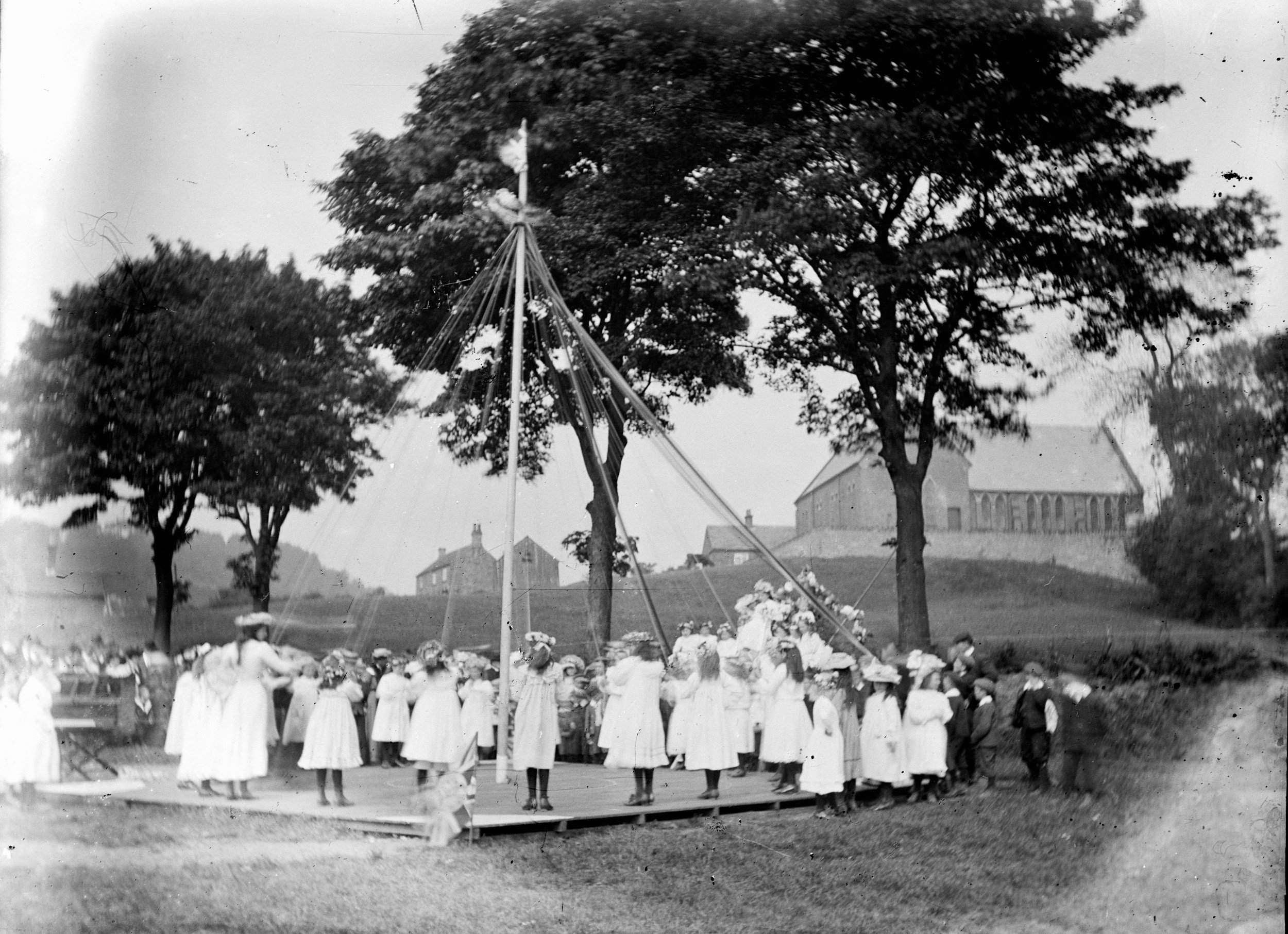
The old English custom of "going a-Maying" — going out into the fields and woods in the early morning of May Day to gather hawthorn branches, flowers, and greenery to bring into the house and decorate the doorways — is one of the most persistently documented of all spring customs, surviving well into the early modern period even as its pre-Christian roots were generally forgotten. The maypole itself was a May tree: a tall pole decorated with flowers and ribbons, set up in the village centre as a focal point for the May Day dances, its origins in the sacred trees of the old religion.
"The hawthorn did not merely signal that Beltane had come. It was itself the threshold — beautiful and dangerous, smelling of the Otherworld, standing exactly at the border between what is safe and what is wild."
Desire and the Body in the Festival
Beltane was, among all the festivals of the Celtic year, the one most openly and unapologetically associated with human sexuality. This is not a modern reinterpretation or a romantic embellishment. The historical and folkloric record is consistent and widespread: Beltane was a time of loosened social constraint, of young people going out into the fields and the woods — particularly on Beltane eve — and returning the next morning with the greenery that decorated the houses and, in many accounts, with considerably more experience of the world than they had had the night before.
The Puritan minister Philip Stubbes, writing in 1583, was scandalized by the May Day customs he observed in England: the young people going into the woods overnight, the maypole dancing that he read as a form of pagan idol worship, the general loosening of morality that the season seemed to license. He estimated that of every hundred young women who went out on May Eve, scarcely a third returned with their virtue intact. The number was certainly an exaggeration. The observation that something was happening was not.
The sexual energy of Beltane was not incidental to the festival — it was theologically continuous with it. A world in the full eruption of spring fertility, of animals mating and plants in riotous bloom, of every living thing engaged in the urgent business of reproduction — the human body's participation in that fertility was understood as part of the same sacred process. To make love at Beltane was not a lapse in piety. It was an act of sympathy with the world's own great desire to perpetuate itself.
Go out into the fields on a warm May evening, when the hawthorn is in full bloom and the last light is golden in the long grass. Listen: the birds are still singing at nine o'clock, ten o'clock, the darkness slow to come and slower to settle. The air is warm and loaded with pollen and the smell of the flowering hedgerows. The world is at its most aggressively alive — not the tender beginning-life of early spring, but the full-throated, unself-conscious life of May, the life that does not wonder whether it is doing it right. It simply is. It simply goes on being. There is a reason human beings, for millennia, went out into this world on this particular night and participated in it with their whole bodies.
The Green Man and the Lord of the Wood
Look carefully at the carved stone faces that appear in medieval churches across Britain and northern Europe — faces half-hidden in foliage, faces from whose mouths branches grow, faces assembled entirely from leaves, green eyes peering from between oak and ivy and vine. These are the Green Men, and their presence in Christian sacred spaces is one of the most intriguing puzzles in the history of religious art: what is this pagan figure doing here, in this context, carved with such evident care and frequency into the stones of the new religion's most sacred buildings?
The Green Man is one of the most ancient of the archetypes that cluster around the midsummer season. He is the male principle of vegetation — the figure who embodies the forest's power, the vitality of the growing world, the spirit of summer made flesh and given a face. His name varies across traditions: Cernunnos the antlered god of the Celts, the May King, Jack-in-the-Green, the Lord of the Greenwood. But his essential character is consistent: he is the world in its full summer potency, untamed and sovereign, ruling the season of growth with a power that is entirely natural and entirely not safe.
In Beltane ritual — particularly as reconstructed and revived in the contemporary Celtic pagan tradition — the Green Man or May King is paired with the May Queen, and their union represents the sacred marriage between the male and female principles of the natural world: the land and its sovereign, the forest and the goddess, the seed and the soil. It is a hieros gamos — a holy marriage — one of the oldest ritual forms in human religious practice, the union of opposites that creates abundance from their joining.
The Maypole: Dance at the Axis of the World
The maypole stands at the centre of the village green with a confidence that its origins do not entirely deserve — it has been explained, re-explained, bowdlerized, and enthusiastically revived so many times that disentangling what it originally meant from what various centuries have decided it means is a project for the extremely patient. What we know is this: a tall pole, decorated with flowers and long colored ribbons, set up on May Day, around which the community danced in patterns that wove and interwove the ribbons into a complex braid around the pole — and then danced in reverse to unwrap them.
The maypole is almost certainly descended from the Germanic custom of bringing a decorated tree — the May tree — into the village as an embodiment of the summer's returning fertility. The pole as the world-axis, the axis mundi around which the community organized itself, is a concept so widespread in human religious thought that it appears independently in traditions around the world: the Norse Yggdrasil, the Siberian shaman's pole, the Hindu Mount Meru, the sacred pole of the Plains peoples of North America. To dance around the maypole was to participate in the ordering of the world — to weave your own life into the pattern of the year, your movement part of the seasonal rhythm. The ribbons, woven and unwoven, were the threads of the community's connection to each other and to the living world they shared.
The Puritans were so alarmed by maypole dancing that they had the poles banned in England in 1644, only for them to be restored with considerable popular enthusiasm at the Restoration in 1660. In 1661, a particularly magnificent maypole was erected in the Strand in London — 134 feet tall, the tallest in England — to celebrate the return of the king and the return of the old seasonal pleasures simultaneously. The festival and the political act were one: to restore the maypole was to restore the living relationship between the people and their world.
The Thinning Veil in the Season of Life
Beltane shares with Samhain the characteristic of a thinned boundary between the human world and the Otherworld — a fact that is easy to overlook in the festival's more exuberant aspects. The fires, the fertility, the maypole dancing, the going out into the May-morning fields: all of this speaks of vitality, of the world overflowing with life. But the Celtic tradition held that the veil between worlds was thin at both the dark hinge and the light one, and Beltane's supernatural dangers were real.
The Aos Sí were abroad at Beltane as at Samhain. The fairy world was active and close. Cattle could be fairy-struck — afflicted with mysterious illness by supernatural agency. Milk could be stolen — the cream taken overnight by beings who left only a thin bluish liquid behind. Children could be exchanged for changelings. The Beltane fires, the rowan branches hung above doorways, the offerings left at threshold and well — these were not merely celebratory. They were protective. The same fires that celebrated summer's beginning also held the uncanny at bay.
Beltane's wildness was not only the wholesome wildness of spring fertility. It was also the wildness of a world where the boundaries had temporarily dissolved — where things moved between realms that were ordinarily separate, where the beautiful and the dangerous occupied the same night, the same field, the same hawthorn tree. The ancients held both possibilities simultaneously, without the need to resolve them into a single, comfortable narrative. The festival contained both the joy and the caution. It asked you to celebrate and to stay alert in the same breath.
"The same fires that declared summer also declared a border. Come this far, they said to the dark things. Come this far into our light, and no further."
May Day, Labour, and the Politics of the Living World
On the first of May, 1886, workers across the United States went on strike in what became the Haymarket affair — a turning point in the history of the labor movement, and the origin of International Workers' Day, observed on May 1st across most of the world. The coincidence of date with the ancient Celtic fire festival is precisely that: a coincidence. And yet the resonance is not entirely accidental. May Day as a workers' festival draws on the same cultural reservoir of May as the season of communal celebration, of the common life of the body, of shared labor and shared plenty.
The folk customs of May Day — the communal dances, the shared fires, the deliberate suspension of the ordinary social hierarchy in favor of something more elemental — carry in their bones the memory of a world in which the first of May was a moment of communal assertion: we are here, we are alive, we are together, and the summer belongs to all of us. The political May Day and the pagan Beltane are not the same thing. But they breathe the same air.
The Edinburgh Beltane Fire Festival — revived in 1988 on Calton Hill and held annually on the last night of April — has become one of the most spectacular contemporary observances of the old festival: a procession of fire performers, dancers, and costumed figures moving through the night-time hilltop, the ancient hill above the modern city ablaze with torchlight and drumming. Tens of thousands of people gather in the cold April night on a hill in the middle of a capital city to watch fire dancers perform an ancient rite, and the ancient rite, stripped of its agricultural context, retains something essential: the community gathering around the fire, declaring the summer, choosing life.
The Sacred Marriage of the World
Contemporary Beltane celebrations in the neo-pagan and Wiccan traditions centre on the sacred marriage — the union of the May King and May Queen, the God and the Goddess, the male and female principles of the natural world joining in the great creative act that sustains life. This is celebrated through ritual that ranges from the symbolic — a cup and a blade, representing the feminine and masculine in ritual union — to the fully theatrical enactments of the Edinburgh festival and similar revivalist observances.
Altars at Beltane are dressed in the colors of fire and spring: gold and green, red and white, the colors of flame and hawthorn flower. Offerings are made of milk and honey, of flowers and early herbs. Fires are lit — small ones now, in fire pits and on beaches, the cattle long since replaced by more symbolic forms of purification — and people jump them in the old gesture of cleansing and protection, of passing through fire into the new season carrying less of the old one's weight. The gesture persists because what it expresses persists: the desire to be renewed, to enter summer clean, to leave the winter's accumulated heaviness behind in the fire and step through to the other side lighter.
Seeds planted at Ostara are now visible in the ground. The garden is asserting itself. The days are long enough that dinner can be eaten in the evening light. The body, which contracted and withdrew through the cold months, begins to remember its appetite for the outdoors, for movement, for other bodies, for the particular pleasure of warm air on bare skin. This is not metaphor. It is physiology, and the ancient world read it as sacred — the body's own seasonal wisdom, its conversation with the turning year.
Into the Fire
Here is what Beltane asks of you, underneath all the mythology and the history and the careful scholarship: it asks you to go outside on a warm May evening and feel the world. Not to observe it from a respectful distance. Not to appreciate it aesthetically, from behind the glass of analysis. To actually go out into it, into the smell of the hawthorn and the warmth of the air and the sound of the birds still singing long past dark, and let it do what it is trying to do — which is to wake you up.
The world at Beltane is not subtle. It is not asking to be interpreted or decoded. It is declaring itself with everything it has: every flower open, every bird singing, every green thing reaching as hard as it can toward the light. The appropriate response to this declaration is not analysis. It is participation. It is the willingness to be as alive, in this moment, as the world is being around you — to let the fire of May into your body and burn away whatever is left of winter there.
The ancient Celts understood this instinctively. They did not merely observe the arrival of summer — they entered it through fire, literally and ritually, their bodies passing through the heat and smoke of the Beltane fires and emerging on the other side into the long golden summer half of the year. The fire was the threshold. The fire was the declaration. The fire was the act of choosing, collectively and joyfully, to be alive in the season of life.
Go out. Find a fire, or make one. Watch the sparks rise into the May night and disappear into the dark between the stars. Feel the heat on your face and the cold of the night air on your back simultaneously — that particular Beltane sensation of standing exactly at the border between warmth and dark, between the safe light of the fire and the wild invitation of the summer night beyond it.
Step through.
Summer is waiting.