Imbolc: Sacred Flame, Cleansing, and the First Signs of Spring
February is a difficult month to love. The first excitement of winter has long since faded, the festivities of the solstice are a cold memory, and spring — truly, visibly, undeniably spring — still lies weeks away. The world looks spent. The fields are grey and sodden, the trees remain stripped bare, the light is thin and watery and offers little warmth. And yet. If you know how to look — if you press your palm to the earth and hold very still — you can feel it. Something is moving. Something has decided, quietly and without announcement, that it is time.
This is Imbolc. Not the loud, fire-crowned drama of Samhain or the defiant mid-winter blaze of Yule, but something subtler and, in its own way, more astonishing: the first whisper of return. The Celtic festival of early February occupies a unique place in the wheel of the year precisely because it asks you to believe before there is much visible evidence. It is a festival of faith in the world's willingness to begin again.
Its name is ancient, rooted in Old Irish, and its etymology carries everything you need to understand what the festival is about. Imbolc most likely derives from the Old Irish i mbolg — meaning "in the belly." Some scholars also connect it to a word for ewe's milk, oimelc. Both meanings point to the same reality: the lambs are coming. The ewes are heavy with young. The first milk of the season is flowing. Winter has not yet released its grip on the land, but life, deep in its animal warmth, is already moving forward.
A Festival in the Belly of Winter
Imbolc falls at the midpoint between the winter solstice and the spring equinox — approximately February 1st in the modern calendar, though the Celts would have observed it according to the moon and the behavior of the land itself rather than any fixed date. It is one of the four great fire festivals of the Celtic year, alongside Samhain, Beltane, and Lughnasadh, each one marking not an astronomical event but an agricultural and pastoral turning: the points at which the living relationship between humans, animals, and the earth actually shifted.
For a farming community in ancient Ireland or Scotland, Imbolc was not an abstraction. It was a life-or-death threshold. The stores of food laid in before winter — grain, salted meat, dried herbs, root vegetables — were at their most depleted. The months of cold had taken their toll. Animals that had been wintered indoors were weakened and needed careful management. And yet here, at the very lowest point of the community's resources, came the lambs. Came the milk. The most vulnerable creatures in the flock entering the world at the most precarious moment of the year, and bringing with them — in their warmth, their wobbling determination, their first hungry cries — the unmistakable evidence that something larger than winter was in charge.
"The lambs did not wait for spring to be safe. They arrived into the cold and the mud and the bare fields, and their arrival was itself the proof that spring was coming."
This is why Imbolc's energy is so different from the other festivals of the wheel. Samhain looks backward and inward, toward the dead and the darkness. Yule endures the peak of that darkness with fire and defiance. But Imbolc looks forward — tentatively, vulnerably, with the particular courage of something just beginning. It is the festival of the first green shoot, the first lamb, the first thin shaft of warmer light on a February afternoon, and the enormous hope that those first signs carry.
Brigid: Goddess of the Flame
No figure is more inseparable from Imbolc than Brigid. She is one of the most ancient and enduring presences in Irish mythology — a goddess of such power and breadth that she survived the Christianization of Ireland not by being suppressed or forgotten but by being transformed, seamlessly and somewhat miraculously, into Saint Brigid of Kildare, one of the most beloved saints of the Irish church. She is, uniquely, a figure who belongs fully to both worlds: the pre-Christian sacred feminine and the Christian tradition, each tradition holding her with equal devotion.
As a goddess, Brigid was threefold — a triple deity in the Celtic fashion, her three aspects governing the three great creative fires: the fire of the forge, the fire of the hearth, and the fire of inspiration. She was the goddess of smithcraft: the shaping of metal, the making of tools and weapons, the transformation of raw ore into useful form. She was the goddess of healing: the fire that burns in the body, the warmth of the healer's hands, the knowledge of herb and remedy. And she was the goddess of poetry: the fire that moves in language, the brightness of the well-chosen word, the sacred charge of the bard.
Imagine Brigid as the ancient mind conceived her: a woman standing at the forge in a winter that is just beginning to hesitate. The fire behind her is white-hot and enormous, and her face in its light is both fierce and tender. She is making something — you cannot quite see what. A tool, perhaps. A vessel. A key. The sparks that fly from her hammer rise and drift and become, as they cool, the first snowdrops of the year, small and white and irrefutable, pushing up through the cold ground outside the forge door. She does not look up. She already knows they are there.
The triple nature of Brigid's domain — healing, smithcraft, poetry — might seem to be three separate things, but they share a single underlying principle: transformation through fire. The smith transforms crude ore into beauty and function. The healer transforms illness into health, weakness into strength. The poet transforms raw experience into meaning. All three practices require heat, pressure, skill, and the willingness to work with something difficult until it becomes something useful and true. Brigid presides over the making of things from hard material — which is, at its root, what spring itself is.
The Sacred Flame at Kildare
At Kildare, in County Leinster, there burned one of the most famous sacred fires in the ancient Celtic world — a flame associated with Brigid's sanctuary, tended by her priestesses, never permitted to go out. When Christianity arrived in Ireland and Brigid was transformed into a saint, the fire was not extinguished. The nuns of Saint Brigid's monastery at Kildare continued to tend it. It burned — according to medieval accounts — for centuries without interruption, nineteen nuns keeping it in rotation, the twentieth night's vigil kept by Brigid herself.
The flame was extinguished during the suppression of the monasteries in the sixteenth century. But the story does not end there. In 1993, the Brigidine Sisters of Kildare rekindled the flame in the town square. It burns today — a living thread of fire connecting the present moment to a sanctuary older than Christianity, older perhaps than any written record of the island. Some fires, it seems, are too essential to stay out for long.
The perpetual flame of Kildare belongs to a tradition of sacred fires that recurs across many cultures — the Vestal Virgins of Rome tending their eternal flame in the Temple of Vesta, the sacred fires of Zoroastrianism burning in temples across Persia, the Olympic flame carried across continents as a symbol of continuity. What all these fires share is the understanding that some connections must be maintained without interruption. That to let the fire go out is to break a thread with something essential. That the tending of fire is itself a spiritual practice, requiring consistency, attention, and care.
The Brighid's Cross and the Threshold Rite
On the eve of Imbolc, across Ireland and Scotland, a doll or figure — the Brideog, the Bride's doll — was fashioned from rushes or straw and dressed in white cloth, sometimes adorned with shells, ribbons, and whatever small bright things could be found in the grey February world. This figure represented Brigid herself, making her annual visit to each household. Young women would carry the Brideog from house to house in procession, and at each door the household would welcome the goddess in: making space, offering food, lighting candles.
The figure would be laid in a small bed of rushes — the Bride's Bed — with a ritual wand beside her, and the household would ask for her blessing on the home, the animals, and the fields in the coming year. In the morning, the ashes of the fire would be examined for any mark that might indicate Brigid had visited in the night: the impression of a foot, the trace of a hand. The goddess was expected not merely as a symbol but as a genuine visitor, and the household prepared accordingly — with the same quiet attentiveness you might bring to welcoming any beloved and powerful guest.
"She was not summoned. She was invited. There is an enormous difference — one speaks of compulsion, the other of hospitality. Brigid came to those who made room for her."
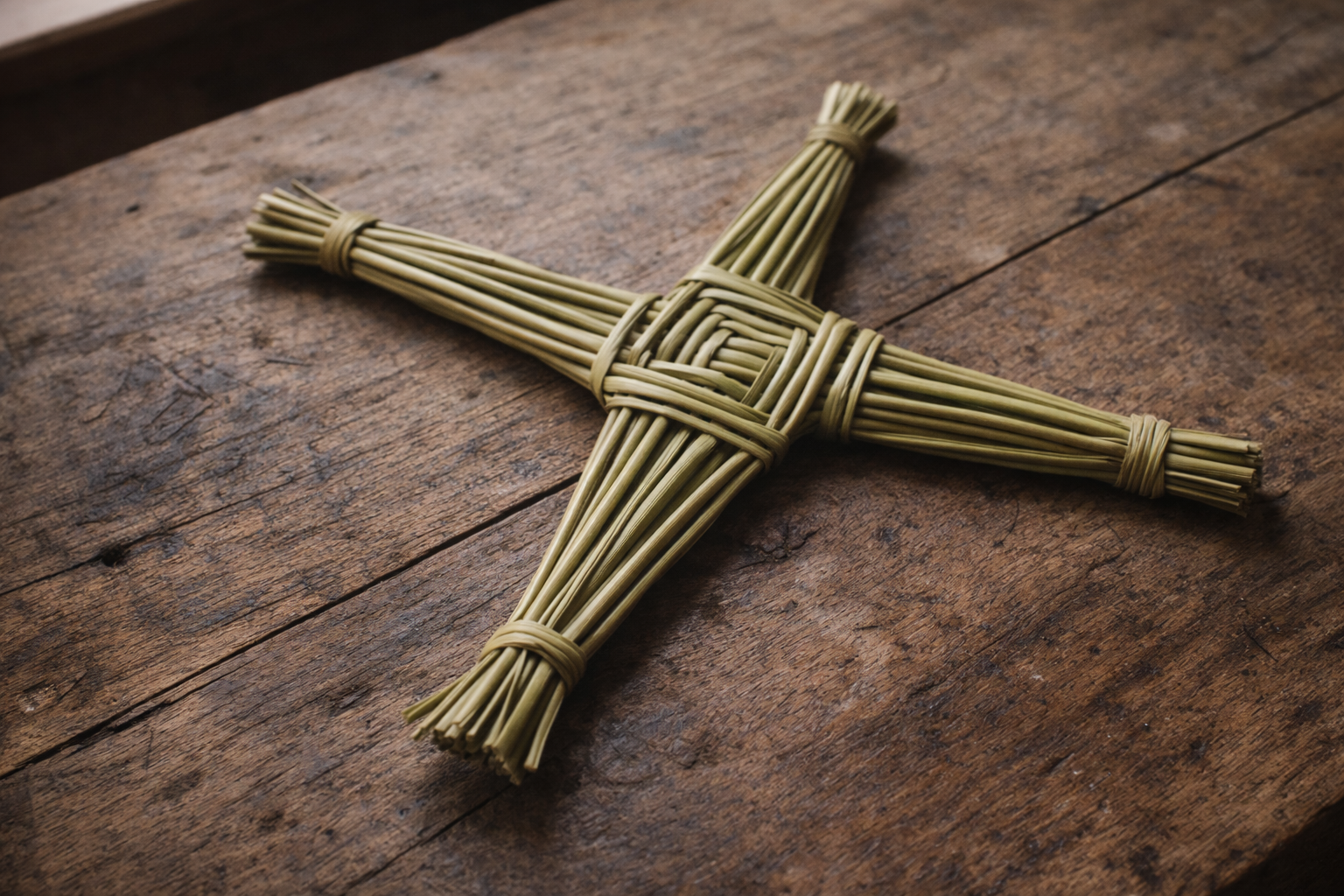
The Brigid's Cross — a distinctive equal-armed cross woven from rushes, its four arms spiraling from a square center — was traditionally made at Imbolc and hung above the door or hearth as protection against fire, illness, and misfortune. Its origins are pre-Christian, its form echoing the solar wheel, though the Church absorbed it into the legend of Saint Brigid with characteristic fluency. A woman weaves a cross from rushes at the bedside of a dying pagan chieftain, explains its significance, and he converts. The story is almost certainly apocryphal, but it captures something true: the cross was a meeting point, an object that belonged equally to two worlds, carrying the protective power of both.
These crosses are still woven today, in Ireland and among the Irish diaspora, on the first of February. Their making is itself the ritual — the gathering of fresh rushes or straw, the weaving that must be done in a single sitting, the hanging of the finished cross in the place of last year's cross. A small, annual act of making that connects the hand to something very old.
Candles in Every Window
Light is Imbolc's primary language. Not the great bonfires of Samhain or the roaring log-fire of Yule — those were fires of defiance and endurance. Imbolc's fire is smaller, more intimate, more precise. It is the candle flame, the rush light, the single point of brightness held at eye level in a dark room. It is light at the scale of the human body, warm and close and particular.
The lighting of candles in every window of the house was a traditional Imbolc practice, widespread across Ireland and parts of Scotland — a signal to Brigid as she made her circuit of the land, a welcome, a declaration that this household was open to her blessing. The candles also had a more directly symbolic purpose: they were a participation in the returning light. February's days are measurably longer than January's, but only just. The difference is felt more than seen, an extra few minutes of thin afternoon light that you wouldn't notice unless you had been watching for it. The candles made visible what the natural world was only beginning to offer.
A farmhouse in County Clare, early February, the year somewhere in the medieval period. The family has been indoors most of the day, the light too meager and the cold too biting for much outdoor work. But at dusk, the eldest daughter lifts the first candle and sets it in the east window, and then her mother sets one in the west, and the children race to fill the others. For a few minutes the house blazes like a lantern against the dark February fields. Outside, a ewe in the byre calls out. The children do not know yet why this makes their mother smile with such sudden relief. They will learn. There is always more milk by morning.
The Church later formalized this aspect of Imbolc as Candlemas — the Feast of the Presentation of Jesus at the Temple, celebrated on February 2nd — in which candles for the whole year were blessed by the priest and distributed to the congregation. Candles blessed at Candlemas were believed to carry particular protective power: lit during thunderstorms, held by the dying, placed in the windows of houses threatened by illness. The practical magic of Imbolc's candles survived intact, simply redistributed through ecclesiastical channels.
The Serpent, the Groundhog, and the Edge of Knowing
Imbolc was also a festival of weather divination — the attempt to read, from the behavior of animals and the quality of the day, how much longer winter would hold its grip. In the Scottish Highlands there was a tradition of watching for the cailleach — the old woman, a spirit of winter and storms — to emerge on Imbolc morning. If the day was bright and clear, the cailleach was out gathering firewood, which meant she intended to sustain winter for some time yet. If the day was grey and foul, she was still sleeping, which meant winter would end soon. Bright weather on Imbolc was, counterintuitively, a bad omen.
In Ireland a similar logic attached to the serpent — the snake emerging from its winter burrow being watched for as a sign of spring's progress. Saint Patrick famously drove the snakes from Ireland (a metaphor, almost certainly, for the pagan traditions, though perhaps also a misremembering of a real Imbolc practice). And in the Germanic traditions of continental Europe, similar animal-watching customs developed around the bear and the badger.
It was German immigrants to Pennsylvania who brought this custom to the United States in the eighteenth century, attaching it to a local animal — the groundhog — and a specific location: Punxsutawney, in western Pennsylvania. Groundhog Day, celebrated on February 2nd, is Imbolc's most direct and most cheerfully absurd descendant. A rodent in a top hat, surrounded by news cameras and civic dignitaries, watched for its shadow in the pale February light — the ancient divination practice perfectly preserved in amber, wearing a costume it would not recognize as its own.
"The question Imbolc always asked — how much longer? — was never answered with certainty. It was only ever answered with faith, and with the decision to plant anyway."
Cleansing, Purification, and the Preparation of the Land
Imbolc was not only a festival of fire and welcome. It was a festival of cleansing. The household was cleaned thoroughly — not the perfunctory tidying of ordinary life but a deliberate, ritual clearing-out, a purification of the space before Brigid's arrival. Old ashes were swept from the hearth. Clutter was removed. Thresholds were washed. In some traditions, the entire household walked the boundary of the property in a sunwise circuit, blessing the land and marking it as under Brigid's protection for the year ahead.
This impulse — to clean the house before the new season, to prepare the space for what is coming — persists in secular form in the tradition of spring cleaning, though we have detached it from any particular date or ritual meaning. The underlying logic remains sound: the end of winter is a natural threshold, a moment when the home that has been closed and sealed against the cold can be opened, aired, cleared of winter's accumulated heaviness.
The land itself was also attended to at Imbolc. Ploughs were blessed. Seeds that had been stored through the winter were inspected and readied. The first tentative assessments of the soil were made: was it soft enough yet to work? Could the first sowing begin? These were not ceremonial gestures but practical urgencies — the agricultural calendar had no slack in it, and missing the window for the first planting could mean hardship by autumn. The sacred and the practical were not in tension at Imbolc. They were the same thing, as they always are at the real thresholds of the year.
Saint Brigid: The Woman Who Became a Country
The historical Saint Brigid of Kildare — if she existed as a distinct individual, which some scholars now question — lived in the fifth and sixth centuries, and the stories gathered around her are among the most extraordinary in the Irish hagiographic tradition. She founded the monastery at Kildare, oversaw a mixed community of monks and nuns, and was said to have performed miracles so numerous and so various that they constitute almost a complete spiritual curriculum: healing the sick, multiplying food, transforming water into ale for unexpected guests, and, in one remarkable story, persuading a king to give her as much land as her cloak could cover — whereupon the cloak spread to cover the entire province of Leinster.
The stories of Saint Brigid carry, very close beneath their Christian surface, the energy of the goddess she displaced or transformed. Her miracles cluster around the themes of the goddess: the multiplication of food speaks to the hearth goddess's abundance; her miraculous ale to the tradition of hospitality and generosity; her land-claiming cloak to the goddess's sovereignty over the earth. She heals. She creates. She inspires. She tends the fire. The saint and the goddess look at each other across the thin membrane of conversion and recognize themselves.
February 1st — Imbolc — was officially designated as Saint Brigid's feast day, making it the first new public holiday in the Republic of Ireland when it was announced in 2023, taking effect in 2024. In the twenty-first century, after fifteen hundred years of layering and relayering, the festival has been formally restored to the calendar. The fires of Kildare burn. The rushes are being woven into crosses in primary schools across the country. Something very old has, once again, found its way back.
The Snowdrop: Proof That the World Remembers
Of all the symbols associated with Imbolc, the snowdrop may be the most quietly perfect. It is a small flower — delicate, white, nodding on its slender stem — and it appears in February with a timing so precise and so reliable that it seems almost willful. The snowdrop does not wait for warmth. It pushes up through frozen ground, through snow if necessary, and blooms in conditions that would destroy almost anything else. It contains, in its small white form, a complete argument against despair.
In the language of Victorian flowers — that elaborate system of assigned meanings that the nineteenth century constructed around the natural world — the snowdrop meant hope. Specifically, hope consoled. Hope in the face of difficulty. It is not the hope of easy circumstances, the hope of the person who has no particular reason to doubt things will work out. It is the harder, more interesting hope of the person who has seen winter and knows how long it lasts and plants the bulb anyway.
You will not see it at first. You will be looking at grey ground, at bare soil still hard in the shadows, and you will think: nothing yet. And then you will shift your gaze two feet to the left and there it will be — three of them, or seven, or a whole scattered constellation of them along the base of the hedge, white heads bowed as if in thought, their thin green stems impossibly sturdy in the cold air. You will feel, in your chest, something ease that you did not know was tight. This is what Imbolc is for. This precise moment of recognition. Not proof that spring has arrived. Proof that it is coming. That has always been enough.
The Festival in the Modern World
Contemporary celebrations of Imbolc range from the elaborate to the intimate. In the neo-pagan and Wiccan traditions, it is observed as one of the eight sabbats of the Wheel of the Year: altars dressed in white and green, candles lit in abundance, offerings of milk and grain, the weaving of Brigid's crosses, and rituals of intention-setting that echo the agricultural logic of the old festival — this is the time to plant what you wish to harvest, literally and metaphorically.
In Ireland, the revival of Imbolc as a cultural festival has gathered momentum through the work of organizations like Féile Bríde — the Festival of Brigid — held annually in Kildare since 1993, drawing together women from spiritual traditions around the world to honor the flame, to celebrate creativity and healing and the sacred feminine, to weave crosses and tell stories and tend the fire that has burned, in one form or another, for longer than the record of it.
But Imbolc does not require elaborate ceremony. It perhaps requires less than any other festival on the wheel, because its core gesture is so simple: paying attention. Going outside on a February morning and looking — really looking — at the ground for the first signs of green. Noticing whether the light at four in the afternoon is just barely different from what it was in January. Listening for the first birds beginning to test their voices after the long winter silence. Imbolc asks only that you show up to the world with enough attention to notice that it is, slowly and surely, showing up too.
In the Belly of the World
There is a particular kind of courage that Imbolc celebrates — not the dramatic courage of the warrior or the martyr, but the quieter, more persistent courage of the seed. The seed does not know, with certainty, that the ground will warm. It does not know that the rains will come at the right time, that the frost will not return after it has committed to sprouting, that the world will cooperate with its determination to become. It begins anyway. It does not wait for certainty before it acts.
This is the deepest teaching of the early Celtic world's second great festival, and perhaps its most enduring gift to whoever chooses to receive it: the permission to begin before conditions are ideal. The permission to trust the pattern even when the evidence is only the faintest whisper of green in the grey ground, only the faint extra warmth in the afternoon light, only the first thin cry of a newborn lamb in a barn that still smells of winter.
Brigid's fire is not a bonfire. It is a candle. A single, careful flame, tended with attention and love, precisely because it is small enough to go out if you stop paying attention. And that is the point. The great roaring fires are for the moments when defiance is what you need. But the candle is for the moments when what you need is patience, care, and the faith that a small, steady light is enough to hold the dark at bay until spring arrives to relieve you.
Light the candle. Weave the cross. Set a place for Brigid at the table and watch for the mark of her presence in the ashes of the morning. Go outside and press your palm to the earth and feel, if you are quiet enough, the first faint heat of a world beginning to remember itself.
Spring is in the belly of the world.
It is already coming.