Yule: The Winter Solstice, Sacred Fire, and the Return of the Sun
There is a moment, precise and measurable, when the earth tilts to its farthest extreme from the sun. In the northern hemisphere this happens sometime between December 20th and December 23rd each year — the exact date drifting slightly with the imperfections of the calendar. For perhaps three seconds, or three minutes, or what feels like three long held breaths, the sun appears to stand still in the sky. The Latin name for this is solstitium — the sun standing still. The world pauses. Then, almost imperceptibly, the arc begins its return.
For the vast majority of human history, this was among the most important moments in the year. Not a date on a calendar but a felt reality, lived in the body: the cold deepening past endurance, the days shortening until there was barely enough light to work by, the stores of food diminishing, the animals huddled and still, the sky the color of old iron. And then — the turn. The almost imperceptible return of the light. The world exhaling.
This is Yule. Not an invention of any single culture, but one of the oldest human responses to one of the oldest human fears: the fear that the sun might not come back.
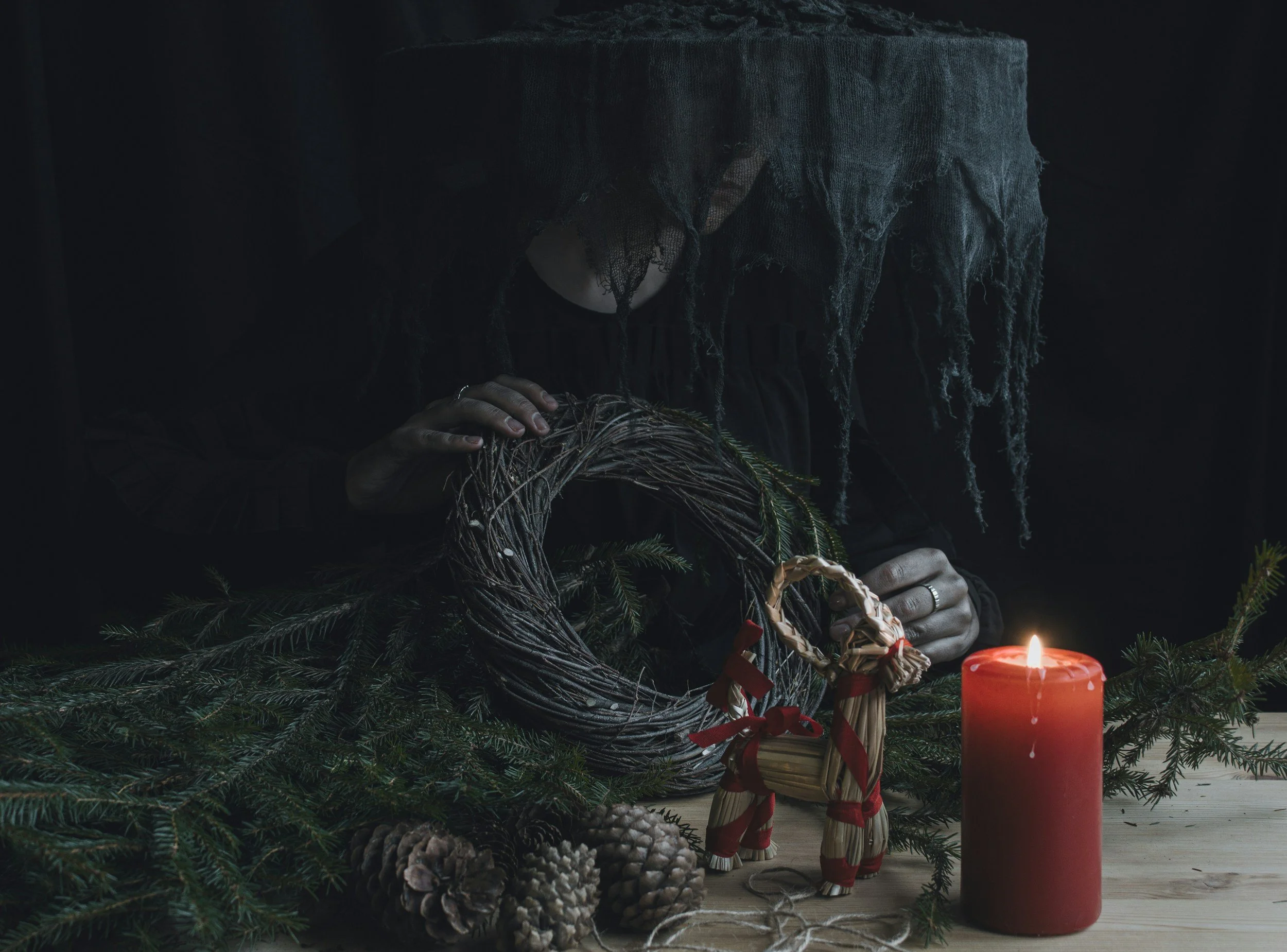
A Fear as Old as Fire
Before we understood the mechanics of planetary tilt, before astronomy gave us the certainty that the winter solstice is not an anomaly but a predictable point in a reliable cycle, the lengthening of winter nights was genuinely terrifying. Each day shorter than the last. Each morning's light a little grayer, a little briefer. How could you be sure it would stop? How could you know, with absolute certainty, that this was not the year the darkness finally won?
You could not know. You could only trust in the pattern. And trusting in patterns — encoding that trust in ritual, in festival, in fire and feast and song — is one of the most ancient things human beings have ever done. Across the northern latitudes, from Scandinavia to Britain to the Germanic lands to ancient Rome, cultures developed their own means of marking the solstice and participating in the sun's return. Their myths differed. Their names differed. Their specific rituals varied enormously. But the underlying impulse was the same: we must do something. We must act, not merely wait.
"The solstice was not an occasion for despair. It was an occasion for defiance — for lighting fires so large the darkness could not deny them."
The fires of the winter solstice are among the oldest recurring facts of human culture. Archaeological evidence suggests midwinter fire festivals at sites like Stonehenge and Newgrange stretching back five thousand years or more. Newgrange, the great Irish passage tomb built around 3200 BCE, is oriented with precision to admit a narrow shaft of solstice sunrise light directly down its passage into its central chamber. The builders — whoever they were, whatever they believed — thought this alignment worth the extraordinary labor of constructing an entire monument around it. The return of the light, for them, was worth commemorating in stone.
The Norse Yule: Wild Nights and the Hanging God
The word Yule — Jól in Old Norse — is ancient and of uncertain etymology. Some scholars derive it from a Proto-Germanic root meaning wheel, others from a word for revelry or feast. What is certain is that it referred to a midwinter festival of tremendous significance in the Norse and Germanic world, one that lasted not a single day but a full twelve nights — the Twelve Nights of Yule — spanning from late December into early January.
Norse Yule was not a gentle festival. It was steeped in the mythology of a cosmos under perpetual existential threat. In Norse cosmology, the world would eventually end — the gods knew it, and the signs were already accumulating. Winters would grow longer. The Fimbulwinter, the great winter before Ragnarök, would last three years without a summer. Midwinter was always shadowed by this mythology: what if this winter was the one that did not end? What if the light this time truly did not return?
Imagine Odin in winter. He does not sit on his golden throne in Asgard at Yule — he rides. He leads the Wild Hunt across the sky: a thundering procession of the dead, of spirits and wolves and ravens, of supernatural riders whose passage brings storm and wind and the sound of hooves on the clouds above. Farmers hearing the howl of a winter gale might whisper that the Hunt was riding. They left offerings at their doorsteps: food, grain, hay for the horses. Not out of worship, perhaps, but out of the ancient wisdom that powerful things moving through the dark should not be provoked. And should, perhaps, be welcomed.
Odin's role at Yule was not merely as the leader of the Hunt. He was also the god who had hung himself on the World Tree, Yggdrasil, for nine nights in order to gain the wisdom of the runes — a myth of sacrifice and transformation that resonated deeply with the solstice's own symbolism. The longest night was the night when the light, like Odin, descended into darkness to be reborn. Death as the price of wisdom. Darkness as the condition of return.
The Norse celebrated Yule with great feasts, with the slaughter of cattle whose blood was used in sacrificial sprinkling — the blót — and with the lighting of fires in the hall. The chief of the household was responsible for keeping the fire burning for the full twelve nights. If it went out, ill fortune would follow. The fire was not decoration but necessity: a contract between the living and the gods, a physical declaration that the warmth of the world was worth defending.
The Yule Log: Carrying Fire Through the Dark
No image is more inseparable from the northern European solstice than the Yule log — a great piece of wood, often the root end of a large tree, dragged from the forest and ceremonially burned through the long midwinter nights. It appears in the traditions of England, Scandinavia, France, Germany, Serbia, and elsewhere, with enough variations in custom to suggest independent origins converging on the same essential idea.
The selection of the log was itself a ritual. It had to be the right wood — oak was most common in Britain, though ash and beech appeared in other traditions. It had to be large enough to burn for the full duration of the feast, a requirement that shaped the size of the log and the scale of the fireplace needed to hold it. In some traditions it was decorated before burning: dressed with evergreens, with ribbons, sprinkled with grain or cider. Even a log became a vessel for meaning when the darkness pressed close enough.
"A piece of the previous year's log was always saved — kept dry throughout the year — to kindle the next one. The fire of one winter lighting the fire of the next. An unbroken chain of warmth across generations."
This detail — the saved piece of old log kindling the new — is one of the most quietly profound things about the Yule log tradition. It created literal continuity: the fire of this winter came from the fire of last winter, which came from the winter before that, tracing back through generations of households to some original fire no one could name. Every Yule, the family was not merely warming itself. It was participating in an inheritance.
The ashes of the Yule log were potent. In various traditions they were scattered over fields to promote the next harvest, buried under doorsteps for protection, stirred into the drinking water of cattle. The log's power, concentrated through burning, distributed itself outward into the life of the household and the farm. Nothing of the ritual was wasted. Even fire's ending was useful.
Evergreen, Holly, and the Theology of Persistence
Walk into a winter forest. The oaks are bare, the beeches stripped, the ash trees angular and skeletal against the pale sky. But the holly is still dark and gleaming, its leaves sharp-edged and lustrous as if it had not noticed winter at all. The ivy clings to the stone. The pine and fir stand full and heavy with needle and cone, impossibly green against the snow. These plants — the ones that refused to die — held enormous symbolic weight for the peoples of the northern winter.
Evergreens brought into the home at Yule were not decoration in the modern sense. They were proof. Proof that not everything submitted to winter's dominion. Proof that green persisted, that life was stubborn, that the world had not yet surrendered. Holly and ivy, whose rivalry is preserved in the old English carol, were both associated with protective magic. Holly, with its sharp leaves and blood-red berries, was masculine, fierce, protective. Ivy was feminine, winding, persistent.
Mistletoe held a special place in the sacred botany of the winter solstice, particularly in Celtic and Norse traditions. It was among the most sacred of druidic plants — not rooted in the earth at all, neither quite tree nor quite shrub, growing suspended between the tree and the sky. The Roman writer Pliny describes a druidic ceremony in which mistletoe was cut from oak trees with a golden sickle by white-robed priests, collected in white cloths so it would not touch the ground and lose its power. It was a plant of the in-between, associated with healing, fertility, and protection — the perfect Yule plant, for Yule itself was a time of the in-between.
Step outside on the solstice morning, before the sun has fully risen. The ground is iron-hard beneath your feet. The trees stand stripped and patient. But look: the robin on the lowest branch, the holly burning red against the grey hedge, the smell of cold pine from somewhere in the dark wood. The world is not dead. It is waiting. There is a difference, and it matters enormously: death has no interest in spring. But waiting does.
Saturnalia and the Roman Winter of Reversals
To the south, in the Roman world, the winter solstice period was marked by one of the most extraordinary festivals of the ancient world: Saturnalia. Held in honor of Saturn, god of agriculture and time, Saturnalia began on December 17th and lasted up to a week, eventually settling around the solstice itself. It was a festival of a kind that the modern world has mostly forgotten how to stage: a complete, systematic, temporary reversal of the social order.
Schools closed. Businesses shuttered. Courts did not sit. Gambling, normally forbidden, was permitted openly. Masters served their slaves at table — a reversal so complete that it staggers the imagination of anyone who knows the brutality of Roman slavery. Gifts were exchanged. Candles were lit against the dark. The rigid hierarchies of Roman life dissolved, briefly, into something looser, warmer, more human. As if the world, tilting to its darkest point, had also tilted away from its own severity.
Saturnalia was followed, on December 25th, by the Dies Natalis Solis Invicti — the Birthday of the Unconquered Sun. This festival, associated with the solar deity Sol Invictus and popular in the later Roman Empire, celebrated the solstice's aftermath: the moment when the days began, definitively, to lengthen again. The unconquered sun: the one that darkness could not keep down. The choice of this date — so close to what would become Christmas — was not coincidental, and its influence on the Christian feast that displaced it was deep and lasting.
The Wild Hunt: What Rides the Winter Sky
Across the Germanic and Norse world, the midwinter nights were haunted by the Wild Hunt — a supernatural cavalcade of riders moving through the storm-dark sky, heard in the howl of winter winds, seen in the movement of storm clouds. The leader varied by region and tradition: sometimes Odin, sometimes Wotan, sometimes a local figure, sometimes a female leader, sometimes the devil in the Christianized versions. But the basic form persisted with remarkable consistency across an enormous range of cultures and centuries.
The Hunt was not something you watched safely from a distance. It passed through the human world. It came down chimneys. It swept through farmyards. Those who encountered it might be swept up into the procession themselves, carried away for a year and a day, or simply terrified into illness. The appropriate response was to get indoors, to leave out offerings, to make no noise that might attract attention. The sky in winter was a road, and things used it.
The Wild Hunt's relationship to Yule was intimate. Some traditions held that the Hunt rode most fiercely during the Twelve Nights — the sacred period of the festival — when the boundary between worlds was at its most permeable. Yule, like Samhain, was a time when the cosmos showed its seams, when the careful separation between the human and the supernatural grew unreliable. The hearth fire was not merely warmth; it was sanctuary.
"The fire in the hall was a declaration: we are here, we are alive, we are not surrendering to whatever moves in the dark between the stars."
It is worth pausing to note how differently various cultures have related to their winter spirits. The Wild Hunt is terrifying, yes — but it is also, in some versions, generous. Odin riding in winter is not only a harbinger of death but also the god who brings wisdom, who sacrificed himself for knowledge, who is associated with poetry and prophecy and the strange fertility of the mind. The riders of the Hunt in some traditions leave gifts, fill shoes left out on doorsteps, scatter grain. Terror and generosity, riding side by side through the winter sky. This duality — the dangerous supernatural thing that might also, if approached correctly, be a source of blessing — runs throughout the Yule tradition.
The Long Christianization of the Winter Feast
When Christianity expanded northward into Germanic and Scandinavian territories, it encountered Yule as it had encountered Samhain in the Celtic world: a festival too large, too deep in the life of the community, too essential to the human need to mark the dark season, to be simply abolished. The Church absorbed it. Christmas, placed on December 25th — a date for which there is no biblical evidence as the actual birthday of Jesus of Nazareth — settled over the solstice celebration like a new garment over an old body. The body continued to move as it always had.
The word "Yule" itself survived in English as a synonym for Christmas through the medieval period and well beyond. The Yule log became a Christmas tradition. The evergreens were reinterpreted: holly's red berries were said to represent the blood of Christ, its prickles the crown of thorns. The twelve days of feasting became the Twelve Days of Christmas. The gifts, the fires, the feasting, the singing in the dark — all of it continued, wearing new names, carrying old bones.
Medieval Christmas was, in many ways, closer to its pagan predecessors than to the modern holiday: it was raucous, wine-soaked, driven by the logic of communal feast and inversion. The Lord of Misrule — a figure appointed to preside over Christmas revels and licensed to mock the normal social order — echoes Saturnalia's reversals so directly that the lineage is unmistakable. The midwinter feast demanded a certain loosening of ordinary life, regardless of what theological story was placed above it.
Victorian Reinvention and the Modern Christmas
The Christmas that much of the contemporary world recognizes — candlelit trees, wrapped presents, carols in the snow, a figure in red delivering gifts by night — is, in its specific form, largely a Victorian construction, assembled from fragments of much older traditions and shaped by the enormous cultural machinery of the nineteenth century. Prince Albert of Saxe-Coburg and Gotha, husband of Queen Victoria, is credited with popularizing the Christmas tree in England: a practice from his native Germanic tradition that became, after an 1848 illustration of the royal family around their decorated tree, a fashion across the British Empire and eventually the world.
Charles Dickens's A Christmas Carol, published in 1843, did as much as any single text to define the emotional shape of the modern Christmas: the warmth of the fire against the winter dark, the redemptive power of generosity, the ghost of the past returning in the cold season. Whether Dickens knew it or not, he was working with material as old as the first midwinter feast. The ghost story at Christmas — a tradition strong enough that it features explicitly in "The Most Wonderful Time of the Year" — is Yule's oldest inheritance: the returning dead, the thinned veil, the stories told by firelight to make the darkness less absolute.
Scrooge's world is cold before it is transformed — pathologically, symbolically cold. His counting house is cold, his bedroom is cold, the streets outside are cold. And the Ghost of Christmas Present, the great spirit of the feast itself, is abundance made physical: fire, food, warmth, greenery, the smell of roasting meat and orange peel and mulled wine. The redemption Dickens offers is not theological but elemental. It is the redemption of warmth. Of the fire lit against the winter. Of the table set for the stranger and the beloved both. It is, in its bones, a Yule story.
The American Santa Claus — drawn from Dutch Sinterklaas traditions, shaped by Clement Clarke Moore's 1823 poem, then definitively visualized by Haddon Sundblom's Coca-Cola advertisements in the 1930s — is the latest avatar in a long line of winter gift-bringers: Odin on his eight-legged horse Sleipnir, Saint Nicholas on his feast day, Père Noël, Father Christmas. The gifts left in shoes, the riders in the winter sky, the generosity that accompanies the terror of the dark season — all of it flowing through centuries of reimagining into the red-coated figure we know.
The Return of the Old Ways
In the late twentieth and early twenty-first centuries, Yule returned — not as Christmas, but as itself. Neo-pagan and Wiccan communities, following the Wheel of the Year, observe Yule as one of the eight sabbats: the winter solstice, the longest night, the turning point. It is a feast of darkness and light held in tension, of gratitude for what has survived the diminishing year, and of trust — not certainty, never certainty, but earned trust — that the light will return.
Contemporary Yule celebrations vary enormously: some are elaborate, involving altars with candles in solar colors, decorated with evergreens and crystals and images of the sun; others are minimal, a single candle held through the longest night, extinguished before dawn and relit with the first true light of the returning sun. The form matters less than the attention: the deliberate act of stopping, in the darkest moment, and acknowledging that this is the darkest moment, and that it is also — precisely because of that — the turning point.
"To celebrate Yule is to practice a very old kind of faith: not faith in a creed or a doctrine, but faith in the pattern of the world. The sun has always returned. It will return again."
There is a psychological wisdom to this that transcends any theology. The winter solstice is genuinely the darkest point of the year, and the human psyche feels it — in seasonal affective disorder, in the heightened rates of depression during the winter months, in the strange melancholy that can descend even in the midst of holiday celebration. The ancient festivals acknowledged this directly. They did not deny the darkness or rush past it. They stood in it, lit a fire, and said: we see you. We are not pretending you are not here. And we are still here, and we will still be here when you pass.
The Sun, Still Standing Still
Every year, without exception, on a day between the 20th and the 23rd of December, the sun reaches its southernmost point in the sky and pauses. From our perspective on earth, it has been falling for six months — each day shorter than the last, the angle of light shallower and colder, the darkness arriving earlier and staying longer. And then it stops. And then it turns.
We know, now, exactly why this happens. We can predict it to the second, centuries in advance. The mystery has been resolved by science into a beautiful and exact mechanism: the tilt of the earth's axis, the ellipse of its orbit, the geometry of a solar system that has been running with metronomic regularity for four and a half billion years. There is no danger that the sun will not return. There is no doubt about it.
And yet. Light a candle on the solstice night and something still moves in you that is older than certainty. The small flame against the window, against the darkness that presses the glass. The smell of pine and wood smoke. The gathering in, the closing of doors, the pulling close of whatever warmth and whoever you love. The knowledge — felt in the body before it is thought in the mind — that this moment matters. That the turning of the year is worth marking. That we should stop and face the dark before we celebrate the light.
This is what Yule teaches, has always taught, will always teach: the light is more beautiful because you sat with the dark. The warmth is more precious because you felt the cold. The fire you light is not a small thing. It is the same fire that has burned on every hilltop and in every hall and on every hearth, through all the long ages of the turning world.
Light it anyway. The sun will return.
It always does.