Ostara: Spring Equinox, Fertility Symbols, and the Return of Balance
There is a moment in March — you may have felt it without knowing its name — when the quality of the light changes. Not the quantity, not yet, though the days have been lengthening since December. It is something subtler: the angle of the sun shifts, and suddenly the light falls differently on the familiar world. It finds colors that were hidden all winter. It makes the mud look golden. It touches the bare branches of the trees, and you see, for the first time, that the buds are already there — have been there all along, waiting for exactly this light. The world, which seemed thoroughly finished with itself, turns out to have been preparing. It is ready. You just weren't looking at the right angle.
This is the season of Ostara. Named for a Germanic goddess of spring whose name echoes in the word Easter itself, the spring equinox festival is one of the oldest celebrations in the human calendar — a moment when the axis of the earth arrives at precise equilibrium, when day and nightstand in perfect, temporary balance before the year tips fully into the long bright half. It is a festival of thresholds, of eggs and hares and crocus-purple mornings, of the world betting everything on warmth and winning.
The Astronomical Miracle at the Heart of the Festival
The spring equinox occurs when the sun crosses the celestial equator moving northward — when the earth's axial tilt is oriented neither toward nor away from the sun, but perfectly perpendicular to the line between them. In that moment, every place on earth receives approximately twelve hours of daylight and twelve hours of night. The word equinox comes from the Latin aequus nox: equal night.
This is not, strictly speaking, a metaphor for balance. It is actual balance — measurable, predictable, precise to the second. And yet every culture that has ever watched the sky closely has felt the charge of it, the sense that something larger than the merely mechanical is happening. Because of course it is. The balance of light and dark is also the balance of cold and warm, of rest and labour, of the world breathing in and the world breathing out. The equinox is the moment when the scales tip — not in favor of darkness, not yet in the full triumph of light, but held perfectly, tremblingly, at the point of decision.
"For one day, neither darkness nor light could claim dominion. The ancient world felt this balance as sacred — because it was the only moment in the year when the world was not in the grip of one or the other."
The earliest cultures to systematically observe the equinox did so with monumental precision. The great megalithic structures of the ancient world — Stonehenge, the Mnajdra temples of Malta, the Chichen Itza pyramid in the Yucatan — all incorporate equinox alignments into their architecture, their stones oriented to capture the exact sunrise or sunset of the equinoctial day. These were not accidents. They were declarations: we see you. We have been watching for you. We have built in stone our knowledge that you will return.
Eostre: The Goddess at the Edge of Things
The name Ostara comes from Eostre — a Germanic goddess of spring and dawn whose worship is attested most directly by the Venerable Bede, the eighth-century English monk who noted that the Anglo-Saxon month of April — Eosturmonath — was named for her, and that a pagan festival was held in her honor during this month. Beyond Bede's brief mention, the historical record of Eostre is sparse. She is one of those figures who exists more in the linguistic record than in the mythological one: we know her name, we know it was important enough to anchor a month and eventually a major Christian holiday, and we know almost nothing else with certainty.
This sparseness has made Eostre a figure of great scholarly debate and, paradoxically, enormous cultural vitality. The linguist Jacob Grimm — one half of the Brothers Grimm — reconstructed from Bede's account and from comparative Germanic linguistics a figure he called Ostara, goddess of the radiant dawn, whose symbols included the hare and the egg. Grimm's reconstruction was speculative, but it planted a seed in the imagination of Germanic and later pan-European paganism that grew, over the nineteenth and twentieth centuries, into the full mythology of Ostara as she is celebrated today.
She does not arrive with thunder or proclamation. She arrives the way spring actually arrives: incrementally, without announcement, in the quality of the morning light before you have quite woken up. She is the goddess of the threshold between dark and light, between sleep and waking, between winter and the world. Her hour is dawn. Her color is the particular pink-and-gold of the sky just before the sun clears the horizon — not quite light, not quite dark, the color of a world making up its mind. Her animals are restless. Her flowers cannot wait.
The etymology of Eostre's name connects her, through the Proto-Germanic Austrō, to the Proto-Indo-European root h₂ewsōs — the dawn. This same root gives us the Greek Eos, goddess of the dawn; the Roman Aurora; the Sanskrit Uṣas. Eostre is one member of an enormous family of dawn goddesses stretching across the Indo-European world, each one presiding over the threshold of light, the hinge of the day. To worship the dawn goddess at the spring equinox was to honor the same moment at two scales simultaneously: the hinge of the day and the hinge of the year, both held in a single name.
The Egg: Everything Contained in One Small Shell
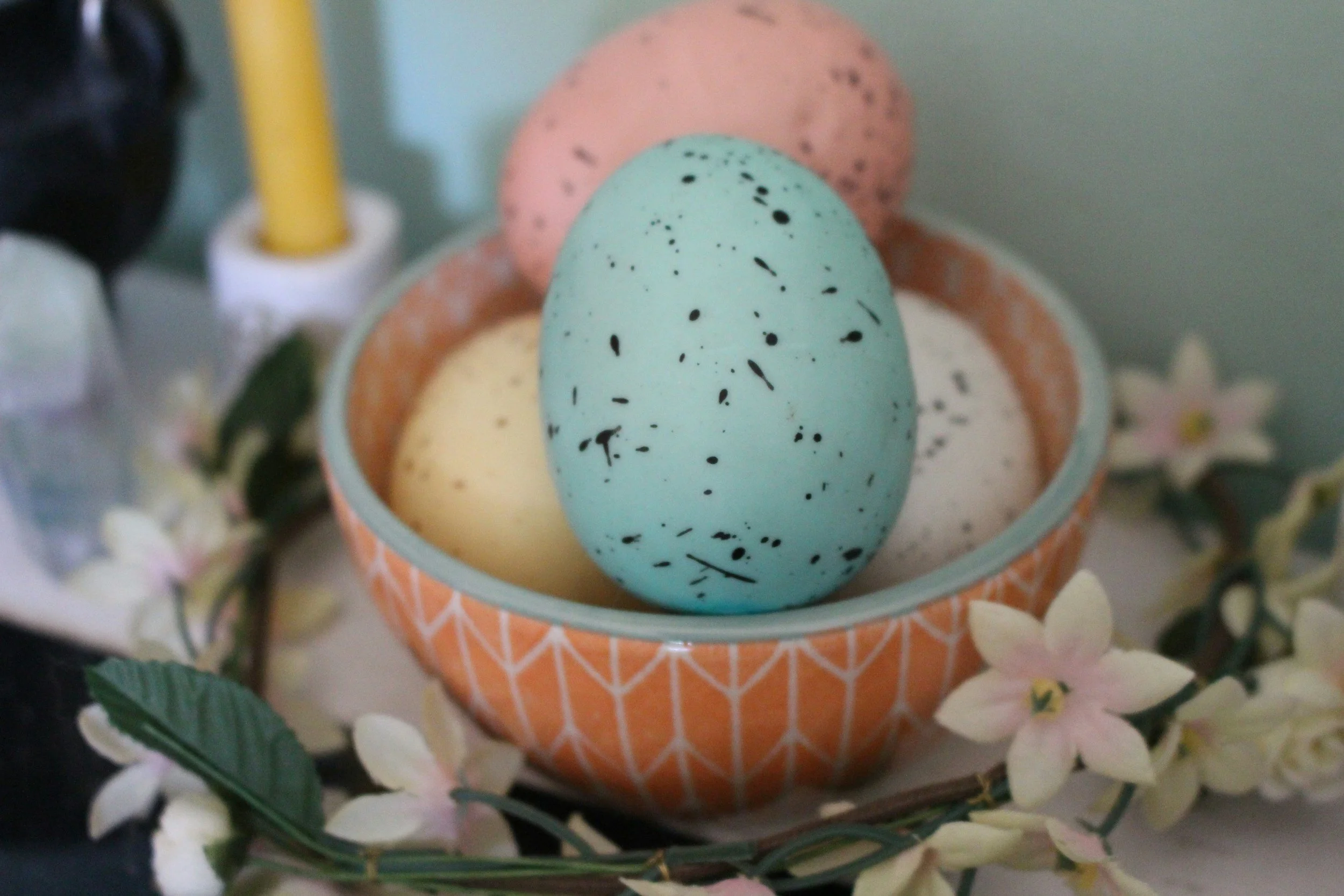
If there is a single image that travels most completely from ancient spring ritual to modern cultural practice — passing through religious transformation, folk custom, Victorian sentimentality, and commercial production without losing its essential charge — it is the egg. The spring egg. The decorated egg. The egg hidden in the garden, the egg given as a gift, the egg that appears with such symbolic insistence at Easter that the pre-Christian resonance is impossible to explain away.
The egg as a cosmological symbol is ancient beyond any single culture. In the Orphic tradition of ancient Greece, the primordial egg — the Orphic Egg — was the source of the universe: the world hatched from it, order emerging from the spinning shell. In Hindu cosmology, the golden egg of Brahma contains the entire cosmos in potential. In Finnish mythology, the world is made from the broken egg of a cosmic bird. The egg appears and reappears in creation mythology across the world because it is, in fact, the perfect symbol of potential: closed, self-contained, giving no outward sign of what it carries within, and then — quite suddenly — not.
At the spring equinox, the egg's cosmological resonance became immediate and agricultural. The hens were laying again. After the long winter diminishment of production, the return of eggs to the farmyard was a genuine event — food, fertility, the evidence that the animals were responding to the returning light. The egg you held in your hand at Ostara was not merely symbolic. It was proof: the world was fertile again. Life was renewing itself in the most literal, crackable, yolk-yellow way possible.
"Every egg contains, in miniature, the entire argument of spring: that what appears finished and sealed is actually full of something that has been gathering itself, very quietly, for exactly this moment."
The tradition of decorating eggs at this season is documented across a strikingly wide range of cultures. The Pysanka eggs of Ukraine — elaborately decorated with geometric and symbolic patterns using a wax-resist technique — are among the oldest and most sophisticated of these traditions, with designs that preserve pre-Christian solar and fertility symbolism within an Orthodox Christian practice. The Fabergé egg, at the extreme end of elaboration, carries this impulse to its most extravagant conclusion. But even the humble dyed egg in a cardboard carton carries the oldest memory: this small, closed thing is full of something extraordinary.
The Hare: Wildness at the Heart of Spring
The hare runs through the mythology of spring with the same quality it has in actual fields: fast, unpredictable, present and then suddenly not, its long ears catching something you cannot hear, its yellow eyes holding a knowledge they decline to share. Of all the animals associated with Ostara and the spring equinox, the hare is the most ancient, the most widespread, and the strangest.
In the European folk tradition, the hare was associated with the moon — itself a symbol of cyclical renewal — with witchcraft and the uncanny, with shape-shifting and the boundary between worlds. Hares were said to be the familiars of witches, or witches themselves in animal form. They were creatures of the liminal: most active at dusk and dawn, the threshold times; born in open fields rather than underground burrows, with their eyes already open, already watching, already knowing. The hare was not a gentle animal. It was a wild one, carrying wildness itself as its essential attribute, and spring has always had wildness in it — in the sudden growth, the unchecked bloom, the animal energy that bursts through the cold ground with something close to violence.
Go out into a field in early March at dusk and, if you are lucky, you will see them. Not one but many, moving in wide circles, boxing with their front legs, rearing up and chasing each other through the long grass at speeds that seem impossible for their bodies. This is the behavior that gave us the phrase "mad as a March hare" — the mating frenzy of early spring, a wildness that the old world read as the earth's own seasonal ecstasy made animal. To watch March hares is to understand, viscerally, what the spring equinox actually feels like from the inside: unstoppable, a little frightening, shot through with energy that has been compressed all winter and now has nowhere left to go but out.
Jacob Grimm's reconstruction of Ostara associated her with the hare as her sacred animal, and from this the story emerged — embellished in later tellings — of the Easter Bunny: a hare that laid eggs, a conflation of the two primary symbols of the season into a single mythological creature that makes no biological sense and yet carries, precisely in its impossibility, the quality of the miraculous that spring actually requires. Spring does not happen by the ordinary rules. It happens by something closer to insistence — the world simply refusing to accept that winter is the permanent condition.
The Persian Nowruz: A New Year as Old as Civilization
Ostara and the Germanic spring equinox traditions are only one strand of a vast global web of spring equinox celebration. Among the most ancient and most continuously observed is Nowruz — the Persian New Year, celebrated at the exact moment of the spring equinox and observed for at least three thousand years across Iran, Central Asia, the Caucasus, and South Asia. Nowruz means simply "new day" in Farsi, and the simplicity of the name belies the extraordinary depth of the festival.
The centrepiece of Nowruz is the Haft-Seen table — a ceremonial arrangement of seven items, each beginning with the Persian letter S, each carrying symbolic significance for the new year: sprouted wheat or lentils for rebirth, vinegar for patience, garlic for health, an apple for beauty, a coin for prosperity, a hyacinth for spring, and a sumac berry for the color of sunrise. On the table also: a mirror, candles, painted eggs, goldfish in a bowl, and sometimes a copy of the Shahnameh or the Quran, depending on the household. The table is a complete cosmology in miniature — the whole of life set out in careful order, facing the new year.
Like the best of the ancient festivals, Nowruz survived the conquest of Persia by Islam and continued to be celebrated — sometimes underground, sometimes openly — as a cultural observance even where its pre-Zoroastrian religious roots were officially suppressed. It is, today, a UNESCO-recognized cultural heritage, celebrated by an estimated three hundred million people worldwide. The spring equinox is too deep in the human body to stay down for any ideology.
Flowers, Seeds, and the Theology of Beginning Again
The flowers of early spring — the crocus in its purple and gold, the daffodil startlingly yellow against grey soil, the cherry blossom so extravagant and so brief it seems almost irresponsible — hold a particular charge at the equinox because they arrive before they seem possible. The crocus pushes through snow. The daffodil is fully bloomed when the nights are still cold enough to see your breath. They do not wait for permission. They arrive with the authority of something that has been planned underground for months.
Seed-planting at the equinox was a ritual as much as a practical act for farming cultures across the ancient world. To plant at the equinox was to synchronize your actions with the action of the cosmos — to participate in the world's own fertility rather than merely taking advantage of it. The seed you pressed into the ground was your offering, your declaration of faith in the returning warmth. Planting was always an act of faith. You put something into the dark ground and you trusted the world to know what to do with it. The equinox was the moment when that trust was most thoroughly warranted.
In Japan, the spring equinox — Shunbun no Hi — is a national holiday, observed with the tending of family graves, gatherings with extended family, and walks in nature to observe the blooming of the season. In Buddhist practice, the equinox period — Higan — is a time of reflection and of crossing between this world and the next, a concept that once again links the equinox to the idea of the threshold, the point of balance between two states. The spring equinox, wherever you encounter it in the world's traditions, insists on being understood as more than an astronomical event. It is a crossing. A decision point. The moment when the year commits to being alive.
Easter and the Absorption of the Spring Rites
The relationship between the Christian Easter and the spring equinox festivals is more complex than a simple case of one absorbing the other — and more interesting. Easter's dating is itself astronomical: it falls on the first Sunday after the first full moon after the spring equinox. This formula, established by the Council of Nicaea in 325 CE, ties the central Christian feast of resurrection irrevocably to the equinox and to the lunar cycle, weaving the new religion into the astronomical framework of the old world rather than replacing it.
The symbolism of Easter — the egg, the hare, the lily, the dawn service, the themes of death and resurrection, the return of the light — draws from a well of spring equinox imagery so deep and so widespread that it cannot have arrived in the Christian feast by accident. The theology of resurrection is, at one level, the theology of spring itself: the impossible return, the life that cannot be contained by the tomb of winter, the power that rolls the stone away and steps out blinking into the dawn.
The sunrise Easter service — held before dawn, in the dark, oriented toward the rising sun — preserves the most ancient stratum of equinox practice most nakedly: the watching for the light, the community gathered in the dark and cold, the collective held breath as the sky begins, almost imperceptibly, to change. Then the light. Then the cry: He is risen. The astronomical fact and the theological claim arriving together, as they always have, in the first light of the equinox morning.
"The Easter egg and the Ostara egg are not rivals. They are the same egg, held in different hands, named in different tongues, carrying the same ancient astonishment at the world's refusal to stay dead."
The Green World Waking
What Ostara ultimately celebrates — beneath the mythology of the goddess, beneath the symbolism of egg and hare, beneath the astronomical precision of the equinox — is something very simple and very large: the return of the green world. The return of color to a landscape that has been held for months in the grey-and-brown grammar of winter. The return of smell — actual smell, the resinous bud-burst of the trees, the wet-earth sweetness of the warmed ground, the shocking green of the first cut grass. The return of sound: the birds who were silent or absent all winter coming back to the hedges in numbers and in voice, filling the morning with a cacophony of territorial declaration that sounds, to the human ear, indistinguishable from joy.
For the peoples of the ancient world, this sensory return was not merely pleasant. It was life-sustaining. The fresh greens of early spring — nettles, watercress, wild garlic, the first new shoots of a dozen edible plants — arrived at the moment when the stored food of winter was most depleted and the body was most in need of exactly what these plants carried: vitamins, minerals, the micronutrients that months of dried and salted food could not provide. To eat the first greens of spring was a medicinal act, a ritual act, and a sensory act simultaneously. The body recognised what it needed and the culture built a festival around the providing of it.
There is a day in spring — it arrives differently each year, you cannot quite predict it — when you step outside and the air smells different. It has been cold and flat and closed all winter, and then suddenly it is open. Something has unlocked. You can smell the soil, warm now just beneath its surface. You can smell the green things thinking about being green. The birds are louder than they were yesterday. The light on the wall of the house is sharper, more interested. Nothing has changed. Everything has changed. The world has decided, without telling anyone, that it is ready to begin.
Balance as a Spiritual Practice
Among contemporary practitioners of the Wheel of the Year, Ostara is understood as the sabbat of balance — a time for attending to equilibrium in one's own life as much as in the astronomical world. This is an interpretive layer added to the older agricultural and astronomical base, but it is not an arbitrary one. The equinox really is a moment of balance. The experience of standing in a world temporarily freed from the dominion of either extreme — neither overwhelmed by darkness nor saturated in light — offers something genuinely rare: the opportunity to see things clearly, without the distortion that either extreme produces.
Practices associated with Ostara in neo-pagan and Wiccan traditions include seed-planting rituals with intention-setting for the coming half-year, the decoration of eggs with personal symbols or wishes, spring cleaning with herbal infusions, time spent in nature observing the specific changes of the season, and the creation of altars incorporating pastel colors, fresh flowers, eggs, images of hares, and the symbols of balance and new beginnings. The egg is often held in meditation — its closed potential, its readiness, its commitment to whatever is growing inside — as an object of contemplation.
There is a psychological wisdom to the equinox that requires no theology to access: the moment of equal day and night is a genuine invitation to assess where you stand. Not in the despair of the dark season, not in the intoxication of midsummer abundance, but here, at the hinge, when the scales are level — what are you carrying? What have you survived? What do you want to grow? The equinox gives you a clear morning to answer these questions, and then the whole long summer to act on the answers.
The World Deciding to Begin
Here is what happens, precisely, at the spring equinox. The earth reaches the point in its orbit where its tilted axis is perpendicular to the sun, neither leaning toward it nor away. For a brief astronomical moment the two hemispheres receive equal light. Then — almost as the moment is registered — the tilt reasserts itself, now in the other direction, and the northern half of the world begins its long lean toward the sun, day by day extending its claim on the light.
This is not a miraculous event in the theological sense. It is a predictable consequence of orbital mechanics, governed by equations that have been stable for billions of years. There is no danger that it will not happen. There is no need to light fires or plant eggs or watch for the hare. The equinox arrives whether or not anyone is paying attention.
And yet. Pay attention anyway. Go outside on the equinox morning before the sun has risen, and stand in the dark that is exactly as long as the light will be, and wait. Watch the sky begin its shift through grey to rose to the pale violet of early dawn. Feel the air change temperature as the light increases. Listen to the birds begin, one by one and then all at once, to sing into the brightening. Notice the particular quality of equinox light when it finally arrives: clear and level and even, falling with perfect fairness on the waking world.
The ancients were not wrong to call this sacred. They were not performing superstition. They were paying the world the attention it deserves — standing at the hinge of the year with open eyes and open hands, witnessing the great balance, participating in the turn.
The egg holds what it holds. The hare runs in its wild circles. The crocus refuses the frost with a stubbornness that is almost personal. And the world, tilting away from darkness at last, commits itself — recklessly, brilliantly, without reservation — to spring.
It is the oldest decision the world makes.
It makes it every year.