Balance, Equinox & Seasonal Turning: The Scales That Never Stay Still
The word equinox comes from the Latin aequus nox — equal night. On two days each year, one in March and one in September, the day and night are of approximately equal length across the entire earth. The sun rises due east and sets due west. The terminator — the line dividing the lit half of the planet from the dark half — runs directly through the poles. For one day, the earth's tilt is exactly perpendicular to the sun's rays, and light and dark are held in a balance so precise that it can be measured to the second.
Then it is over. The balance tips. And everything that follows from that tipping — the shortening days, the cooling air, the turning of the leaves, the long descent toward Samhain and Yule — begins from this single moment of equilibrium, this day when the scales held level before they began their inevitable lean.
This is what makes the autumn equinox philosophically significant beyond its astronomical mechanics. It is not the dark that is remarkable — the dark comes every night. It is the balance before the dark. The moment of perfect equilibrium that exists not as an endpoint but as a pivot: the last moment the scales were level, the last moment the year was equally divided, the last moment before the tipping that cannot be stopped.
Every culture that has ever watched the sky has noticed this. And every culture that has noticed it has understood, in its specific way, the same thing: that balance is not a state. It is a moment. And the appropriate response to a moment is attention.
Themis and the Scales: Justice as Cosmic Principle
The Greek goddess Themis — whose name means "divine law" or "that which is established" — was the goddess of natural order, of the cosmic principles that governed the turning of the seasons, the movements of the heavenly bodies, and the obligations of hospitality and social conduct that held human communities together. She was not the goddess of human-made law. She was the goddess of the laws that exist whether humans acknowledge them or not: the law that says the seasons turn, the law that says the strong owe protection to the weak, the law that says the equinox comes twice each year regardless of what anyone does about it.
Her most persistent iconographic representation — and the one that survived most completely into the modern world through the figure of Justice — was the scales. The balance held level, the two pans in equilibrium, neither side heavier than the other. This image of the scales as the emblem of cosmic justice is older than Themis herself, older than Greece: the Egyptian goddess Ma'at, the embodiment of truth, justice, and cosmic order, was represented by the feather that was weighed against the heart of the dead in the Hall of Two Truths. The scales appear in the Babylonian astronomical tradition as the constellation Libra, which the sun enters at the autumn equinox — the stars themselves organized into the shape of balance at precisely the moment of the year's balance point.
"Themis does not hold the scales to weigh guilt or innocence in the human sense. She holds them because balance is the condition of the world's continued existence. When the scales tip too far in either direction — too much light, too much dark, too much of any single force without its counterweight — things break. The scales are not a metaphor for fairness. They are a description of how the cosmos maintains itself."
The constellation Libra's position at the autumn equinox is not mythologically accidental. The Babylonian astronomers who first mapped the zodiac placed the scales at this point in the sky because they understood the equinox as the cosmic moment of weighing — the point at which the year's accounts were balanced, when light and dark held equal weight before the dark began its seasonal ascendancy. To stand beneath Libra on the autumn equinox night was to stand beneath the sky's own representation of the balance you were living through.
The Turning of Persephone: The Myth of the Equinox
The myth of Persephone, whose descent into the underworld we touched on at Ostara, finds its completion at Mabon. What began at the spring equinox — the first flowers blooming at her return, the earth opening in welcome — ends here at the autumn equinox: the door closing, the descent beginning again, the earth withdrawing its green as she passes back through.
In the Homeric Hymn to Demeter, the fullest ancient source for Persephone's myth, the structure of the year is explicit: Persephone spends part of the year above ground with her mother Demeter, during which time the earth is fertile and productive, and part below with her husband Hades, during which time Demeter withholds her gifts and the earth lies fallow. The specific timing of the descent varies in different ancient sources — some place it at the end of summer, some at the autumn equinox, some at the first autumn storms. But the consistent element is this: she goes down, and the earth knows.
The myth of Persephone's descent is not a myth about victimhood, though it has been read that way. It is a myth about necessary passage — about the fact that the world below has legitimate claims on what moves through it, that the underground is not simply death and absence but a place of genuine power and genuine change. Persephone who returns in spring is not the same as Persephone who descended. She has been queen of the dead. She carries that knowledge with her back into the living world, and the spring that follows her return is a spring that knows about winter in a way that no purely above-ground creature can.
Picture the moment of descent — not the abduction version, but the willing return, which the myth also contains. It is the autumn equinox, the air cooling in the evenings, the first leaves beginning to turn on the hillsides of Attica. Persephone stands at the entrance to the underground — perhaps at one of the several geographical sites the Greeks identified as entrances to the underworld, volcanic or cave-dark or simply the place where the ground opened. She knows where she is going. She has been there before. She turns back once, perhaps, to look at the world in its autumn gold — the specific gold of September, warm and slanted and already leaving. Then she goes down. The earth closes. Demeter begins her mourning. The leaves complete their turning. The cold comes. And underground, Persephone takes her place on her throne and rules.
This is the myth that the autumn equinox tells in its most complete form: the willing descent of something precious into the dark, with the full knowledge that the dark is not the end. That what goes underground does not cease to exist — it transforms. That the queen who rules below is the same person as the girl who gathered flowers above, changed by what she has known, carrying winter's knowledge back to spring.
The Equinox Across Cultures: The Same Moment, Different Names
The autumn equinox as a moment of ceremonial significance appears across cultures with the same consistency as the winter solstice — and for the same reason. The equinox is visible, measurable, and meaningful regardless of the specific mythology used to interpret it.
The Jewish harvest festival of Sukkot — the Feast of Booths or Feast of Tabernacles — falls in the Hebrew month of Tishrei, generally in late September or early October, overlapping with the autumn equinox period. Sukkot is a seven-day festival of harvest thanksgiving in which temporary structures called sukkot are built and inhabited, their roofs open to the sky, recalling the forty years the Israelites spent in the wilderness. The festival combines harvest gratitude with the acknowledgment of impermanence — the temporary structure, open to the elements, is a deliberate practice of living without the protection of permanent walls, of experiencing the vulnerability that the harvest season's end announces.
The Japanese festival of Higan — observed for a week centered on both the spring and autumn equinoxes — carries a meaning embedded in its name: higan means "the other shore," the Buddhist concept of the realm beyond suffering, the shore that is reached by crossing the river of attachment. The equinox, when the sun rises and sets due east and due west, is understood in this tradition as the moment when the passage between this world and the next is most direct — the sun's path on the equinox day being the orientation of the transition between the near shore (shigan, this world) and the far shore (higan, the realm beyond). Families visit the graves of their ancestors during Higan, cleaning the stones, leaving offerings, acknowledging the relationship between the living and the dead that the equinox makes accessible.
The Iranian festival of Mehregan — celebrated at the autumn equinox in honor of Mithra, the deity of covenant, friendship, and the sun — was one of the two great festivals of the ancient Iranian calendar, the counterpart to Nowruz at the spring equinox. Mehregan involved feasting, the wearing of new clothes, the exchange of gifts, the spreading of the feast cloth and the gathering of the community. Its specific association with Mithra — whose name and whose qualities of covenant and mutual obligation echo through the autumn equinox's universal theme of balance and reckoning — places it in the same symbolic family as Themis and her scales, Ma'at and her feather, the constellation Libra crossing the September sky.
"The autumn equinox is the world's most widely observed natural event that has no single name. Every culture that has ever lived under this sky has had a word for this moment — a festival, a ceremony, an acknowledgment. The names are all different. The observation is the same: the scales are balanced. The dark is coming. Take note of where you stand."
The Art of Letting Go: Mabon's Specific Demand
✦ ✦ ✦
The autumn equinox asks something specific that no other point on the wheel requires in quite the same way. Samhain asks you to face death. Yule asks you to keep the fire burning through the dark. Imbolc asks you to watch for small signs of hope. Beltane asks you to be alive without reservation. Mabon asks you to let go of what has been — not because it was bad, but because its season is finished.
This is harder than it sounds. The things that are most difficult to release at Mabon are not the things that failed. The things that failed are already gone. What is difficult to release are the things that worked — the warmth, the abundance, the specific quality of summer light that will not return for six months, the relationships and projects and possibilities that were alive in the growing season and must now, at the turning, be released to whatever winter will do to them.
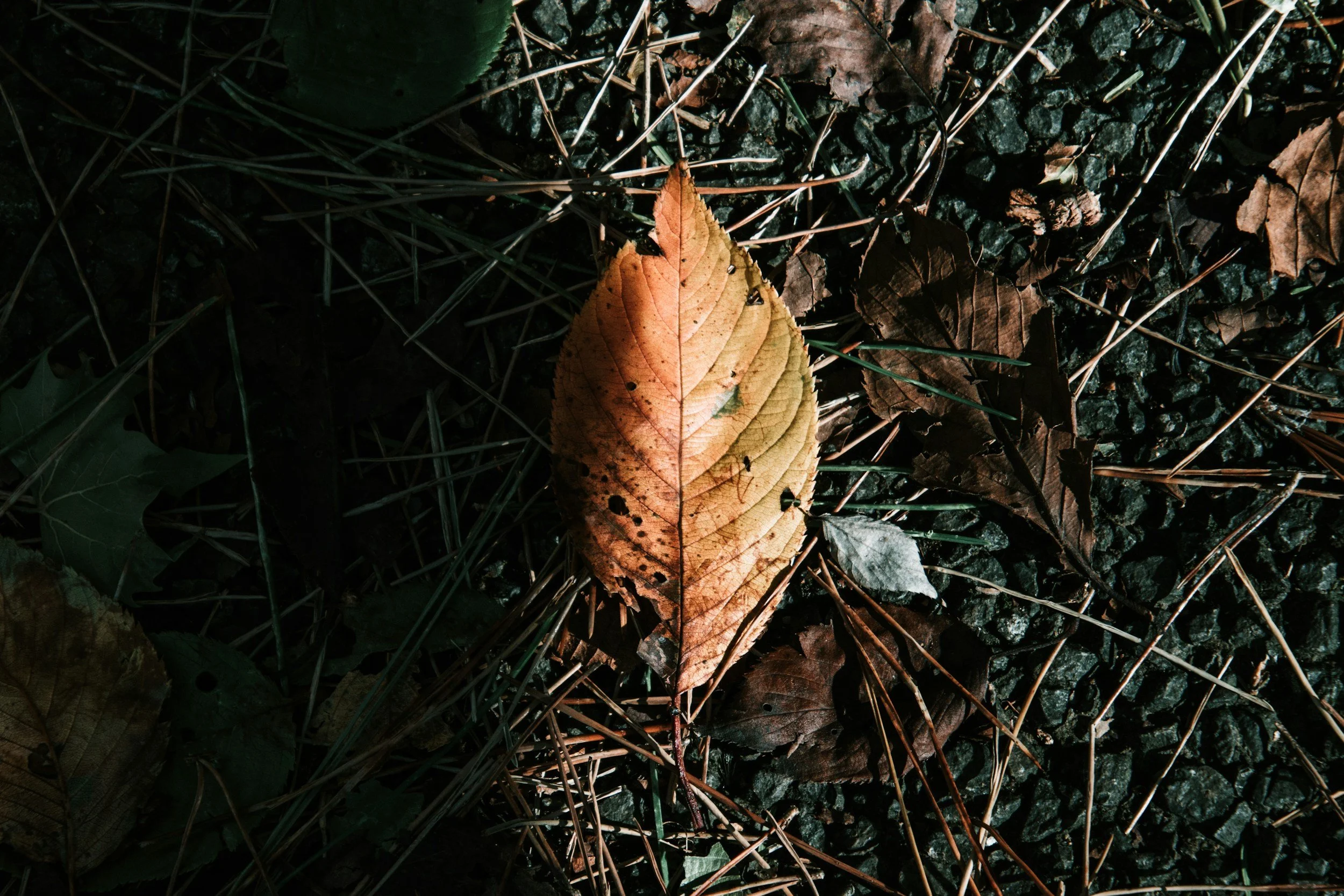
The trees are the model for this. They do not die when they lose their leaves. They are doing something biochemically sophisticated and intentional: they are recalling their resources from the extremities, drawing the chlorophyll back into the branches, abandoning the leaves with a process so complete that the tree will not waste a single nutrient unnecessarily. What looks like dying is strategic conservation. What looks like loss is preparation. The tree lets go of everything that cannot survive winter so that the root system can stay alive and ready for spring.
Mabon's invitation is to practice this with the same deliberateness. What cannot survive winter in your life — the project that has run its course, the pattern that served you in summer but will exhaust you in cold, the version of yourself that belongs to the growing season and not the dark one — can be released now, at the balance point, before winter makes the releasing urgent. The equinox is the moment of choice. You can release before winter forces it, or you can hold on and be stripped. The tree does not hold on. The tree knows better.
Let go of what has served its season. The roots are going nowhere.