Ancestors, Gratitude & The Coming Dark: What Mabon Asks You to Carry
There is a particular quality of autumn light that does something to memory.
It is the angle of it — the low September sun illuminating things from the side rather than from above, throwing the world into relief, making visible the texture of surfaces that summer's overhead light flattened into uniformity. Stone walls. Bark. The grain of old wood. The lines on a face. Autumn light is the light of detail revealed, of what was always there but required this specific angle to become visible. It is the light that makes the old things look most themselves — most permanent, most present, most insistently real.
The ancestors belong to this light. Not because they are sentimental or because the autumn has been arbitrarily assigned to memory. Because the quality of Mabon — the turning toward darkness, the reckoning, the accounting of what the year has built and what it has cost — is precisely the quality of attention that ancestor work requires. To genuinely honor the dead is to look at them in the autumn light, from the angle that makes the texture visible: not the softened, sentimentalized dead of grief's first year, but the actual people — complex, flawed, specific, irreplaceable — who made the choices that produced the world you inhabit.
Mabon is not Samhain. The ancestor work of these two festivals is related but distinct. Samhain's dead come back across the thinning veil — their presence is active, their return something that happens to the living. Mabon's ancestor work is quieter and more internal: not the dead returning but the living turning toward the dead, deliberately, in the season when the world makes that turning natural. This is the choice version — the intentional facing of what stands behind you, before the door between the worlds opens at Samhain and the dead have their say regardless.
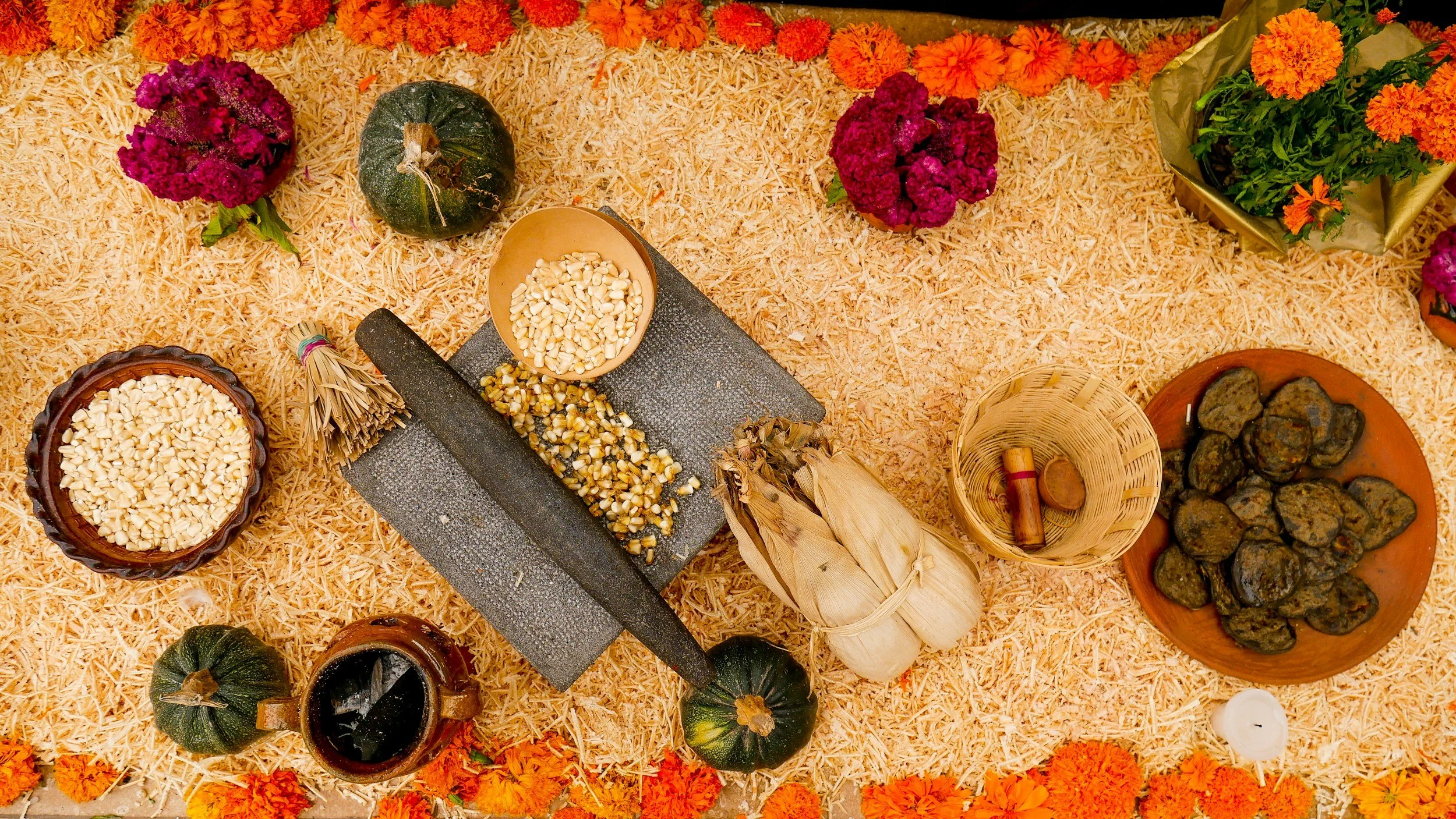
The Harvest as Inheritance: What the Ancestors Left
Every harvest is built on the work of the dead.
This is not metaphor. The specific seeds planted in September came from last year's harvest, which came from the year before, which came from generations of selection and preservation going back to the first farmers who recognized a productive variety and kept it going. The technique used to thresh the grain was learned from a parent who learned it from a grandparent. The knowledge of which field drained well enough for autumn planting and which held water until January was embedded in the community's inherited understanding of the land — knowledge that could not have been generated in a single lifetime, that required the accumulated observation of multiple generations to develop.
Every harvest, in this sense, is a collaboration between the living and the dead. The dead are not absent from the Mabon feast. They are in the food itself — in the varieties they preserved, the techniques they passed on, the land they worked and understood and left in a condition that made the next harvest possible. To sit down to the harvest feast with genuine awareness of this is to sit at a table with a great many more people than are physically present.
"The harvest you eat at Mabon was grown by the living. It was made possible by the dead. This is not sentiment. It is agricultural fact — the kind of fact that becomes invisible when you are too far from the food system to see the chain of knowledge and labor and inheritance that connects the meal to the century of work that preceded it."
The Celtic tradition of setting a place at the harvest feast for the ancestors — a practice that runs through multiple festivals on the wheel, appearing at Samhain's dumb supper and at Imbolc's welcome for Brigid and here at Mabon's harvest gathering — was not ghoulishness. It was accounting. The acknowledgment that the feast was not generated from nothing, that it had a history, and that the history had faces.
The Welsh Tradition: Mabon ap Modron
The mythological figure for whom the festival is named — Mabon ap Modron, the Great Son of the Great Mother — carries an ancestor story at his core that is worth examining in detail, because it is not a story about death and return in the way that many of the wheel's myths are. It is a story about recovery. About finding what has been lost so long it has become legend.
In the Welsh tale of Culhwch and Olwen, preserved in the Mabinogion, one of the tasks assigned to the hero Culhwch is to locate and free Mabon ap Modron, who was taken from his mother when he was three nights old and has been imprisoned ever since — for so long that no one alive knows where he is or what happened to him. To find Mabon, Arthur's men must ask the oldest creatures in the world, working backward through the chain of animal memory: the Blackbird of Cilgwri, the Stag of Rhedynfre, the Owl of Cwm Cawlwyd, the Eagle of Gwernabwy, the Salmon of Llyn Llyw. Each creature is older than the one before. Each one passes the question back further in time. Until finally the Salmon of Llyn Llyw — the oldest creature of all, the one whose memory goes back to the beginning — knows where Mabon is imprisoned, and leads Arthur's men to free him.
Picture this chain of consultation — the heroes moving backward through time with each creature they ask, each one older and stiller and further from the human world than the last. The blackbird on its ancient anvil. The stag in its forest so old the trees have grown from saplings to ancient timber in its lifetime. The owl in the valley it has watched be flooded and dried and flooded again. The eagle on its rock, the rivers of its long life mapped in the landscape below. And finally the salmon in the pool — cold-blooded, ancient, carrying in its body the memory of every river it has swum, every year of its impossibly long life. The salmon knows. The salmon always knows. The oldest memory is the deepest water.
The myth of Mabon is the myth of the lost ancestor retrieved through patient consultation of memory — the memory of the natural world, which goes back further than any human recollection. To free what has been imprisoned since before living memory requires going to sources of knowledge older than living memory. The ancestors speak, but sometimes they speak through the oldest things rather than through direct contact. Mabon teaches you to listen to the salmon.
The Harvest Reckoning: Gratitude That Costs Something
The gratitude tradition of Mabon is the most demanding form of gratitude the wheel contains — more demanding than Lughnasadh's first-fruits offering, more demanding than the gentle hope of Imbolc. This is because Mabon's gratitude is offered at the end of the full year's account, when everything is visible: the abundance and the loss, the successes and the failures, the things the year gave and the things it took.
Genuine gratitude at the autumn equinox requires that you look at all of it. Not just the harvest that came in, but the harvest that failed. Not just the relationships that flourished, but the ones that didn't survive the summer. Not just the plans that worked, but the plans that were wrong from the beginning or simply ran out of time. The equinox is the moment of the complete inventory — the reckoning — and gratitude offered at the reckoning is gratitude that has been tested against the full weight of the year's reality and offered anyway.
This is categorically different from gratitude offered from a position of pure abundance. That gratitude is real, but it is easy. Mabon's gratitude is the kind that says: this year cost me something, and I am still grateful for what it gave. The scales are not in my favor in every column of the ledger, and I am still grateful for the columns where they are. The dark is coming, and I am grateful for the light that is leaving.
"The hardest gratitude is offered at the end of a year that was mixed — that gave and took in roughly equal measure, that left you neither clearly better nor clearly worse than you began. This is the gratitude Mabon specializes in. The gratitude that does not require a net positive to be genuine. The gratitude that is a choice made in full awareness of the cost."
The specific practice the harvest tradition recommended for this reckoning was material and communal: the harvest feast, at which every household brought what they had — not what they wished they had, not what they hoped to have next year, but what the year had actually produced. The feast was an honest accounting made edible. Everyone could see, in what was on the table, what the year had been. The community ate together in full knowledge of each other's harvests, and in that shared knowledge, the gratitude became collective rather than private.
Walking Toward the Dark: The Spiritual Work of Autumn
✦ ✦ ✦
The final thing Mabon asks is the one that no amount of ritual preparation fully prepares you for: the willingness to walk toward the dark rather than waiting for it to overtake you.
The wheel does not pause at the equinox. The tipping happens whether or not you are ready, whether or not you have completed your harvest reckoning, whether or not you have released what needed releasing and honored what needed honoring. The dark comes. The question Mabon poses is only whether you will face it with the autumn's full intelligence behind you — the harvest counted, the ancestors acknowledged, the scales observed, the gratitude offered — or whether you will arrive at Samhain still carrying everything you should have put down at the equinox.
The trees know how to do this. They have been doing it for longer than anything else currently living on earth. They do not mourn the leaves. They do not attempt to hold the summer. They complete the season's work — photosynthesis, seed production, the drawing down of resources — and then they let go with the complete confidence of something that has done this before and knows what comes next. The bare branches are not the tree's failure. They are the tree's intelligence made visible: the decision to keep only what is essential, to protect only the root and the heartwood, to present the winter with nothing it can damage.
This is what it looks like to walk toward the dark with Mabon's wisdom rather than against it. Not stoicism. Not the suppression of grief for what the year has been and what the season is taking. But the trust — earned through the cycle's full turning, through Imbolc's fragile hope and Beltane's exuberance and Lughnasadh's reckoning and all the rest — that the dark is not the end. That the root system is intact. That what survives winter will be ready for spring. That the wheel turns, and has always turned, and will turn again.
The ancestors walked into this dark. Every generation before you walked into this dark. Some of them did not make it to spring — and this is the honest weight that Mabon's ancestor work carries, the acknowledgment that the dark is real and that its dangers are not merely symbolic. But most of them did make it. The chain of inheritance that produced you required that most of them make it. And what they left behind — in the seeds, in the knowledge, in the specific ways of facing winter that were encoded in tradition and practice and the memory of the oldest creatures — is available to you now, at the turning, if you are willing to receive it.
The dark is coming. The ancestors have been here before you.
Walk toward it with everything the year has given you. It is enough.
It has always been enough.