Western Water Hemlock: The Most Violent Poison in North America
This is not the hemlock that killed Socrates. That plant — poison hemlock, Conium maculatum — has its own entry in this archive and its own ancient reputation. Western water hemlock is a different, distantly related plant entirely, native to North America rather than the Mediterranean, and by most toxicological accounts, considerably more violent in how it kills. It's regularly cited as the most poisonous plant on the continent, and the way it earns that title is genuinely unlike almost anything else covered in this archive: not through slow delirium, not through a creeping cardiac failure, but through a fast, brutal hijacking of the nervous system that can end in seizures within the hour.
It also happens to belong to one of the most beloved plant families in the human diet. Carrots, celery, parsley, dill, fennel, parsnip — all close relatives. Western water hemlock is the one violent exception inside a family otherwise responsible for half the contents of a spice rack.
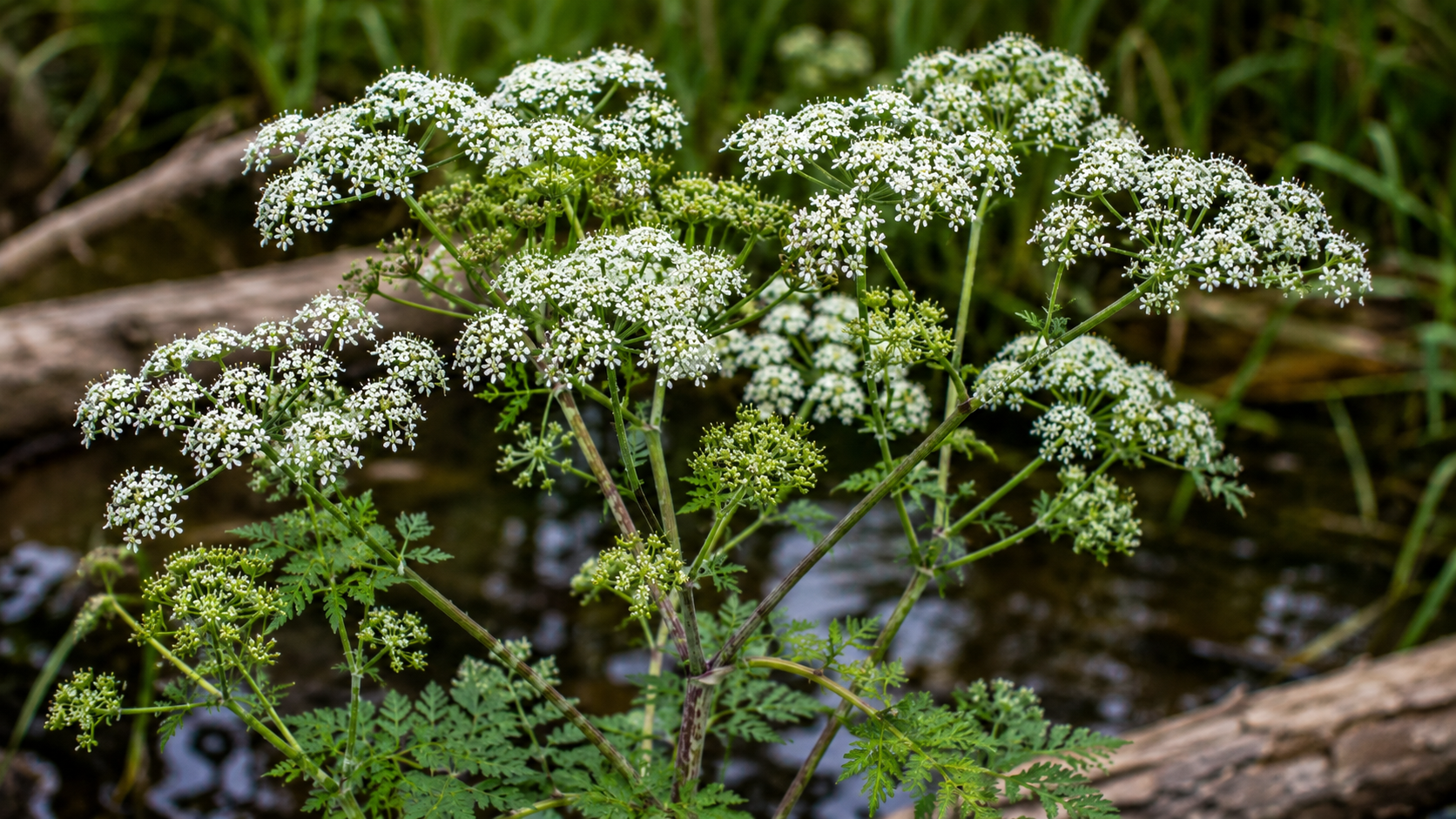
A Killer Hiding Among Its Edible Cousins
Western water hemlock grows in wet ground — stream banks, ditches, marshes, irrigation canals — reaching several feet tall on a hollow, often purple-spotted stem, topped with the same kind of loose, umbrella-shaped white flower clusters found across its entire family. That resemblance is exactly the problem. The plant looks close enough to genuinely edible relatives, and to other wild plants foragers might reasonably trust, that misidentification is the leading cause of human poisoning, not deliberate use.
There are a few reliable ways to tell it apart, for anyone determined to identify it correctly rather than simply avoid the whole family in the wild: the leaf veins run to the notches between the leaflet's teeth rather than to the tips, the stem base is internally divided into distinct horizontal chambers when sliced open, and the root exudes a yellowish, oily liquid with a sharp, turnip-like smell. None of these are details a casual forager is likely to check carefully enough before it's too late.
A Toxin That Attacks the Brain Directly
The compound responsible, cicutoxin, works through a mechanism that's genuinely different from most of the poisons in this archive. Rather than disrupting heart rhythm like oleander or foxglove, or producing a slow hallucinatory delirium like datura or henbane, cicutoxin directly blocks a key receptor in the brain responsible for calming neural activity. With that receptor disabled, neurons fire without the usual restraint, and the result is rapid, severe overstimulation of the nervous system.
In practical terms, that means cicutoxin poisoning moves fast. Early symptoms — excessive salivation, nervousness, muscle twitching — can progress to violent seizures and respiratory failure within as little as sixty minutes of ingestion. It's considered one of the most potent convulsant poisons known in the plant kingdom, and unlike many of the slower-acting toxins covered elsewhere in this archive, there's often very little window between "feeling wrong" and a genuine medical emergency.
Strangely, survival isn't always predictable even with comparable doses. Some poisoning victims have recovered with aggressive medical treatment — typically heavy sedation aimed at calming the overstimulated nervous system long enough for the body to clear the toxin — while others, even with similar exposure, have died. Researchers studying the plant have noted, somewhat unsettlingly, that nobody fully understands why outcomes vary as much as they do.
A Plant Nothing Wants to Eat
One detail naturalists have repeatedly noted about water hemlock is just how thoroughly it seems to repel the natural world around it. Unlike many toxic plants that still show signs of insect damage or animal grazing, observers studying water hemlock in the wild have reported essentially never finding bite marks or feeding damage on its leaves — a pattern that suggests almost everything in its ecosystem has learned, generation over generation, to leave it strictly alone.
Livestock haven't always had that luxury. Grazing animals encountering water hemlock in pasture or along waterways have been poisoned and killed in significant numbers throughout North American agricultural history, and it remains a genuine concern for livestock managers wherever the plant grows near grazing land.
Misidentification as the Real Killer
There's no witch trial attached to water hemlock, no flying ointment, no underworld mythology — its danger has always been almost entirely a matter of mistaken identity rather than deliberate use. Documented human poisonings trace back centuries, with the first reports of toxic effects from the genus recorded as early as the late seventeenth century, and the first documented poisoning case in the United States recorded in the early 1800s. Reviews of poison center data have continued to find water hemlock responsible for more confirmed fatalities than any other toxic plant tracked in North America.
The pattern behind nearly every case is consistent: someone mistakes the plant, or specifically its root, for a wild carrot, parsnip, or similar edible relative. Children are particularly at risk simply because the plant's tuberous roots can resemble something worth digging up and tasting out of curiosity. Even experienced foragers, confident in their plant identification skills generally, have been caught out by how convincingly water hemlock wears its edible relatives' disguise.
Quick Answers
Is western water hemlock the same plant that killed Socrates? No — Socrates was poisoned by Conium maculatum (poison hemlock), a different, only distantly related plant. Western water hemlock (Cicuta douglasii) is native to North America and works through an entirely different toxic mechanism.
How quickly does water hemlock poisoning act? Very quickly — symptoms can begin within minutes, and severe effects including seizures can occur within about an hour of ingestion.
What part of the plant is most toxic? The roots and root base contain the highest concentration of cicutoxin, particularly in early spring growth, though all parts of the plant should be considered dangerous.
Can water hemlock poisoning be survived? Yes, sometimes, with prompt aggressive medical treatment aimed at controlling seizures, though outcomes vary unpredictably even among similar exposure levels, and many cases have been fatal.
Why is it so often confused with edible plants? It belongs to the same plant family as carrots, parsley, and parsnips, and shares a similar appearance — white umbrella-shaped flower clusters and a thick, tuberous root — that closely resembles genuinely edible relatives.
Is water hemlock dangerous to livestock too? Yes, significantly — grazing animals have been poisoned and killed by it across North American pastureland, and it remains an active concern for ranchers and livestock managers wherever it grows.