Death Camas: The Poison That Hides in Plain Sight
Death camas doesn't need a dramatic origin myth or a witch trial confession to earn its place in this archive. Its horror is quieter and, in a lot of ways, more unsettling than belladonna's or henbane's — this is a plant that kills primarily through mistaken identity. It looks enough like a wild onion, and its bulb grows alongside genuinely edible camas species closely enough, that otherwise careful, knowledgeable people have eaten it by accident and died.
There's no Hecate here, no flying ointment, no gallows folklore. Death camas belongs to a different, more practical genre of plant horror: the danger that doesn't announce itself, doesn't look particularly sinister, and waits patiently in a meadow for someone to confuse it with dinner.
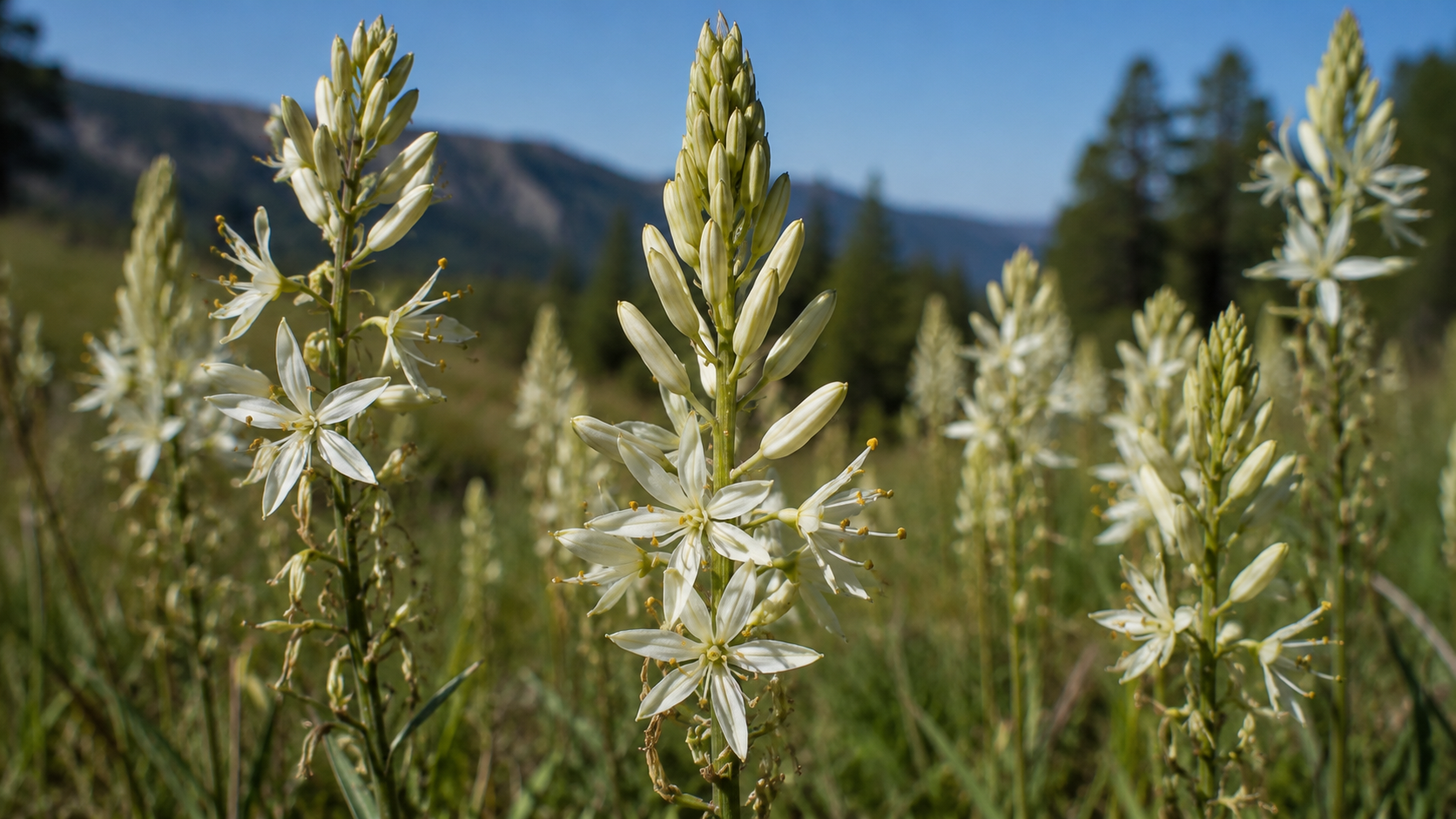
A Name With No Subtlety At All
Unlike most plants in this archive, death camas never needed an elaborate etymology — its common name says exactly what it is. "Camas" refers to its resemblance to the genuinely edible camas lily bulbs that Indigenous peoples across western North America relied on as a significant food source. "Death" is simply the warning attached to the lookalike that isn't safe to eat.
Its scientific naming has been genuinely unsettled for over a century, which is its own kind of interesting history. The genus was first named Zigadenus in the late 1700s, drawing from Greek words for "yoke" and "gland," referencing a small paired feature on the flower. A botanist proposed splitting it into a new genus, Toxicoscordion, in 1903 — a name that translates roughly to "poisonous garlic-relative," and about as direct a scientific name as exists in all of botany. For most of the twentieth century, sources kept using the older Zigadenus name anyway, and the two names still appear interchangeably across plant guides and toxicology literature today, decades after the more recent classification was confirmed.
The Look-Alike Problem
Death camas's defining danger is structural, not chemical alone. Its onion-shaped bulb and narrow, grass-like leaves emerge early in spring looking remarkably similar to wild onions and to true edible camas — close enough that the most reliable way to tell them apart isn't sight, but smell. True wild onion carries an unmistakable onion odor; death camas has none, and tastes notably bitter rather than savory.
That single missing detail — the smell — has been the difference between a foraged meal and a medical emergency more times than anyone has been able to fully count. The toxin responsible, an alkaloid called zygacine, doesn't discriminate by how the plant ends up in someone's body. Whether it's a child mistaking the bulb for a wild onion, a hungry traveler unfamiliar with regional plants, or livestock grazing through a meadow indiscriminately, the chemistry works the same lethal way every time.
Lewis and Clark, and a Reversal Nobody Saw Coming
Death camas has a quiet but real footprint in American frontier history. Members of the Lewis and Clark expedition are believed to have encountered a poisonous bulb in the western territories that may well have been an early run-in with death camas, a plant entirely unfamiliar to explorers used to a different continent's flora entirely.
A stranger, more pointed historical episode came later, when early Mormon settlers in Utah were reportedly poisoned after Native American traders sold them death camas bulbs as food — a troubling reversal of the more commonly told frontier narrative, in which it's typically settlers who poison or are poisoned by unfamiliar plants through their own ignorance. In this case, the deception (intentional or not) ran the other direction, and it's a detail historians of frontier toxicology still note specifically because it complicates a much more familiar story.
The danger didn't end with the frontier era, either. Twentieth-century medical records include an account of railroad workers who died shortly after eating death camas bulbs they'd apparently gathered and mistaken for something safe — a reminder that this isn't an exclusively historical hazard. Toxicologists have continued documenting both fatal and nonfatal human poisonings well into the modern era, almost always rooted in the same basic mistake: assuming this bulb was something else.
What the Body Goes Through
Death camas poisoning in humans typically begins with intense nausea and vomiting, progressing to a dangerously slowed heart rate and a sharp drop in blood pressure, along with a loss of coordination. In severe cases, this can lead to coma and death. Emergency treatment has historically relied on atropine and dopamine to stabilize heart rate and blood pressure — an odd echo of the fact that atropine, drawn originally from a different toxic plant entirely (belladonna), is now used to treat poisoning from this one.
Livestock bear the heaviest burden of death camas toxicity by sheer volume. Sheep are especially vulnerable and have died from it in significant numbers across the American West, with cattle and horses also at serious risk. In one of the plant kingdom's stranger immunities, pigs again show up resistant to a toxin that devastates almost everything else that eats it — the same pattern seen with henbane, and a detail that toxicologists still don't have a fully satisfying explanation for.
Knowledge Older Than the Warning Label
Indigenous peoples across the plant's native range developed detailed, specific knowledge of death camas long before formal toxicology existed to confirm it. Several tribes reportedly used the plant externally — as a rubdown for athletes or to strengthen muscles — a use that depended entirely on knowing the difference between what was safe applied to skin and what was lethal if swallowed. The Navajo are recorded using it specifically as a treatment associated with rabies, sometimes called "mad coyote" medicine in older ethnobotanical records — a specialized, narrow application built on a precise understanding of a genuinely dangerous plant.
This kind of knowledge represents the same pattern seen throughout the witch's garden: communities living in close contact with a toxic plant didn't avoid it entirely, they learned exactly how to work around its danger to extract narrow, specific value from something that could just as easily kill them.
An Unlikely Specialist Pollinator
One of death camas's strangest details has nothing to do with poisoning at all. Its nectar is toxic enough that most pollinators avoid the plant entirely — except for one species that's evolved specifically to handle it: the aptly named death camas miner bee, a specialist pollinator that has adapted to tolerate the plant's toxins well enough to rely on it as a primary food source. In a meadow full of flowers, this is apparently the one bee willing to drink from the cup everything else learned to avoid.
Quick Answers
How can you tell death camas apart from edible wild onion? Smell is the most reliable test — true wild onion has an unmistakable onion odor, while death camas has none and tastes distinctly bitter rather than savory.
Is death camas dangerous to pets and livestock? Yes, significantly — sheep are especially vulnerable and have died from it in large numbers across the western United States, with cattle and horses also at serious risk.
What does death camas poisoning feel like in humans? It typically starts with severe nausea and vomiting, followed by a slowed heart rate, dropping blood pressure, and loss of coordination, progressing to coma in severe cases.
Is death camas the same plant in every part of North America? Not exactly — several closely related species across the genera Toxicoscordion, Zigadenus, Stenanthium, and Anticlea are all commonly called "death camas," and their toxicity levels and exact ranges vary somewhat by species.
Did Indigenous peoples actually eat death camas by mistake? Historical accounts include both Indigenous and settler poisonings, and there's a notable case where early Mormon settlers in Utah were reportedly poisoned after purchasing death camas bulbs sold to them as food.
Why are pigs immune to death camas poisoning when other animals aren't? The exact mechanism isn't fully understood, but pigs show notable resistance to several other tropane and steroidal plant alkaloids as well, a pattern toxicologists have observed but not completely explained.