Rue: The Herb That Blessed Holy Water and Warded Off Witches
Few plants in this archive have been trusted by quite as many opposing institutions as rue. Catholic priests dipped it in holy water to bless congregations. Ancient Greek and Roman poison antidotes were built around it. Folk magic practitioners hung it over doorways specifically to keep witches out — and other folk magic practitioners used the exact same plant as an ingredient in their own spellwork. Few entries in this collection have managed to be claimed, simultaneously and without apparent contradiction, by both sides of the witch trial.
It earns the name "herb of grace" honestly: this is a plant genuinely associated with mercy, protection, and purification across an unusually wide range of traditions — while also carrying a real toxicity, a genuine skin hazard, and at least one mythological connection to one of literature's most infamous sorceresses.
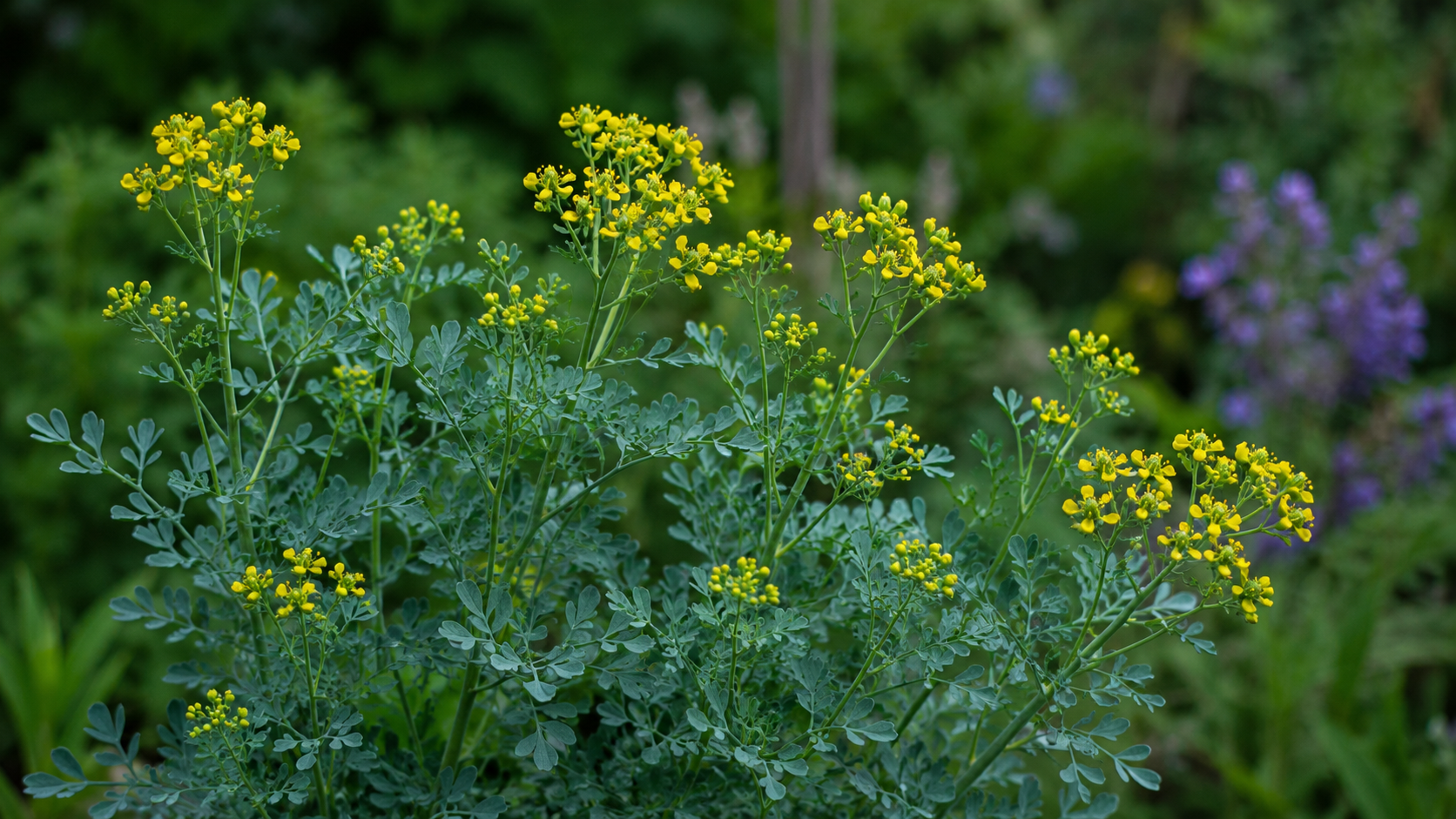
A Name That Means the Opposite of What It Sounds Like
It's a common and entirely understandable mistake to assume "rue" relates to the English verb "to rue" — to regret. The two words are, in fact, etymologically unrelated entirely by coincidence. Rue's actual name traces back to the Greek word reuo, meaning "to set free" or "to liberate" — a reference to its long-standing reputation as a remedy capable of relieving people from all manner of afflictions, poisons very much included.
The genuinely regretful associations came later, layered on by English speakers who simply assumed a connection that was never really there. Shakespeare leaned into this confusion directly and repeatedly: Ophelia, distributing herbs in her own madness in Hamlet, hands out rue specifically as a symbol of sorrow and regret, and the play calls it "herb of grace o' Sundays" in the very same breath — sorrow and grace, knotted together in a single plant, built on a linguistic coincidence nobody bothered to correct.
The Herb That Saved Odysseus From a Witch
Rue's mythological pedigree runs deep into Greek epic. According to tradition, it was the very herb given to Odysseus as protection against the sorceress Circe — the same Circe already established elsewhere in this archive as a figure deeply associated with poisonous, transformative plants like mandrake. Rue's role here is notably defensive rather than offensive: not a weapon, but a shield, specifically credited with helping Odysseus resist Circe's spells and counteract the effects of her potions where his men had already fallen victim.
A separate strand of Greek belief held that rue specifically protected against the witchcraft of strangers — a use the philosopher Aristotle, ever the rationalist, explained away rather deflatingly: Greeks unused to dining with foreigners simply ate too quickly out of nervousness, became flatulent, and rue's genuinely real digestive-calming effect was then mistaken for having broken a stranger's curse.
Rue even shows up woven into mythological natural history beyond witchcraft directly. According to ancient belief, the basilisk — a creature whose very breath could wilt plants and crack stone — had no power over rue whatsoever. Weasels bitten by a basilisk were said to retreat specifically to eat rue, recovering enough to return and continue the fight. Even mythology's most lethal creature, in other words, met one plant it apparently couldn't touch.
The King of Poisons' Own Antidote
Rue's reputation as a genuine antidote against poison runs through real, non-mythological history as well. It was a core ingredient in mithridate — a general-purpose poison antidote named directly after King Mithridates VI of Pontus, the same poison-obsessed ruler already covered in this archive's rhododendron entry for his deployment of toxic "mad honey" against a Roman army. The connection is almost too fitting: a king famous for studying poison defensively, by reportedly dosing himself with small amounts of toxins to build tolerance, relied in part on the very same plant later generations would hang over their doors to keep witches away.
Centuries later, rue found its way into one of folk history's most famous protective concoctions: Four Thieves Vinegar, a blend of rue, garlic, rosemary, lavender, vinegar, and cloves, reportedly invented by thieves who used it to protect themselves while robbing the bodies of plague victims. The belief in rue's protective power against contagion ran deep enough that it shaped real market behavior centuries later — when a rumor spread in 1760 that plague had appeared at a London hospital, the price of rue at Covent Garden market reportedly jumped by 40 percent overnight, pure folk faith in a single herb's protective power moving real money in a panic.
Blessed by Priests, Wielded by Witches
Rue's most enduring nickname, "herb of grace," comes directly from Christian liturgical practice: priests historically dipped branches of rue into holy water and used them to sprinkle blessings over congregations and homes, tying the plant directly to forgiveness, purification, and divine mercy. The association ran deep enough to attach itself to the Virgin Mary in some medieval devotional traditions, linking the herb's bitter taste to a kind of sorrowful purification.
And yet, in an irony this archive keeps circling back to, the exact same plant carried an equally strong reputation in folk magic and witchcraft traditions — used to break curses, ward off the evil eye, and cleanse spaces of negative energy. Carried as a protective amulet or burned during cleansing rituals, rue occupied genuinely contested ground: claimed by the Church as a tool of grace, and claimed by folk practitioners as a tool of protection against exactly the kind of accusation the Church itself might level at them.
A Plant That Bites Back in Sunlight
Despite its protective reputation, rue carries a real, well-documented hazard of its own: it contains psoralen, a compound that reacts with ultraviolet light to cause phytophotodermatitis — a severe skin reaction producing burn-like blisters anywhere the plant's sap has contacted skin later exposed to sunlight. Historical accounts note that even careful cultivators occasionally misjudged this danger; one ninth-century monk reportedly believed rue was only safe to handle in the morning, becoming progressively more dangerous to pick as the day wore on and sun exposure increased.
The plant carries other genuine risks as well. Used historically and traditionally as what was termed a "woman's herb" for its effects on the reproductive system, rue has a long-documented history as an abortifacient — a use reflecting real, if dangerous, pharmacological activity, not folklore. Modern guidance is consistent and unambiguous: rue should be avoided entirely during pregnancy, and used only with real caution and in small quantities even outside of that context, given its broader toxicity profile.
Quick Answers
Is rue dangerous to grow in a garden? It can be, primarily through skin contact combined with sun exposure — handling rue and then exposing that skin to sunlight can cause a genuine burn-like reaction, so gloves and caution are recommended when pruning or handling it.
Why is rue called "herb of grace"? The name comes from the Christian practice of priests dipping rue branches in holy water and using them to sprinkle blessings over congregations, tying the plant to forgiveness and divine mercy.
Is rue actually an effective poison antidote? It was historically believed to be, and was a core ingredient in ancient antidote preparations like mithridate, though modern medicine doesn't rely on it as a genuine poison treatment today.
Is rue safe to eat as a culinary herb? It's been used historically in small quantities in Mediterranean and Roman cuisine, but it's bitter, can cause gastric discomfort, and should be avoided by pregnant women or anyone with liver issues due to its toxic compounds.
Why does rue appear in both Christian blessing rituals and witchcraft practices? Its reputation as a protective, purifying plant made it valuable to both traditions independently — each interpreting the same protective qualities through their own framework, without necessarily borrowing from the other.
Is rue dangerous to pets? Yes — rue contains compounds toxic to cats, dogs, and other animals, and should be kept out of reach in gardens where pets have access.