Larkspur: The Flower Inscribed With a Dying Man's Grief
According to Greek legend, the tall blue spires of larkspur first bloomed from a hero's own blood — and if you look closely at the petals, the story claims, you can still find his initials written there in grief. It's an unusually literary origin story for a flower that's also, in practical agricultural terms, responsible for genuine and ongoing livestock losses across the American West every single year.
Larkspur lives a kind of double life in this archive already, having appeared once as a comparison point in the Delphinium dictionary entry. This is its full story — a flower carrying more competing legends, across more unconnected cultures, than almost anything else in the witch's garden.
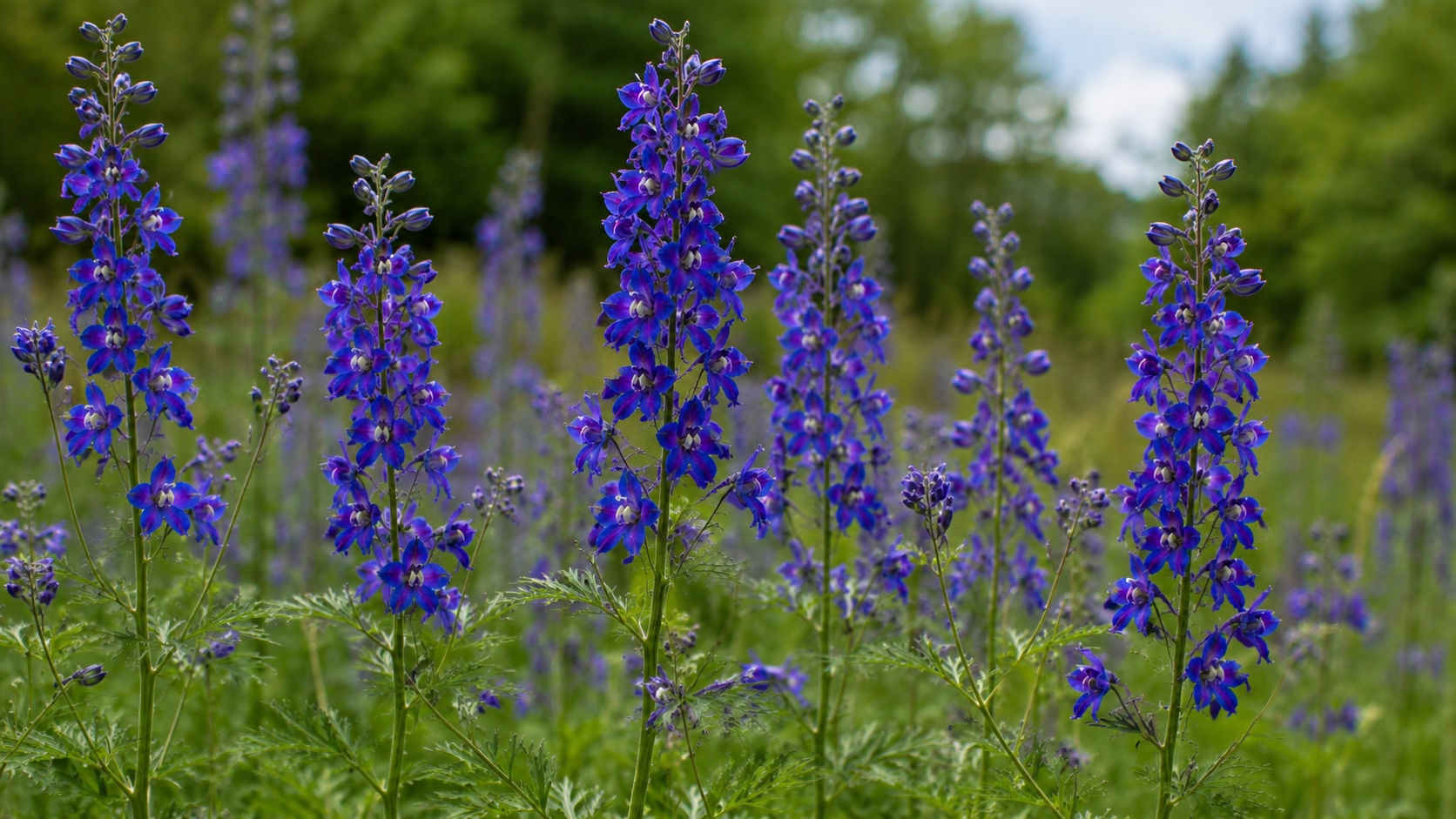
A Name Built From Two Different Animals
Larkspur's common name comes from the shape of its flower: each bloom carries a single elongated, backward-pointing petal that resembles a spur — specifically, by most accounts, the hind claw of a meadowlark. Its scientific name tells an entirely different visual story. Delphinium comes from the Greek word delphis, meaning dolphin, because the unopened flower bud, viewed from the right angle, was thought to resemble a small leaping dolphin. One flower, two completely different animal comparisons, neither one obviously related to the other — a small reminder of how differently the same shape can read depending on who's naming it.
Other folk names attached to the plant lean into a third visual reading entirely: Lark's Heel, Lark's Claw, and Knight's Spur, the last of these tying the flower specifically to chivalry and bravery, a theme that resurfaces directly in its most famous myth.
A Flower Written in Grief
The most enduring legend attached to larkspur comes from Greek mythology, tied to the aftermath of the Trojan War. After the death of Achilles, both Ajax and Odysseus laid claim to his armor — considered the rightful inheritance of the greatest remaining warrior. When the assembled Greeks awarded the armor to Odysseus instead, Ajax, consumed by rage and humiliation, took his own life with his sword. Where his blood spilled onto the ground, the legend holds, larkspur sprang up in his place. Even more specifically, the story claims the letters "AI" — Greek for "alas" — can be found inscribed on the petals themselves, a permanent, botanical cry of grief left behind by a hero who couldn't bear his own disgrace.
It's a striking origin myth, and a fitting one: a flower born from wounded pride and a violent ending, carrying its mourning forward in its own physical form for anyone willing to look closely enough to find it.
A Rabbit, a Tomb, and a Different Kind of Faith
Christian folk tradition tells an entirely different, far gentler story about the same flower. According to this legend, after Christ's crucifixion and burial, a small rabbit kept faithful watch outside the sealed tomb through the darkness, waiting for the resurrection nearly everyone else had given up on. When Christ rose and found the rabbit still keeping its vigil, he knelt down and showed the animal a small blue larkspur flower, telling it to look closely — and there, within the bloom, the rabbit could see the reflection of its own face, a permanent mark of having kept faith when no one else had.
This version of the larkspur myth carries none of the rage or grief of the Ajax legend — it's a story about loyalty rewarded, not pride punished, and it gave the flower a lasting association with trust and faith that exists alongside, rather than replacing, its more tragic Greek origin.
A Sky Spirit's Gift, in North American Tradition
A separate, unrelated legend comes from Native American tradition, describing a celestial being who descended from the sky carrying spikes made from fragments of the heavens themselves. When these sky-spikes touched the earth, the legend holds, they transformed directly into larkspur flowers — explaining both the plant's distinctive spire-like growth habit and its striking, otherwise hard-to-find shade of true blue, a color genuinely rare across the flowering plant world. Larkspur held a position of real esteem in various Native American traditions, valued both for this origin story and, more practically, as a source of blue dye — a use later adopted by European settlers as well.
Protection Against Witches, Scorpions, and Ghosts
Across an entirely different set of folk traditions, larkspur shows up repeatedly as a protective plant rather than a mythological one. In Transylvania, planting larkspur near stables was believed to keep witches away from livestock. In England, people reportedly sprinkled larkspur into bathwater specifically as protection against ghosts and malevolent magic. Even further back, in ancient Greece, the plant was credited with the ability to ward off scorpions, and was used medicinally to treat open wounds — a genuinely protective reputation running in parallel with, rather than separate from, its violent mythological origin story.
The Toxicity Behind the Beauty
Beneath all of this folklore sits a real, significant danger, already touched on in this archive's Delphinium dictionary entry: larkspur contains diterpenoid alkaloids, primarily methyllycaconitine, which block acetylcholine receptors in a manner closely related to monkshood's mechanism, causing neuromuscular paralysis and cardiac effects. Wild larkspur growing in mountain meadows across the American West remains a documented, economically significant cause of cattle and sheep poisoning, particularly in spring when the plant is young, most toxic, and most likely to be one of the only green options available to grazing animals at elevation. The seeds carry the highest concentration of toxin, and as an ornamental garden plant, larkspur also accounts for regular accidental poisonings in children drawn to its seeds.
It's a flower that's been called grief made permanent, faith rewarded, a gift from the sky, and a shield against witches — and through every one of those stories, it has also, quietly and consistently, been capable of killing the animals and people who underestimate it.
Quick Answers
Is larkspur the same plant as delphinium? Yes, largely — "larkspur" is the common name most often used for plants in the genus Delphinium (and the closely related genus Consolida), with the names frequently used interchangeably.
Why does Greek mythology connect larkspur to Ajax? Legend holds that the flower sprang from the ground where Ajax's blood spilled after he took his own life in despair over losing Achilles's armor, with his initials said to appear marked on the petals.
Is larkspur actually dangerous to livestock? Yes, significantly — wild larkspur poisoning of cattle and sheep is a documented, economically meaningful problem across the American West, particularly in spring when the plant is young and grazing animals have fewer alternative food sources.
Is larkspur dangerous to touch? The greater risk is ingestion rather than casual contact, though gloves are a reasonable precaution when handling the plant, particularly the seeds.
Why is larkspur associated with rabbits in some traditions? A Christian folk legend describes Christ showing a faithful rabbit, who had kept vigil at his tomb, a blue larkspur flower containing the reflection of the rabbit's own face — a symbol of loyalty and faith rewarded.
What part of the larkspur plant is most toxic? The seeds carry the highest concentration of toxic alkaloids, with the plant overall most dangerous in spring during early, active growth.