Baneberry: The Plant That Grows Its Own Eyes
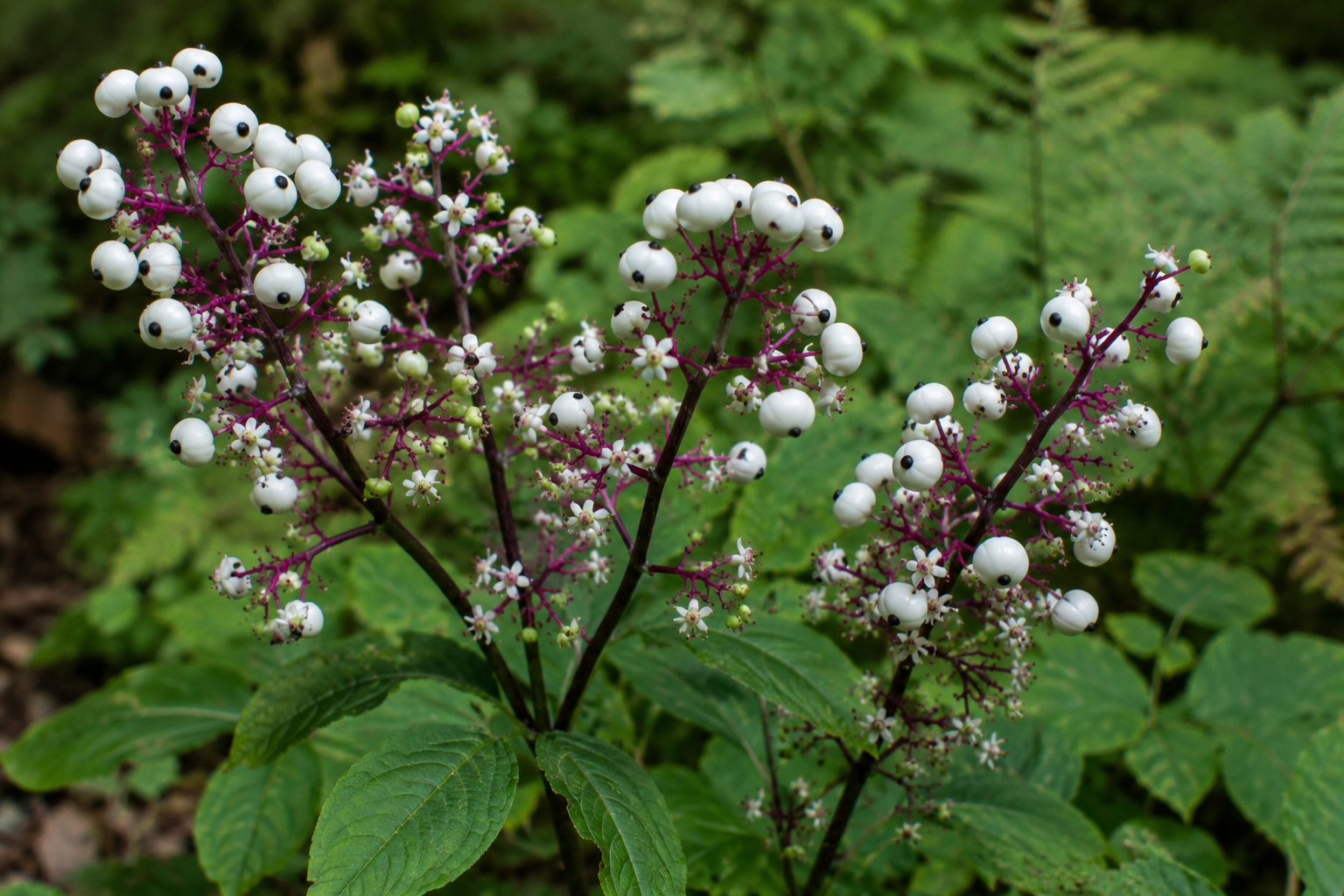
Walk through certain shaded North American forests in late summer and you might find something watching you back — clusters of glossy white berries, each one marked with a single dark spot, sitting atop hot-pink stems like a small forest of staring eyes. The plant's actual common name leaves nothing to the imagination: doll's eyes. Its other name is more direct still. Baneberry. "Bane," in old plant-naming convention, means exactly what it sounds like — something that brings death.
Unlike most of the entries in this archive, baneberry's reputation isn't built on ancient mythology, witch trial confessions, or a famous historical death. Its horror is purely visual and immediate — a plant that looks unsettling on first glance, for reasons that turn out to be entirely justified once you understand what it's capable of.
Eyes That Aren't Decorative
The white-berried species, Actaea pachypoda, earns its "doll's eyes" name with almost unnerving precision: each berry is a shiny, porcelain-white sphere centered with a single black dot, clustered along a stem so vividly pink it looks almost artificial. The naturalist Henry David Thoreau, encountering the plant, described the berries as looking like they contained "a pearly venom," with an "imp-eyed" quality he clearly found as unsettling as anyone walking past one today.
A closely related species, red baneberry (Actaea rubra), trades the white-and-black eye effect for clusters of bright red berries, equally toxic and equally eye-catching against the plant's green foliage. Both belong to the buttercup family and share a close botanical relationship with another plant already covered in this archive — monkshood — a family tie that makes sense once you know how seriously both plants need to be taken.
A Toxin Nobody's Fully Identified
Baneberry holds a strange distinction in modern toxicology: despite being well-documented as dangerous for well over a century, scientists still haven't conclusively identified the exact compound responsible for its toxicity. Researchers suspect an essential oil or a poisonous glycoside affecting the heart directly, since the symptoms of poisoning are notably cardiac in nature — described as cardiogenic, with an almost immediate effect on heart muscle that can lead to cardiac arrest in as little as thirty minutes in a serious case.
Other symptoms of baneberry poisoning include stomach cramps, dizziness, vomiting, diarrhea, and delirium, with the roots and berries carrying the highest concentration of toxin, though the entire plant should be considered dangerous. There's a small mercy built into the plant's own bitterness, however: the berries taste unpleasant enough that consuming a fatal quantity by accident is genuinely difficult. No confirmed deaths from baneberry ingestion have been recorded in the United States, though a related European species has been linked to fatalities, particularly among children.
Safe for Birds, Lethal for Almost Everyone Else
One of baneberry's most quietly remarkable features is how selectively its toxicity operates. The same white or red berries that pose a real danger to humans, pets, and livestock are entirely harmless to birds, which eat them freely and spread the seeds through their droppings — the plant's actual reproductive strategy depends on this exact asymmetry. Evolution appears to have shaped the berry's vivid, eye-catching coloring specifically to attract the one group of creatures equipped to eat it safely, while every mammal nearby remains vulnerable to the same fruit.
It's a clean, almost elegant evolutionary trade-off: a plant that needs to be eaten to reproduce, wrapped in a toxin that only works on the animals it doesn't need as partners.
A Narrow, Careful Medicinal History
Despite its danger, baneberry has a real, if narrow, history of traditional medicinal use. The Blackfoot Nation is documented preparing a decoction from the plant's roots as a remedy for colds and coughs — a precise, dosage-conscious application built on generations of accumulated knowledge about exactly how far this particular plant could be pushed before it stopped being medicine and started being poison.
European settlers gave the plant another, gentler-sounding name entirely: Herb Christopher, after the patron saint of travelers — a striking contrast to "bane" and "doll's eyes," and a reminder that even a plant with this much danger attached to it could still be folded into protective, devotional naming traditions by people determined to find something benevolent in it.
Quick Answers
Are baneberry plants dangerous to touch? The greater risk by far is ingestion rather than contact, though as with most toxic plants, washing hands after handling is a reasonable precaution, particularly before touching the face.
How many baneberries does it take to be dangerous? Eating roughly six or more berries has been associated with respiratory distress and cardiac arrest in documented cases, though the berries' bitter taste makes consuming that many by accident relatively unlikely.
Has anyone actually died from eating baneberry in the United States? No confirmed deaths have been recorded from red or white baneberry in the U.S., though a related European species has been linked to child fatalities.
Why do the berries look like eyes? The white variety's berries are naturally porcelain-white with a single dark stigma scar at the tip, creating a striking resemblance to a doll's glass eye — a coincidence of plant anatomy rather than anything deliberate, but a genuinely effective visual warning all the same.
Is baneberry dangerous to pets? Yes — all parts of the plant are toxic to pets and livestock as well as humans, with the berries and roots posing the greatest risk.
Why can birds eat the berries safely when other animals can't? Birds appear to be physiologically resistant to the plant's specific toxins, an adaptation that benefits the plant directly, since birds are its primary method of spreading seeds to new locations.