ASH & INK: Chapter 2
Four months into working nights at Ash & Ink Books, I had learned there were many perfectly reasonable things about the shop that only seemed creepy if you lacked imagination, sleep, or a basic understanding of buildings older than your grandmother’s grudges.
The pipes knocked because the plumbing was ancient.
The floorboards complained because the wood had survived a century of Portland rain, bootleggers, book dust, and whatever Nora Pike considered “routine maintenance.”
The lamps flickered because the wiring had probably been installed by a man who thought electricity was a fad and safety was for cowards.
The footsteps upstairs were harder to justify, but I had become impressively committed to the idea of very large, very punctual rats.
A person can make peace with almost anything if she needs the paycheck badly enough.
Almost anything.
The exception began a little after eleven on a Thursday night.
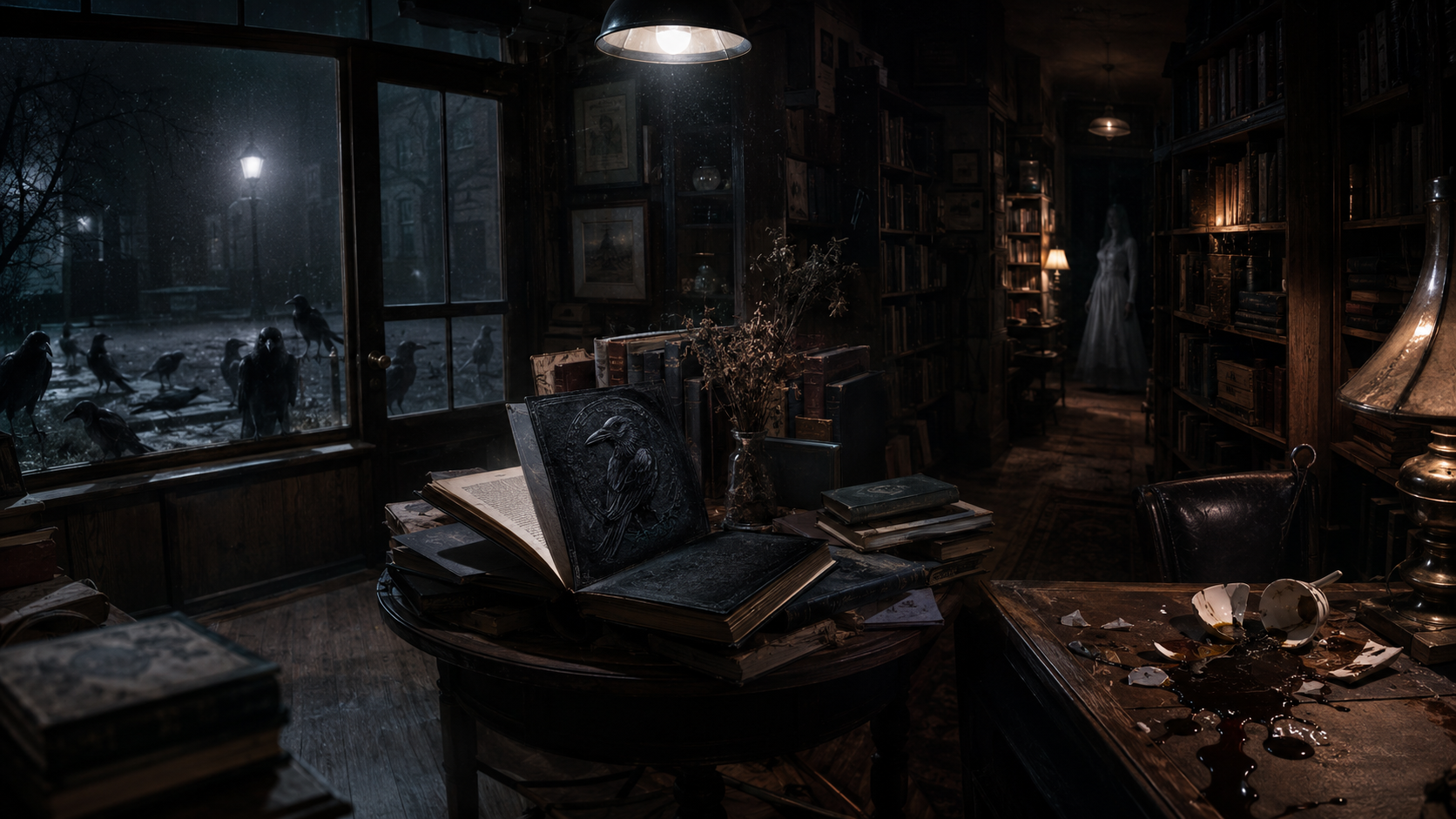
My alarm went off just as I was finishing a box of old cookbooks that smelled faintly of nutmeg, mildew, and neglect. I used the Pomodoro method to keep myself awake during shifts: twenty-five minutes of focused work, five minutes to stand, stretch, drink water, and remind my spine that it was not actually part of the furniture. After four rounds, I took a longer break. It was either that or be found at dawn face-down in a stack of birdwatching guides, drooling gently onto someone’s grandmother’s copy of The Joy of Pickling.
I stood in the back office, arms raised over my head, shoulders cracking in a way that made me briefly consider whether adulthood was a curse placed on the spine by an angry god.
The shop was closed. The front door was locked. The lights were low except for the amber lamps I preferred at night. The bright white overheads in the back office were technically available, but using them after midnight felt like being interrogated by a dentist.
My playlist was changing songs when I heard something fall.
Not a creak.
Not a pipe.
A slap.
Paper and weight hitting bare floor.
My arms froze above my head.
For one full second, I looked absurd and spiritual, as if I were offering myself to the gods of poor decision-making.
Then I lowered my arms, paused the music, and listened.
Silence opened around me.
Ash & Ink had many silences. There was the soft silence of ordinary late-night work, padded by rugs and books and the distant hiss of traffic beyond the windows. There was the after-rain silence, when the whole city seemed to hold moisture in its mouth. There was the dawn silence, exhausted and gray.
This was none of those.
This silence was listening back.
I waited a full minute.
Nothing moved.
Nothing fell.
Nothing breathed loudly enough to be polite.
I reached into my book bag and pulled out my mace.
Do not misunderstand me. I am not one of those horror-movie women who hears a noise in the dark and immediately wanders toward it barefoot, unarmed, and apparently determined to become a cautionary tale. You know the type. White nightgown. No flashlight. Calling “hello?” like the axe murderer is going to answer, “So sorry, wrong house.”
No, thank you.
If death wanted me, it could at least respect that I had accessories.
I picked up the nearest heavy book with my other hand. It happened to be an illustrated history of Oregon railroads, which was not my first choice in defensive literature, but it had weight and the stern moral authority of trains.
Good enough.
Ash & Ink occupied the entire ground floor of the building, though occupied was generous. The books occupied the space. The rest of us were only permitted to navigate through it.
From the back office, a narrow archway opened into the main store. It was the only way in or out unless you counted the rear hallway leading to the bathrooms and loading dock, which I did not, because in that moment I had decided nothing good had ever happened in a rear hallway after midnight.
The office itself was cramped but functional. The desk sat slightly left of center, facing two high-backed chairs comfortable enough that I had, on more than one occasion, committed accidental sleep in them. To the right was a little kitchen corner with a coffee maker, fridge, sink, toaster oven, and trash can. Supply shelves lined the wall beside it. Beyond those, the hallway led to the bathrooms and the back door.
On the other side of the archway lay the main store.
If you entered from the street, the checkout desk stood to your left, curved like a half-moon and always cluttered with pens, bookmarks, receipts, and whatever Nora had decided counted as a “small impulse item” that week. Behind it was a shelf of non-book oddities: candles, postcards, old keys, little bottles of ink, brass bells, bundles of dried herbs, vintage photographs no one had claimed. Beside that shelf was the archway to the office, then the staircase leading up to the abandoned apartments.
Straight ahead from the front door: books.
Books on shelves. Books on tables. Books in crates. Books stacked in corners waiting to be processed. Books balanced in piles that obeyed physics only because Ash & Ink had apparently entered into a private arrangement with gravity.
At night, during my five-minute breaks, I usually made little piles beside the shelves where books belonged, then came back later to actually shelve them. It was not the most elegant system, but it worked, and no one had been crushed by a biography of Winston Churchill yet.
The sound had come from the front of the store.
I knew that much by the slap of it. Most of the floors were covered with old rugs, but the area near the entrance had bare wood around the display tables. If something hit there, it sounded flat and sharp.
So, mace in my left hand, Oregon railroads in my right, I moved around the perimeter of the back office and stopped just inside the shadow of the archway.
The shop smelled different at night.
Old paper, dust, cedar, rain in the walls.
And something else.
Something dry and bitter I still had not identified.
It was stronger when I was scared.
Everything is stronger when you are scared. The dark has texture. Silence has weight. Your own pulse becomes an inconsiderate percussionist.
I scanned the staircase first.
Nothing.
Then the nearest shelves.
Nothing.
Then I leaned just far enough around the archway to see the front room.
The store was exactly as I had left it.
Books on shelves. Books on tables. Books stacked in corners. A brass floor lamp glowing beside the local history section. Rain streaking the windows in thin, silver threads.
No movement.
No shape where a shape should not be.
No murderer waiting politely between Occult and Regional Travel.
Then I saw it.
On the floor beside the display table near the entrance was a book.
Spine down.
Pages splayed open like it had been dropped from a height.
Like someone had thrown it.
I had swept that spot an hour earlier.
I was certain of it.
I moved forward, keeping my back to the shelves on my right and my eyes on the staircase to my left. At the front door, I checked the lock.
Still secured.
The chain was in place.
The deadbolt was turned.
Outside, the Pearl District glistened under streetlights, all wet pavement and expensive windows and people making bad decisions in better shoes.
Inside, nothing moved.
I turned on the bright overhead lights.
The front room flashed white and ugly.
For a moment, Ash & Ink stopped being charming and became what all old places become under honest lighting: stained, crowded, and vaguely accusatory. I blinked hard, checked the aisles, checked the staircase, checked behind the front display.
Nobody.
I let out the kind of breath that tries to pass itself off as confidence.
“Siri, continue playing.”
The playlist resumed halfway through a low, moody song with strings and a woman singing like she had unfinished business with the sea.
I slipped the mace into my pocket and bent to pick up the book.
There was a missing spot at the top of the nearest display stack, one of those little arrangements Nora liked to make so passersby could see the cover through the window. I assumed the book had fallen from there. A bad angle. A truck passing outside. A shift in air pressure. One of those explanations people assemble quickly when they are not emotionally prepared for the alternative.
As the book closed in my hand, I looked down out of habit.
And went still.
It was the raven book.
The same black volume from the window.
The same one I had seen months ago from my side mirror, its cover forming that almost-face beneath the morning rain.
The cloth was worn soft at the corners. No title. No author. No publisher mark. Only a raven embossed on the front, black on black, its wings slightly raised so they caught the light in strange little silver flashes when I shifted my hand.
I turned it over.
Blank.
I checked the spine.
Blank.
Against my better judgment, which had apparently stepped out for a cigarette, I opened it.
Nothing.
The pages were empty.
Not clean, exactly. Brown stains marked some of them, faint rings and blooms like someone had set down mugs of tea or coffee over many years. Some pages bore darker smudges along the edges, as if thumbed through by hands that were never entirely clean.
But there were no words.
No illustrations.
No ravens.
No dedication to some dead woman who should have minded her business.
Just blank paper and stains.
I closed the book and put it back on the display stack.
“Stay,” I told it.
The book, being a book, did not respond.
I took that as a win.
For a full minute, I stood there staring at it beneath the brutal overhead lights. It looked harmless. Ordinary. A little odd, yes, but so was half the inventory. Ash & Ink had once accepted a box containing four copies of Jonathan Livingston Seagull, a taxidermied squirrel in a doll bonnet, and a handwritten journal titled Dreams of My Teeth. A blank raven book barely made the top twenty.
My heart settled.
Mostly.
I reached to turn off the overhead lights, then stopped.
Something in the back of my mind said: leave them on.
This was inconvenient, because I had survived most of my life by aggressively ignoring the back of my mind.
Still, I left the lights on.
Then I told myself a passing car had caused a pressure shift, or maybe the stack had been uneven, or maybe gravity had finally renegotiated its contract with the store.
I returned to the back office for my book cart.
Late-night restocking. Normal work. Normal tasks. Normal people did not stand in bookstores arguing with blank books like Victorian widows with unresolved property disputes.
I set the railroad book back on the desk and began loading the cart.
Assorted paperback romance.
Damaged cookbooks.
Three local hiking guides.
Theology.
Birdwatching.
An antique medical text with engravings that made me grateful for modern anesthesia.
I pushed the cart through the archway and glanced toward the display table.
The raven book was still there.
Good.
I started shelving.
There is something calming about putting books where they belong. The alphabet has its flaws, but at two in the morning, it can feel like a little spell against chaos. A before B. Birds before Botany. Murder before Mythology, depending on Nora’s mood and whether she had reorganized True Crime again.
I had two books left when my alarm went off.
Back to inventory.
I slid the last two books onto their shelves, not as neatly as Nora would have preferred, and made my way toward the front.
The raven book was still where I had put it.
Good.
The word had begun to feel less like satisfaction and more like prayer.
In the back office, I started another pot of coffee and made myself a peanut butter and honey sandwich while it brewed. Night shifts taught a person many things, including the fact that dignity becomes theoretical somewhere around midnight. I poured a fresh mug, took an enormous bite of sandwich, and returned to the desk.
I sat down, pulled the next stack of books toward me, picked up the top three, and turned to set them on the desk.
Then I stopped.
The raven book was sitting on my desk.
Not near the desk.
Not on the floor beside it.
On the desk.
Centered between my keyboard and the coffee mug, as if it had an appointment.
For one ridiculous second, my brain attempted kindness.
Did I bring it back with me?
Had I picked it up without noticing?
Had I somehow set another book on the display table and carried this one here by mistake?
This was the sort of thing the brain does when reality misbehaves. It runs around with a dustpan, frantically sweeping up broken laws of nature and insisting everything is fine.
I stared at the book.
The raven stared back without eyes.
After a moment, I set down the coffee and the three books.
“No,” I said. It was supposed to be an illistrated history of Oregon railroads.
It was not a dramatic no. It was a tired no. A customer-service no. A no that had spent four months learning Nora’s filing system and refused to be bullied by stationery.
I picked up the raven book with both hands and marched back into the main room.
The display stack was empty at the top.
The spot where the raven book belonged was vacant.
My hands went numb.
The book slipped from my fingers and hit the floor.
It landed spine down with the same flat slap I had heard earlier.
I stepped back so quickly my hip struck the corner of the arch doorway.
Pain flared. Good. Pain was real. Pain had paperwork. Pain belonged to a world where objects stayed where one put them.
My hand flew to my necklace in a need for comfort and grounding.
I had worn it since I was nine years old. A small oval pendant of darkened silver with a black stone set in the center. Tess had given it to me on a rainy afternoon in her kitchen, pressing it into my palm with both hands as if she were giving me something alive.
“Don’t take it off voluntarily,” she had told me.
At nine, I had thought that was dramatic and delicious.
At thirty-something, standing in a closed bookstore while a blank raven book played fetch with itself, I found the wording considerably less charming.
I closed my eyes.
I do not remember deciding to. One moment the shop was too bright, too white, too crowded with books and shadows, and the next I was behind my own eyelids, fingers wrapped around the pendant so hard the edges pressed into my skin.
When I opened my eyes, the raven book was back on the display stack. Exactly as it had been.
At my feet lay a different book.
The correct book.
A faded hardcover about Oregon rail lines.
For several seconds, I could not move.
Then I bent slowly, picked up the railroad book, and looked from it to the raven volume.
“I told you to stay put.”
My voice was steady enough to offend me.
I returned to the back office.
The smell hit me first.
Lavender and cedar.
Not the shop’s usual old-paper cedar. Not furniture polish. Not one of the candles Nora sold near the counter.
Tess.
My feet stopped at the edge of the office.
The scent moved through the room like breath.
I turned my head toward the rear hallway.
In the corner of my vision, something white slipped past.
A skirt.
Long.
Pale.
Gone before I could look directly at it.
The hallway to the bathrooms stood dim and narrow, lit only by the sickly yellow bulb above the doors.
I stared at it.
Then, very carefully, I walked to the desk, picked up my coffee, and took a sip.
“That,” I said to the hallway, “is going to be a nope from me, big dog.”
“Good girl,” whispered a voice to my right.
I dropped the mug.
It struck the corner of the desk, shattered, and spilled hot coffee across the floor in a dark, steaming sheet. Porcelain shards skittered under the chair. A few drops splashed the lower books in the nearest stack, which some small, professional part of me had the audacity to find upsetting.
My eyes whipped right.
Nothing.
No one.
Just the chair, the supply shelf, the pale wall, the half-open drawer where Nora kept extra receipt paper and possibly secrets.
For a moment, I did not move.
Not because I was brave.
Because every animal instinct inside my body had collectively decided that playing dead was the most spiritually honest option.
The coffee spread toward the desk legs. One shard rocked once, gently, then settled with a tiny porcelain click that sounded obscene in the silence.
My playlist was still playing.
That somehow made it worse.
A woman sang softly about summer rain while something had whispered into my ear like it knew me. Like it had approval to speak that close. Like it had been standing there the whole time with its mouth near my hair.
I swallowed.
“Aunt Tess?” I asked.
My voice came out thin, but it came out, and sometimes that is the entire victory.
I paused the playlist.
The silence closed in.
“Aunt Tess,” I whispered, “are you here?”
For a second, nothing answered.
Then lavender filled the room.
Stronger this time.
Cedar underneath.
Old drawers. Dried bundles. Her office after rain.
Tears rose before I could stop them.
I pressed one hand to the desk to steady myself.
Every foolish, aching part of me wanted to ask her to come back. To speak. To tell me what to do. To tell me I was not alone. To tell me my family had not erased her as completely as they had tried.
But Tess had taught me better than that.
Never invite what you cannot name.
Never answer a voice that uses grief as a key.
And never, ever open a door just because something on the other side sounds like someone you miss.
So I did not ask again.
The scent thinned.
No footsteps.
No whisper.
No woman in white.
Just me, a broken mug, and a floor becoming increasingly caffeinated.
I stepped around the mess, grabbed the roll of paper towels from under the desk, and immediately regretted bending down. There are few positions more vulnerable than crouched on the floor cleaning coffee in a possibly haunted bookstore after midnight, and I had apparently chosen to enter it voluntarily. Excellent work. A stunning contribution to the survival arts.
I kept one hand near my necklace while I cleaned, the pendant warm against my chest.
Too warm, maybe.
I gathered the broken pieces of the mug and dropped them into the trash. My hands shook badly enough that one shard slipped and nicked the pad of my thumb.
“Damn it.”
A bead of blood welled up, bright and immediate.
I had a paper towel halfway to my thumb when a memory surfaced with the unpleasant clarity of a bell struck in an empty church.
Blood binds.
Tess had said it once while making soup, of all things, because apparently my childhood education had been conducted by a woman who believed occult warnings paired nicely with lentils.
Blood was promise. Blood was name. Blood was a door with a handle on both sides.
Old contracts had been sealed in it. Old charms fed by it. Old curses sharpened with it.
If someone had your blood, Tess said, they had something that knew how to find you.
I put my thumb in my mouth.
Not elegant.
Not mystical.
Very effective.
I finished cleaning the coffee one-handed, then went to the kitchen sink and rinsed the cut carefully, making sure not a single drop touched the counter, the floor, or the drain more than necessary. Under the sink, I found the first-aid kit, wrapped my thumb in a bandage, and told myself it was a small cut.
I would survive.
Probably.
Optimism is important in cursed retail environments.
I returned to the desk, restarted the playlist, poured another coffee into a mug I had not personally offended, and sat down with my stack of books.
For five whole minutes, nothing happened.
It was glorious.
Then the lavender and cedar returned.
From the hallway.
Stronger.
Not perfume exactly. Not candle. Something older. Sachets in a drawer. A cedar chest opened after years of being shut. Dried lavender crushed beneath a dead woman’s gloves.
I turned my head slowly.
The rear hallway was narrow and dim. On the left wall hung framed prints of old Portland street maps. On the right, a waist-high shelf held damaged books we used for crafts and display. Beyond that were the two bathroom doors, both closed.
And standing in front of the women’s room was a woman in white.
I did not scream.
I would love to claim composure, but the truth is my body had upgraded from fear to administrative shutdown.
She stood with her back to me.
Her dress was long and old-fashioned. Not bridal, exactly, but close enough that my brain tried to force the word into place. High collar. Long sleeves. Narrow waist. The fabric was yellowed at the hem, as if it had been dragged through attic dust. Her hair was pinned in a loose knot, pale gray or perhaps blonde, though the hallway light made every color look ill.
She was very still.
Too still.
People sway. They shift weight. They breathe.
She did none of that.
My bandaged thumb throbbed.
I shifted my weight without meaning to.
The woman’s head tilted.
Just slightly.
As if she had heard my blood moving.
I held my breath.
Her hand lifted to the bathroom door.
Slowly, she touched the knob.
Then she turned her head just enough for me to see the corner of her face.
Not all of it.
Just the cheek.
The jaw.
The faint suggestion of a mouth.
And then she smiled.
It was not the worst smile I had ever seen because I had never seen anything like it before.
It was not wide.
It was not monstrous.
It was worse.
It was polite.
Like she had been expecting me.
Like I was late.
“Aunt Tess?” I whispered.
My phone rang.
I nearly launched myself through the ceiling.
The ringtone cut through the shop so violently that the woman vanished.
Not faded.
Not slipped away.
One second she was there, and the next the hallway held only yellow light, closed doors, and the fading smell of lavender and cedar.
I lunged for the desk, grabbed my phone, and saw the caller ID.
Mara.
Thank every god, ghost, and underpaid night-shift guardian angel.
I answered so fast I almost dropped it.
“Mara?”
Static crackled.
Then my friend’s voice came through, distant and thin. “Hey. Are you still at the shop?”
I stared at the hallway.
“No.”
A pause.
“What?”
“I mean yes, physically. Spiritually? Absolutely not.”
“Okay,” she said slowly. “That’s concerning. What’s going on? You okay?”
I opened my mouth.
And stopped.
Because how exactly does one say, the blank raven book is teleporting around the store, a dead woman in Little House on the Prairie formalwear just smiled at me by the bathrooms, something invisible called me a good girl, and I may or may not have almost initiated a blood contract with the floor, without sounding like a person who needs electrolytes and supervision?
I opened my mouth again.
The static sharpened.
Not louder.
Closer.
Like something else had leaned in on the line.
“You should get out of there,” Mara said.
I froze.
“What?”
“I said I want to visit you out there.”
My fingers tightened around the phone.
“No, you didn’t.”
“What?”
“You just said I should get out of here.”
Another burst of static.
“I said I wanted to visit you this weekend. Are you okay?”
I looked toward the main room.
The bright overheads were still on, making the shop beyond the archway look flat and unreal. Too exposed. Too empty.
“Yeah,” I lied. “Connection’s weird.”
“When you end up dead,” Mara said.
The words slid through the phone cold and perfect.
I pulled it away from my ear and stared at the caller ID.
Mara.
Still Mara.
I put it back slowly.
“What did you just say?”
“Are you okay?” she asked.
My pulse thudded in my throat.
“What did you say, Mara?”
“I asked if you were okay.”
“No. Before that.”
“I said I wanted to visit you?”
I stared at the hallway until my eyes watered.
“What were you calling about?”
“I was thinking of coming this weekend,” she said. “If you can get time off.”
The static breathed.
"Let me know if you hear them."
I closed my eyes.
“What?”
“I said let me know what you hear from them.”
“Mara.”
“Your boss,” she added, sounding confused. “Let me know if they give you time off or whatever.”
I opened my eyes.
The raven book was no longer visible from where I sat, but I could feel the direction of it in the front room the way you feel a person staring at you across a bar.
“Right,” I said. “For sure.”
“Are you messing with me?” Mara asked.
“I was about to ask you the same thing.”
“Dude, you sound awful.”
“I’m having a very interactive evening.”
“That means nothing and yet somehow worries me.”
“I have to go.”
“Okay. Text me when you get home?”
“Yeah.”
A long pause.
Then, softly, through a veil of static, Mara said, “Tell Raven I said hi.”
The line went clear.
Too clear.
My breath stopped.
“Mara?”
“What?”
“What did you just say?”
“I said text me when you get home.”
“No. After that.”
“I didn’t say anything after that.”
"I gotta go. I think I need another coffee."
We said our goodbyes and I ended the call.
For several seconds, I sat with the phone in my hand and the taste of copper in my mouth.
Then the footsteps started upstairs.
Bare feet this time.
Not shoes.
Not the slow, measured steps I had grown used to pretending were rats with discipline.
Bare feet on old floorboards.
A soft, skin-on-wood patter directly above the office.
I checked the time.
2:13 a.m.
Of course.
Of course the building had a favorite hour.
I looked up at the ceiling.
“Would you mind?” I said. “I’m trying to get work done, and I really need this job.”
The footsteps stopped.
The silence that followed was complete.
I stared upward.
“Thank you.”
For half a second, nothing happened.
Then something upstairs ran.
Not walked.
Ran.
A frantic rush of feet pounded across the ceiling, heading toward the staircase. The sound struck the top step and descended too fast, too heavy, too many impacts for one person. Wood thundered. The railing shuddered. Dust sifted from the archway.
I stood so quickly my chair rolled backward and hit the wall.
The footsteps reached the landing.
The air in the shop collapsed inward.
Every lamp flickered.
The scent of lavender and cedar vanished beneath something acrid and old, like wet ash and burned feathers.
Then the words came rushing into me.
Not spoken.
Not heard.
Entered.
As if someone had shoved a hand through my ribs and written them on the inside of my bones.
She sold what was not hers.
She kept what should have burned.
She opened the door.
The front room went dark.
From somewhere upstairs, a woman began to weep.
And from the main store, Nora Pike’s desk phone rang.
CHAPTER 3 COMING SOON!
Who is she? What did she sell that wasn’t hers? Who’s on the phone?
Chapter 3 is available NOW on Patreon for early access subscribers.