ASH & INK: Chapter 1
ASH & INK
Chapter One: What Sticks Around
Working at a musty old bookstore had always been a lifelong dream of mine.
I just hadn’t considered how many dead people came with the inventory.
I was always that strange kid who liked books more than friends, the one who would rather spend Saturdays haunting the public library than sitting in bleachers pretending to understand football. Books were easier. They didn’t ask why you were quiet. They didn’t care if you were odd. They only opened when invited, and even then, only page by page.
So, no. It was not especially shocking that I ended up at Ash & Ink Books.
What was shocking was how quickly the place began to feel less like a job and more like a room in a house I had already dreamed about.
Ash & Ink sat in Portland’s Pearl District, wedged between a coffee shop that sold lavender oat milk lattes for the price of a minor indulgence and a boutique full of clothes that looked as if they had been designed for grieving heiresses with excellent credit. The bookstore was narrower than it looked from the street. Tall front windows. Old brick. A brass-handled door that stuck in wet weather. A black-painted sign over the entrance with gold lettering gone soft at the edges.
ASH & INK BOOKS
USED BOOKS & CURIOSITIES
The sign made the place sound charming.
That was the first lie.
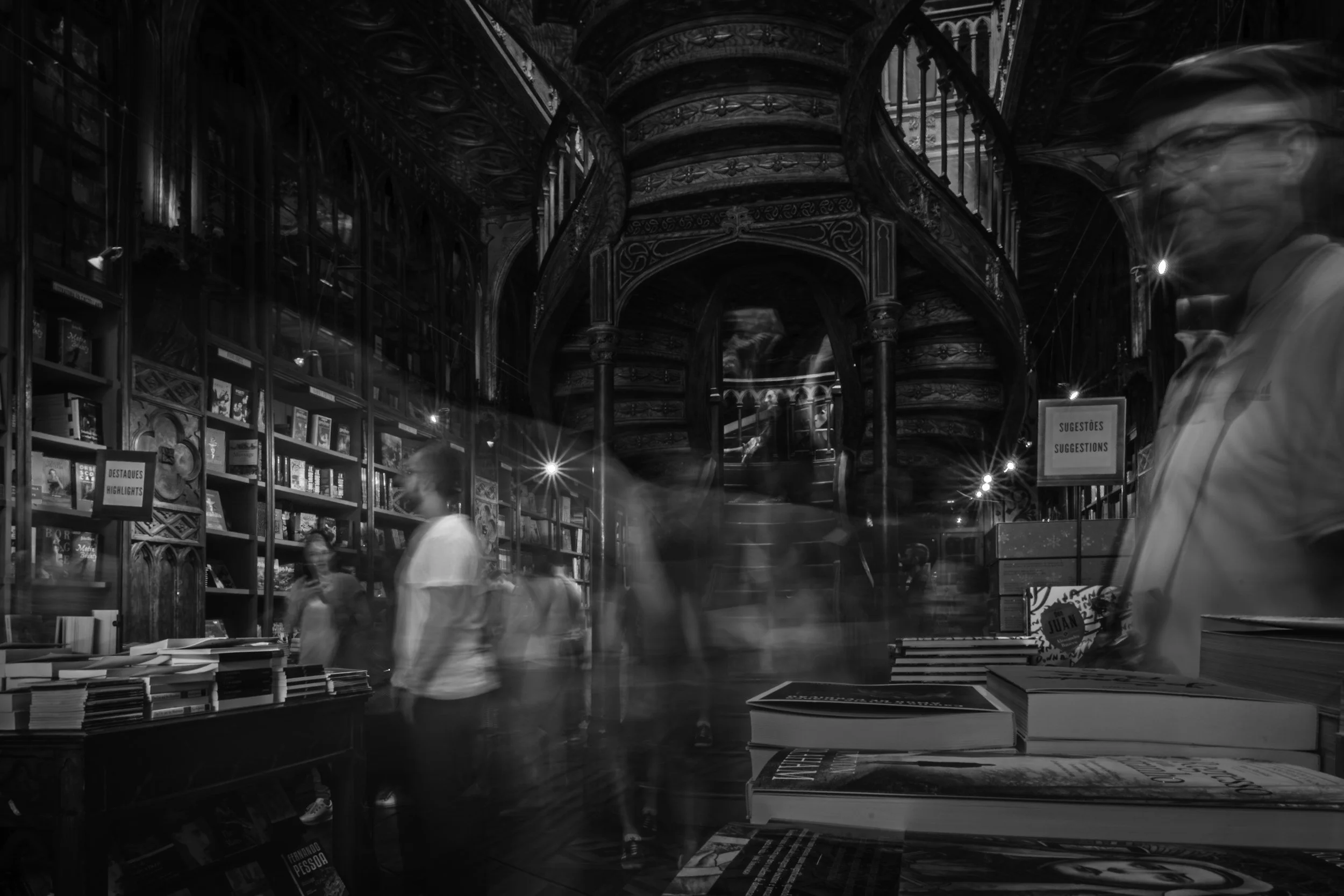
Inside, Ash & Ink smelled of old paper, lamp dust, cedar, rain-soaked wool, and the faint, bitter ghost of coffee left too long on a burner. The aisles were close enough that if you turned too quickly, your shoulder brushed spines. The shelves climbed higher than they had any right to. Books leaned in their rows like old men at a funeral, muttering among themselves. There were Persian rugs worn down to their threads, display tables with uneven legs, lamps with amber shades, and framed prints of dead authors watching the customers with the exhausted judgment of people who had already seen what humanity could do with literacy.
Most of the books were not valuable in the collector’s sense. They were just old.
Estate-sale old.
Dead-relative old.
The kind of old that came in cardboard boxes with brittle tape, faded handwriting, and family members who wanted the whole thing gone before grief became inconvenient.
People brought us books for all kinds of reasons. Sometimes they were clearing out a parent’s house. Sometimes they were downsizing. Sometimes they had inherited a library from someone they did not love enough to keep and did not hate enough to throw away. Occasionally, someone came in because they knew Ash & Ink’s reputation and wanted to be rid of something with a story attached—not the story printed on the pages, but something else entirely.
A woman once donated six books on ceremonial magic because, according to her, they kept appearing on her nightstand no matter how many times she boxed them up in the garage.
A man brought in a water-damaged Bible wrapped in three grocery bags and refused to touch it after placing it on the counter.
An elderly couple left behind a complete set of children’s encyclopedias from the 1950s and told Nora Pike, the owner, that the volume marked M had been whispering names through their heating vents.
Nora bought the set anyway.
That was Nora.
She was a narrow woman in her late fifties with silver-black hair usually pinned at the back of her head with whatever pencil she had most recently misplaced. She had a smoker’s voice despite claiming she had never smoked a day in her life, a laugh like gravel in a teacup, and the unsettling habit of looking at people as though she were reading the inscription on the inside of their skull.
Nora Pike owned Ash & Ink Books, though sometimes I had the impression ownership was not quite the right word. She kept the lights on. She paid the taxes. She argued with the landlord. She fed the shop with dead people’s libraries. But I was never entirely convinced the building considered her in charge.
By the time I had been working there four months, I understood why people used the word haunted. By eight months it became nothing new.
Not that I said so out loud.
I was raised with enough sense not to insult a house where the floorboards listened.
But before Ash & Ink became mine for the twelve dark hours between dusk and morning, it belonged to Nora. Before Nora, I suppose it belonged to whoever had signed the first papers and opened the first door. And before any of them, it belonged to the city—to damp stone, bootleggers, old brick, rats in the walls, and whatever else had learned to breathe there in secret.
That was the thing about old places.
People thought they were empty just because no one was standing in the room.
I knew better even before I knew better.
I got the job because of my great-aunt Tess.
Great Aunt Tess was my best friend, though my family preferred words like eccentric, difficult, and—when they thought I couldn’t hear them—kooky. They called her house a mess. They called her collections hoarding. They called her business nonsense, right up until one of them needed a salve for a rash or a tea blend for sleep.
Tess called it practical magic.
She lived in an old house just outside the city with a garden that looked wild until you noticed how deliberately everything grew. Rosemary by the steps. Lavender under the windows. Foxglove where no child could easily reach. Mugwort in a patch near the back fence, silver-green and always moving even when there was no wind.
Inside, her living room was a library in the kind of way the ocean is damp.
She had bookshelves built from floor to ceiling, two stories high, with a balcony and a rolling ladder that made every visit feel as if I had wandered into the private wing of some reclusive duchess who might also know how to curse a man with a soup spoon. Thousands of books lined those walls. Folklore. Botany. Poetry. Old medical texts. Fairy tales. Religious histories. Cookbooks. Grimoires. Books with cracked leather spines and books with notes tucked into them like secrets waiting to be remembered.
Every book had a story.
Tess remembered where she had bought them, who had been with her, what the weather had been like, what song had been playing in the shop, whether the cashier had been kind. She treated books like living things, not in the precious way some collectors do, but in the practical way one treats cats, knives, and elderly relatives with sharp tongues.
With respect.
With caution.
With the understanding that they might hurt you if you handled them carelessly.
Her death was sudden, but not entirely unexpected.
That didn’t make it gentler.
She had been ill long enough that everyone had made their peace with the idea of losing her except me. My family stepped over the threshold of her house after the funeral and saw work. I stepped inside and saw her everywhere.
In the herbs hanging from the kitchen beams.
In the rings left by teacups on the desk.
In the dust swimming through the morning light.
In the books.
Especially in the books.
She had been in the ground less than a week when my family started talking about dumpsters.
“Great,” one of my cousins said, standing in the living room with his hands on his hips. “We get to deal with all this.”
All this.
That was what they called a life when they did not know how to read it.
I cried for six days straight. Not elegantly. Not in the restrained, cinematic way where one tear slips down your cheek and catches the light. I sobbed until my face hurt. I cried in the shower, in the car, in the grocery store while staring at soup cans because Tess had loved soup and apparently grief enjoys ambushing people in canned goods.
Then I volunteered to clear the house.
Nobody argued. Nobody else wanted to do it. My family gave me permission with the relief of people being spared an unpleasant errand. They wanted nothing. Not the furniture. Not the jars. Not the dried herbs. Not one inconvenient scrap of her.
So it was mine, if I wanted it.
The trouble was that I lived in a very small apartment in Southwest Portland with two cats, Chaos and Bastet, and enough furniture already wedged into corners that navigating my living room required either flexibility or witchcraft. There was no possible way to bring Tess’s house home with me.
I tried anyway, at first.
Grief is not known for its spatial reasoning.
I stayed in her house for a month.
I cleared one room and made it my own, the spare bedroom I had claimed during childhood visits. The double bed stayed against the wall. My suitcase sat open on top of it. Chaos, who believed any freshly folded clothing existed for his personal worship, immediately curled into the cleanest pile. Bastet took the pillow and glared at the room as if deciding which corners were beneath her standards.
I made piles. Keep. Donate. Sell. Trash.
Then I made more piles because the first piles began breeding in the night.
I moved through Tess’s house room by room, touching everything. Her scarves. Her chipped mugs. The little brass bells she hung beside windows. Jars labeled in her careful handwriting: yarrow, nettle, vervain, comfrey, calendula. Candles wrapped in brown paper. Drawers full of buttons and matchbooks. A black dress with silver thread at the cuffs. A box of old photographs showing people I did not recognize standing beside people I did, all of them caught in that strange, solemn posture of the dead before they knew they were dead.
By the end of the first night, I had cleared her home office.
That room hurt the most.
Tess had run a small apothecary business out of the house. Balms. Candles. Herbal remedies. Trinkets. Little muslin bags full of things that smelled like forests and sleep. Her office always carried the same scent: lavender and honeysuckle with cedar underneath, faint but steady, like a hand on the back of your neck.
Even after I boxed most of her inventory, the smell remained.
I told myself that made sense.
Old wood held scent.
Fabric held scent.
Grief held everything.
The following morning, I began making drop-offs. Antique boutiques first. Then clothing stores. Then, finally, books.
I started small because I could not bear to start large.
The first box was full of gardening guides, yellowed romance paperbacks, local histories, and a few unmarked volumes with spines blank or faded beyond reading. Some had handwritten notes in the margins. Not normal notes. Not definitions, dates, or underlined passages. Symbols. Lists. Little arrangements of words that looked like recipes until you realized nothing in them belonged in a kitchen.
One page mentioned salt, thread, and a black bird’s tongue.
I closed that book and pretended I hadn’t read it.
By then, I had learned that pretending not to notice things was a useful adult skill.
I did not ask my family about the strange books.
They would only have made that face—the tired, indulgent expression people use when they believe they are the sensible ones in the room.
So I carried the box myself into Ash & Ink Books.
The bell over the door gave one thin, uncertain chime as I stepped inside.
The moment I crossed the threshold, I felt peace for the first time since Tess died.
Not happiness.
Peace.
There is a difference. Happiness enters a room loudly, throwing open curtains. Peace sits beside you in the dark and says nothing because it does not need to.
Ash & Ink smelled like her.
Lavender. Old paper. Cedar.
But beneath that was something else. Damp stone, maybe. Dust that had been settling for decades. The kind of dust that does not move when you walk through it, only waits for you to become part of it.
Tears stung my eyes before I could stop them.
Then a woman’s voice cut through the room and ruined the moment beautifully.
“Oi. You’re blocking the door.”
I startled, clutching the box to my chest like it contained my internal organs. “Sorry.”
The woman behind the desk looked me over. She was thin, sharp-eyed, and wrapped in a dark cardigan that had seen better centuries. A mug of coffee steamed beside her hand. Behind her, stacks of books rose in uneven towers, and somewhere in the back of the shop, a pipe ticked softly inside the wall.
“Nora Pike,” she said, as if the name explained both the shop and her mood. “You buying, selling, or seeking absolution?”
“Selling, I think.” I stepped toward the desk. “Or donating. Maybe both. My great-aunt passed away, and I’m trying to find places for her books. I’d rather they go somewhere people will appreciate them.”
Nora’s expression shifted.
Only slightly.
Something softened around the mouth.
“Sorry for your loss,” she said.
It was the first time I had said Tess was dead to a stranger.
The grief rose again, sudden and humiliating. My eyes burned. My throat tightened. I looked down at the box because cardboard, unlike people, rarely expects you to be composed.
“So,” Nora said after a moment, not unkindly, “are you going to put them on the desk or just clutch them until they hatch?”
I laughed because it was either that or cry all over her counter.
“Oh. Right.”
I set the box down.
Nora went through the books with quick, practiced hands, murmuring little judgments under her breath.
“Water damage. Foxing. Bad binding. Hm. Lovely cover. Terrible advice. Someone underlined half of this in red, never a good sign.”
While she worked, a breeze moved across the back of my neck.
Right to left.
Cold enough to lift the fine hairs along my arms.
I turned toward the door, expecting someone to enter. No one did. The door was shut. The bell was still. Outside, traffic hissed over wet pavement. Inside, the bookstore held its breath.
That was when I noticed the sign in the front window.
HIRING: NIGHT MANAGER
The letters had been written in gold marker on black cardstock. Someone had drawn a little crescent moon in the corner.
Nora looked up from the box. “I’ll give you thirty dollars for this lot.”
I blinked, dragged back into the world. “For the box?”
“For the box.”
I stared at her.
Then at the hiring sign.
Then back at her.
“I’ll give you my great-aunt’s collection,” I said, “if you give me the job in the window.”
I have no idea what came over me.
Exhaustion, probably.
Grief, certainly.
Maybe something else.
Nora followed my gaze to the sign and then looked back at me. “How big a collection?”
I took out my phone and showed her photographs of Tess’s library. The two-story shelves. The balcony. The rolling ladder. The impossible number of books watching from the walls.
Nora did not speak for a long moment.
That was the first thing I liked about her.
Most people filled silence because they feared what might crawl into it. Nora let silence come and sit beside her.
“I have experience cataloging and sorting,” I said, because silence made me nervous even if it did not bother her. “Tess taught me. And I love books.”
“That’s not always a recommendation.”
“No,” I admitted. “But it helps.”
She handed back my phone. “You don’t mind nights?”
“I prefer nights, actually.”
“Boyfriend or girlfriend going to mind you working twelve-hour shifts?”
“It’s just me and my two cats.”
“Cats mind everything.”
“True. But they lack financial leverage.”
For the first time, Nora smiled.
Then she looked back at the box on the desk. Her fingers rested on the spine of one of the unmarked volumes. The one I had closed after reading about salt, thread, and a black bird’s tongue.
“I bet you miss her,” she said.
The question caught me in a soft place.
“More and more by the minute.”
Nora watched me with something close to pity, though not quite. Pity looks down. This looked across.
“Once you bring her collection here, she’ll be everywhere,” Nora said. “Every shelf. Every stack. Every back corner you forget to dust.”
For the first time in days, I smiled and meant it.
“I’d have it no other way.”
Nora’s thumb moved slowly over the blank spine beneath her hand.
“Sometimes,” she said quietly, “I wonder if that’s all that sticks around in a place like this.”
I should have asked what she meant.
Instead, I looked around Ash & Ink Books, breathing in lavender and cedar and old paper, and felt, foolishly, as if I had been welcomed home.
That is the danger of houses with appetites.
They do not always bite first.
Sometimes they open the door.
And just like that, I had a job.
The arrangement was simple. I arrived at five in the evening, sharp. Nora stayed for an hour to pass off anything important, then locked the front door at six and left me to the shop. At four in the morning, she returned with coffee and pastries from whichever bakery owed her a favor that week. We would sit in the back office until opening, talking about inventory, customers, books, weather, rent, ghosts—though never ghosts directly at first.
My job was processing new arrivals, shelving, prepping online orders, keeping the shop’s social media alive, and general maintenance. I could listen to whatever music I wanted as loudly as I wanted after closing.
Just me and the books.
There are worse ways to spend a night.
At least, that is what I believed then.
For the first few weeks, Ash & Ink behaved like any other old bookstore. It creaked. It sighed. The pipes complained. Lamps flickered. Books fell over if stacked badly. The front door rattled when buses passed. Rain tapped the windows with long, patient fingers. Nothing I could not explain. Nothing worth embarrassing myself over.
Then came the footsteps upstairs.
The first time, I heard them around two in the morning while entering a box of old theology books into inventory.
Slow.
Measured.
One step directly above the back office.
Then another.
Then another.
I looked up so fast my neck cracked.
The ceiling stared back.
For a while, I sat there with my hands hovering over the keyboard, waiting. The footsteps crossed from one side of the ceiling to the other, stopped, then began again somewhere farther away.
I told myself it was the building.
Buildings settle.
Pipes knock.
Old wood shifts in cold weather.
Rats, probably.
Very disciplined rats with shoes.
After that, the footsteps came often enough that I began to recognize their route. Over the office. Across the main room. Pause near the front windows. Back again. Sometimes I heard something faster too, a brief patter like a child running from one room to another before being sharply called to heel.
There were no apartments upstairs.
There was not supposed to be anyone upstairs at all.
I waited two months before asking Nora.
It was just after dawn, one of those wet Portland mornings when the whole city looked rinsed in pewter. Nora had brought coffee and cinnamon rolls wrapped in parchment. We sat in the back office between towers of donations, our knees nearly touching beneath the cramped desk.
“Hey,” I said, as casually as I could manage while definitely not being casual. “What’s upstairs?”
Nora tore a cinnamon roll in half. “The remains of a bad idea.”
“Sounds ominous.”
“Most bad ideas do, once they get old enough.” She waved one hand toward the ceiling. “Technically, two apartments. Or they would have been. There’s so much work needed I haven’t bothered. Plumbing, wiring, walls, the whole miserable opera. Being a landlord sounds like a curse with paperwork.”
I nodded and sipped my coffee.
I did not mention the footsteps.
Not immediately.
“Could be cool though,” I said. “Living above a bookshop.”
“Oh?” Nora’s eyes narrowed with amusement. “Would you want to move in up there?”
“With rent right now? I don’t think you’d have to twist my arm much.”
We both laughed.
Hers ended first.
She checked the clock on the wall, then her watch, as if expecting them to disagree.
“People say this building is haunted,” she said.
I nearly choked on my coffee. “What?”
“I said people say this building is haunted.”
“Yes, thank you, I heard the words. I’m questioning the casual delivery.”
Nora shrugged. “Old buildings collect rumors. This one was built in the 1920s. Prohibition years. Places around here had all sorts of uses. Speakeasies. Storage. Smuggling routes. Back rooms for men who preferred their sins unrecorded. Portland has always enjoyed keeping a few things below street level.”
“Below street level?”
“Don’t start looking for trapdoors. I already did.”
“Did you find any?”
Nora took a bite of cinnamon roll and did not answer quickly enough.
“Nora.”
“No useful ones.”
“That is not the same as no.”
“No,” she agreed, “it is not.”
The pipes ticked in the wall.
Somewhere above us, the floor gave a soft creak.
Nora looked up.
Only for a second.
Then she looked back at me.
“I think most of what people hear is the building settling,” she said. “Old foundations. Old wood. Original windows. Wiring done by someone who probably considered safety more of a suggestion than a rule. People hear creaks and flickering lights, and they start adding ghosts because ghosts are more interesting than repairs.”
“So you don’t believe in the paranormal?” I asked.
Nora laughed.
Not loudly.
Not kindly.
“Now, I never said that.”
There are sentences that enter a room and lock the door behind them.
That was one of them.
Before I could press her, she checked the clock again. “You should get going. Ms. Sandres is supposed to stop by today with what she described as a truckload of books, which means either three boxes or enough paper to crush a mule. Either way, you’ll have plenty to process tonight.”
She pointed toward the stack in the corner I still had not touched.
I checked my watch.
6:32 a.m.
“Yeah,” I said, standing. “Okay. I’ll see you tonight.”
I drained the last of my coffee, grabbed my bag, and took one more look around the shop before leaving.
In daylight, Ash & Ink looked almost harmless.
Almost.
The lamps still glowed amber against the shelves. Rain trembled against the tall front windows. The books stood in their uneven rows. The display table near the entrance was crowded with staff picks, antique poetry, and a few oddities Nora liked to rotate whenever the mood struck her.
Just an old building, I told myself.
Old wood.
Old bones.
Old history.
I stepped outside into the wet morning, locked my jacket against the chill, and walked to my car.
Nothing followed me.
Nothing called my name.
Nothing tapped from the inside of the glass.
I got into the driver’s seat, started the engine, and checked my side mirror before pulling away from the curb.
That was when I saw the face in the bookstore window.
Gaunt.
Long.
Stretched open in a silent scream.
For one awful second, it hung there behind the glass, pale against the dark interior, its mouth a black oval, its eyes hollow places where something had been dug out and left empty.
My heart lurched so hard it hurt.
I snapped my head toward the window.
No face.
Only the display table.
Only books.
Only a black volume propped near the front, its cover embossed with ravens.
Their wings overlapped in a strange pattern. Their beaks pointed inward. Their bodies curved around one another like ink caught in water. If you looked at it just right—if you were tired enough, grieving enough, foolish enough to keep staring—their shapes almost became a face.
Almost.
I looked back into the side mirror.
No face.
Just Ash & Ink Books crouched beneath the gray morning, its windows dark, its sign dripping rain.
I let out a laugh that sounded thin even to me.
“Nights are getting to you,” I muttered, easing into traffic. “Note to self: no coffee at the end of shift. Tea only.”
The city swallowed me by degrees. Wet pavement. Brake lights. Buses sighing at curbs. Cyclists hunched against the rain like penitents. Portland waking up around me with its usual damp reluctance.
But all the way home, through the pale wash of early morning, I kept glancing at the rearview mirror.
I could not shake the feeling that Ash & Ink Books was still watching.
And worse than that, some quiet part of me was certain it had been watching long before I ever walked through the door.
CHAPTER 2 COMING SOON!
Want to know what happens when she tries to shelf the raven book?
Chapter 2 is available NOW on Patreon for early access subscribers.