Spring Blooms & the Earth Awakening: The First Flowers and What They Meant
The first flower of spring does not arrive when spring arrives.
It arrives before. Sometimes weeks before, sometimes only days — but always in advance of any reasonable expectation, pushing through ground that is still cold and sometimes still frozen, blooming before the trees have budded, before the grass has greened, before anything else has decided the risk is worth taking. The first flower of spring is always an act of defiance.
This is not coincidence, and the people who watched it happen for thousands of years did not treat it as coincidence. The first flowers — the snowdrop at Imbolc, the crocus and the primrose and the wild violet at Ostara, the bluebells pushing through the forest floor as Beltane approached — were read as messages. Not poetic messages, not symbolic decoration. Actual communications from the earth about the state of things below the surface, where the real work of spring happened invisibly for weeks before anything visible appeared.
To tend a garden in the ancient world, to farm, to survive on what the land produced, was to develop a reading of the landscape so detailed and so practiced that the appearance of a specific flower in a specific place carried the same weight as a weather forecast or a soil report carries today. The flowers were data. They were also, within the ritual framework of the spring festivals, something more: they were the earth's first words after a season of silence, and the people who heard them understood that paying attention was the beginning of everything.
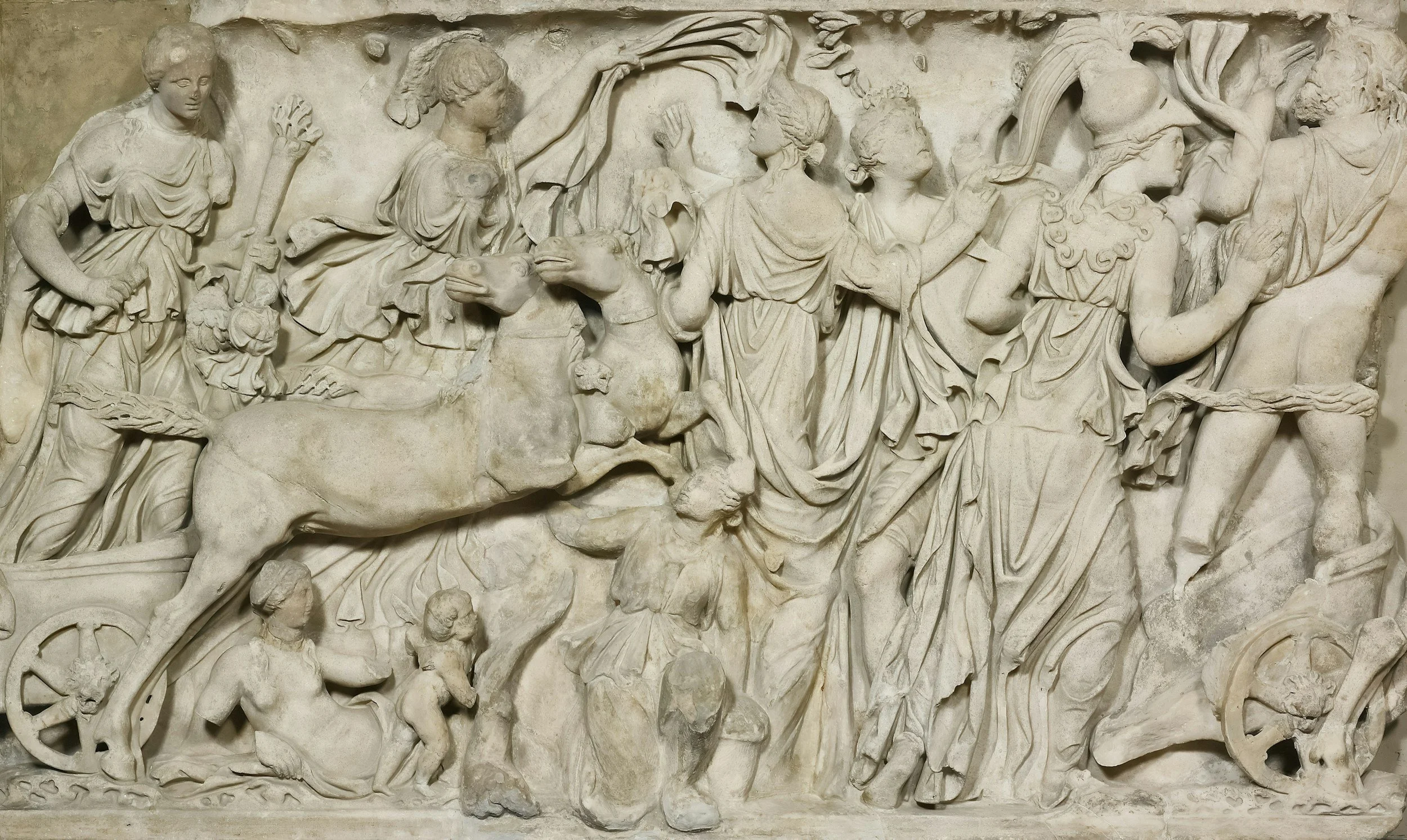
Persephone Rising: The Mythological Earth Awakening
No mythology of spring's return is more complete, more psychologically sophisticated, or more enduring than the Greek story of Persephone — and none connects the blooming of the earth more directly to the movement of a divine being through the underworld and back.
Persephone, daughter of Demeter the harvest goddess, was taken by Hades into the underworld — in some versions against her will, in others with an ambiguity the myth deliberately maintains. Demeter's grief at her daughter's disappearance caused the earth to stop producing: the crops failed, the animals could not reproduce, the world entered a state of suspended barrenness that threatened to end all life. The gods intervened, and a compromise was reached: Persephone would spend part of the year above ground with her mother, and part below with Hades as his queen.
The seasons are Demeter's response to this arrangement. When Persephone returns from the underworld in spring, Demeter's joy causes the earth to bloom. When Persephone descends again in autumn, Demeter's grief withdraws the earth's productivity. Winter is not a physical phenomenon in this mythology — it is an emotional one. It is what happens to the world when a mother loses her daughter.
"The flowers do not bloom because it is warm enough. They bloom because she is coming back. The earth knows before the air does. The roots know before the eye does. Spring begins underground, in the dark, in the approaching footstep of the one who carries it."
The myth contains something that purely astronomical accounts of the seasons do not: the understanding that spring is not merely a change in temperature and light but a change in the world's emotional state. The earth is not a machine running a program. It is a being capable of grief and joy, and its productivity is connected to that emotional life. When the beloved returns, things grow. This is not a primitive misunderstanding of meteorology. It is a different and equally valid frame for understanding why the world does what it does in spring — one that places relationship, love, and loss at the center of the natural cycle rather than at its edges.
Persephone herself is a figure of immense complexity. She is the maiden and the queen, the above-ground and the below-ground, the flowering and the winter. She is not innocent — she has ruled the dead, has eaten the pomegranate seeds that bound her to the underworld, has become something that cannot be entirely retrieved by any amount of maternal love. The Persephone who returns each spring is changed by what she has seen. The spring that follows her return contains within it the knowledge of the underworld. The flowers bloom, but they bloom over the bones of the dead.
The Sacred Plants of Ostara: What the Equinox Grows
Each sabbat has its plants — not assigned arbitrarily but derived from what actually blooms or becomes available at that moment in the agricultural year. The plants of Ostara are the first plants, the earliest risers, and their folklore and symbolism reflect the specific quality of the equinox moment: balanced, hopeful, delicate, not yet certain of its own survival.
The Primrose
The primrose — Primula vulgaris, "first" and "small," which together describe it precisely — is the most emblematic of Ostara's flowers. It blooms in pale yellow, the color of early sunlight, in hedgerows and on south-facing banks in March and April, often appearing in clusters that make them look like pools of captured light in an otherwise grey landscape.
In the folklore of the British Isles, primroses were fairy flowers — plants under the protection and patronage of the fairy folk, which meant they should be treated with respect and not casually destroyed. To bring the right number of primroses across a threshold was protective; to bring the wrong number was unlucky. The specific numbers varied by region, but the underlying message was consistent: this plant has attention on it. Handle it carefully.
Primroses were used in love divination and in the making of protective charms. A primrose ball — flowers bound tightly into a sphere and hung at the entrance to the cowshed — protected the cattle from fairy interference at the vulnerable moment of spring when the animals were being moved from their winter quarters back to the fields. The flowers that bloomed earliest were the most powerful, their proximity to winter giving them a quality of endurance that later flowers lacked.
The Violet
The violet blooms so low to the ground, in such tucked and hidden places — beneath the hedgerow, at the base of stone walls, in the shaded corners of old gardens — that finding one requires the specific quality of attention that Ostara demands: looking close, looking low, looking for what is not announcing itself but simply being, quietly, in the place it has always been.
In Greek mythology, violets were associated with Persephone — they grew in the meadow where she was gathering flowers when Hades took her. They are the flowers of the last innocent moment, the bloom that was in her hand when everything changed. This gives them a quality that their sweetness alone does not convey: they are both the joy of spring and the shadow within it, both the beauty of the world above and the reminder of the world below.
Violets were strewn on graves in the classical world, used in love potions, worn as protective charms, and made into a sweet syrup that was understood to be medicinally useful for headaches and insomnia. They were among the first plants to be cultivated for their fragrance in the ancient world, their scent — intense, brief, disappearing the moment you think you have caught it — understood as something that could not be held, only encountered.
Picture an early morning at the spring equinox, still cold enough to see breath in the air, in an old garden somewhere in the British Isles. The equinox has just passed — the night and day were equal yesterday, and today the light wins by a fraction of a second. Along the north wall where the stone still holds the winter cold, nothing is growing. But at the base of the south wall, where the stone radiates the afternoon sun it has stored, a cluster of violets has appeared overnight — or perhaps they were there yesterday and the light was not right to see them. They are very small and very purple and entirely serious about what they are doing. They have not waited for permission to bloom. They have simply decided that it is time.
Forsythia and the Borrowed Yellow
Forsythia is not a native plant of the British Isles or Ireland — it was introduced from China and Japan in the nineteenth century — but its behavior at the spring equinox so perfectly embodies Ostara's quality that its inclusion in contemporary spring practice has felt entirely natural. Forsythia blooms before it leaves. Bare branches erupt in brilliant yellow in late February or March, covering the entire plant in flower before a single green leaf has emerged. It is the most extravagant possible argument for spring, stated before spring has proven itself, before the evidence is in, before caution would advise the expenditure.
The willingness to bloom fully, on bare branches, before any of the usual infrastructure of a flowering plant is in place — this is the spirit of Ostara's first flowers. Not waiting for conditions to be ideal. Deciding that now is the moment, that the light that has returned is sufficient, that what lies ahead is worth committing to before it is certain.
Seed Blessing and the Sacred Act of Planting
✦ ✦ ✦
The flowers of Ostara are the earth's spontaneous offering — growing without human assistance, responding to their own biological timing. But Ostara was also the festival of the human side of the spring equation: the blessing of seeds, the preparation of ground, the deliberate act of putting something in the earth and trusting it to come back.
In agricultural communities across the Celtic and Germanic world, the spring equinox was the moment when planting began in earnest. The ground was tested — not with instruments but with the knowledge encoded in generations of farming practice: the warmth of the soil assessed by feel, the drainage of the field observed through the previous weeks, the behavior of the first weeds (which sprouted at lower soil temperatures than most crops) used as a gauge of readiness.
Seeds were blessed before planting. The specific form of the blessing varied by region, by faith, by the specific crop, but the underlying logic was the same: the act of planting was an act of trust, of investment in an uncertain future, and that investment deserved ritual acknowledgment. You were putting something small and apparently inert into the dark ground and asking it to become something you could eat. This is either mundane or miraculous, depending on how much attention you pay to it. The people who blessed their seeds paid enough attention to find it miraculous.
"A seed is a living thing in suspension. Everything it will ever be is already present, waiting for the specific conditions that will tell it to begin. To plant a seed is to provide those conditions — warmth, water, darkness — and then to wait. The waiting is not passive. It is the most active kind of faith: the faith of someone who has done everything that can be done and now trusts the process to do the rest."
For contemporary practitioners, seed blessing at Ostara translates directly and practically into the modern context in a way that few sabbat practices do. You do not need a farm or a field. You need seeds — of any kind, literal or metaphorical — and the willingness to acknowledge that what you are beginning is real, that the act of beginning deserves attention, that the thing you are putting in the ground (or the ground of your life, your work, your relationships) will require patience and darkness and time before it is visible.
The ritual of writing your intentions on slips of paper, folding them into pots of soil at Ostara, and tending them through the spring — watching for the first emergence, the first sign that what you planted is alive — is a direct descendant of the seed blessing. The earth does not distinguish between literal and metaphorical planting. Both require the same thing: putting something in the dark and trusting it enough to wait.
The Earth Beneath: What Wakes Before the Flowers
The flowers are the earth's announcement. But the awakening begins long before the announcement.
Beneath the ground, the work of spring starts weeks or months before anything appears on the surface. Root systems that have been dormant begin absorbing water and nutrients again as soil temperatures rise. Mycorrhizal networks — the vast underground webs of fungal connection that link trees and plants in a system of mutual exchange that scientists are still only beginning to map — begin transmitting resources between plants as the network comes back to life. Earthworms, dormant in cold weather, resume their movement through the soil, aerating and enriching it. Seeds in the dark feel the changing temperature and the increasing moisture and begin the internal process that will produce a sprout — which may not be visible for weeks.
All of this is invisible. All of it precedes and enables what becomes visible at Ostara. The flowers do not bloom out of nothing. They bloom out of an enormous underground process that has been underway in the dark, unannounced and unobserved, for longer than the flowers themselves will last.
This is perhaps the most important thing Ostara's spring blooms communicate, to those who are willing to receive the message in its full depth: what you see is never all that is happening. The visible emergence is always the last stage of a process that began long before anyone could see it. Spring, when it arrives, has already been underway for a very long time.
The flowers are proof, not beginning. The beginning was in the dark.