Harvest, Bread & Grain Rites: The Sacred Technology of the First Reaping
Bread is the oldest miracle.
Not metaphorically — technically. The transformation of grain into bread requires a sequence of processes that are individually simple and collectively extraordinary: the grain must be cut, dried, threshed, winnowed, ground, combined with water and a leavening agent, shaped, and exposed to sustained heat. Each of these steps destroys something to create something better. The living plant becomes dead grain. The grain becomes flour. The flour becomes dough. The dough becomes bread. At every stage, something is given up to make the next thing possible, and what arrives at the end of the process is something that could not have been predicted from its beginning: a food so complete, so calorie-dense, so storable, and so utterly unlike the plant it came from that the first person who made it must have experienced something approaching revelation.
The people who built the grain rites of Lughnasadh understood this. They were not celebrating bread because it was pleasant or because the harvest was an occasion for communal gathering, though it was both of those things. They were celebrating bread because bread was the reason civilization was possible — because the ability to grow grain, process it, store it, and transform it into a food that could sustain a community through the lean months was the technology on which everything else was built. To honor the grain at Lughnasadh was to honor the foundation. And foundations deserve more than casual gratitude.
The Last Sheaf: Rituals of the Harvest's End
The grain harvest was not a single event but a sustained operation that occupied the entire community for weeks — and within that operation, two moments were ritually marked above all others: the cutting of the first grain and the cutting of the last.
The last sheaf was the most ritually significant. As the harvesters worked their way across the field, the standing grain diminished until only a small patch remained — the last of the crop, the final portion that had not yet been given to the blade. In the folk tradition of the British Isles and across much of Northern Europe, this last standing grain was understood as the refuge of the spirit of the crop — the animating force of the field that had retreated before the advance of the reapers and was now concentrated in this final standing cluster.
The cutting of the last sheaf was therefore a charged moment. In some traditions it was treated as a competition: the reapers would stand at a distance and throw their sickles at the last sheaf until it fell, no single person being responsible for the cut that ended the harvest spirit's residence in the field. In others, the honor was given to the most skilled reaper, the last cut being a mark of recognition. In still others, the last sheaf was cut with ceremony — a specific prayer said, a specific gesture made, the blade brought down with deliberate acknowledgment of what was being ended.
"The last sheaf was the harvest's soul made tangible. To cut it carelessly was to disrespect what had kept the field alive all summer. To cut it with ceremony was to acknowledge that what you were ending was real — that the field had been a living thing, and that its living was now, at this moment, concluding."
What happened to the last sheaf after cutting determined the winter's fortune in the folk belief of multiple cultures. In the Scottish Highland tradition, the last sheaf was given to the oldest woman in the community — the cailleach, the hag, the figure of winter — and this sheaf, dressed and decorated, was kept through the winter as a protective talisman and then ploughed back into the earth at the following spring's first ploughing, completing the cycle. In other traditions, the last sheaf was kept in the farmhouse through winter and fed to the cattle in spring to ensure their productivity. In others, it was burned, its ash scattered on the field.
What all of these practices shared was the understanding that the last sheaf was not waste material. It was the concentrated essence of the harvest — the thing that had been left until the end because it mattered most, and that required specific, careful handling to ensure that its power continued to serve the community rather than dissipating in the stubble field.
The Corn Dolly: The Spirit Given a Body
From the last sheaf came the corn dolly — the straw figure woven from the final stalks of the harvest, given a human or animal shape, understood as the physical vessel of the harvest spirit through the winter months.
The word corn in this context is the British usage: not maize, which did not exist in Europe until after the Columbian exchange, but grain generally — wheat, barley, oats, rye, whatever grew in the specific field and region. The corn dolly was made from whatever grain the field had produced, and its specific form varied enormously by region: the Suffolk Horseshoe, the Staffordshire Knot, the Welsh Fan, the Northamptonshire Horns, the Cambridgeshire Bell. Each region had its traditional form, passed down through the generations of harvest workers who made them, their specific shapes encoding local meaning in ways that are now only partially recoverable.
Picture a harvest field in Suffolk sometime in the eighteenth century — though the practice is considerably older than that. The last sheaf has been cut. The lead harvester is sitting at the field's edge, the remaining stalks in his lap, his hands working with a speed and precision that comes from decades of repetition. The other workers are watching. The shape emerging from his hands is the Suffolk Horseshoe — a curved form, both arms of the horseshoe plaited from multiple strands of straw, the whole structure tied at regular intervals to hold its shape. It takes perhaps twenty minutes. When it is done he holds it up and the workers call out — something traditional, something that belongs to this moment and this harvest and this field specifically. The horseshoe will hang in the farmhouse until the following harvest. Nothing will be planted without it in the house. Nothing will be certain without it.
The corn dolly's function was specific and serious: it housed the harvest spirit through the winter so that the spirit would be available to animate the following year's crop. If the spirit was allowed to disperse at harvest's end — if no vessel was made to contain it — the field's animating force would be lost, and the following year's planting would go into dead ground. The corn dolly was continuity made tangible. It was the harvest's soul given a form that could be carried indoors, kept safe through the cold, and returned to the earth when the time came.
The practice of weaving corn dollies has been revived extensively in Britain from the mid-twentieth century onward, primarily as craft rather than as active folk practice. The traditional regional forms are documented, taught, and preserved by craftspeople who understand them as both cultural heritage and living art. Whether the revival carries the same spiritual weight as the original practice is a question each practitioner answers for themselves. The craft, at minimum, is genuine.
Lammas Bread: The Loaf That Was a Sacrifice
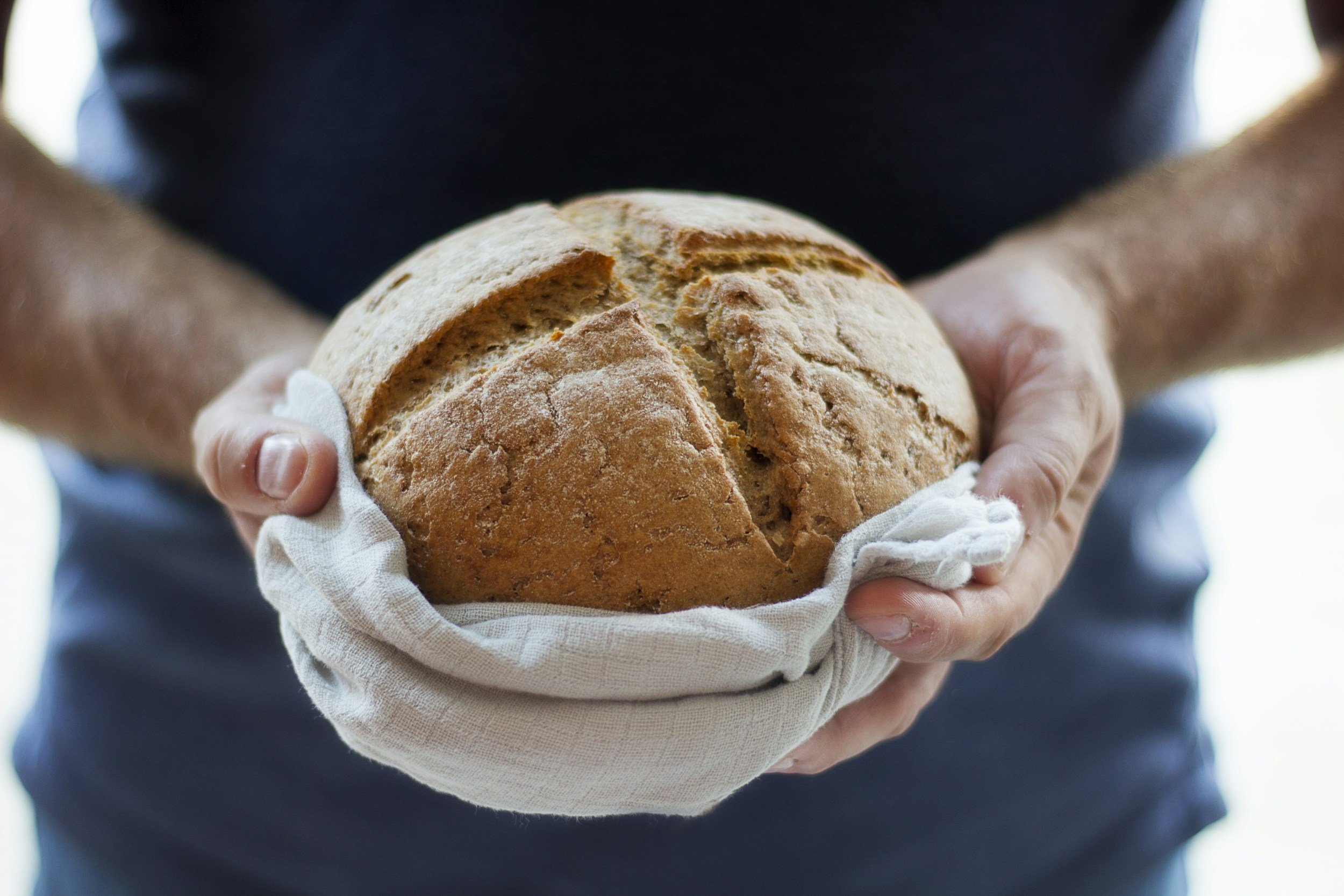
Lammas — the Anglo-Saxon name for August 1st, from hlāfmæsse, loaf-mass — was the Christian reframing of the harvest festival that replaced Lughnasadh in the parts of the British Isles where the Celtic tradition gave way to the Germanic. Its central practice was the baking of the first loaf from the first grain of the harvest and the bringing of that loaf to the church to be blessed and broken.
The Lammas loaf was not ordinary bread. It was made from the first grain cut — grain that had been kept separate from the rest of the harvest for this specific purpose — and its baking was an act of ritual completion: the full sequence from seed to loaf accomplished in a single gesture of offering. To bring the Lammas loaf to the church was to bring the harvest's first fruit to the sacred space and acknowledge that what the earth had given had come from somewhere beyond the farmer's skill or effort alone.
The loaf was broken after blessing — not eaten by the community but used: its four pieces placed in the four corners of the barn to protect the stored grain through the winter. This apotropaic use of the Lammas loaf — bread as ward, bread as protection — reveals the older practice beneath the Christian ceremony. The blessed loaf placed at the corners of the barn is the same logic as the salt at the threshold, the rowan above the door, the iron at the gate. The first fruit of the harvest, blessed and placed at the boundaries of the stored grain, was understood to extend the harvest's own power outward to protect what it had produced.
"The Lammas loaf was both offering and weapon. Given to the sacred to be blessed, then returned to the secular world to perform the specific work of protection. The church received it. The barn needed it. Between those two destinations, the bread had been transformed — from food into something that carried the season's concentrated power."
John Barleycorn: The Grain as God, the Harvest as Death
✦ ✦ ✦
The ballad of John Barleycorn — documented in English and Scottish sources from the late sixteenth century but clearly preserving something far older in its structure — is the harvest myth told plainly and without mythology's softening distance. John Barleycorn is the grain, and the ballad describes, with unflinching specificity, every stage of his death.
Three men come to bury John Barleycorn in the ground. They plow the earth over him. They let him lie through winter. In spring, he rises — despite everything they did to kill him, he comes back. He grows tall. And then, at harvest time, they cut him down. They bind him. They thresh him. They grind him. They brew him. And in the drinking of the ale made from his ground body, they consume him — and he makes them merry, which is his final victory over the men who killed him.
The ballad is a myth of the grain cycle told in the specific vocabulary of violence and resurrection. John Barleycorn must be killed to be useful. His death is the harvest's necessary condition. But his death is not the end — he rises from the ale cup in the body of the drinker, his power distributed through the community that consumed him, his life continuing in the lives it sustained.
This is the oldest harvest theology there is: the grain that dies to feed the people, the food that requires death to exist, the cycle of planting and reaping and planting again that underlies every civilization that has ever survived a winter. Lughnasadh holds this without prettifying it. The grain bows to the blade. The earth gives what it grew. And the people who eat the bread made from the harvest are eating something that died for them — and should know it.
For contemporary practice, the baking of Lammas bread at Lughnasadh is the most immediate and most grounded connection available to the festival's grain rites. Not as ceremony requiring elaborate preparation, but as deliberate act: the gathering of ingredients, the working of dough by hand, the attention paid to what is happening in the bowl and on the board and in the oven. Bread made with intention at Lughnasadh carries the full weight of the season's knowledge: that abundance has a cost, that nourishment requires death, that the loaf in your hands is the harvest's final form.
Break it with gratitude. The grain did not come free.