Odin: Textual Record, Cultic Context, and Later Reconstruction
Few figures in the pre-Christian North loom as large — or as ambiguously — as Odin. He appears as war-god and poet, wanderer and king, seeker of forbidden knowledge and orchestrator of cosmic fate. He presides over Valhalla [val-HAL-uh], bargains for wisdom, practices magic associated with social transgression, and stands at the threshold of Ragnarök.
And yet, for a deity of such magnitude, the historical ground beneath him is remarkably thin.
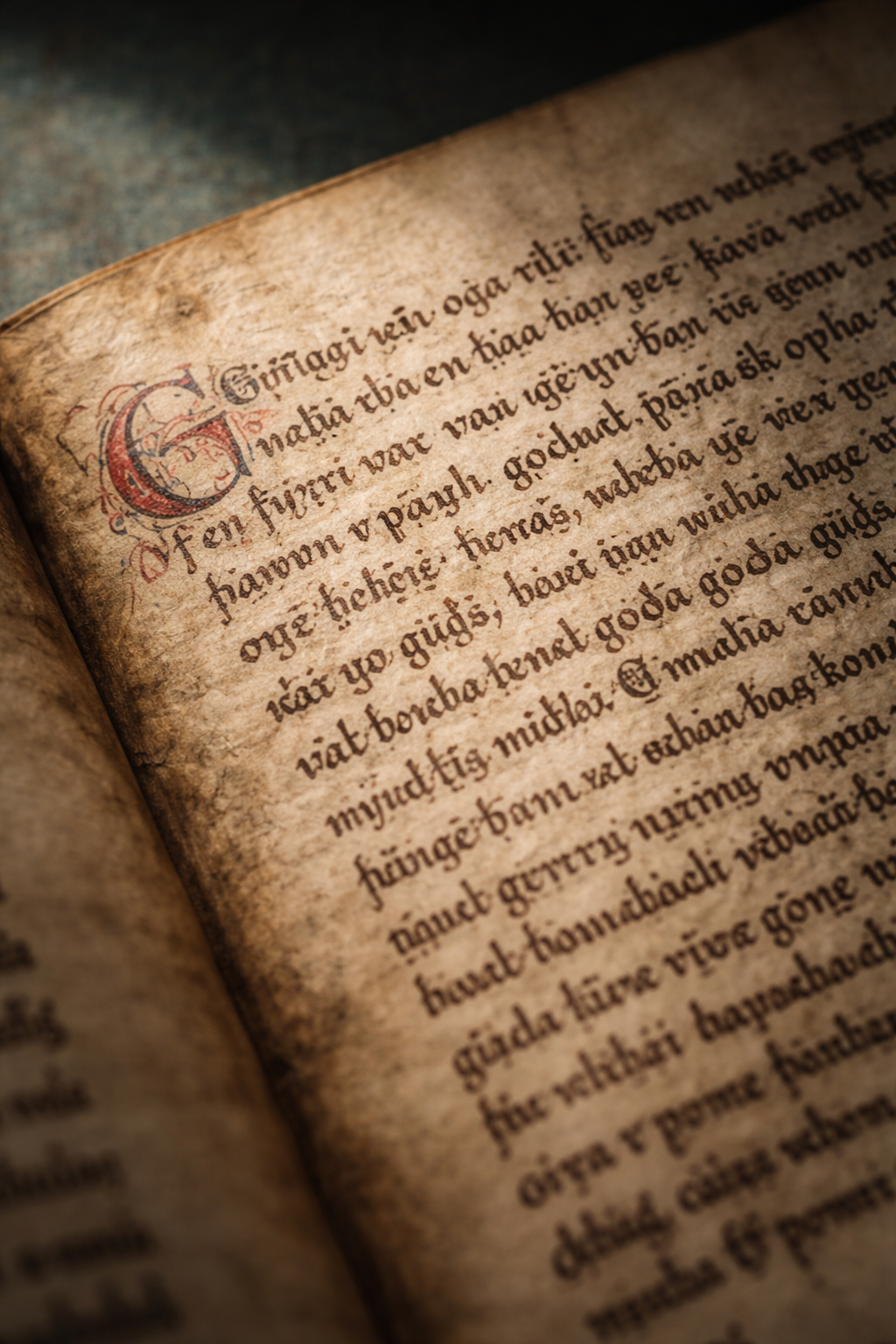
What we know of Odin does not come from temple liturgies preserved intact. It does not come from pagan priesthood manuals or systematic theological treatises written by his own devotees. Instead, the majority of surviving material derives from texts written in 13th-century Iceland — centuries after the formal Christianization of Scandinavia.
The two principal literary sources are:
The Poetic Edda (preserved in the Codex Regius manuscript, c. 1270 CE), a compilation of earlier anonymous poems.
The Prose Edda, written by Snorri Sturluson (c. 1220 CE), an Icelandic historian and politician seeking to preserve skaldic poetic tradition.
These works are invaluable. Without them, Odin would be little more than a name scattered across place-names and fragments. But they are not neutral transcripts of living pagan practice. They are literary preservations, recorded within a Christian cultural framework, shaped by medieval intellectual concerns and political realities.
This does not render them unreliable.
It renders them layered.
In addition to the Eddas, Odin appears in:
Skaldic poetry composed between the 9th and 12th centuries.
Saxo Grammaticus’ Gesta Danorum (late 12th century), written from a Christian Danish perspective.
Scattered references in runic inscriptions.
Place-name evidence across Scandinavia and Anglo-Saxon England.
Early medieval accounts such as Adam of Bremen’s description of the temple at Uppsala.
Taken together, these sources form a mosaic rather than a single portrait.
They reveal Odin as literary figure, cultic presence, mythic ancestor, and political symbol — but never in a unified theological system authored by pre-Christian Scandinavians themselves.
This presents a methodological challenge.
When studying Odin, we must continually ask:
Are we reading an early poetic layer or a later medieval synthesis?
Is this myth preserved for theological memory or for poetic instruction?
How much has Christian authorship shaped narrative tone and moral framing?
Where does archaeology support — or complicate — literary tradition?
Odin, as he survives in the record, is not a static god preserved in amber.
He is a figure refracted through oral tradition, medieval transcription, political consolidation, and modern reinterpretation.
To approach him responsibly, we begin not with attributes or offerings, but with documentation.
Because understanding the instability of our sources is not a weakness in study.
It is the beginning of precision.
Ancient manuscript with red ornate initial
Name, Etymology, and Linguistic Context
The Old Norse name Óðinn [OH-thin] is not merely a label. It encodes theology.
Linguistically, Óðinn derives from the Proto-Germanic reconstruction Wōðanaz [WOH-than-az]. Cognates appear across the Germanic-speaking world:
Old English: Wōden
Old High German: Wotan
Old Saxon: Wōdan
These names suggest not a uniquely Scandinavian invention, but a deity whose roots extend into earlier Germanic religious strata.
The key lies in the Old Norse noun óðr [OH-der].
Óðr carries a range of meanings: fury, inspiration, ecstatic mental state, poetic frenzy, heightened consciousness. It is not simply anger, nor merely emotion. It implies altered intensity — a state beyond ordinary cognition.
Thus, Óðinn may be understood, etymologically, as “the master of ecstasy,” “the one possessed by fury,” or “he who embodies inspired consciousness.”
This linguistic root complicates simplistic categorizations.
Odin is often presented as a war god, and indeed he presides over battle and the slain. But his name does not derive from warfare terminology. It derives from ecstatic intensity — a condition equally associated with poetry, magic, prophecy, and altered states of awareness.
Philological scholarship suggests that this root may connect to broader Indo-European concepts of inspired speech and divine frenzy, though such connections remain debated and should not be overstated. What is clear is that Odin’s identity is linguistically tied to mental transformation rather than mere martial power.
This distinction matters.
Thor’s name derives from thunder.
Týr’s name likely connects to sky or divine order.
Odin’s name derives from ecstatic force.
Even before we reach the mythic narratives, the language signals his sphere.
Linguistic Spread and Cultural Implication
The distribution of cognates — Woden in Anglo-Saxon England, Wotan in continental Germanic regions — indicates that this figure predates the Viking Age literary record.
Place names across England (e.g., Wednesbury, Wansdyke, Woden’s field references) and Scandinavia preserve his memory in the landscape. Wednesday itself derives from “Woden’s day,” paralleling the Latin dies Mercurii (Mercury’s day), suggesting early interpretatio Romana where Roman observers equated Woden with Mercury.
This comparison is recorded in Tacitus’ Germania (1st century CE), where he describes a chief Germanic deity whom scholars identify as Odin, though Tacitus uses Roman interpretive language.
Already, we see layering:
A Proto-Germanic ecstatic deity.
Roman observers translating him through their own pantheon.
Anglo-Saxon and Norse adaptations preserving his name.
Medieval Icelandic poets systematizing his mythology.
Language traces continuity across centuries, even where ritual detail is lost.
A Note on Caution
Etymology can illuminate. It can also seduce.
Not every poetic attribute in the Eddas can be derived directly from the root óðr. Nor can we assume a perfectly stable theological concept stretching unchanged from Proto-Germanic antiquity to 13th-century Iceland.
Language evolves. So do gods.
But the persistence of the Wōðanaz root across Germanic cultures suggests that the figure preserved in the Icelandic manuscripts is not a late literary invention. He stands within a much older linguistic tradition, even if the full contours of that early worship remain beyond our recovery.
Before Odin is king of Ásgarðr [AWS-gar-thur], before he sacrifices himself upon Yggdrasil [IG-drah-sil], before he gathers the slain to Valhalla —
He is the embodiment of ecstatic force.
And that is where the record begins.
Misty dawn over a tranquil lake
Odin in the Poetic Edda
The Poetic Edda, preserved in the 13th-century Codex Regius manuscript, contains mythological and heroic poems composed in Old Norse verse. While the manuscript itself dates to c. 1270 CE, many of the poems are believed to preserve material from earlier oral traditions, possibly as early as the 9th or 10th centuries — though precise dating remains debated.
Within these poems, Odin appears not as a distant abstraction, but as an active participant in mythic drama.
Three texts are especially central to understanding his character: Völuspá, Hávamál, and Grímnismál.
Odin in Völuspá: Cosmic Architect and Doomed Sovereign
Völuspá (“The Prophecy of the Seeress”) frames the Norse cosmos from creation to destruction. Odin appears here not as warrior alone, but as seeker of knowledge.
The poem opens with Odin summoning a völva [VOL-vuh] — a prophetic seeress — compelling her to recount the origins and ultimate fate of the world. Already, the dynamic is clear: Odin desires knowledge beyond ordinary reach, even when that knowledge reveals his own death at Ragnarök [RAG-nuh-rock].
The poem recounts Odin’s sacrifice of an eye for wisdom at Mímir’s well [MEE-meer]:
“All know I, Odin,
where you hid your eye:
in the famous well
of Mímir…”
(Völuspá, stanza 28, trans. Larrington)
Here, wisdom is transactional. Vision is surrendered for deeper sight.
Odin is not omniscient. He bargains for knowledge.
And even armed with prophetic understanding, he cannot prevent Ragnarök. His fate — to be devoured by the wolf Fenrir — is foreknown and unavoidable.
Thus, in Völuspá, Odin is neither absolute ruler nor cosmic victor.
He is a sovereign bound by fate.
Odin in Hávamál: Self-Sacrifice and Runic Knowledge
If Völuspá frames Odin cosmically, Hávamál reveals him intimately.
Hávamál (“Sayings of the High One”) is a composite poem, part wisdom literature and part mythic narrative. Much of it consists of gnomic counsel attributed to Odin — pragmatic, often severe observations about hospitality, speech, loyalty, and caution.
But its most famous passage is the account of Odin’s self-sacrifice upon Yggdrasil.
“I know that I hung
on the wind-swept tree
nine long nights,
wounded with a spear,
dedicated to Odin,
myself to myself…”
(Hávamál, stanzas 138–139)
The ambiguity is striking.
Odin sacrifices himself — to himself.
He hangs upon the cosmic tree, pierced by a spear, deprived of food and drink, until he perceives the runes below and seizes them.
This is not martyrdom in a Christian sense. It is initiatory ordeal.
Knowledge requires suffering. Power requires ordeal. Runes are not granted — they are wrested from the abyss.
The structure mirrors shamanic interpretations proposed by some scholars (notably Hilda Ellis Davidson), though the term “shamanism” remains debated in academic circles when applied to Norse contexts.
What is clear is this:
Odin is a god who undergoes transformation.
He is not merely born wise.
He becomes wise through self-inflicted ordeal.
Lonely tree on a winter hill
Odin in Grímnismál: Disguise and Revelation
In Grímnismál, Odin appears in disguise as Grímnir [GRIM-nir] (“the Hooded One”). Captured and tortured between two fires, he remains silent until the moment of revelation, when he discloses cosmic knowledge to the young prince Agnarr [AG-nahr].
The motif recurs across Eddic material:
Odin wanders.
Odin disguises himself.
Odin tests hospitality and loyalty.
He is not a stationary temple god.
He is peripatetic, unpredictable, liminal.
His many names — listed extensively in the Eddas — reinforce this multiplicity. Each name marks a role, a mood, a function. He is Allfather, but also Bolverk [BOHL-vairk] (“Evil-Worker”), Grimnir, Hår (“High”), and countless others.
Identity, for Odin, is fluid.
Themes Emerging from the Poetic Edda
Across these poems, several consistent traits emerge:
Relentless pursuit of knowledge.
Willingness to sacrifice bodily integrity for wisdom.
Mastery of poetry and inspired speech.
Association with death — not merely as killer, but as receiver of the slain.
Boundness to fate, despite power.
What does not emerge clearly is a standardized liturgical framework. The Poetic Edda preserves mythic narrative and poetic instruction, not ritual manuals.
Thus, our understanding of Odin in this corpus is literary and mythological — textured, powerful, but not systematized theology.
And always, we must remember:
These poems survive in a Christian manuscript.
They may preserve pre-Christian oral tradition — but they reach us through medieval preservation.
The voice is old.
The page is not.
Odin in Snorri Sturluson’s Prose Edda
Written in the early 13th century (c. 1220 CE), the Prose Edda was composed by Snorri Sturluson — a Christian Icelandic law-speaker, poet, and political figure. Its stated purpose was instructional: to preserve the knowledge necessary for understanding skaldic poetry, which relied heavily on mythological references.
By Snorri’s time, Iceland had been Christian for over two centuries.
This matters.
Snorri was not recording living pagan liturgy. He was preserving mythic material for literary continuity within a Christian intellectual world.
Odin as Allfather and Political Sovereign
In the Prose Edda, Odin is elevated explicitly as Allfather — ruler of Ásgarðr [AWS-gar-thur], progenitor of gods, architect of cosmic structure.
Snorri systematizes:
The genealogy of the gods.
The layout of the cosmos.
The function of Valhalla.
The ordering of divine hierarchy.
This differs in tone from the Poetic Edda, where Odin often appears as seeker, wanderer, and liminal figure.
Snorri presents coherence.
But coherence may reflect literary order more than pre-Christian theological uniformity.
Euhemerization: Odin as Human King
One of Snorri’s most significant interpretive strategies is euhemerization — the framing of gods as ancient human rulers later deified.
In the Ynglinga Saga (part of Snorri’s larger Heimskringla corpus), Odin is described as a chieftain from Asia who migrated north and established royal lineages in Scandinavia.
This approach allowed Christian authors to preserve myth without endorsing pagan theology. Gods became heroic ancestors rather than divine beings.
Thus, Odin is both god and historical founder — depending on narrative need.
This dual presentation complicates interpretation.
Are we reading preserved pagan cosmology?
Or Christian-era rationalization of mythic material?
Often, we are reading both simultaneously.
The Structured Cosmos
Snorri’s Gylfaginning (“The Tricking of Gylfi”) lays out the Norse cosmos in dialogic form. Odin appears as High, Just-as-High, and Third — three enthroned figures answering King Gylfi’s [GILL-fih] questions.
This triadic presentation may reflect literary dramatization rather than theological doctrine.
Under Snorri’s pen, the cosmos becomes architecturally ordered:
Nine worlds mapped.
Ragnarök described sequentially.
Divine roles clarified.
This systematic presentation is invaluable — yet it also risks giving modern readers the illusion of a unified, canonical Norse theology.
Pre-Christian religion was likely more regionally varied and less centralized than Snorri’s prose suggests.
Odin’s Domains Reaffirmed
Within Snorri’s account, Odin retains key attributes found in the poetic corpus:
Patron of kings and warriors.
Receiver of the slain in Valhalla.
Master of runes and magic.
Practitioner of seiðr [SAY-thur] — a form of magic associated with prophecy and altered states.
Snorri even acknowledges that seiðr was considered socially unmanly, implying Odin crossed gendered boundaries in pursuit of power.
This detail aligns with earlier poetic hints of liminality and transgression.
Yet again, interpretation requires caution.
Is Snorri preserving inherited cultural memory?
Or shaping it for narrative coherence?
The Christian Lens
Snorri writes within a Christian moral universe.
Ragnarök, as presented in the Prose Edda, bears structural parallels to apocalyptic narrative — cosmic battle, divine destruction, renewal of the world. While scholars debate the degree of Christian influence, the possibility cannot be ignored.
Moreover, Snorri’s framing distances himself from pagan belief. Myth is described, not endorsed.
Thus, Odin in the Prose Edda is both preserved and reframed.
He survives.
But he survives through mediation.
Literary Construct vs. Cultic Reality
By the time we leave Snorri’s text, Odin appears fully formed: Allfather, architect of war, patron of poets, orchestrator of fate.
But we must remember:
The Prose Edda is not a pagan catechism.
It is a 13th-century literary manual drawing on older material.
The Odin we encounter here is invaluable — but he is also curated.
Cultic and Archaeological Evidence
What can be demonstrated beyond literary preservation?
If the Eddas give us mythic Odin, archaeology asks a quieter question:
Was he worshipped?
If so, how?
And by whom?
The material record is less dramatic than the poems — but in many ways, more revealing.
Weathered runestone with moss and runes
Place-Name Evidence
One of the strongest indicators of cultic presence is toponymy — the study of place names.
Across Scandinavia and Anglo-Saxon England, numerous locations preserve variants of Odin’s name:
Old Norse: Óðinsvé (Odin’s sanctuary), Óðinslundr (Odin’s grove)
Old English: Wōdnesburh, Wōdnesfeld
Wednesday (Woden’s day), paralleling Latin dies Mercurii
These names suggest that sites associated with Odin were embedded in the landscape.
Place names often outlast ritual.
They indicate memory.
In some cases, the distribution of Odin-derived place names suggests elite or regional cult activity, particularly in Denmark and parts of Sweden. However, compared to Thor — whose name appears more frequently in toponyms — Odin’s cult may have been less universally popular and more closely tied to aristocratic or warrior elites.
This remains debated.
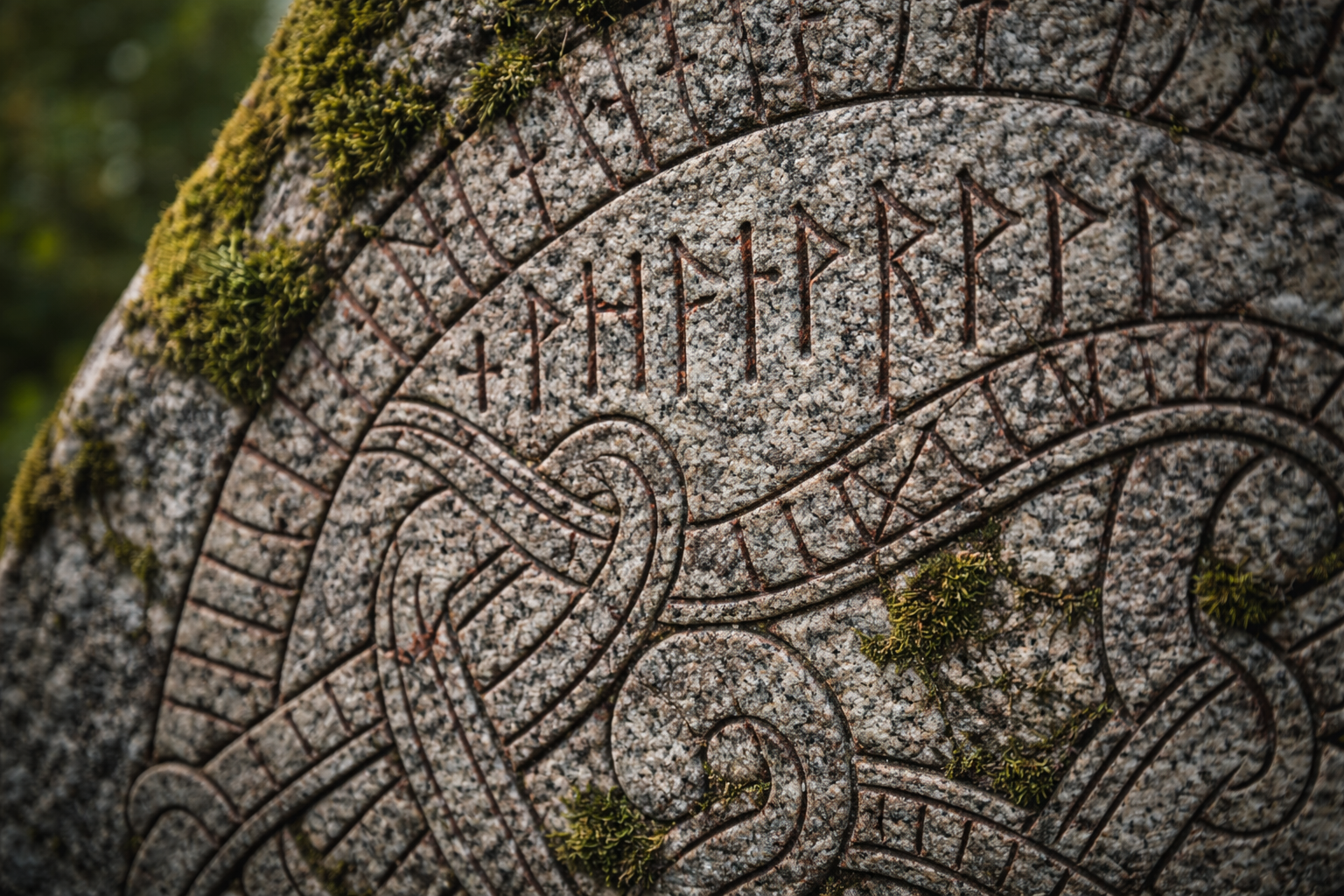
Runic Inscriptions
Runic evidence associated explicitly with Odin is limited but significant.
Some inscriptions invoke him directly. Others reference runes — which later texts attribute to Odin’s acquisition through ordeal.
The relationship between Odin and runes, however, must be approached cautiously.
While Hávamál describes Odin’s self-sacrifice to gain knowledge of runes, archaeological evidence shows that runic literacy existed independently as a writing system across Germanic cultures.
It is not possible to prove that historical rune-carvers understood their script primarily through Odin’s mythic narrative.
The literary and material traditions intersect — but not seamlessly.
Bracteates and Iconography
Migration-period bracteates [BRACK-tee-its] (gold medallions dating roughly from the 5th–6th centuries CE) sometimes depict a one-eyed figure accompanied by animals, often interpreted by scholars as proto-Odin imagery.
Some bracteates show a human head above a horse — potentially linking to later myths of Odin and Sleipnir [SLAYP-neer].
Interpretations vary.
Iconography is suggestive, not definitive.
We do not possess labeled statues reading “This is Odin.”
We infer.
Adam of Bremen and Uppsala
The 11th-century chronicler Adam of Bremen describes a temple at Uppsala in Sweden containing statues of three principal gods: Thor, Odin, and Freyr [FREY-er].
In his account, Odin is associated with war and sovereignty.
However, Adam wrote as a Christian cleric describing pagan practice from outside the culture. His account may contain exaggeration or theological framing.
Yet it remains one of the few near-contemporary descriptions of organized cult practice.
Elite vs. Popular Worship
A recurring scholarly question:
Was Odin primarily a god of kings and warrior aristocracy?
Literary sources often associate him with:
Royal lineage.
Berserkers and battle frenzy.
Valhalla — the hall of the slain.
Poetic patronage among skalds.
Thor, by contrast, appears more frequently in rural place names and protective amulets.
This has led some scholars to propose that Odin’s cult may have been more closely tied to elite warrior culture, political legitimacy, and poetic courts.
The evidence is circumstantial — but plausible.
What the Archaeological Record Does Not Show
We do not have:
Preserved Odin-specific liturgical texts.
Detailed temple ritual manuals.
Systematic priesthood records.
Uniform iconography across regions.
The cult of Odin, insofar as it can be reconstructed, appears decentralized.
Ritual practice likely varied regionally. Oral tradition shaped mythic emphasis. Political context influenced divine prominence.
The literary Odin looms large.
The archaeological Odin whispers.
The Tension Between Myth and Material
The Eddas describe Odin as Allfather, cosmic strategist, orchestrator of fate.
The archaeological record suggests:
Cultic presence, but not overwhelming dominance.
Regional variation.
Possible elite association.
The tension between these layers reminds us:
Myth magnifies.
Material culture grounds.
Responsible scholarship requires holding both simultaneously — without allowing either to erase the other.
Odin’s Domains in Context
War, poetry, magic, kingship, and death — grounded in attested sources.
If Odin can be reduced to anything without losing him entirely, it is this: he is a god of power gained through knowledge—and knowledge gained through risk. The poems do not present him as a simple “war god” or a distant creator. They present a figure who pays for insight: an eye, blood, reputation, stability.
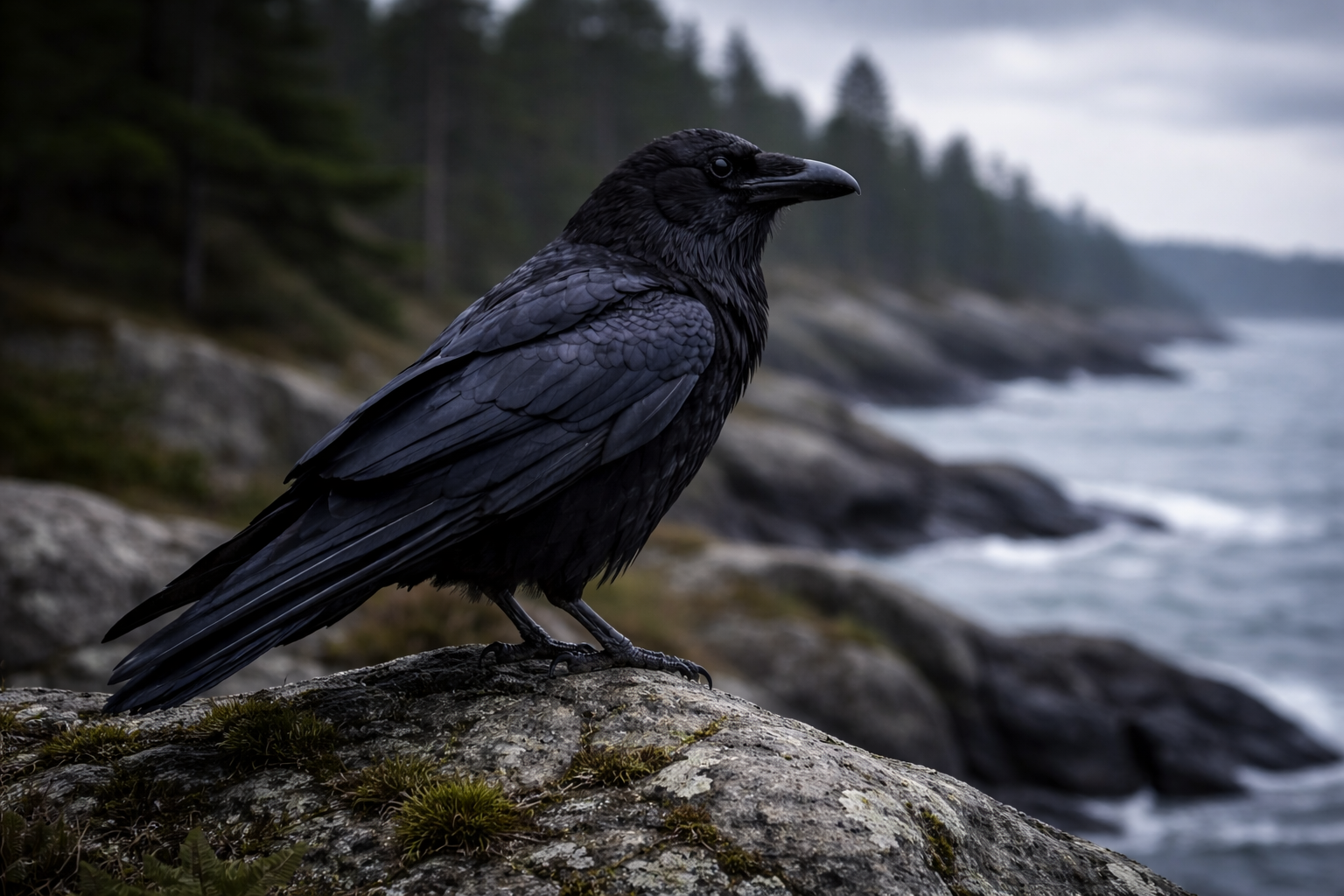
Raven on mossy coastal rock
1) Wisdom, Knowledge, and the Price of Sight
Odin’s pursuit of knowledge is not a personality trait—it is a defining mythic function.
In Völuspá, the seeress speaks directly to Odin about his sacrificed eye and Mímir’s well, making the exchange explicit: wisdom is purchased, not granted.
In Hávamál, that same economy appears again—only this time the payment is his own body. Odin describes hanging on the “windy tree,” wounded by a spear, “myself to myself,” in an ordeal that ends with the taking of runes.
Domain summary: Odin is defined by acquired knowledge—vision taken by sacrifice, not inherited as omniscience.
2) Poetry, Inspired Speech, and Ecstatic Mind
Even when Odin is delivering practical wisdom (hospitality, caution, speech), Hávamál frames him as a speaker whose authority comes from knowing the hidden rules of survival and reputation.
This matters because, in Norse literary culture, poetry is not decoration—it is social power: praise binds kings, insults damage honor, memory preserves fame. Odin’s association with inspired speech sits naturally beside his hunger for knowledge: words are a form of dominion.
Domain summary: Odin’s “wisdom” is not gentle—it’s strategic. In the North, speech can be weapon, contract, and legacy.
3) Kingship, War, and Sovereignty
Odin’s war-aspect in the textual tradition is tightly linked to rulership and victory, not merely violence.
One of the clearest external (non-Eddic) descriptions comes from Adam of Bremen’s account of the cult at Uppsala, where Odin (Wodan) is presented among the major gods and associated with warlike function (often compared to Mars through Roman interpretive language).
Later summaries of Adam’s account (and related medieval tradition) also preserve the idea of Odin being toasted for victory and power/sovereignty (“victory and dominion”). This reflects Odin’s repeated positioning as the god most useful to rulers and warrior elites.
Domain summary: Odin is a sovereignty-and-victory god—deeply entangled with elites, strategy, and the terrible costs of rule.
4) Death, the Slain, and the Logic of Valhalla
Odin’s relationship to death is not simply “underworld.” It’s selection.
The Eddic material emphasizes Odin’s connection to the slain and to fate-laden knowledge of endings. In Völuspá, the prophetic frame makes clear that even the gods are subject to doom—and Odin is the one who insists on hearing it anyway.
Domain summary: Odin is not a comforter at the grave. He is a collector of consequence—death as recruitment, death as destiny, death as knowledge.
5) Magic, Seiðr, and Transgressive Power
Odin’s magic is bound to boundary-crossing. Even in later prose framing (Prose Edda and saga tradition), seiðr is treated as powerful yet socially complicated—coded as improper for men, and thus morally charged when Odin practices it.
We’ll treat the seiðr evidence more fully when we move into the Snorri-and-sagas section (because that’s where the social commentary is most explicit), but the essential point belongs here:
Odin pursues power even when it stains reputation.
Domain summary: Odin’s magic is not “witchy aesthetics.” It is liminal authority—knowledge that costs status.
The Thread That Ties the Domains Together
War, poetry, magic, kingship, death—these are not separate “correspondences.”
They are one theme expressed through different doors:
Odin is the god of costly knowing.
Eye for insight. Body for runes. Reputation for power. Certainty for prophecy.
And that is why he remains so difficult to simplify.
Odin in Later Medieval and Early Modern Interpretation
From mythic sovereign to “historical” king — and the slow Christian reframing of the old gods.
Once the Eddas are on the table, it’s tempting to assume we’ve reached “the Norse worldview.” But the medieval North was not preserving paganism in a sealed jar. It was repackaging inherited material inside a Christian intellectual climate—sometimes respectfully, sometimes opportunistically, often both at once.
1) Christian Chroniclers and the “Translation Problem”
Medieval Christian writers routinely explained foreign gods by comparing them to Roman ones. That habit doesn’t just describe Odin—it changes how he is framed.
A famous example is Adam of Bremen’s description of the temple at Uppsala, where he depicts a triad of gods (Thor central, with Odin/Wodan and Freyr/Fricco to the sides) and explicitly interprets Odin through a Roman war-god comparison.
This is useful evidence that Odin was understood in a war/sovereignty register in at least one medieval report—but it is also filtered through an outsider’s lens, Christian polemic, and Roman interpretive language.
2) Saxo Grammaticus: Gods as Men in a Danish History
If the Eddas preserve Odin in poetic myth, Saxo Grammaticus preserves something else entirely: a Christianized Danish national history where pagan gods are frequently handled through euhemerism—the idea that gods were once exceptional humans later elevated into divinity.
Modern scholarship regularly notes Saxo’s euhemerizing approach in Gesta Danorum, where divine narratives are reshaped into human conflicts and historical drama.
What this does to Odin is subtle but profound:
He becomes less a cosmic figure and more a powerful agent in a human past.
Myth shifts toward “history,” and theology becomes narrative material.
The gods are preserved—while their divinity is quietly domesticated.
This is not a flaw in Saxo; it is his project.
3) Saga Memory: Odin as Ancestry, Authority, and Pattern
In saga tradition and medieval genealogical thinking, Odin often functions as a legitimizing ancestor—the deep root beneath ruling houses and heroic lineages. This is not “cult practice” evidence so much as cultural memory weaponized into social authority: the past used to anchor status.
Here’s the important takeaway:
Later medieval Odin is not just a god. He becomes a political technology.
4) Early Modern Afterlives: From Learned Curiosity to Romantic Re-enchantment
As the medieval period recedes, Odin survives through antiquarian collecting, national histories, and later—Romantic-era re-enchantment (especially in the 18th–19th centuries). In these later frames, Odin is increasingly treated as a symbol: of “the North,” of imagined ancestral identity, of heroic pre-Christian spirit.
This matters because it sets the stage for modern Odin: a figure repeatedly reinterpreted to meet the needs of the present.
Modern Reconstruction and Revival Movements
What’s rebuilt, what’s reinvented, and why the distinction matters.
Modern engagement with Odin often arrives through revivalist paths—especially varieties of Ásatrú / Heathen reconstruction, which attempt to rebuild practice from medieval texts, archaeology, and comparative scholarship. The intention is often careful and sincere, but the method is inevitably interpretive: gaps are filled, choices are made, modern ethics shape ritual.
Two points belong in a responsible archive treatment:
1) Modern Odin is not medieval Odin (and that’s okay—if named)
Modern practice frequently blends:
Eddic poetry (Poetic Edda)
Snorri’s system (Prose Edda)
Saga material
Modern occult ideas
Personal devotional experience
The problem is not blending.
The problem is calling the blend “ancient and unchanged.”
2) Odin is vulnerable to misuse as a symbol
Because Odin has been reframed repeatedly as “heritage” and “ancestry,” he can be (and has been) pulled into modern identity projects—including harmful nationalist mythmaking.
A responsible archive flags this without turning the article into a political treatise: mythic figures can be recruited. Part of scholarship is noticing when that happens.

Scholarly study with handwritten notes
Scholarly Debates
Origins, interpretation, and the limits of certainty
If there is one responsible conclusion to reach in Odin studies, it is this:
Scholars do not agree on everything.
And that disagreement is productive.
1. Was Odin Always Supreme?
The literary Odin of the 13th-century texts appears as Allfather — architect of the gods, sovereign of Ásgarðr.
But was he always the central deity in earlier Germanic religion?
Some scholars have suggested that Thor may have been more widely worshipped among common people, based on the frequency of place names and amulets invoking Thor’s protection. Odin’s cult, by contrast, may have been more closely associated with elites, warrior aristocracy, and poetic courts.
This raises a question:
Did Odin rise in prominence over time?
Or do the literary sources simply overrepresent elite theology?
The archaeological record does not provide a definitive answer.
2. Shamanic Interpretations
The episode in Hávamál — Odin hanging on the tree, wounded, deprived, gaining runic knowledge — has led some scholars (notably Hilda Ellis Davidson and others influenced by comparative religion studies) to interpret Odin through a “shamanic” lens.
Arguments for this include:
Ecstatic states (linked linguistically to óðr).
Self-induced ordeal.
Seiðr practice.
Spirit-travel motifs.
Shape-shifting themes.
However, the term “shamanism” is contested in Norse scholarship. It originates from Siberian contexts and may not map cleanly onto Scandinavian practice.
Some argue the comparison is illuminating.
Others caution that it imposes external categories onto Germanic religion.
The debate remains open.
3. Indo-European Origins
Because Odin’s name derives from Proto-Germanic Wōðanaz, some scholars explore possible Indo-European parallels — especially in relation to divine frenzy, inspired speech, or warlike sovereignty.
Yet Odin does not align neatly with the reconstructed Proto-Indo-European sky father (Dyēus ph₂tḗr), more commonly linked to deities like Zeus or Jupiter.
This complicates attempts to place Odin into a simple Indo-European inheritance model.
He may preserve older ecstatic elements within Germanic religion that do not correspond directly to a single Indo-European prototype.
Again, interpretation diverges.
4. Christian Influence on Ragnarök
One of the most discussed debates concerns Ragnarök — the destruction and renewal of the cosmos.
Did the apocalyptic structure of Ragnarök absorb Christian eschatological (relating to death, judgment, and the final destiny of the soul and of humankind) influence? Or does it reflect indigenous mythic patterns independent of Christianity?
Some scholars argue that elements of cosmic battle, moral framing, and post-destruction renewal may have been shaped or emphasized by Christian scribes.
Others maintain that cyclic destruction myths are widespread and need not derive from Christian influence.
The textual record cannot fully resolve this.
But the possibility of Christian narrative shaping cannot be ignored.
5. The Problem of Snorri
How much of what we “know” about Odin is Snorri’s systematization?
Did he clarify an already coherent theology?
Or did he impose order onto fluid oral traditions?
Snorri’s prose is elegant and structured. But that very coherence may obscure earlier regional variation.
Scholars continue to parse where Snorri preserves and where he synthesizes.
What These Debates Reveal
Odin is not a closed case.
He is:
Linguistically ancient.
Literarily medieval.
Archaeologically suggestive.
Theologically debated.
Politically repurposed.
Continuously reinterpreted.
The responsible position is not to choose a single theory and declare it final.
It is to recognize the layered nature of the evidence — and to remain attentive to what can be supported, what is speculative, and what remains unknown.
Odin as Layered Figure, Preserved and Refracted
What survives of Odin is not a single, stable god frozen in pre-Christian antiquity.
It is a figure refracted.
Through oral poetry.
Through medieval Christian scribes.
Through political genealogies.
Through Romantic nationalism.
Through modern reconstruction and reinterpretation.
The Odin of the Poetic Edda is not identical to the Odin of Snorri.
The Odin glimpsed in place names is not identical to the Odin of saga ancestry.
The modern Odin of revival movements is not identical to the medieval literary sovereign.
And none of them exist in isolation.
What we can say, with reasonable scholarly grounding, is this:
His name reaches deep into Proto-Germanic linguistic strata.
His literary presence in the Eddas preserves mythic material shaped by earlier oral tradition.
Archaeological and toponymic evidence suggests cultic recognition, possibly with elite associations.
His domains consistently revolve around knowledge gained through ordeal, sovereignty, poetic inspiration, and proximity to death.
Beyond that, certainty thins.
Odin is not a simple war god.
Not merely a sky father.
Not solely a poetic patron.
He is a god of costly knowing — and that cost is written into every layer of his survival.
The eye at Mímir’s well.
The body on the tree.
The reputation risked through seiðr.
The fate foreknown but unavoidable at Ragnarök.
Yet even this understanding is mediated.
We do not possess pagan theological treatises written by Odin’s own priesthood. We possess medieval literary preservation, fragmentary material culture, and modern interpretation built atop both.
Responsible study does not diminish him.
It situates him.
It allows us to say:
This comes from Völuspá.
This comes from Hávamál.
This appears in Snorri.
This is inferred from archaeology.
This is modern reconstruction.
Clarity is not disenchantment.
It is precision.
And precision is the foundation upon which any further engagement — scholarly or devotional — must stand.
If this examination shifted how you understand Odin, continue exploring our archive — or share which layer of his history you find most compelling. I’m listening.

Twilight on a rugged Nordic coast
Works Consulted
Primary Sources
Adam of Bremen. History of the Archbishops of Hamburg-Bremen. Translated by Francis J. Tschan. New York: Columbia University Press, 1959.
Saxo Grammaticus. The History of the Danes (Gesta Danorum). Translated by Peter Fisher. Oxford: Oxford University Press, 2015.
Snorri Sturluson. The Prose Edda. Translated by Anthony Faulkes. London: Everyman, 1995.
The Poetic Edda. Translated by Carolyne Larrington. Oxford: Oxford University Press, 2014.
Place-Name and Linguistic Studies
Hoad, T. F. The Oxford Concise Dictionary of English Etymology. Oxford: Oxford University Press, 1996.
de Vries, Jan. Altnordisches Etymologisches Wörterbuch. Leiden: Brill, 1962.
Modern Scholarship
Davidson, Hilda Ellis. Gods and Myths of Northern Europe. London: Penguin Books, 1964.
Davidson, Hilda Ellis. The Road to Hel: A Study of the Conception of the Dead in Old Norse Literature. Cambridge: Cambridge University Press, 1943.
Lindow, John. Norse Mythology: A Guide to the Gods, Heroes, Rituals, and Beliefs. Oxford: Oxford University Press, 2001.
Simek, Rudolf. Dictionary of Northern Mythology. Translated by Angela Hall. Cambridge: D. S. Brewer, 1993.
Archaeological and Historical Context
Brink, Stefan, and Neil Price, eds. The Viking World. London: Routledge, 2008.
Price, Neil. The Viking Way: Magic and Mind in Late Iron Age Scandinavia. Oxford: Oxbow Books, 2002.
Citations reflect primary literary sources and modern scholarship. Interpretations are presented with attention to source layering and historical context.