Brigid: Textual Fragment, Sacred Continuity, and Syncretic Survival
If Brigid [BRIH-guhd] were measured by the volume of myth preserved about her, she would appear minor.
There is no surviving epic centered on her.
No extended narrative cycle in which she dominates the stage.
No lengthy theological exposition preserved from pre-Christian Ireland.
And yet, she endures.
Brigid’s presence in the early Irish corpus is brief but pointed. She appears in medieval manuscripts compiled by Christian scribes — texts such as the Lebor Gabála Érenn and Cath Maige Tuired — where she is named among the Túatha Dé Danann [thoo-ah-hah day dan-an], identified as daughter of the Dagda [DAHG-duh], and associated with poetry, craft, and lamentation.
These references are not expansive. They are fragments.
What survives of her mythic identity must be reconstructed from scattered mentions embedded in genealogies, battle narratives, and glossaries. Unlike figures preserved in sustained poetic cycles, Brigid’s early literary footprint is light.
But fragmentation does not imply insignificance.
It suggests a different mode of preservation.
Where some deities survive in epic verse, Brigid survives in lineage, craft, seasonal custom, and eventually — sanctity.
By the early medieval period, a Christian holy woman, Saint Brigid of Kildare, emerges in the historical record. She is associated with Kildare, with healing, with generosity, and notably, with a perpetual flame tended by women. The parallels between the saint and the earlier goddess have long invited comparison.
Yet the relationship between them is not straightforward.
It is tempting to frame the story simply: pagan goddess becomes Christian saint. But such narratives flatten a far more complex process of cultural transformation. Medieval Ireland did not erase its past overnight, nor did it preserve it unchanged. Religious memory was negotiated, reframed, and often braided together.
Brigid exists precisely at that braid point.
She stands at the intersection of:
Pre-Christian Irish religious tradition.
Medieval monastic authorship.
Hagiographic literature.
Domestic seasonal ritual.
Early modern folklore.
Contemporary revival movements.
To study Brigid responsibly requires accepting this layered survival.
We do not possess pre-Christian Irish liturgical texts written by her devotees. What we have are medieval manuscripts compiled within Christian scriptoria, references filtered through ministerial redaction, and later folkloric practices whose origins must be evaluated carefully rather than assumed.
This presents both challenge and opportunity.
Unlike figures preserved primarily in epic myth, Brigid’s continuity appears not in dramatic cosmic narrative but in quieter cultural persistence — in names, in wells, in seasonal rites, in woven crosses hung in homes.
Her story is not one of dominance.
It is one of adaptation.
And that distinction will shape everything that follows.
Misty spring oak grove at dawn
Name, Etymology, and Linguistic Context
The Old Irish name Brigit (later Anglicized as Brigid or Bríd) derives from the Proto-Celtic Brigantī, a feminine form rooted in the word brig- — meaning “high,” “exalted,” “elevated.”
The semantic field is consistent across Celtic languages.
The element appears in:
Old Irish brí (strength, power, virtue).
Welsh bri (authority, honor).
Gaulish divine names such as Brigantia, attested in inscriptions from Roman Britain.
The connection between Brigit and Brigantia is widely discussed in scholarship. Inscriptions from northern Britain (particularly among the Brigantes tribe) reference Brigantia as a goddess associated with sovereignty and protection. Whether Brigantia and the Irish Brigit represent regional expressions of a shared Celtic divine figure remains debated, but the linguistic continuity is difficult to ignore.
Elevation is the key motif.
Not necessarily physical height — though hills and high places are common in Celtic sacred geography — but elevated status: exalted, noble, powerful.
Where Odin’s name encodes ecstasy and altered consciousness, Brigid’s encodes height and eminence.
This distinction is not trivial.
Names in early Indo-European traditions often preserve theological emphasis. Thor’s name derives from thunder. Týr’s from a sky-root linked to divinity. Odin’s from inspired fury.
Brigid’s name signals elevation — moral, social, or sacred.
Linguistic Spread and Regional Continuity
Unlike Odin, whose name appears widely across Germanic regions under cognate forms (Woden, Wotan), Brigid’s linguistic relatives appear primarily within Celtic-speaking territories.
The presence of Brigantia in Roman Britain suggests that a goddess of elevated status or sovereignty was known beyond Ireland. However, we must resist assuming uniformity. Roman inscriptions reflect local interpretation under imperial administration, often blending indigenous and Roman divine frameworks.
What we can say is this:
The root brig- carried divine weight across Celtic linguistic communities.
Whether expressed as Brigit in Ireland or Brigantia in Britain, the association with exalted status persists.
A Caution Against Overreach
Etymology can illuminate structure. It cannot substitute for narrative evidence.
Because Brigid’s mythological corpus is sparse, there is a temptation in modern spirituality to fill gaps using linguistic inference alone — for example, to assume that because her name means “exalted,” she must have functioned as a primary sovereignty goddess across all Celtic lands.
The evidence does not fully support that scale of claim.
What it supports is linguistic prominence.
The name signals status.
It does not map an entire theological system.
Elevation as Thematic Thread
Even in the limited early Irish references, Brigid’s domains — poetry, craft, lamentation — carry social prestige.
Poetry in early Ireland was not ornamental; it shaped law, satire, honor, and political memory. Smithcraft was not merely artisanal; it was technologically and symbolically potent. Lamentation structured communal grief.
Elevation here may not be throne-bound sovereignty.
It may be cultural authority.
The name does not tell us everything.
But it tells us enough to recognize that Brigid was not marginal.
She was marked — linguistically — as exalted.
Serene dawn over rolling hills
Brigid in Early Irish Literature
Fragmentary presence within medieval preservation
The primary textual references to Brigid appear in medieval Irish manuscripts compiled by Christian scribes between the 11th and 14th centuries. As with much of early Irish mythological material, the texts themselves are later than the traditions they preserve. They represent preservation through monastic redaction, not pagan theological manuals.
Two key sources frame her mythic presence:
Lebor Gabála Érenn (“The Book of the Taking of Ireland”)
Cath Maige Tuired (“The Second Battle of Mag Tuired”)
Neither centers Brigid as a dominant protagonist. Yet her appearances are deliberate and revealing.
Brigid in Lebor Gabála Érenn
In Lebor Gabála Érenn, Brigid is listed among the Túatha Dé Danann, the divine or semi-divine beings who precede the Milesians in Irish mythic history. She is named as the daughter of the Dagda, a central figure within that mythological corpus.
The text associates her explicitly with poetry.
In some manuscript traditions, three Brigids are mentioned — one associated with poetry, one with smithcraft, and one with healing. Whether this represents theological triplicity or literary amplification remains debated. It may reflect the medieval scribes’ tendency to systematize or categorize divine roles.
What is clear is this:
Brigid is not peripheral in lineage.
She is genealogically situated within the core mythic family of the Túatha Dé Danann.
Brigid in Cath Maige Tuired
In Cath Maige Tuired, Brigid appears in connection with lamentation.
Following the death of her son Ruadán, she is said to have keened — an act described as one of the earliest instances of ritual lamentation in Ireland.
This detail is brief, but significant.
Keening (caoineadh) would later become a culturally embedded form of structured mourning in Irish society. To associate Brigid with the origin of lament is to place her within the domain of cultural practice rather than abstract myth.
This reinforces a pattern:
Brigid’s domains are not primarily martial or cosmological.
They are civilizational.
Poetry. Craft. Lament.
Structures that bind community.
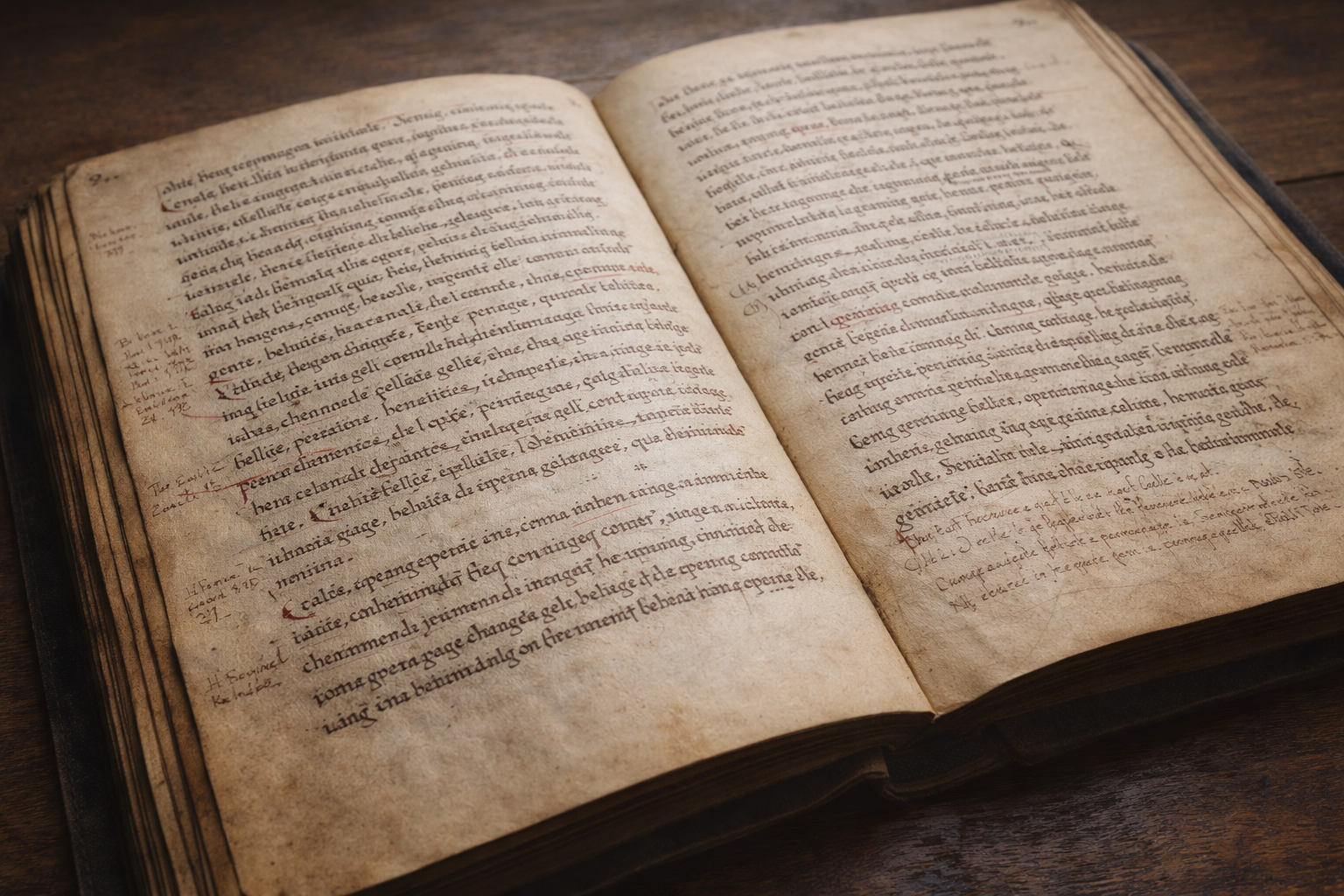
Ancient Irish manuscript with annotations
The Question of Triplicity
The mention of “three Brigids” in some traditions has led to extensive modern interpretation.
It is tempting to read this through later triple-goddess frameworks or Wiccan theology. However, the textual evidence is sparse and must be handled cautiously.
The triadic structure may reflect:
A literary device common in Celtic narrative.
A way of categorizing overlapping domains.
A theological multiplicity.
Or scribal clarification rather than original doctrine.
The early texts do not provide systematic explanation.
Responsible scholarship acknowledges the ambiguity.
Silence as Evidence
Perhaps the most important feature of Brigid’s early literary presence is its brevity.
She does not dominate mythic cycles in the way figures like the Dagda or Lugh do. She is not framed as war leader, cosmic architect, or apocalyptic figure.
And yet, she persists in name and role.
Her influence appears structural rather than narrative.
She is woven into the fabric of cultural function — poetry, craft, mourning — rather than grand mythic spectacle.
This pattern will become crucial when we move into her later transformation within Christian Ireland.
Because while epic dominance fades, domestic and communal continuity endures.
Domains in Context
What the texts support — and where the record becomes quiet
Brigid’s domains are often summarized as poetry, smithcraft, and healing—a triad that appears repeatedly in modern sources and, in some form, in medieval Irish tradition. The problem is not that the triad is invented; it is that it is frequently presented as if it were a fully documented, unified ancient doctrine.
It is not.
What we can responsibly say is shaped by the surviving texts: Brigid is associated with cultural powers that hold societies together—speech, craft, and ritualized social practice. Her mythic footprint is light, but the imprint is clear.
1) Poetry and Inspired Speech
Brigid’s strongest early textual association is with poetry.
In early Irish society, poetry was not a hobby. It was a power structure.
Poets (filí) shaped reputation, encoded genealogy, carried law and memory, and wielded satire with real social force. To be associated with poetry is to be associated with cultural authority and the shaping of fate through language.
Thus, Brigid as a figure of poetry aligns with her name’s implication of elevation: exalted status expressed through the prestige of speech and art.
Brigid is remembered, in medieval mythic compilation, as a poetically charged figure within the Túatha Dé Danann.
2) Craft and Smithwork
The second recurring domain is craft, often specified as smithing.
Here again, modern summaries often move too quickly—treating “smithcraft” as a simple correspondence rather than a major cultural technology. In early societies, smithing carried practical and symbolic potency: transformation by fire, mastery of metal, creation of tools and weapons, the threshold between raw matter and shaped destiny.
While the early textual references to Brigid as a smith figure are less expansive than modern devotional portrayals, the association itself remains meaningful within the cultural context of Ireland’s mythic world, where craft is often sacred-adjacent.
Brigid is linked to exalted cultural skills—not only speech but making.
3) Lamentation and Structured Grief
This is the domain that many modern summaries omit, but it is one of the most revealing.
In Cath Maige Tuired, Brigid is connected to keening—the ritualized lament associated with communal mourning. This places her in a different category than the “hearth goddess” simplification often used today.
She is not merely domestic.
She is a figure tied to:
the shaping of communal grief,
the formal expression of loss,
and the binding of society through ritual response to death.
Brigid is embedded in what holds people together when survival becomes grief.
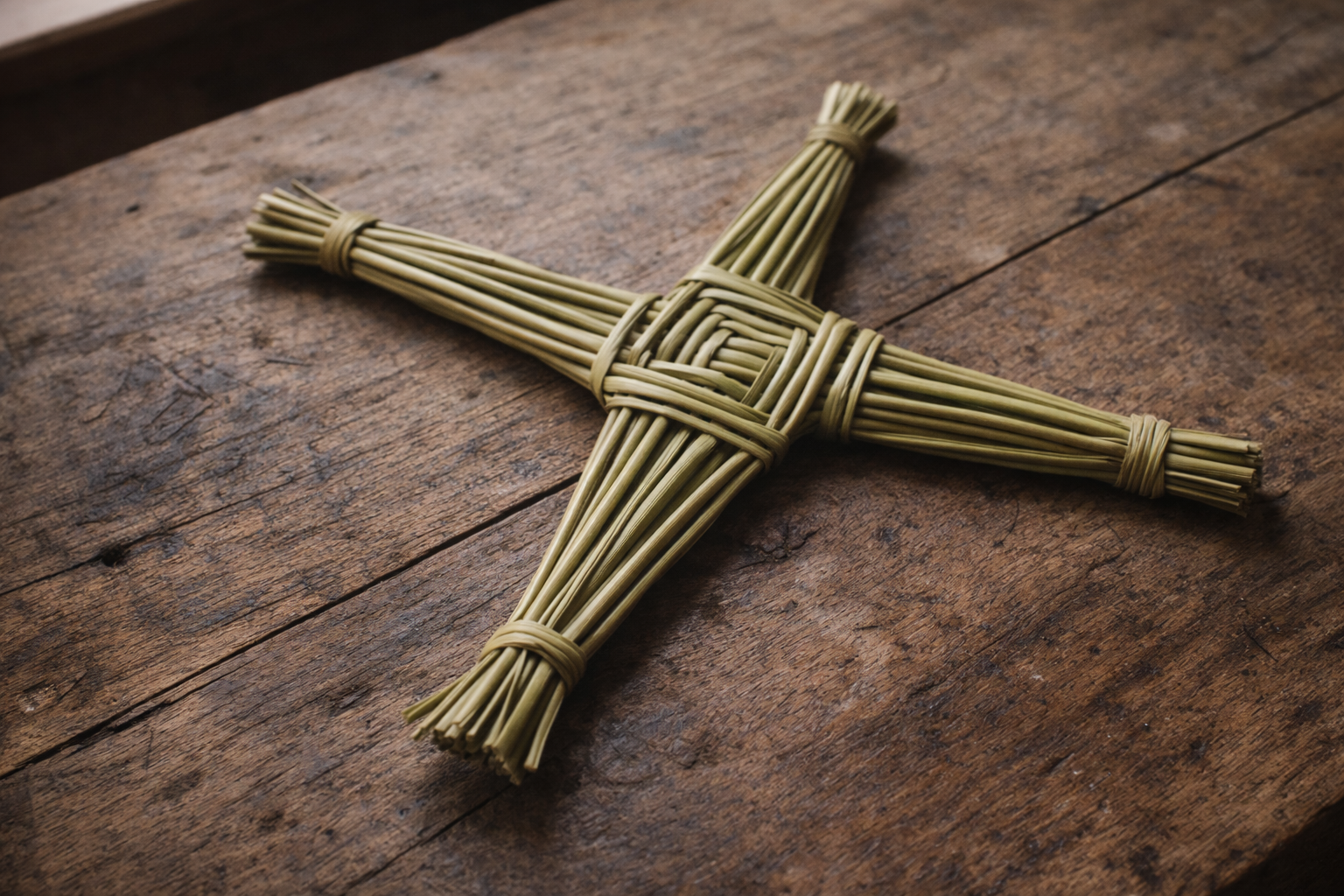
St. Brigid's cross on rustic wood
4) Healing — Present, But Often Amplified
Healing is commonly listed as Brigid’s third major domain. It appears strongly in later tradition, especially through Saint Brigid, holy wells, and folk practices. In the earliest mythic texts, however, healing is not always foregrounded with clarity.
This does not mean the association is false.
It means the documentary weight shifts across layers.
5) The Question of Triplicity
Triads are common in early Irish material. They can represent:
multiplicity within a divine figure,
a literary method of classification,
or later scribal system-building.
The early texts do not give us a clean theological statement like: “Brigid is triple, therefore…”
So we present it as:
A recurring motif.
Not a settled doctrine.
The Thread That Holds These Domains Together
Brigid’s domains are not primarily conquest or cosmic apocalypse.
They are the tools of continuity:
Speech that shapes memory.
Craft that transforms matter.
Ritual that holds grief.
Healing that survives through later layers.
Brigid’s power is civilizational.
Not loud.
Enduring.
Archaeological and Cultic Evidence
What can be demonstrated—and what must remain inference.
Brigid presents the scholar with a familiar frustration: her cultural presence feels enormous, but the material record speaks in a quieter voice.
Unlike some deities attested through abundant inscriptions or unmistakable iconography, Irish Brigid is not easily “caught” in the archaeological net. That does not mean she was not venerated; it means the evidence we do have is indirect, regionally uneven, and often preserved through later Christian or folkloric continuity rather than explicitly pagan artifacts.
So we proceed carefully—stone first, inference second.
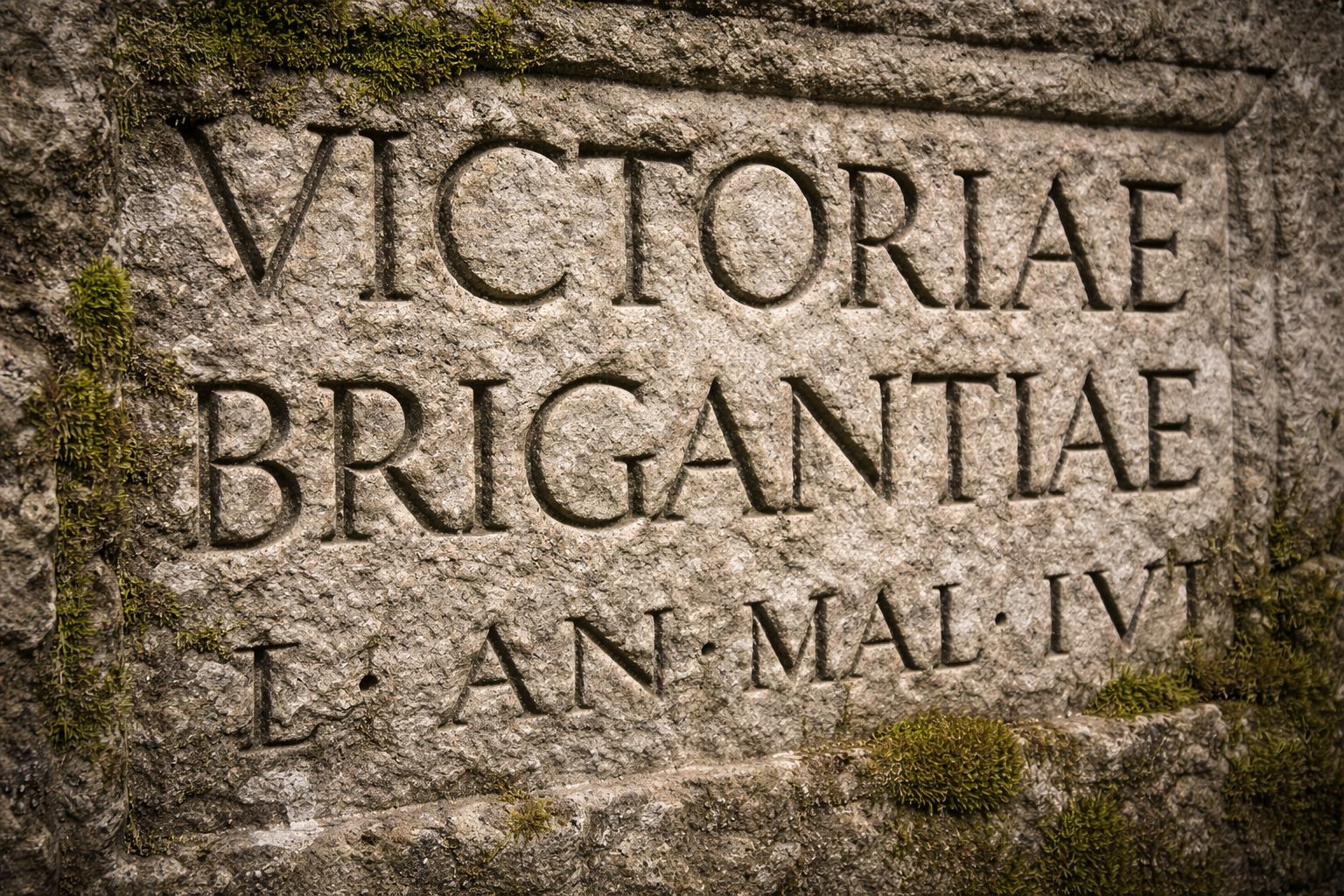
1) Brigantia in Roman Britain: Inscriptions as Hard Evidence
Where the Irish material record is sparse, Roman Britain gives us something firmer: the goddess Brigantia—a Celtic deity whose name derives from Proto-Celtic brigantī (“the High One”), linguistically cognate with Brigid/Brigit.
Brigantia is attested in votive inscriptions (often altars) in the north of Britain. The most responsible way to anchor this is through the Roman Inscriptions of Britain (RIB) database, which records multiple dedications—such as altars to Brigantia and Victoria Brigantia (e.g., sites including Castleford, Adel, and Greetland).
This is crucial:
It demonstrates that a goddess bearing the brigantī name-root was formally venerated in a Romano-British context.
It also shows interpretatio Romana at work—Brigantia being paired with Roman divine concepts like Victoria in some dedications.
What we can say responsibly:
A “High One” goddess (Brigantia) is materially attested in Roman Britain; she may be linguistically related to Irish Brigid, but identity across regions cannot be assumed as proven fact.
2) Ireland: The Evidence Problem (and Why It Exists)
Pre-Christian Ireland does not offer the same volume of inscriptions. Part of this is cultural: Ireland was outside the Roman epigraphic habit that produced so many altar dedications in Britain. The result is that Irish divine figures are often preserved more through manuscript tradition and place-embedded practice than through named stone offerings.
So for Brigid in Ireland, archaeology tends to support settings more than labels:
sacred wells and water sites later associated with Brigid
locations and cultic landscapes that become strongly Brigid-centered in Christian and folkloric layers
We can trace continuity of sacred sites, but proving pre-Christian Brigid-cult at those exact sites is often beyond the evidence.
3) Kildare and the Fire Tradition: Continuity, Not Certainty
The Kildare material is powerful precisely because it is layered.
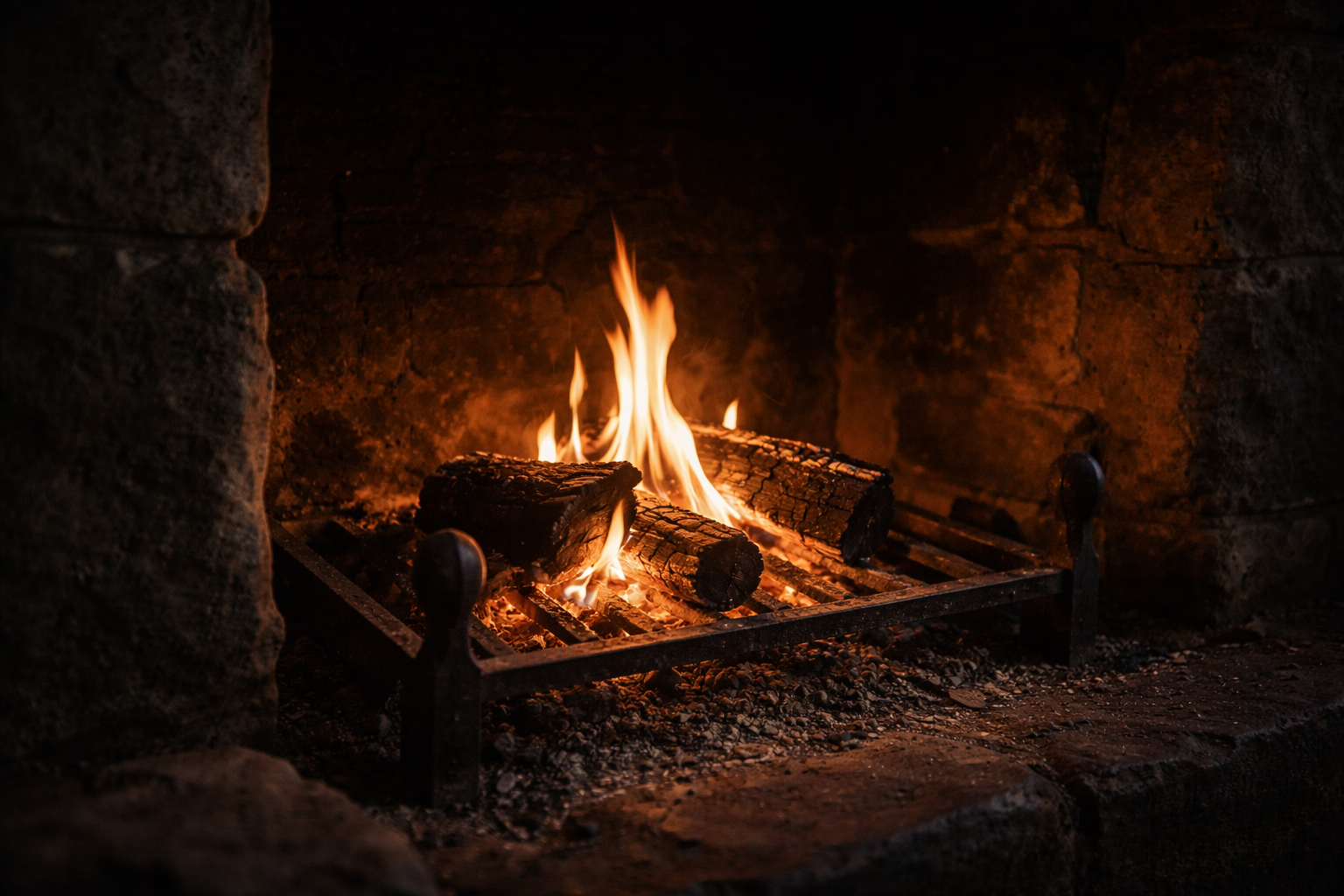
Later medieval accounts—most notably Gerald of Wales (12th century)—describe a perpetual fire tended by nineteen women at Kildare in honor of Brigid, with a boundary men were not permitted to cross.
Modern Brigidine sources and contemporary Kildare institutions continue to frame the flame as a meaningful tradition, though interpretations vary regarding how far back it reaches.
This is where we speak carefully:
The perpetual flame is strongly attested as a medieval Christian-era tradition associated with Saint Brigid.
Claims of direct continuity from a pre-Christian goddess-cult are plausible but not conclusively provable from the surviving evidence alone, and should be presented as scholarly discussion rather than fact.
What we can say responsibly:
Kildare preserves a Brigid-centered fire tradition in medieval sources; its relationship to pre-Christian practice is a matter of interpretation, not settled proof.
Ancient Roman stone inscription in detail
4) What This Section Gives Us
Archaeology does not hand us an “Irish Brigid altar” with a neat label.
Instead, it gives us a more honest picture:
A linguistically related goddess (Brigantia) is materially attested in Britain through inscriptions.
Brigid in Ireland is preserved more through textual genealogy, saint tradition, and folk practice, with Kildare standing as a major anchor point in the historical record.
This is not a weakness.
It tells us what kind of figure Brigid is in the archive:
Not the goddess of the monumental statue.
The goddess of continuity through culture—carried in names, practices, and places where memory refuses to die.
Saint Brigid of Kildare
Sanctity, transformation, and the braided survival of memory
By the 5th–6th centuries CE (traditional dating), a historical religious figure emerges in Ireland: Saint Brigid of Kildare.
She is remembered as:
Founder of a monastery at Kildare.
Abbess of significant influence.
Associated with generosity, healing, and miraculous abundance.
Linked to a perpetual flame tended by women.
Connected to agricultural blessing and household protection.
Her cult spreads rapidly across Ireland and beyond.
And immediately, the parallels invite attention.
A woman named Brigid.
Associated with fire.
Linked to healing.
Honored at a sacred site that may have pre-Christian resonance.
The temptation is immediate and modern:
“The goddess became the saint.”
But responsible scholarship requires restraint.
Warm glow from a rustic fireplace
What We Can Support
Saint Brigid is well attested in early medieval hagiography, including texts such as the Vita Brigitae attributed to Cogitosus (7th century). These texts are explicitly Christian in framework and theology.
They describe miracles that align with Christian sanctity:
Food multiplication.
Healing.
Hospitality to the poor.
Authority within monastic structure.
They also describe the perpetual flame at Kildare — a detail that has drawn scholarly interest due to potential resonance with earlier sacred fire traditions.
However:
There is no direct textual statement in early hagiography claiming the saint is a rebranded goddess.
That narrative emerges much later in interpretive tradition.
Theories of Relationship
Scholarly approaches generally fall into several categories:
Continuity Theory
The saint preserves attributes of an earlier goddess figure; Christianization absorbs and recontextualizes her.Overlay Theory
The saint is fully Christian, but later folkloric memory overlays older goddess attributes onto her.Parallel Development
Shared cultural symbols (fire, healing, poetry, seasonal rites) naturally overlap without requiring direct divine-to-saint transformation.Syncretic Braiding
Cultural memory, Christian devotion, and older symbolic structures gradually intertwine in a way that cannot be cleanly separated.
The fourth model is often the most cautious.
Religious transformation in early medieval Ireland was not a clean replacement. It was a negotiation.
Kildare: The Sacred Site Question
Kildare (Cill Dara, “Church of the Oak”) carries layered meaning.
Oak groves were significant in pre-Christian Celtic sacred geography. Later Christian monastic settlement often occurred at sites already considered spiritually potent.
The perpetual flame described at Kildare, tended by women, has invited comparison with pre-Christian ritual fire traditions. Medieval chroniclers such as Gerald of Wales describe the flame in detail, including restrictions placed upon it.
Yet we must state clearly:
There is no surviving pre-Christian Irish text describing a goddess Brigid’s temple fire at Kildare.
The connection is inferential.
It may be highly plausible.
It is not archaeologically proven.
Why This Complexity Matters
If we collapse Brigid into “pagan goddess turned saint,” we lose the subtlety of cultural survival.
If we deny all continuity, we ignore how deeply memory shapes adaptation.
Brigid’s survival is not epic like Odin’s — preserved in long mythic poems.
It is relational.
She moves from mythic daughter of the Dagda
to medieval abbess
to household guardian
to patron of wells and woven crosses
to modern symbol of seasonal renewal.
This is not replacement.
It is transformation through proximity.
The Archive Position
We do not declare the saint identical to the goddess.
We do not declare them unrelated.
We acknowledge:
The name persists.
The domains overlap.
The site remains sacred.
The tradition continues.
Brigid’s survival is braided.
And braided threads are difficult to separate without breaking them.
Folklore and Early Modern Survival
Wells, crosses, seasonal rites, and the persistence of domestic devotion
If Odin survives loudly—in poems, kingship myths, and apocalyptic scaffolding—Brigid survives quietly, where most traditions actually endure: in households, thresholds, and the turning of the year.
By the later medieval and early modern periods, Brigid’s presence is no longer primarily a matter of mythic genealogy. She becomes something closer to a cultural constant—a figure carried through seasonal custom, protective craft, and place-bound devotion. This is where her longevity becomes most visible.
But again: we name the layer.
What follows is largely folkloric and Christian-era practice, sometimes plausibly echoing older patterns, but rarely provable as direct, unchanged pagan continuity.
1) Imbolc and the Calendar of Return
Brigid’s feast day (February 1) aligns with Imbolc, the Gaelic seasonal marker at the hinge between winter and spring. In Christian calendars it becomes Saint Brigid’s Day; in folk practice it continues to carry threshold themes: renewal, protection, and blessing for what must grow next.
In other words: Brigid’s survival is calendrical. You don’t need an epic when the year itself keeps calling her name.
2) Brigid’s Crosses and Protective Craft
The making of Brigid’s crosses—woven forms traditionally hung in homes and byre spaces—sits squarely in the realm of folk religion: protective, domestic, practical. This is not “altar aesthetic.” It’s warding. It’s household spirituality expressed through simple materials and repeated action.
Even where specific practices vary by region, the pattern is consistent: a crafted object made at the seasonal threshold, placed at the threshold of the home. That is Brigid’s mode—craft as protection, repetition as continuity.
3) Holy Wells, Water, and Place-Bound Devotion
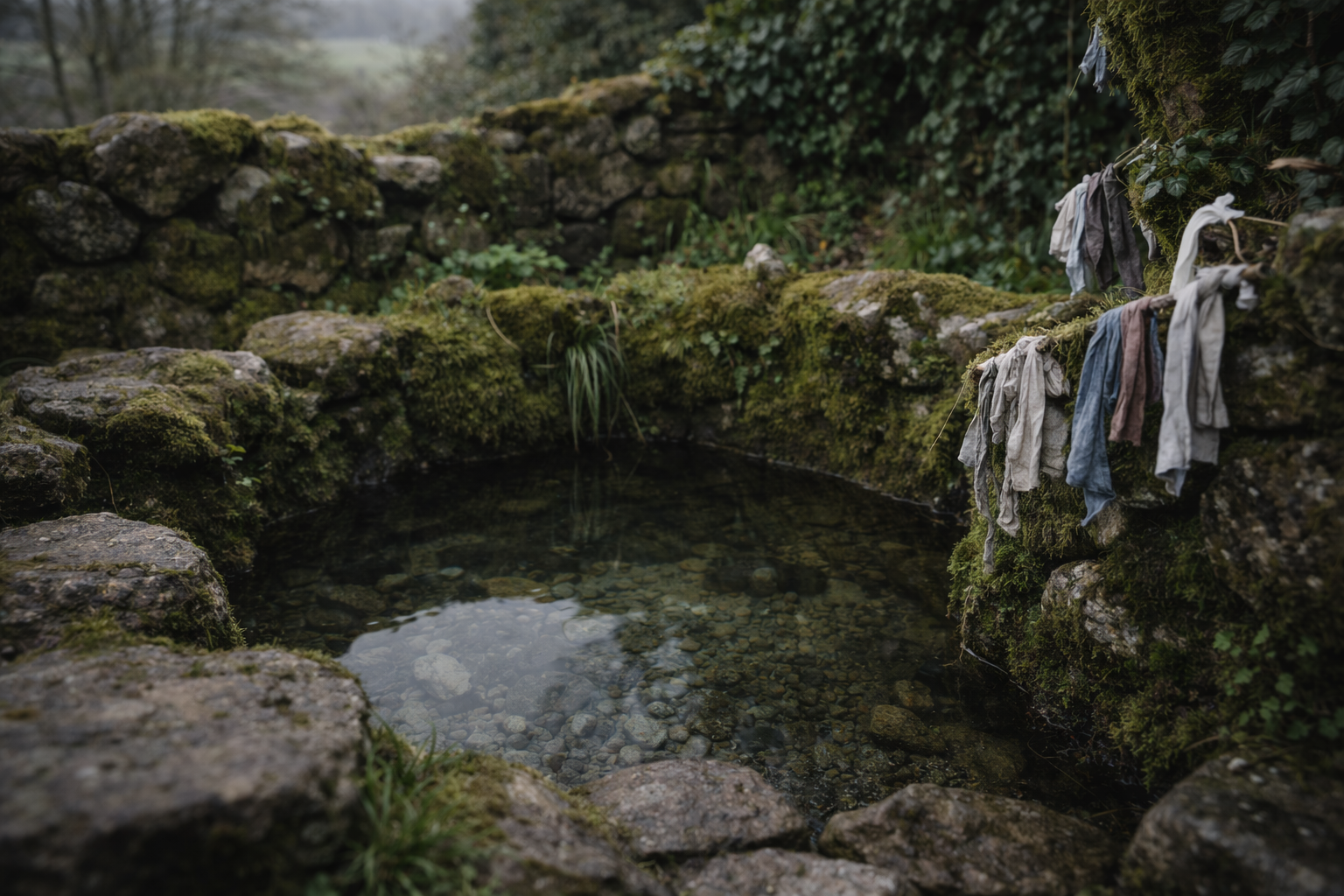
Brigid’s name is strongly associated with holy wells across Ireland and the broader Gaelic world—sites where prayer, pattern-walking, offerings of cloth, and requests for healing or protection became culturally embedded.
From an archive standpoint, the key point is this:
Wells are sacred sites with long memory.
Brigid becomes one of their most persistent names.
But the evidence usually demonstrates continuity of sacred place, not a neat, documentable line from pre-Christian Brigid worship to Christian-era well devotion.
It is still meaningful—just methodologically different.
(We treat wells as folk and Christian-era practice with possible older roots, not as guaranteed pagan survivals.)
Ancient Irish holy well in nature
4) Kildare’s Flame as Cultural Anchor
The Kildare tradition functions like a fixed nail in the timeline: later medieval accounts describe nineteen nuns tending a perpetual fire, with Brigid symbolically guarding it on the twentieth night.
Whatever its relationship to pre-Christian ritual fire traditions, by the medieval period this flame becomes a recognized Brigid-centered practice within Christian Ireland—powerful evidence of how Brigid’s imagery (fire, protection, continuity) persists through sanctity.
5) What Folklore Reveals About Brigid’s “Type”
Across these practices—calendar rites, woven crosses, wells, flame—the same shape repeats:
Threshold timing (Imbolc / early spring)
Household protection (craft objects hung in lived spaces)
Place devotion (wells, sacred sites, local continuity)
Sustaining forces (fire, healing, blessing, survival)
This is why Brigid cannot be treated as “minor” because she lacks epic dominance.
Her survival is infrastructural.
She lives where people actually live.
Modern Reconstruction and Revival
Where Brigid becomes more systematized than the early record—and why naming the layer matters.
In the modern era, Brigid returns with unusual force—not because new ancient texts were discovered, but because modern readers and practitioners want a Brigid who is whole.
That desire is understandable. The early record is fragmented. The saint tradition is expansive. Folklore is rich but methodologically slippery. Modern reconstruction often steps in to stitch the layers into something coherent enough to live with.
This is where the archive must keep its lantern steady.
Modern Brigid commonly appears in three overlapping forms:
1) Brigid as Reconstructed Goddess
Reconstructionist approaches tend to build from:
early Irish textual mentions (genealogies and brief mythic references),
medieval glossarial material on her domains,
parallels to Brigantia as a cognate “High One” goddess attested epigraphically in Britain,
and folk survivals (crosses, wells, seasonal rites).
This tends to produce a Brigid framed as a deity of poetry / smithcraft / healing—sometimes triplicate, sometimes unified.
2) Brigid as Saint-with-Older-Contours
Many modern treatments emphasize continuity through Saint Brigid and Kildare traditions (especially fire and hospitality), reading the saint as either a Christianized overlay of a goddess, or as a later vessel that carried older memory forward. Scholarly work here is cautious: it tends to treat “pagan survival” as possible, not automatic.
3) Brigid as Contemporary Symbol
Brigid is increasingly invoked as a figure of:
women’s authority,
cultural renewal,
national memory,
and seasonal return.
This is not “wrong.” It is simply modern meaning-making—and it should be labeled as such, rather than back-projected into the early medieval record.
Modern devotion and modern reconstruction are valid layers—but they are not primary evidence.
Scholarly Debates
Where the evidence frays, scholars argue—and the argument is the point.
Brigid studies are defined less by a single unanswered question and more by a cluster of them:
1) Brigid and Brigantia: Same deity, or related names?
Brigantia is materially attested in Roman Britain through dedications and inscriptions (a firmer evidentiary footing than we have for many Irish deities).
The debate is whether Irish Brigid and British Brigantia are:
regional expressions of one divine figure,
related figures sharing a name-root,
or later scholarly linkage driven by linguistic similarity.
The archive’s position: linguistic kinship is strong; full identity is not provable.
2) Triplicity: Theology, classification, or scribal ordering?
The “three Brigids” pattern (poetry / healing / smithcraft) is frequently cited as evidence of a triple goddess structure—but triads are also a common Celtic literary and classificatory habit.
Scholars debate whether this reflects:
an actual theological multiplicity,
a way of organizing overlapping domains,
or later medieval systematizing impulses.
3) Goddess and Saint: absorption, overlay, or braided continuity?
This is the most famous dispute, and the easiest to flatten.
Was the saint constructed to replace an older goddess?
Or did later folklore “re-paganize” the saint?
Or do both processes occur at once, over centuries?
Serious scholarship tends to resist the clean headline (“goddess becomes saint”) in favor of more careful models of cultural negotiation and syncretic memory.
4) How “pagan” are the folk survivals?
Imbolc / St Brigid’s Day customs, cross-weaving traditions, and well practices are historically real and culturally significant—but the debate is what proportion of these practices can be credibly traced to pre-Christian religion versus medieval and early modern Christian folk religion.
Spring's first touch on frost-kissed earth
Continuity Through Transformation
If Brigid were judged only by the volume of myth preserved in early Irish literature, she might appear secondary.
But preservation is not always loud.
Unlike figures sustained through epic narrative cycles, Brigid survives through adaptation.
Her name carries linguistic elevation across Celtic territories.
Her early textual presence situates her within the Túatha Dé Danann.
Her domains align with cultural infrastructure — poetry, craft, lamentation.
Her later sanctified form as Saint Brigid of Kildare anchors her to site, flame, and seasonal rite.
Her folk survival embeds her in homes, wells, woven crosses, and the turning of February.
Where Odin’s survival is literary and aristocratic, Brigid’s is domestic and calendrical.
Where his presence looms in cosmic narrative, hers persists in repetition.
This distinction matters.
Brigid is not easily reconstructed because she was never preserved in a single, centralized theological system. She is preserved in:
scattered manuscript references,
monastic redaction,
hagiographic layering,
folk continuity,
and modern reinterpretation.
Each layer adds, reshapes, reframes.
Responsible study does not collapse these layers into a single claim.
It does not declare the saint identical to the goddess.
It does not deny continuity outright.
It does not treat folklore as proof of unchanged pagan ritual.
Instead, it recognizes a braided survival.
Brigid endures because she adapts.
She moves from mythic genealogy to sanctified abbess.
From lamentation in battle narrative to blessing at the hearth.
From exalted name-root to woven cross above a doorway.
Her continuity is not linear.
It is cyclical — like the season most associated with her.
And perhaps that is the most fitting lens through which to understand her:
Not as a frozen relic of a pre-Christian past,
but as a figure who persists precisely because she can inhabit multiple worlds at once.
If this exploration deepened your understanding of Brigid, continue into our archive — or tell me which strand of her braided survival resonates most with you. I read every reflection.
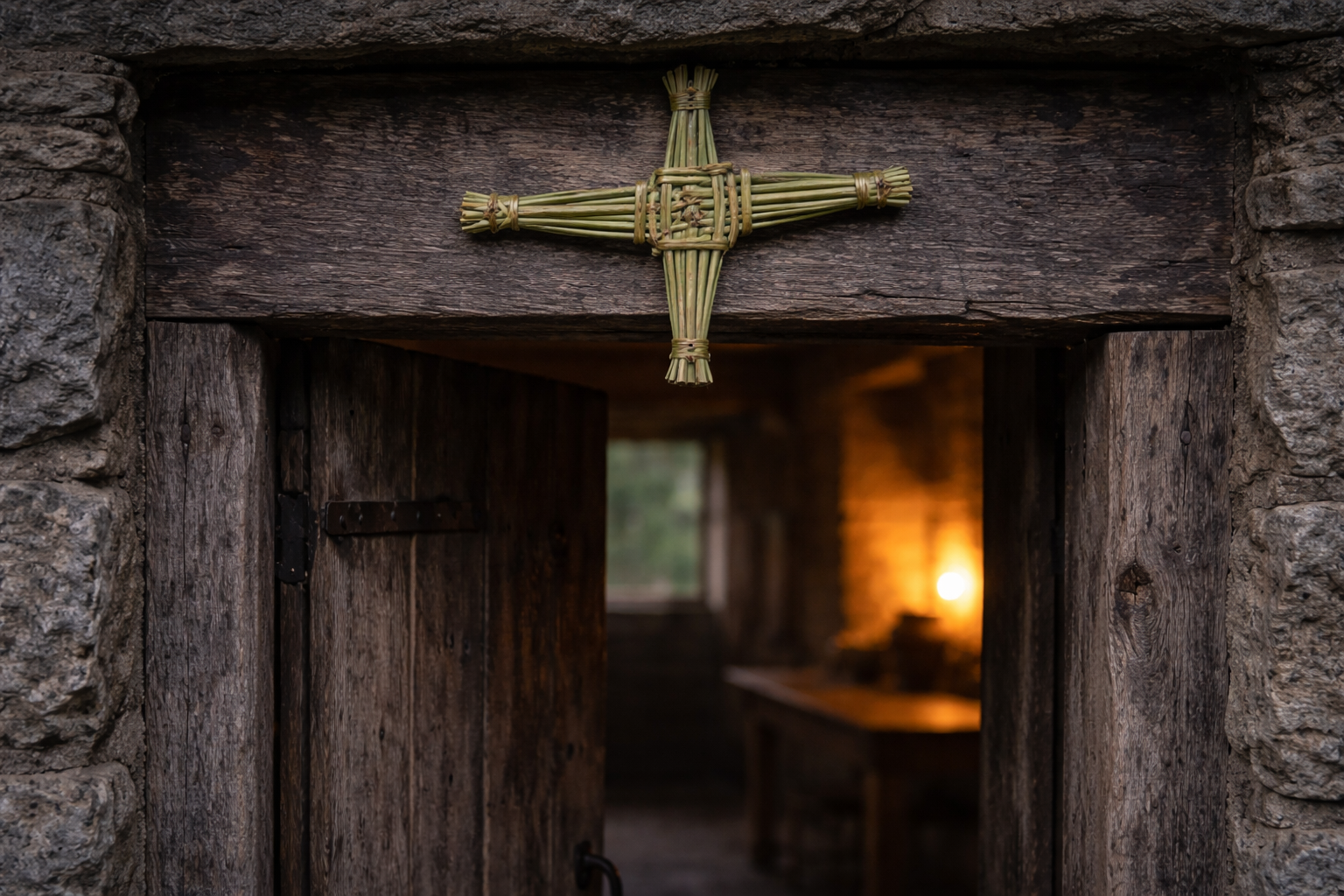
Brigid's cross above weathered doorway
Works Consulted
Primary Sources
Cogitosus. Vita Sanctae Brigitae (Life of Saint Brigid). 7th century.
Lebor Gabála Érenn (The Book of the Taking of Ireland). Edited and translated by R. A. S. Macalister. Dublin: Irish Texts Society, 1938–1956.
Cath Maige Tuired (The Second Battle of Mag Tuired). Edited and translated by Elizabeth A. Gray. Irish Texts Society, 1982.
Medieval and Early Modern Sources
Gerald of Wales. Topographia Hibernica (Topography of Ireland). 12th century.
Ó hÓgáin, Dáithí. The Sacred Isle: Belief and Religion in Pre-Christian Ireland. Woodbridge: Boydell Press, 1999.
Archaeological and Epigraphic Evidence
Roman Inscriptions of Britain (RIB). Entries referencing Brigantia and Victoria Brigantia.
Green, Miranda. The Gods of the Celts. Gloucester: Sutton Publishing, 1986.
Modern Scholarship
Bitel, Lisa M. Landscape with Two Saints: How Genovefa of Paris and Brigit of Kildare Built Christianity in Barbarian Europe. Oxford: Oxford University Press, 2009.
Ó Catháin, Séamas. The Festival of Brigit: Celtic Goddess and Holy Woman. Dublin: DBA Publications, 1995.
Carey, John. Ireland and the Grail. Aberystwyth: Celtic Studies Publications, 2007. (For contextual mythological framing.)
Mac Cana, Proinsias. Celtic Mythology. London: Hamlyn, 1970.
Citations reflect surviving medieval manuscripts, epigraphic evidence, and modern scholarship. Interpretations distinguish between early textual record, saint tradition, folklore, and contemporary reconstruction.