Who Was John Dee?
John Dee (1527–1608/9) was a mathematician, navigator, book collector, and adviser to Elizabeth I who spent the last decades of his life trying to speak with angels. Both halves of that sentence are documented. The trouble is that four centuries of storytelling have piled on top of them: the spymaster signing his letters "007," the sorcerer behind Shakespeare's Prospero, the black mirror that showed him the future.
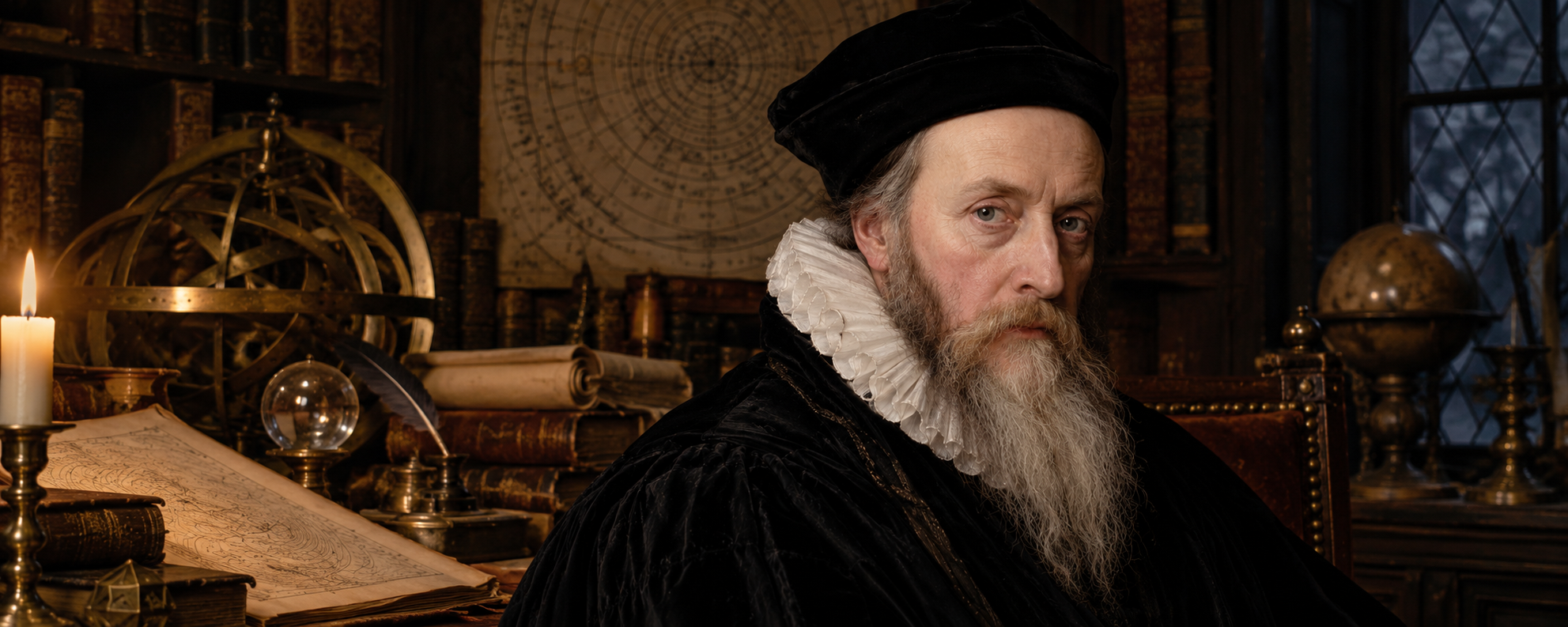
This entry sorts the record from the legend. Dee was stranger than most myths make him, and more interesting for being real.
In This Article
Early Life: A Mercer's Son at Cambridge
Courtier and Scholar: Elizabeth, Navigation, and Mortlake
The Hieroglyphic Monad and the Mathematical Preface
The Angelic Conversations
Wandering Europe, the 1587 Covenant, and a Quiet End
Myth vs. History
Legacy
Early Life: A Mercer's Son at Cambridge
Dee was born in London on 13 July 1527. His father, Rowland Dee, was a mercer (a cloth merchant) of Welsh descent who held a minor post at the court of Henry VIII. That Welsh ancestry mattered to Dee all his life; he later claimed descent from the princes of Wales and wove British origin myths into his political writing.
He entered St John's College, Cambridge, around 1542, took his BA in 1545, and became one of the founding fellows of Trinity College in 1546. There he staged a production of Aristophanes' Peace featuring a mechanical beetle that flew up toward the heavens. The audience was impressed. Some were unsettled. Dee would later complain that the stunt earned him his first reputation as a "conjuror," a label he spent decades trying to shake.
In the late 1540s he went to the Low Countries to study at Louvain (Leuven). He worked alongside Gemma Frisius, the great mathematician and instrument-maker, and formed a lasting friendship with the cartographer Gerard Mercator. In 1550 he lectured on Euclid in Paris to crowds large enough that, by his own account, people climbed to the windows to hear. Some of that is Dee's self-reporting, and he was not a modest narrator, but his continental reputation as a mathematician is well attested.
Courtier and Scholar: Elizabeth, Navigation, and Mortlake
Dee's proximity to power began dangerously. In 1555, under Mary I, he was arrested on charges of "calculating" — casting horoscopes — for the queen and for Princess Elizabeth, a charge that edged close to treason. He was cleared, then held for religious examination under Bishop Edmund Bonner, and released.
When Elizabeth took the throne, Dee's fortunes turned. He is traditionally credited with selecting an astrologically favorable date for her coronation, 15 January 1559. Over the following decades he advised the Crown on navigation, cosmography, and the legal basis for English claims to lands overseas. He tutored navigators connected to the Muscovy Company and the voyages of Martin Frobisher and Humphrey Gilbert.
In General and Rare Memorials pertayning to the Perfect Arte of Navigation (1577), Dee argued for a permanent royal navy and used the phrase "Brytish Impire." He is often called the man who coined "British Empire." That is roughly fair, with a caveat: he meant a maritime and legal claim rooted in Arthurian legend, not the empire of later centuries.
The Library at Mortlake
Dee's house at Mortlake, on the Thames west of London, held what was likely the largest private library in England: an estimated 3,000 to 4,000 printed books and manuscripts. It covered mathematics, astronomy, medicine, history, alchemy, and magic. Scholars visited to consult it. Elizabeth herself called at the house.
The library is one of Dee's most concrete legacies. His own catalog of 1583 survives, and books bearing his handwritten annotations are still being identified in collections today.
The Hieroglyphic Monad and the Mathematical Preface
Two published works show Dee's mind at its most characteristic: one turned inward toward the hidden structure of the cosmos, the other outward toward practical craft.
Monas Hieroglyphica (Antwerp, 1564) presents a single glyph — a combination of the symbols for the Moon, Sun, the elements, and Aries — that Dee claimed encoded the unity of all things. He dedicated it to the Holy Roman Emperor Maximilian II. The text is dense, deliberately cryptic, and still argued over. Readers have taken it as alchemy, Kabbalah, geometry, or all three. The glyph itself has had a long afterlife; it appears on the title page of the 1616 Rosicrucian Chymical Wedding of Christian Rosenkreutz.
The "Mathematicall Praeface" (1570), written for Henry Billingsley's first English translation of Euclid, is the opposite in tone. It surveys the mathematical arts and their uses — architecture, navigation, mechanics, music, perspective — and argues that ordinary craftsmen deserve access to them in their own language. Historians of science often rank it as his most influential writing.
It is tempting to split Dee into a rational scientist and an occult crank. He would not have recognized the division. For Dee, number was the language in which God had written creation, and studying it was a devotional act.
The Angelic Conversations
By the early 1580s Dee had concluded that books and mathematics could take him only so far. If he wanted true knowledge of creation, he would have to ask its authors. He began working with "scryers" — mediums who gazed into a crystal or polished stone and reported what they saw and heard.
The first, Barnabas Saul, did not last. In March 1582 a young man calling himself Edward Talbot arrived at Mortlake. He soon became known by his real name, Edward Kelley, and over the next seven years he and Dee conducted hundreds of recorded sessions. Kelley looked into the stone; Dee asked the questions and wrote everything down.
Those records are the heart of the matter. Dee's manuscript diaries, largely preserved in the British Library, describe angels with names such as Uriel, Michael, and Madimi — the last appearing as a small girl. The spirits dictated tables of letters, instructions for ritual furniture, and the Sigillum Dei Aemeth (Seal of God's Truth), a wax disc inscribed with names and figures. Examples of Dee's wax seals survive in the British Museum.
They also delivered a language. Dee called it "Angelical" or the language of Adam; later occultists named it Enochian. It has its own alphabet and a consistent grammar in the "Calls" or "Keys" Kelley received. Whether it is a revelation, a constructed language Kelley invented, or something in between is not something the documents can settle.
What the documents can tell us is Dee's sincerity. He was a devout Christian who believed he was receiving divine knowledge to heal religious division and prepare for the end times. Kelley's motives are harder to read. He had a reputation as a forger and a con man before he met Dee, and modern historians remain divided on whether he was a fraud, a believer, or both by turns.
Wandering Europe, the 1587 Covenant, and a Quiet End
In 1583 Dee, Kelley, and their families left England in the company of Albert Łaski, a Polish nobleman who had visited Mortlake and taken an interest in the sessions. They spent the next six years moving through Poland and Bohemia, seeking patrons. Dee secured an audience with Emperor Rudolf II in Prague in 1584 and tried to win over King Stephen Báthory of Poland. Neither became the champion he hoped for. The group eventually settled at Třeboň under the protection of the Bohemian magnate Vilém Rožmberk.
In April 1587 the angels, as relayed by Kelley, instructed the two men to share everything they had — including their wives. Dee was horrified, and so, by his account, was his wife Jane. After much distress, the four signed a covenant, and the diaries indicate it was carried out at least once. The partnership did not survive long afterward. Kelley stayed in Bohemia, briefly prospered as an alchemist at Rudolf's court, and died in imprisonment around 1597.
Dee returned to England in 1589 to find Mortlake looted. Many books and instruments were gone, some taken by people he had trusted with the house. Elizabeth eventually appointed him Warden of Christ's College in Manchester in 1595, a post he found difficult and unrewarding. Jane died of plague in 1605.
Under James I, who had written against witchcraft, Dee found no favor. He returned to Mortlake, sold books to survive, and continued scrying with a new medium, Bartholomew Hickman. He died there in poverty, cared for by his daughter Katherine, in late 1608 or early 1609; records disagree on the exact date.
Myth vs. History
Most popular claims about Dee fall somewhere between documented fact and later invention. Here is where the best-known ones land.
-
This is a: Legend.
No surviving letter uses "007." The claim traces largely to Richard Deacon's 1968 biography, which historians treat as unreliable. Dee did gather intelligence informally while abroad, as many travelers did.
-
This is a: Documented Tradition.
Widely reported from early sources and consistent with his role at court, though no surviving horoscope proves the specific calculation.
-
This is a: Tradition (partly supported).
The polished obsidian mirror is Aztec in origin, likely brought to Europe after the Spanish conquest. Its link to Dee comes through Horace Walpole's 18th-century collection; there is no contemporary record of Dee owning it.
-
This is: Largely True
He used "Brytish Impire" in 1577 and argued for English maritime claims, though in a sense far from the later empire.
-
This is: Speculation
A popular and plausible reading, but there is no direct evidence Shakespeare modelled the character on him.
-
This is an: Interpretation
The language is first recorded in Dee's diaries in the 1580s, received through Kelley. Its origin beyond that is a matter of belief.
Dee's own life story is not much help here. He was a careful record-keeper but also an advocate for himself, and his autobiographical Compendious Rehearsal (1592) was written to win back royal support.
Legacy
Dee's reputation was largely shaped by someone who wanted to ruin it. In 1659 the scholar Meric Casaubon published a large portion of the angel diaries as A True & Faithful Relation of What Passed for Many Yeers Between Dr. John Dee… and Some Spirits. Casaubon meant it as a warning about demonic deception. Instead, he preserved the material and handed it to every occultist who came after.
The Hermetic Order of the Golden Dawn incorporated Enochian into its system in the late 19th century, and Aleister Crowley carried it further in the early 20th. Most modern Enochian practice descends from those adaptations rather than directly from Dee's manuscripts, which is worth keeping in mind when reading contemporary sources.
Meanwhile, historians of science have spent the last fifty years recovering Dee the mathematician and bibliophile. In 2016 the Royal College of Physicians in London, which holds over a hundred books from his library, mounted the exhibition Scholar, Courtier, Magician: The Lost Library of John Dee. The title is a fair summary. He was all three, and he did not think of them as separate.
Related Reading
The Monas Hieroglyphica
Scrying and the Shew-Stone
Primary Source
Related Historical Topic
The Golden Dawn and the Victorian Occult Revival
Questions Worth Investigating
Did Edward Kelley believe in the angels he reported, and does the answer change how we read Enochian?
How much of Dee's library can still be traced today, and where did the stolen books end up?
Why did a mathematician as rigorous as Dee turn to scrying, and what does that tell us about how Renaissance thinkers understood knowledge?