Samhain: The Ancient Feast of Death, Memory, and the Thinning Veil
Imagine a night that does not simply fall — it descends. A night that carries weight, that smells of woodsmoke and rot and cold earth, that makes the cattle low uneasily in their pens and sends children pressing close to the fire. Imagine a night when the world as you know it becomes unreliable, when the border between what is seen and what is unseen grows as thin as gossamer, as permeable as breath. This was Samhain. This is still Samhain, if you know how to listen.
Long before the carved pumpkins and the candy-bright costumes, long before the name "Halloween" ever settled into the English tongue, there existed a festival so old it pre-dates the written history of the peoples who kept it. Its fires lit the hilltops of ancient Ireland, Scotland, and Britain sometime around 2,000 years ago — perhaps longer. Its name, rooted in Old Irish, means simply summer's end. But what ended at Samhain was more than a season.
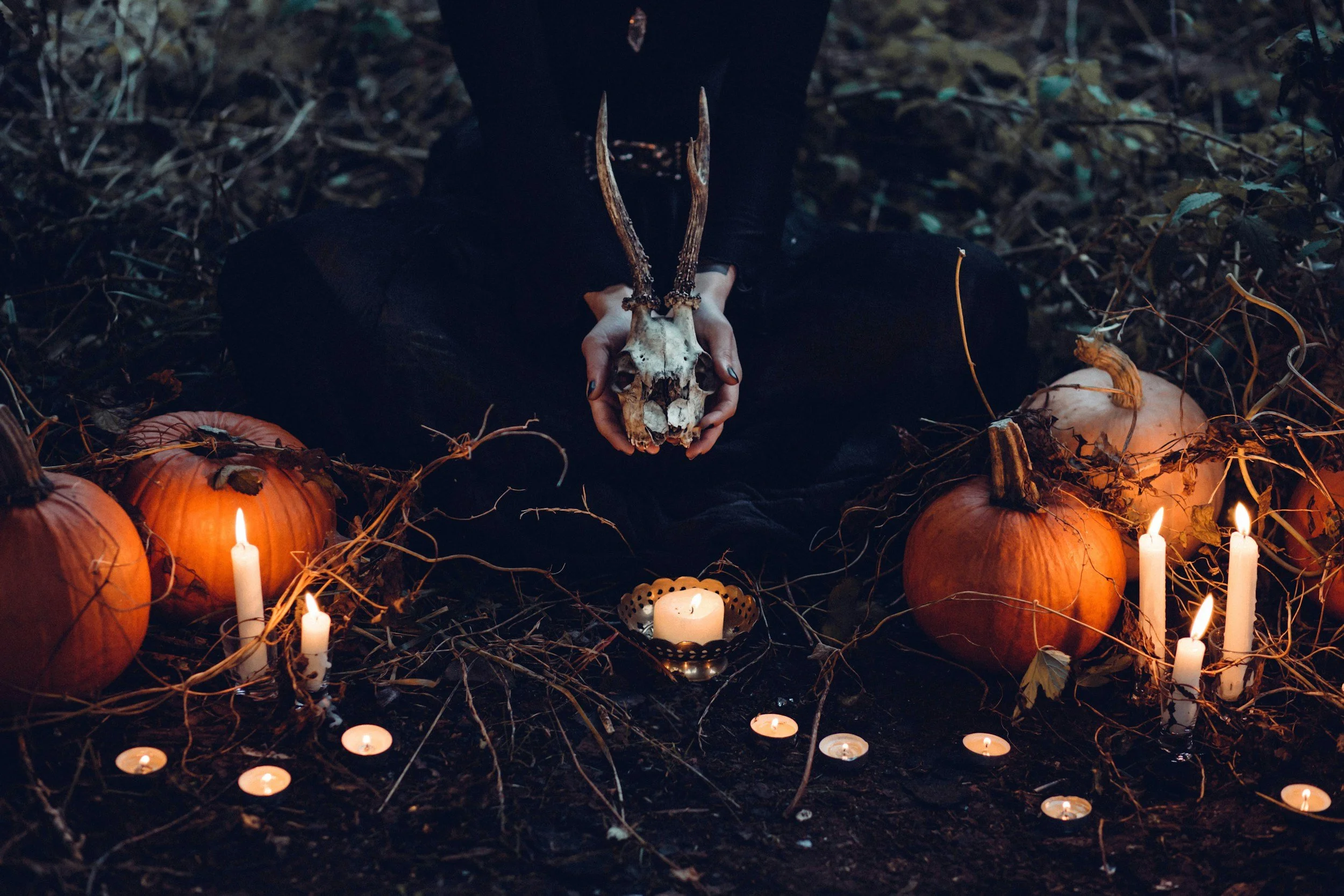
The Turn of the Year
The Celts did not divide their year the way we do. They did not place the great threshold of time on the first of January, in the dead of a winter already past its darkest point. For them, the year pivoted twice: at Beltane in May, when the world bloomed back into warmth, and at Samhain, the final day of October and the first days of November, when it retreated again into shadow.
Samhain was one of four great fire festivals — the others being Imbolc, Beltane, and Lughnasadh — that marked the turning of the Celtic wheel. But Samhain stood apart. It was the hinge of the year, the moment when the calendar folded back on itself. Not a beginning and not an end, but something stranger: the crack between.
Celtic cosmology did not imagine time as a clean, forward-moving line. Time was cyclical, layered, sometimes doubling back on itself. At Samhain, this layering became literal. The Otherworld — the realm of gods, spirits, and the dead, known in Irish mythology as Tír na nÓg or the realm beneath the hills — drew close to the land of the living. The membrane between them grew thin enough to pass through, in both directions.
"At Samhain, the living and the dead were not divided by an unbridgeable gulf — only a curtain of smoke, a flicker of firelight, a held breath."
This was not a metaphor. For the ancient Celts, the spirits of the dead were not consigned to some distant afterlife beyond reach. They lingered. They returned. And at Samhain, more than at any other time, they walked among the living — welcomed back, appeased, and sometimes feared.
Fire on the Dark Hills
The bonfires came first. Always the bonfires. On the eve of Samhain, every hearth fire in the community was extinguished — the kitchens gone cold, the forge dark, the warmth of ordinary life deliberately snuffed out. Then, on a high hilltop, the druids kindled a sacred flame. From this single source, each family would carry an ember home to relight their hearth. The community, for one night, breathed as one breath.
These fires were not merely symbolic. They were functional magic. Smoke was purifying. Fire was protective. The jumping of the flames — a practice that survived well into medieval and even early modern times — was not mere theatrics. It was a ritual act, a passage through the purifying element, a way of arming yourself against whatever walked in the dark beyond the firelight's reach.
Picture it: a hilltop in ancient Connacht, the sky above dense with cloud. Below, a valley full of settlements, all dark now — every fire extinguished. Then a spark catches at the summit, and the first tongue of flame rises against the black sky. People begin to move toward it, from all directions, carrying cold torches and unlit brands. The hill fills with light and shadow, faces orange-lit and dark-eyed. The fire roars. Someone strikes a drum. A child, too young to understand but old enough to feel the weight of the night, grips her mother's hand and does not look toward the edge of the firelight. Something is there. Something always is.
Cattle were driven between two bonfires — a practice recorded in early Irish annals — to protect them from disease and malevolent spirits in the coming cold months. The bones of slaughtered animals were cast into the flames. Indeed, some scholars suggest the very word "bonfire" derives from bone-fire, a blaze of bones, though this etymology is debated. What is not debated is that Samhain was a time of slaughter: the livestock that could not be kept through winter were killed and preserved. Death, practical and sacred, was everywhere in the air.
The Return of the Dead
Central to Samhain's power was the belief that the dead came home. Not all the dead, perhaps, and not only the benevolent ones — but the ancestors, the beloved, the recently departed, they were thought to walk back through the thinned veil and gather at the hearths they had known in life.
To welcome them, places were set at the table. Doors were left unlocked. Food — the best food, whatever the household could spare — was laid out as an offering: bread still warm from the oven, a cup of ale, perhaps a portion of meat from the Samhain feast. The dead were hungry, and the living fed them, because kindness to the dead was protection for the living.
Not all the spirits who walked at Samhain were ancestors. The sídhe — the fairy mounds, the supernatural beings of Irish myth — were also abroad. The Aos Sí, sometimes translated as the people of the mounds or the fairy folk, were more dangerous than quaint. They were powerful, capricious, and easily offended. Offerings were left at their mounds too, and people traveled carefully on Samhain night, staying close to fire and community, avoiding certain crossroads and hilltops and old stone places.
"The dead did not vanish into nothing. They watched. They waited. And at Samhain, they were close enough to touch."
This dual nature of Samhain's spirits — beloved ancestors and genuinely threatening otherworldly beings — is part of what gave the festival its particular texture of mingled tenderness and terror. You welcomed the dead because you loved them and because you feared what anger or neglect might cost you. Love and fear, grief and appeasement, were braided together in a single night of firelight and held breath.
Disguise, Divination, and the Edge of Knowing
If the spirits walked among the living, then the wise thing was not to be recognized. This is one compelling explanation for the ancient practice of disguise that threads itself through Samhain's history and eventually becomes the Halloween costume: by dressing as something monstrous, something inhuman, you might pass unnoticed among the supernatural beings who wandered the night. You became, for a few hours, something neither here nor there, neither living nor dead — and therefore invisible to both.
There are records, too, of people going door to door — an early form of what we might recognize as trick-or-treating — sometimes in disguise, sometimes representing the souls of the dead. Offerings were given to keep misfortune at bay. The line between hospitality and appeasement was always thin.
Divination was perhaps the most intimate ritual of Samhain. Because the veil was thin, the future was knowable — barely, flickeringly, the way a reflection shifts in moving water. Nuts were cast into fires, and the way they cracked and burned told something about the year ahead. Apple peeling was done by candlelight, the long curl of skin thrown over the shoulder to reveal the initial of a future spouse. Blindfolded young people chose between bowls — one holding clean water, one holding soiled — and in the choosing, learned whether their coming year held life or death.
A young woman sits alone at midnight at the edge of a well, holding a candle in one hand and a mirror in the other. She has been told that if she looks into the mirror by candlelight at Samhain, she will see the face of the man she will marry. She raises the mirror. For a moment there is only her own face, pale and wavering. Then she closes her eyes. She is not sure she wants to see. This is always the condition of divination: the terror of knowing.
Samhain, in this way, was the festival of the edge. The edge of the year, the edge between worlds, the edge of what could be known. It held within it not just the past — the honored dead, the old seasons — but the future too. Standing at the threshold, you faced both directions at once.
Tlachtga and the Sacred Fires of Myth
In Irish mythology, Samhain's fires had a specific sacred origin: the Hill of Tlachtga in County Meath, where the great Samhain fire was kindled each year. Tlachtga herself was a goddess — or perhaps a druidess, the daughter of the great druid Mog Ruith — whose story is dark and tragic, woven through with themes of violation, sacrifice, and sacred power. Her namesake hill became the place where the ritual fires began.
Not far away stood the Hill of Tara, seat of the High Kings of Ireland. On Samhain, no fire in all of Ireland was supposed to burn until the fire at Tlachtga had been lit. The king's fire at Tara was kindled from Tlachtga's flame. The hierarchy of fire was the hierarchy of power and the sacred bound together — the ritual dictating the political, the mythological underpinning the real.
This landscape — hills visible to one another across the dark plain of the Boyne Valley — would have been electric with firelight on Samhain night. A system of beacons, a network of flame, passing light from sacred site to sacred site across the dark land. The whole country, for one night, mapped in fire.
✦ ✦ ✦
The great tales of Irish mythology cluster around Samhain with peculiar intensity. It is at Samhain that the monstrous Fomorians descend upon the gods. It is at Samhain that the hero Cú Chulainn receives supernatural visitors and endures his great trials. It is at Samhain that the sídhe are opened and the gods walk out into the world. The festival was not merely a human observance — the cosmos itself oriented around it, stories accumulating at the hinge of the year like leaves in a corner.
The Church, the Calendar, and the Long Survival
When Christianity spread through the Celtic world — through Ireland in the fifth century, through Scotland and Britain in the centuries following — it encountered Samhain not with immediate conquest but with the slower, more complicated process of absorption. The Church was, in practice, often pragmatic: ancient festivals with deep roots in community life could not simply be abolished. They could, however, be redirected.
Pope Gregory III moved the feast of All Saints from May to November 1st in the eighth century — whether in direct response to Celtic practice is debated by historians, but the proximity is impossible to ignore. All Hallows' Eve — the evening before All Saints' Day — fell on October 31st. The word "Halloween" is simply a contraction of this: Hallows' Even, or Hallow E'en in the Scottish form.
November 2nd became All Souls' Day, a day of prayer for the souls of the dead — once again, the Church folding itself over an existing wound in the calendar, the ancient human need to acknowledge and propitiate the departed. The dead refused to leave the late October calendar, no matter what name was placed above them.
The practices survived too, if in altered form. Souling — going door to door to pray for the dead in exchange for "soul cakes" — continued into the early modern period in Britain and Ireland. Guising, the tradition of dressing in disguise and going out on Halloween night, persisted in Scotland and Ireland long after the theological rationale for it had been forgotten. The bones of the old ritual continued to move beneath the Christian flesh laid over them.
Immigration, Commerce, and the Making of Halloween
The Halloween that much of the modern world knows — the American Halloween, the one exported globally through cinema and commerce — was substantially made by Irish and Scottish immigrants arriving in the United States in the nineteenth century, particularly during and after the catastrophic Irish famine of the 1840s. They brought their October customs with them: the bonfires, the guising, the turnip lanterns. In America, the pumpkin — more abundant, more dramatic — replaced the turnip, and the jack-o'-lantern was born.
The twentieth century commercialized Halloween at scale. Costumes moved from homemade to mass-produced; candy replaced home-baked soul cakes; the holiday expanded from a single evening into a month-long retail event. Samhain, which had survived druids and missionaries and the Reformation, encountered something perhaps stranger than any of them: consumer capitalism, which absorbed it entirely and made it profitable.
And yet. Beneath the plastic skeletons and the film franchises and the candy aisle, the old pulse still beats. People still gather. Fires still burn, in fire pits and on beaches and in backyards. The dead are still remembered, sometimes consciously — in the Día de los Muertos altars of Mexican tradition, in the grave-tending of Celtic revival practitioners — and sometimes not. The impulse to mark this particular moment in the year, this hinge of dark and cold, does not require theology to sustain it. It only requires being human.
Memory as the Living Practice
Contemporary neo-pagan and Celtic revivalist communities have, over the past century, worked to reconstruct and revive Samhain in a form closer to its ancient roots. The festival is observed in the Wiccan Wheel of the Year as one of the eight sabbats — and holds particular weight as the most sacred, the night when the veil between worlds is thinnest. Altars are built for ancestors. Photographs of the dead are placed at the table's center. Stories are told about those who have passed, their names spoken aloud in the belief that to be remembered is to remain, in some form, present.
There is something profound in this, something that transcends any particular belief system. The practice of setting aside time to remember the dead — to speak their names, to acknowledge their continuing presence in the shape of who we are — is not unique to any culture. But Samhain gives it a form: a specific night, a specific ritual, a specific fire. Not grief formless and uncontained, but grief given architecture.
"The dead do not ask to be mourned forever. They ask only to be remembered — a name spoken, a candle lit, a story told one more time in the dark."
This, perhaps, is Samhain's deepest gift: the permission to stop and turn toward the dead. Modern life moves with terrible velocity. The dead, if we let them, are swept out of sight by that velocity — archived, digitized, gradually de-realized until they become background noise. Samhain insists on a different relationship. It insists that the dead remain our neighbors, our responsibility, our community. That winter cannot begin until we have acknowledged them.
The Veil, Still Thin
Here is what is true about Samhain, stripped of mythology and belief, reduced to the irreducible: at the end of October, in the northern hemisphere, the light fails. The days contract. The cold arrives in earnest. The natural world makes its annual approach toward what looks, every year, like death — the trees bare, the ground hard, the sky the color of ash. Every human culture that has lived in these latitudes has had to reckon with this moment. Every one of them has developed rituals to survive it.
Samhain's genius was to insist that the dying of the year was not only loss. It was also a door. Through that door came the dead, yes — and the supernatural, and the uncanny, and all the things that comfort and unsettle in equal measure. But through that same door came something else: the memory of continuity. The knowledge that this has happened before, that winter has been survived before, that the people who stood at fires on these hilltops are part of the same story you are living right now.
You are not the first person to feel the October dark pressing close. You are not the first to feel the year turning against you, to stand at the edge of warmth and look out at the gathering cold and wonder what is out there. The people who lit the first Samhain fires felt it too. They lit the fire anyway. They set the table for the dead. They put on their strange disguises and went out into the dark, and they came home.
The veil, they said, is thin tonight.
Listen, and you might hear who is walking there, just beyond the firelight.