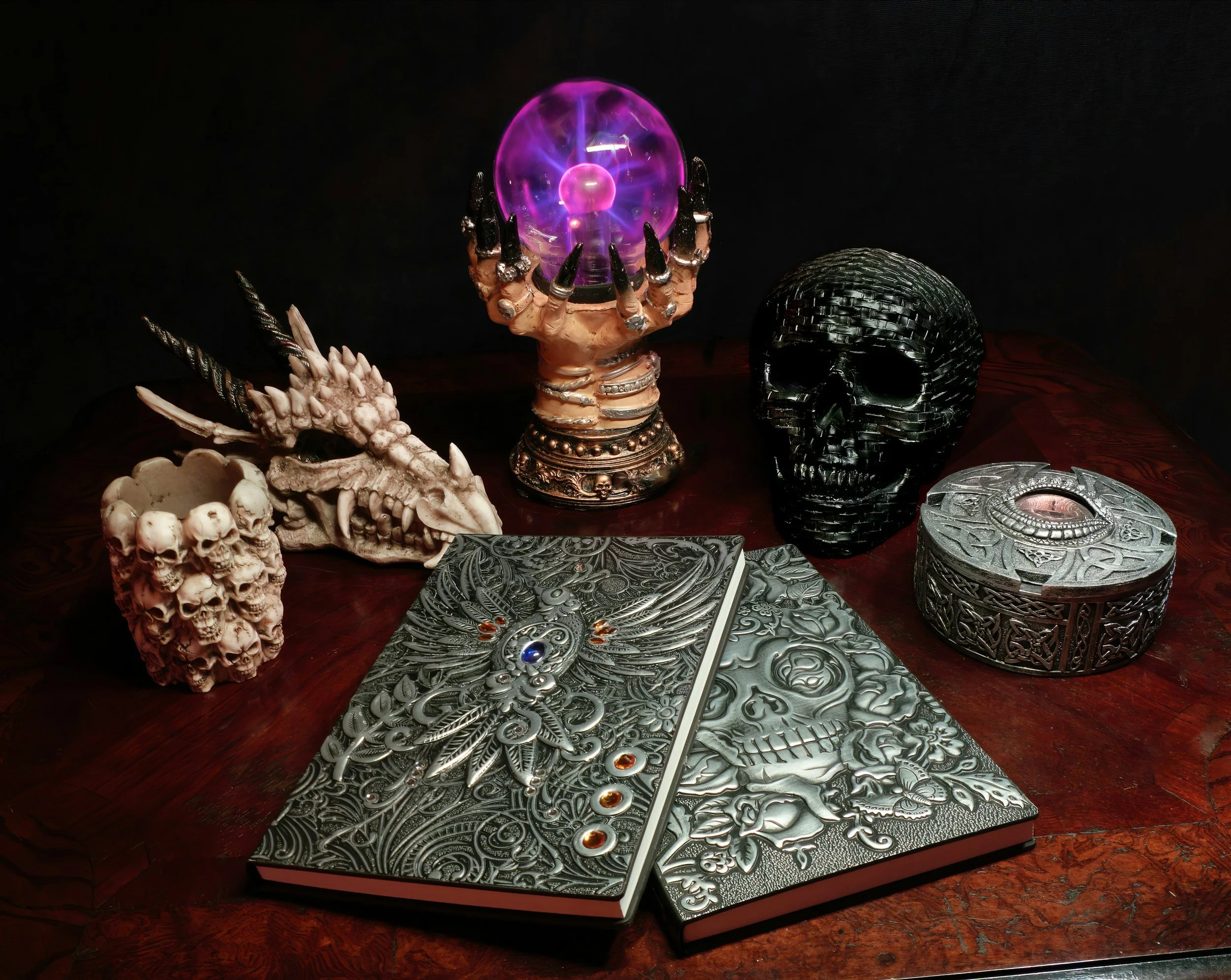
ALL TOOLS OF PRACTICE
Humans have always created objects to make the unknown feel navigable. A candle lit during grief. A bell rung to clear a room. A deck of cards shuffled while searching for answers. Across centuries and cultures, ordinary tools slowly transformed into ritual objects simply because enough hands repeated the gesture.
This section explores the folklore, symbolism, and cultural history surrounding divination tools, ritual objects, protective charms, candles, mirrors, pendulums, keys, lanterns, and ceremonial instruments. Some were sacred. Some practical. Most existed somewhere uncomfortably between the two.
🜂 A
Altar (history and construction of)
The altar is the oldest purpose-built ritual object in human history — a designated surface where the ordinary world meets whatever lies beyond it. Archaeological evidence of altar use predates written language by thousands of years. What constitutes an altar varies enormously: stone slabs in ancient temples, domestic hearths in Roman homes, flat rocks in the wilderness, elaborately dressed tables in Victorian occult lodges, and the windowsill arrangement of objects that means something only to the person who made it. The common thread is intention: the altar is not furniture. It is address.
full entry coming soon
Altar cloth
The fabric laid beneath ritual objects to define and consecrate the working space — not decoration but demarcation. Altar cloths appear in every tradition that uses a dedicated ritual surface: the liturgical cloths of Catholic and Anglican churches that change color with the liturgical calendar, the elaborate embroidered cloths of Vodou altars, the simple black or white cloth of a home practice space. Color, material, and embellishment all carry meaning specific to the tradition. What matters most is the act of laying the cloth: the gesture that says this surface is now different from every other surface in the room.
full entry coming soon
Anointing oils (ritual use)
Oil applied to the body, to objects, or to surfaces as a consecrating act — transferring intention, sanctity, or protective power through touch. Anointing is documented in ancient Egypt, Mesopotamia, Greece, Rome, and throughout the Hebrew Bible, where kings and priests were anointed to mark their consecration to their role. The word Messiah means "the anointed one." In folk magic traditions anointing a candle, a talisman, or a tool before use is the act of dedicating it — charging it with purpose before it is put to work. The oil carries the intention into the object.
full entry coming soon
Athame
The ritual knife of Wiccan and broader Western esoteric practice — double-edged, typically black-handled, used to direct energy, cast circles, and perform ceremonial functions rather than to cut anything physical. The athame's roots are traceable to the ceremonial daggers described in grimoires like the Key of Solomon, where specific knives made under specific astrological conditions were essential tools for ritual operations. The distinction between the athame (a tool of will and direction) and the bolline (a practical curved knife for actual cutting of herbs and cords) is consistently made in modern practice and frequently ignored by beginners who only bought one knife.
full entry coming soon
Automatic writing
The practice of writing without conscious direction — pen to paper, mind set aside, and whatever comes through allowed to arrive without editorial interference. Automatic writing was a central technique of 19th-century Spiritualism, used to receive communications from the dead. The Surrealists adopted it as a method for accessing the unconscious. Contemporary practitioners use it for journaling, divination, and channeling in various forms. Whether the source is spirits, the unconscious, or something else entirely has never been settled, but the technique reliably produces writing that surprises the person holding the pen.
full entry coming soon
🜃 B
Bell (ritual use)
The bell clears space, marks transitions, calls attention to the sacred, and has been used in religious and ritual contexts across virtually every culture that had the metallurgy to make one. Tibetan singing bowls, church bells, the bell rung at the elevation of the Host in Catholic Mass, the Japanese temple bell struck 108 times at New Year to dispel 108 human desires, the small bell on an altar rung to open and close a working — the same instrument, the same essential function: sound as a boundary marker between ordinary and sacred time. The bell says: this moment is different from the one before it.
full entry coming soon
Besom (ritual broom)
The broom's association with witchcraft is well-known and frequently misunderstood. The besom — the traditional bundle-and-handle broom — was used in folk magic primarily as a cleansing tool: sweeping negative energy out of a space, particularly before ritual work or after conflict, illness, or death. The sweeping was done without touching the floor in some traditions, making it a symbolic rather than practical cleaning. The flying broomstick image emerges from later demonological literature and is almost certainly not the origin. The original besom is a threshold guardian, a space-clearer, a tool of beginnings.
full entry coming soon
Black mirror (obsidian mirror)
A dark reflective surface used for scrying — seeing images, symbols, or visions in the depth of the reflection. John Dee's obsidian mirror, still held at the British Museum, was reportedly used by his scryer Edward Kelley to receive the Enochian angelic communications that occupied them both for years. Obsidian mirrors were also used in Aztec divination and associated with Tezcatlipoca, the smoking mirror god of darkness, conflict, and the night sky. A dark mirror shows you things a clear one cannot, which is either a feature or a warning depending on what you were hoping to find.
full entry coming soon
Book of Shadows
The personal ritual journal introduced into modern Wicca by Gerald Gardner in the mid-20th century — a handwritten record of spells, rituals, correspondences, observations, and accumulated practice kept by a witch or magical practitioner. The name implies secrecy, but the tradition of keeping a personal magical journal is considerably older than Wicca: grimoires, commonplace books of charms, and personal recipe books for household magic have been found dating back centuries. The Book of Shadows formalized the practice and gave it a name with the appropriate atmosphere. It is, at its most useful, a practitioner's working document rather than a finished text.
full entry coming soon
Bolline (white-handled knife)
The practical counterpart to the athame — a curved or straight knife with a white handle used in Wiccan and ceremonial practice for physical cutting: harvesting herbs, carving candles, cutting cord, inscribing wax. Where the athame directs energy and is never used for mundane cutting, the bolline does the actual work. The distinction matters because in esoteric practice the tool used for physical tasks acquires the associations of those tasks, and a knife used to cut cord during a binding ritual is a different instrument afterward than one used to trim candle wicks. Keeping the tools separate keeps their uses clear.
full entry coming soon
Bones (as divination tools)
Casting bones — throwing a collection of small bones, shells, stones, and other objects and reading the patterns of how they fall — is one of the oldest and most geographically widespread divination practices in the world. African divination traditions, particularly in South Africa (throwing the bones is central to Sangoma practice), use complex sets of bones each representing different forces, ancestors, and aspects of life. The I Ching's yarrow stalk casting and early Chinese oracle bone divination belong to the same broad category of casting objects and reading their configuration. The bones do not speak. The reader does. The bones provide the occasion.
full entry coming soon
🜄 C
Cauldron
The cauldron precedes its witchcraft associations by several thousand years. Celtic mythology gave us the Dagda's cauldron of plenty, Cerridwen's cauldron of inspiration, and the cauldron of rebirth in the Mabinogion — vessels of transformation, abundance, and the possibility of return from death. In ritual practice the cauldron represents the womb, the void, the place where things are broken down and reformed. The iron cauldron over a fire producing something unrecognizable from its ingredients is such a perfect metaphor for transformation that it was inevitable it would become a ritual object. The witchcraft association came later. The transformation was always the point.
full entry coming soon
Candle magic (overview)
Fire has been sacred since humans first controlled it, and the candle concentrates that sacredness into a portable, controllable, and symbolically rich object. Candle magic — the use of lit candles in ritual, petition, and spell work — appears in ancient Roman votive practice, Catholic devotional tradition, Hoodoo and rootwork, Wicca, and folk magic systems worldwide. The candle does several things at once: it creates light in darkness, it transforms solid matter into flame and air, it marks the passage of time, and it can be inscribed, anointed, dressed, and colored to carry specific intentions. Few tools are simultaneously this simple and this layered.
full entry coming soon
Candle colors (symbolism and use)
In candle magic tradition, color carries the intention before the flame is even lit. White for purification, protection, and all-purpose use when the right color is unavailable. Black for banishing, binding, and protection through the removal of harm. Red for passion, courage, and urgency. Green for abundance, growth, and healing. Blue for peace, communication, and truth. Yellow for clarity, intellect, and the sun. Purple for spiritual work, psychic development, and power. Pink for love of the gentler and more durable kind. Orange for attraction, opportunity, and change. The system is not universal — different traditions assign different meanings — but the core associations are remarkably consistent across Hoodoo, Wicca, and folk Catholic candle traditions.
full entry coming soon
Candle reading (ceromancy and capnomancy)
Reading the flame, the wax, and the smoke of a burning candle for omens and information — ceromancy (wax reading) and capnomancy (smoke reading) are among the oldest forms of divination still in active use. A flame that burns high and steady indicates clear path and strong energy. A flickering flame suggests interference or active spiritual attention. Black soot collecting on a glass-encased candle reads differently depending on where it accumulates. Wax drippings form shapes read like inkblots. The candle, in other words, is not only a tool of intention but also one of response — it can be asked a question and observed for an answer.
full entry coming soon
Candle shapes and forms
Beyond color, the physical form of a candle carries specific associations in folk magic traditions. Pillar candles for long workings requiring sustained energy. Taper candles for focused, directional intentions. Figure candles shaped like humans for workings directed at specific people. Skull candles for ancestor work and communication with the dead. Lovers' candles for relationship workings. Seven-day glass-encased candles for petitions requiring sustained attention across a week. Cat candles for luck. Double-action candles — red on one end, black on the other — for simultaneously attracting good and banishing harm. The candle aisle at a Botanica is a catalog of human need.
full entry coming soon
Casting circles
The ritual act of creating a sacred boundary in space — typically by walking a circle clockwise while directing energy through a tool or the hand, establishing a protected sphere for magical work. Circle casting appears in ancient Assyrian magical texts, in the Key of Solomon, in Wiccan practice, and in numerous folk traditions where a line drawn around a person or space provides protection. The logic is consistent: the circle creates a boundary between ordinary space and sacred space, between the practitioner and whatever lies outside, and between the intention being worked and the interference that might otherwise reach it.
full entry coming soon
Chalice
The ritual cup — for water, wine, or other sacred liquids — appears in ceremonial practice across traditions. The Holy Grail is the most famous chalice in Western mythology: the vessel of the Last Supper, the object of the Arthurian quest, the thing that heals the wounded king and restores the wasted land. In Wiccan practice the chalice represents water, the feminine, and the west. In ceremonial magic it is associated with Venus. The cup as receptive vessel — that which receives, holds, and offers — is among the most enduring sacred object concepts across world religion and ritual practice.
full entry coming soon
Charms (spoken and written)
A charm is a fixed verbal formula — words spoken or written in a specific sequence believed to produce a specific effect. Charms for healing, protection, love, the stopping of blood, the curing of burns, the warding of cattle — the surviving corpus of charm texts from medieval and early modern Europe runs to thousands of examples. Many blend Christian prayer with older formulaic structures, invoking saints alongside more ambiguous protective forces. The charm works through repetition, specificity, and the accumulated weight of use: words said the same way by the same tradition across generations acquire a kind of ritual authority that new words cannot purchase.
full entry coming soon
Crystal ball (scrying sphere)
The crystal or glass sphere used for scrying has been a symbol of mystical vision since at least the medieval period, though actual crystal balls were extraordinarily expensive before modern manufacturing and were therefore primarily the tools of professional diviners and wealthy practitioners. John Dee used a polished obsidian mirror rather than a sphere. Most historical "crystal balls" were actually polished rock crystal or, later, glass. What the ball provides is a surface that is simultaneously reflective and transparent, neither a clear window nor a true mirror — a threshold object, optically speaking, appropriate for seeing things that are neither fully there nor fully not.
full entry coming soon
Cord magic (knot spells)
Tying intentions into cords — nine knots on a cord while speaking a specific charm, each knot fixing one element of the working into place — is documented in ancient Assyrian curse tablets, Norse saga, Cornish folk magic, and contemporary Wiccan practice with the same basic structure across all of them. The cord holds what the knot fixes. The working is complete when the last knot is tied and sealed with breath or intent. Releasing the knots releases the spell — or, in binding magic, the knots are never released, and the cord is buried or kept hidden where it cannot be undone. The binding is only good as long as the knot holds.
full entry coming soon
🜁 D
Divination (history and theory of)
The systematic attempt to gain information about the unknown through structured interpretation of signs, objects, or patterns — one of the oldest documented human practices. Every civilization with written records practiced some form of divination and most practiced several. The underlying theory varies: some systems assume direct communication with gods or spirits; others assume that all events in the universe are connected and that reading one can reveal another; others function as structured reflection tools that work primarily through the reader's intuition regardless of any metaphysical mechanism. All three theories have been argued, and in practice most working diviners operate somewhere in the middle of all three without finding this problematic.
full entry coming soon
Dowsing rods
Two L-shaped rods held loosely in the hands, or a forked stick, used to locate water, buried objects, or subtle energies through the involuntary movement of the instrument responding to the holder's body. Dowsing for water has been practiced in Europe since at least the 15th century and remains in use today — occasionally by water companies who, when asked, tend to quietly admit they've tried it. Scientific testing has consistently failed to demonstrate that dowsing performs better than chance. Field practitioners maintain it works when the practitioner is skilled and the conditions are right. This disagreement has been ongoing for roughly five hundred years and shows no signs of resolution.
full entry coming soon
Dream journals
The practice of recording dreams upon waking — capturing what arrived in sleep before waking consciousness dissolves it — is among the oldest forms of written record. Ancient Egyptian dream temples produced dream incubation texts. The Talmud contains extensive discussion of dream interpretation. The Oneirocritica of Artemidorus, a 2nd-century CE dream interpretation manual, survived in continuous use through the medieval period. Carl Jung's extensive dream journals formed the basis of much of his psychological theory. The dream journal treats sleep not as unconsciousness but as information — a different kind of attention operating in a different register, worth taking seriously enough to write down.
full entry coming soon
Drum (ritual use)
The drum is the oldest musical instrument used in ritual contexts and the primary tool of shamanic practice across Siberia, Central Asia, and indigenous cultures worldwide. The shamanic drum represents the vehicle through which the practitioner travels between worlds — the drumbeat, typically at 4–7 beats per second, induces theta brainwave states associated with trance and vivid imagery. The drum skin was stretched over a frame often carved with cosmological symbols; the drum was understood as a living partner in the work. In West African and Afro-diasporic traditions the drum calls the spirits. It does not merely accompany ceremony. It is the mechanism by which ceremony works.
full entry coming soon
🜂 E
[no entries]
🜃 F
Feather (ritual and symbolic use)
Feathers connect the earthbound to the aerial — they are the part of the bird that carries it through a medium humans cannot enter. In Egyptian ritual the feather of Ma'at was the measure against which the heart of the dead was weighed. In Native American traditions specific feathers carry the power and characteristics of the bird they came from. In folk magic traditions feathers are used for cleansing (smudge fans), for directing energy, for writing magical texts, and as offerings. The quill pen as the tool of scribes and scholars carries a trace of this: the feather that communicates between worlds, used for the human work of putting words on paper.
full entry coming soon
Fire (as ritual tool)
Before fire was a metaphor it was a necessity, and the transition from necessity to ritual was probably immediate. Bonfires at Beltane and Samhain, the sacred flame of Vesta kept perpetually burning by the Vestal Virgins, the Zoroastrian atar tended in fire temples for over two millennia, the Hanukkah menorah, the Diwali lamp, the Yule log — fire as ritual object spans every tradition that has ever existed and continues in active use in all of them. The burning of petitions, the leaping of fires for purification and blessing, fire divination, candle-lighting as prayer — fire is the oldest ritual tool, and it works without being charged, consecrated, or instructed.
full entry coming soon
🜄 G
Grimoire (history of)
The word grimoire derives from the Old French grammaire — grammar, the mechanics of language — and a grimoire is exactly that: a textbook of magical operations, a grammar of the invisible. The great medieval grimoires — the Key of Solomon, the Lesser Key, the Munich Manual, the Grand Grimoire — compiled ritual instructions, spirit names, sigils, and conjurations for an educated European audience that treated magic as a learned discipline continuous with theology and philosophy. Most grimoires were not secret underground texts; they circulated among scholars, clergy, and the educated elite. What made them dangerous was not their existence but their use.
full entry coming soon
Grimoire, creating a personal
The personal grimoire differs from the Book of Shadows in emphasis: where the Book of Shadows is a journal of practice and experience, a grimoire is more prescriptive — a reference system for operations that have been tested and confirmed. Building one is an act of accumulation: recording what works, noting what the conditions were, building a personal correspondence system based on experience rather than received tradition. The grimoires that survived centuries did so because they were useful, copied, and corrected by practitioners who found they actually worked. A personal grimoire earns its authority the same way.
full entry coming soon
🜁 H
Herb bundles and smoke cleansing
The burning of bundled herbs to cleanse a space — clearing stagnant energy, marking a transition, or establishing sacred atmosphere — is documented in traditions worldwide. Sage bundles in Native American traditions, copal resin in Mesoamerican ceremony, frankincense in Catholic and Eastern Orthodox liturgy, juniper smoke in Tibetan ritual, rosemary burned in European folk practice for protection and memory — the specific plants differ, the underlying logic does not: smoke carries intention upward, moves through space in a way solid objects cannot, and marks the boundary between what was and what the practitioner is now establishing. The word "perfume" derives from per fumum: through smoke.
full entry coming soon
Holy water (ritual water, lustral water)
Water consecrated through prayer, intention, or ritual contact with sacred objects — used for blessing, protection, purification, and the warding of evil across traditions. Catholic holy water, collected from churches and used to bless homes and ward illness, is the most widely recognized Western form. But ritual water with protective and purifying properties appears in ancient Greek lustral basins at temple entrances, in Hindu ritual bathing in sacred rivers, in Shinto misogi purification, in Vodou ritual preparations, and in folk magic traditions where water left overnight under the full moon, or collected from a crossroads, or poured over a threshold carries specific charged properties.
full entry coming soon
🜂 I
I Ching (history and use)
The Chinese Book of Changes — one of the oldest continuously used divination systems in the world, with roots in Zhou dynasty oracle bone divination reaching back over three thousand years. The I Ching operates through 64 hexagrams, each composed of six stacked lines (broken or unbroken), generated by casting yarrow stalks or coins. Each hexagram carries a named condition and commentary accumulated across centuries of philosophical reflection. Carl Jung considered it a system for accessing synchronicity — meaningful coincidence — and introduced it to a Western audience in the 1950s. It has never gone away, which is a strong endorsement from a system that old.
full entry coming soon
Incense (ritual history of)
Burning aromatic substances to please gods, mark sacred space, carry prayers upward on smoke, repel evil, and alter the consciousness of participants — incense use is documented from ancient Egypt, Mesopotamia, India, China, Greece, and Rome through to every living religious tradition on earth. The word "incense" shares a root with "to set on fire" and also with "to incense" in the sense of arousing strong feeling — which may or may not be coincidental. Frankincense, myrrh, copal, sandalwood, benzoin, dragon's blood resin — each carries its own associations, its own history, and its own specific quality of smoke that anyone who has burned them can identify in the dark.
full entry coming soon
Ink (magical and ritual uses)
The substance that makes thought permanent — and in magical practice, intention permanent. Dragon's blood ink, dove's blood ink, bat's blood ink (none of them containing the substance their names imply; all of them resin-based formulas with long folk magic histories), dove's blood for love and reconciliation, bat's blood for binding and compulsion, dragon's blood for power and protection. Invisible inks made from plant juices, activated by heat or acid, were used in early modern magical practice for texts meant to be hidden. The grimoire tradition specifies inks for specific operations. Writing a spell in the correct ink is not decoration. It is part of the working.
full entry coming soon
🜃 J
Jar spells and container magic
Sealing ingredients — herbs, papers, small objects, liquids — inside a vessel to contain and concentrate an intention is one of the most widespread and practical techniques in folk magic. Honey jars to sweeten a person's feelings, vinegar jars to sour a situation or bind an enemy, money jars to attract prosperity, protection jars buried at the corners of a property — the container creates a closed system in which the ingredients work together over time without dispersing. The logic is sympathetic: seal the right combination of correspondences together and let them work. The witch's bottle is the protective version. The honey jar is the persuasive version. The principle is identical.
full entry coming soon
🜄 K
Key (symbolism and ritual use)
The key is among the most symbolically loaded objects in folk magic and religious tradition — it opens what is closed, grants access to the forbidden, and represents authority over a domain. Hecate holds keys. Saint Peter holds keys. The papal crossed keys are the symbol of the power to bind and loose. In folk magic traditions keys are carried for luck, used in divination by suspension (key and Bible divination was practiced widely in early modern England to identify thieves), placed under pillows to unlock dreams, and hung above doorways as protective objects. The key that does not open a lock you currently possess is sometimes considered more magical than the one that does.
full entry coming soon
🜁 L
Lantern (ritual and folk symbolism)
The lantern carries light into darkness and protects the flame from wind — a portable boundary between illumination and the extinguishing night. Jack-o'-lanterns were originally carved from turnips in Ireland, placed on doorsteps at Samhain to represent or ward off the spirits of the dead wandering on the night when the veil thinned. Chinese lantern festivals release light onto water and into sky for the dead and the new year. Miners' lanterns became good luck objects carried for protection underground. The lantern as a symbol of guidance through darkness appears in the tarot's Hermit, holding his lamp for those who come after him, illuminating exactly one step ahead.
full entry coming soon
Lecanomancy (water scrying)
Divination by gazing into a bowl or basin of water — one of the oldest recorded forms of scrying, practiced in Mesopotamia, ancient Greece, and medieval Europe. The technique appears in the Greek magical papyri, in medieval grimoires, and in folk traditions worldwide: a bowl of still dark water, a darkened room, and patience. The water's surface provides a threshold between the visible and the seen. What appears may be symbolic images, fleeting impressions, or nothing at all on a given night. Like most forms of scrying, lecanomancy works inconsistently, which practitioners generally attribute to the practitioner rather than the method.
full entry coming soon
Libation
The ritual pouring of liquid — wine, water, milk, oil, spirits, blood — as an offering to gods, ancestors, or spirits. Libation is documented in ancient Mesopotamia, Egypt, Greece, Rome, China, and sub-Saharan Africa, and continues in active practice in Shinto, Vodou, Candomblé, and African traditional religions, as well as in the informal "pour one out" gesture preserved in contemporary culture. The act is the same across all contexts: liquid released from the controlled human space into the earth or the air, given away to something that does not have hands to hold a cup. The offering is precisely what you cannot take back once poured.
full entry coming soon
🜂 M
Magic circle (casting and theory)
See: Casting circles. The magic circle as a formal structure — with specific directional correspondences, elemental guardians, and a precisely established boundary — is most fully developed in the ceremonial magic tradition descended from the medieval grimoires. The Key of Solomon provides detailed instructions for circle construction, including the specific divine names to inscribe at each quarter, the correct planetary hour for the working, and the consequences of breaking the circle before the operation is complete. The consequences were specified with enough detail that they were clearly not theoretical. The circle was not optional. It was the difference between contained and uncontained work.
full entry coming soon
Mirror (ritual uses)
The mirror shows the truth of appearances and has been treated as a threshold between worlds in folk tradition for as long as reflective surfaces have existed. Covering mirrors in a house of mourning — practiced in Jewish shiva tradition and in folk customs across Europe — prevents the soul of the newly dead from being trapped in the reflection. Chinese feng shui uses mirrors to deflect negative energy. Scrying mirrors (black or dark) show what ordinary sight misses. The myth of Perseus killing Medusa by looking only at her reflection in his shield is a story about using a mirror to approach what cannot be confronted directly — still a valid strategy.
full entry coming soon
Mojo bag (gris-gris, medicine bag)
A small cloth bag containing a combination of roots, herbs, minerals, personal items, and other charged materials, carried on the body for a specific purpose — protection, love, money, luck, health. The mojo bag is central to Hoodoo and rootwork traditions in the American South, drawing on West African, Native American, and European folk magic elements. The bag is alive in the practitioner's tradition — fed with oil or whiskey, spoken to, kept warm and close. It is not a passive charm but an active working that requires maintenance and relationship. When a mojo bag stops working, the relationship has broken down somewhere, not merely the luck.
full entry coming soon
🜃 N
Needle and pin (folk magic uses)
The pin and needle in folk magic are tools of fixation — fixing a thing in place, fixing attention, or fixing harm. Pins stuck into poppets to cause or cure illness, pins bent and thrown into wells as offerings, needles used to sew shut charm bags or mouths (metaphorically), pins pushed into candles to mark the point at which a spell reaches its peak — the folk magic uses of the humble pin span binding, healing, protection, and curse work. Iron pins in particular carry the protective quality of iron against evil spirits. The witch bottle commonly contains bent pins along with thorns, hair, and urine. The combination is not random.
full entry coming soon
🜄 O
Oracle cards (versus tarot)
Oracle cards are any card-based divination deck that does not follow the 78-card tarot structure — free-form systems created by their authors to encode whatever symbolic language the deck is built around. Where tarot has a fixed structure developed over centuries with accumulated interpretive tradition, an oracle deck's meanings are entirely determined by its creator and the guidebook that accompanies it. This makes oracle cards more accessible and more personal, and considerably less stable as a shared symbolic language. A tarot reading can be cross-referenced against centuries of interpretation. An oracle reading can only be cross-referenced against the guidebook, which the person who made the deck wrote last month.
full entry coming soon
Ouija board (history of)
The Ouija board was patented in 1891 by Elijah Bond and marketed as a parlor novelty — a talking board for communicating with spirits that was, initially, primarily a game. It was sold in toy stores. Norman Rockwell illustrated it. It became sinister largely through accumulated cultural association: the spiritualist movement, subsequent horror literature and film, and the genuine unease produced by the ideomotor effect — the unconscious muscular movements that move the planchette without the participants realizing they are the ones moving it. Whether Ouija boards contact spirits, the unconscious, or nothing but other participants has not been resolved. The atmosphere they generate is real regardless of the mechanism.
full entry coming soon
🜁 P
Pendulum
A weighted object suspended on a thread or chain, allowed to swing in response to subtle muscular movements the holder does not consciously control — used for divination, dowsing, and accessing information through the body's unconscious responses. The pendulum amplifies the ideomotor effect: tiny involuntary muscle movements that produce observable swings. Whether this accesses genuine intuition, the unconscious, or external information remains contested. Practitioners establish a language with their pendulum before use (this swing means yes, this means no), and the tool is understood as translating the body's knowing into a form the conscious mind can read. The pendulum does not know things. The person holding it might.
full entry coming soon
Poppet (folk magic doll)
A small figure made to represent a specific person, used in folk magic to direct workings toward that person through sympathetic magic — the principle that like affects like. Poppets were used for healing as often as for harm, and early modern cunning folk made them regularly for clients who needed illness transferred away from a sick person or protection focused on a vulnerable one. The malevolent version — the voodoo doll stuck with pins — is a cultural shorthand that vastly oversimplifies the tradition and attributes most of it to Vodou, which uses it considerably less than European folk magic does. The poppet is a proxy. What you do to the proxy, you do to the target, in both directions.
full entry coming soon
🜂 Q
Quill (as magical writing instrument)
The feather quill as a writing tool carried the symbolism of its origin: a feather from a bird capable of moving between earth and sky, used to inscribe words intended to move between the world of the living and whatever receives petition and prayer. Grimoire tradition often specifies the type of quill to be used for specific operations — quills from birds associated with the planetary force being invoked. A Mercury working calls for quill from a bird of Mercury. The instruction sounds fussy until you understand it as a correspondence system: every component of the working should reinforce the intention, including the instrument used to write it down.
full entry coming soon
🜃 R
Ritual bathing
Immersion in water to mark a transition, purify from spiritual contamination, or prepare the body for sacred work — one of the most universal ritual acts in human religious practice. Mikveh in Jewish tradition, baptism in Christian tradition, Shinto misogi, Hindu ritual bathing in the Ganges, the spiritual baths of Hoodoo and rootwork prepared with specific herbs for specific purposes, salt baths for cleansing after difficult magical work or draining encounters — the body is understood as a surface on which experience accumulates, and water as the substance capable of dissolving what should not be carried forward. The bath is not about being dirty. It is about being clear.
full entry coming soon
Ritual clothing and vestments
The act of putting on specific clothing for ritual work — the priest's vestments, the witch's robe, the shaman's costume, the ceremonial regalia of indigenous traditions — accomplishes something beyond dress code. The ritual garment marks the transition from ordinary to sacred identity: the person who puts on these clothes is entering a role, not merely a room. Colors, materials, and ornaments carry specific associations tied to the tradition. Gerald Gardner's insistence on ritual nudity (skyclad) in early Wicca was a specific rejection of clothing's social coding — a deliberate erasure of rank, status, and pretension before the work began. Both approaches understand clothing as a statement about who is present.
full entry coming soon
Ritual cord and measure
A cord cut to a specific length — often the practitioner's own body measurements — and kept as a personal ritual tool. In traditional Wiccan initiation, a measure was taken of the initiate's body and kept by the coven as a form of accountability and connection. The cord also served for cord magic (see: Cord magic), for tying symbolic knots during workings, and as a physical representation of the practitioner's commitment to the tradition. The measure is intimate in the way that few ritual tools are: it is cut to your body and held by someone who initiated you. That is either a beautiful gesture of trust or an unsettling one, depending entirely on the relationship.
full entry coming soon
Runes (as divination tools)
The Elder Futhark runes cast as a divination system — drawn from a bag, laid in a spread, or cast onto a cloth and read by position and proximity — is a modern practice with genuine ancient roots complicated by a significant gap. There is solid evidence of runic magical use in inscription; there is limited direct evidence of runes cast for divination in the way modern practitioners use them. Tacitus describes Germanic peoples casting marked wooden staves for divination in the 1st century CE, which is close enough to be cited. Modern runic divination draws on historical evidence, poetic kennings, and considerable reconstructive creativity. It works well enough that the reconstruction question tends to matter less in practice than in theory.
full entry coming soon
🜄 S
Scrying (overview)
Gazing into a reflective, refractive, or ambiguous surface to receive visions, impressions, or information — one of the oldest documented forms of divination. Crystal balls, dark mirrors, still water, flame, smoke, ink pools, and polished metal surfaces have all been used as scrying surfaces across cultures and centuries. The technique requires a specific state of relaxed, unfocused attention — neither sleep nor ordinary wakefulness — that allows images to arise in the surface or behind it. Whether those images come from the scrier's unconscious, from external sources, or from the interaction between concentrated attention and a visually ambiguous surface is a question the technique declines to settle for you.
full entry coming soon
Seal and wax (correspondence magic)
Pressing a seal into wax was the primary means of marking letters and documents as authentic and unaltered from antiquity through the early modern period — and in magical practice, sealing a petition letter or a working carries the same logic: this is fixed, this is closed, this cannot be altered without breaking the seal. Specific seals from grimoire tradition — the planetary seals, the seals of the 72 spirits — were pressed into wax and worn as talismans or used to close ritual vessels. The wax seal is an act of completion: the working is finished, closed, sent. What happens next is no longer in your hands.
full entry coming soon
Singing bowl
Metal bowls played by striking or circling the rim with a mallet to produce sustained tones and overtones — used in Tibetan Buddhist practice for meditation, ritual marking, and sound healing, and in Himalayan shamanic traditions with roots significantly older than their Buddhist associations. The tone produced by a singing bowl is not a single frequency but a complex layered sound that changes as the bowl warms and as the playing technique shifts. In contemporary wellness practice they are used for clearing space and inducing meditative states through sound. The ancients used them for similar purposes and were less apologetic about the mechanism.
full entry coming soon
Staff and wand (history of)
The wand as a tool for directing energy, casting circles, and conducting magical operations appears in ancient Egyptian ritual, in the caduceus of Hermes, in the thyrsus of Dionysus, in the wizard's staff of popular imagination, and in the formal wand of ceremonial magic and Wiccan practice. The distinction between staff and wand is largely one of scale: the staff is the full-body extension of the practitioner's will, the wand is the fine-motor version. Both represent the principle that intention can be directed through an instrument — that the tool acts as a conduit and amplifier for what the practitioner puts through it. The tool does not do the work. The practitioner does. The tool focuses where it goes.
full entry coming soon
Stone casting (lithomancy)
Divination by casting stones and reading the pattern of their fall — the position, proximity, and grouping of stones carrying meaning within a system defined by the practitioner or their tradition. Sets of stones for lithomancy may be assigned meanings based on color, material, and association: a white stone for clarity, a black stone for obstacles, a red stone for passion or urgency. The casting surface is often marked with zones — near and far, past and future, yes and no — that intersect with the stone's position. Lithomancy requires a practitioner who knows their set well enough that the reading flows from genuine familiarity rather than consulting a list. The stones are a language. Fluency takes time.
full entry coming soon
🜁 T
Tarot (history of)
Playing cards arrived in Europe from the Islamic world in the late 14th century, and tarot trumps were added to northern Italian card games by the early 15th century — not as divination tools but as trick-taking game cards. The Visconti-Sforza deck, commissioned by the Milan court around 1450, is among the oldest surviving tarot decks. The connection between tarot and occultism begins in the late 18th century with French occultist Antoine Court de Gébelin, who declared the cards an ancient Egyptian wisdom text in 1781 in a claim that was entirely fabricated and enormously influential. The Rider-Waite-Smith deck of 1909 standardized the imagery still in use today.
full entry coming soon
Tarot spreads (reading structures)
A tarot spread is a predetermined layout that assigns specific positional meanings to each card drawn — past, present, future; situation, obstacle, advice; what is visible, what is hidden, what is possible. The three-card spread is the simplest and most flexible. The Celtic Cross is the most famous, with ten cards covering situation, obstacle, foundation, past, possible future, near future, self-perception, external influences, hopes and fears, and outcome. More complex spreads assign cards to specific areas of life, phases of a cycle, or elements of a question. The spread creates the interpretive framework; the cards speak within it. Reading without a spread is like answering a question you haven't been asked.
full entry coming soon
Tea leaf reading (tasseography)
Reading the patterns left by loose tea leaves in the bottom and sides of a cup after the tea has been drunk — one of the most domestic and accessible forms of divination ever practiced. The reader turns the cup, examines the shapes, and interprets them through a symbolic vocabulary that is partly traditional (anchor for stability, ring for commitment, bird for news or travel) and partly intuitive. Tasseography became widely popular in 18th and 19th century Britain and Europe, practiced in drawing rooms and kitchen tables with equal frequency and seriousness. It requires no special tools beyond the cup you already have, which may explain both its popularity and its continued survival.
full entry coming soon
Thurible and censer
A vessel for burning incense that can be swung on chains to disperse smoke through a space — used in Catholic, Eastern Orthodox, Anglican, and other Christian liturgies as well as in various ceremonial magic contexts. The thurible serves both practical and symbolic functions: the incense scent marks sacred space, the smoke rises as a visual metaphor for prayer ascending, and the swinging motion distributes the blessing or cleansing throughout the room. Ceremonial magic adapted the ecclesiastical censer for its own workings because the technology for producing and directing ritual smoke was already well developed. The church version and the grimoire version are operating on the same principle, which neither party was entirely comfortable acknowledging.
full entry coming soon
🜂 U
[no entries]
🜃 V
Veil (ritual uses and symbolism)
The veil as a ritual object operates on the threshold: it marks a boundary, conceals what is sacred or dangerous from ordinary sight, and signals a transition between states. The veil of the Temple in Jerusalem separated the Holy of Holies — accessible only to the High Priest on Yom Kippur — from the rest of the sanctuary. Bridal veils have ancient roots in the practice of protecting the bride from the evil eye at her most socially visible moment. Oracles and priests in many ancient traditions delivered communications from behind a veil, the concealment adding authority to the message. What is hidden is not necessarily absent. The veil is a statement about what requires a different quality of attention.
full entry coming soon
Votive offerings
Objects left at shrines, altars, sacred sites, or holy wells as petitions, thank-offerings, or commemorations — one of the oldest and most continuous forms of religious practice in human history. Anatomical ex-votos (small metal or wax figures of body parts left at healing shrines), the milagros of Mexican folk Catholicism, the coins thrown into fountains, the ribbons tied to clootie trees at sacred springs, the flowers left at roadside memorials — the votive offering says: I was here, I needed something, I left this in exchange. The practice requires no theology beyond the desire to mark the transaction between need and the hope of its answer.
full entry coming soon
🜄 W
Wax (in spell work)
Wax is one of the most versatile materials in the folk magic toolkit: moldable, seal-able, carvable, and produced by bees — which carry their own considerable symbolic weight across traditions. Beyond candle work, wax appears in poppet-making (wax figures for sympathetic magic), in sealing vessels and petition papers, in ceromancy (reading patterns in melted wax dripped into cold water), in carving sigils into candle surfaces, and in the making of wax tablets for temporary inscriptions. Beeswax in particular was considered sacred in traditions that associated bees with the soul, divine communication, and prophecy. The comb the bees build and the wax they produce are both understood as products of something operating closer to divine order than most things in the hive.
full entry coming soon
Well (holy wells and wishing wells)
The well as a threshold to the otherworld — a vertical axis descending into the earth where water comes from underground — has been a sacred site across Celtic, Germanic, Roman, and indigenous traditions worldwide. Holy wells in Ireland and Britain were sites of pilgrimage, healing, and petition for centuries before Christian saints were attached to them and centuries after. The custom of throwing coins into wells for wishes is a sanitized descendant of votive deposits — offerings thrown into sacred water to reach the powers below. Wishing wells still collect thousands of coins every year from people who, in a rational age, nonetheless feel the pull of the gesture their great-great-grandparents would have understood completely.
full entry coming soon
Witch's ladder
A cord with nine knots — or with feathers, bones, beads, or other objects woven into it at specific intervals — used in folk magic as a focusing and fixing tool. The witch's ladder was documented in Somerset in 1878, when a collection of them was found hidden in a farmhouse, and the term entered the folk magic vocabulary. Whether the Somerset examples were genuinely magical tools or simply items of a different kind is still debated. In contemporary practice the witch's ladder is used for counting prayers or intentions during repetitive magical work, for binding specific energies, and as a physical record of a working completed over multiple sessions — a knotted timeline of intention.
full entry coming soon
🜁 X
[no entries]
🜂 Y
Yarrow stalks (I Ching divination)
The traditional method of I Ching consultation uses 50 dried yarrow stalks sorted through a specific counting procedure to generate the six lines of a hexagram — a process taking roughly twenty minutes per hexagram, compared to the seconds required by the coin method. The slowness is considered a feature: the time spent in the ritual counting is itself a form of meditation on the question, a period of deliberate attention that prepares the reader to receive the answer. Yarrow has independent associations with divination and prophecy in European folk tradition entirely separate from its Chinese use — one of the plants that appears in multiple unconnected traditions as a tool for seeking knowledge from the unseen.
full entry coming soon
🜃 Z
Zoetrope and persistence of vision (as metaphor for ritual)
The zoetrope — a 19th-century optical toy producing the illusion of movement from a sequence of still images — is an unusual entry for a tools section, and it earns its place as a metaphor rather than a tool. Ritual works the same way: individual gestures, objects, words, and actions that are static and ordinary when isolated, but that create the experience of something living when performed in correct sequence at the correct speed. The candle, the incense, the words, the circle, the intention — none of them alone. The movement between them is where the thing actually happens. The zoetrope is a good reminder that magic, like film, is an experience of continuity assembled from discrete still moments.
full entry coming soon
Submit to the Archive
If you would like to suggest a topic or share a lead worth investigating, submit it to us for review. Click Here