ALL SYMBOLS
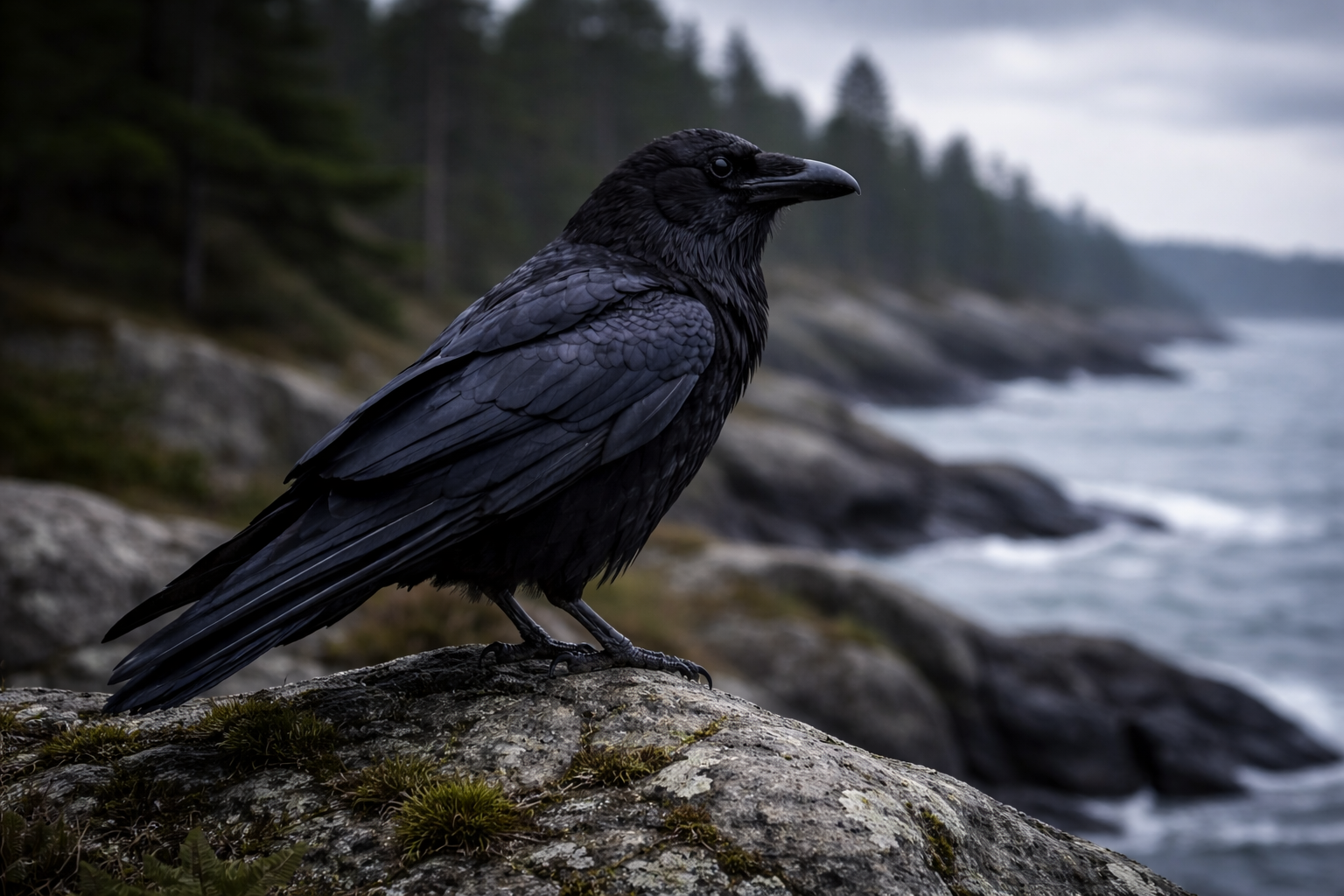
Symbols survive longer than empires. A mark scratched onto a doorway, a spiral carved into stone, an eye painted for protection, a raven circling above a battlefield—certain images repeat across cultures with unsettling consistency, as though humanity keeps rediscovering the same warnings in different languages.
This hall of the archive studies symbols, omens, protective signs, recurring archetypes, and the strange meanings humans continue attaching to certain images generation after generation. Some symbols protected homes. Others invited luck, warded spirits, or warned people away from places best left untouched.
🜂 A
Aegishjalmur (Helm of Awe)
A Norse protective symbol of eight trident-shaped arms radiating from a central point, the Aegishjalmur was believed to confer invincibility and instill fear in enemies. Warriors painted or carved it on their foreheads and weapons before battle. The name translates roughly as "helm of terror" — which is less a hat than a state of mind imposed on everyone around you. It appears in the Völsunga saga and has experienced a vigorous modern revival among people who want their tattoos to mean something genuinely old.
full entry coming soon
Akhet (Egyptian horizon symbol)
The sun disc resting between two mountains — the hieroglyph for horizon and the moment of solar rebirth. Akhet represented the precise threshold between worlds: not day, not night, but the charged instant of transformation between them. Egyptian temples were oriented to capture the akhet sunrise on specific sacred dates, making the symbol architectural as well as written. Threshold moments have always been understood as uniquely powerful, and the Egyptians built entire temples around the ones that mattered most.
full entry coming soon
Algiz (rune)
The rune resembling an upturned hand or the outstretched branches of a tree, Algiz is one of the most consistently protective symbols in the Elder Futhark. Associated with the elk, with shielding, and with the interface between human and divine, it appears in both magical inscriptions and as a standalone protective mark across Germanic and Norse traditions. Inverted, it appeared on Nazi-era death markers and in the modern peace symbol — the same form carrying meanings at maximum possible distance from each other.
full entry coming soon
Alraun (root figures)
Human-shaped roots — particularly mandrake — carved, bound, or simply found in nature's approximation of a person, the alraun was a protective household spirit in Germanic folk tradition. Fed, clothed, and housed in small chests, they were believed to bring luck, warn of danger, and protect the family. They were also inherited, transferred with tremendous ceremony, and could not simply be thrown away without consequence. The folklore of humanoid objects treated as living intermediaries is ancient and widespread and has not entirely gone away.
full entry coming soon
Amulets (history and theory of)
An amulet is any object worn or carried to confer protection, luck, or supernatural influence — one of the oldest categories of human artifact, predating writing and appearing in virtually every culture with an archaeological record. The distinction between an amulet and a talisman is largely one of function: amulets ward and protect, talismans attract and draw. The distinction is consistently made, consistently blurred, and ultimately less interesting than the question of why humans have always needed to carry something charged with intention.
full entry coming soon
Ankh
The looped cross of ancient Egypt is one of the most immediately recognizable symbols in the world and one of the most copied without full comprehension of what it meant. The ankh represented life — specifically the life force, the breath of existence, the thing the gods could bestow or withhold. It appears constantly in Egyptian art in the hands of deities, held to the nostrils of the dead to restore breath, and worn as a protective amulet. What it looks like structurally — a cross with a handle — has never been satisfactorily explained, which may be part of its staying power.
full entry coming soon
Archetypes (Jungian, in folklore)
Carl Jung proposed that certain recurring figures — the hero, the shadow, the wise old man, the great mother, the trickster — appear so consistently across unconnected mythologies because they emerge from the collective unconscious: a shared psychological inheritance of the species. Whether or not one accepts the theory, the patterns are real. The same structural figures appear in Greek myth, Norse saga, West African tradition, and indigenous American story with enough consistency to demand some kind of explanation. The archive covers both the figures and the argument about why they keep appearing.
full entry coming soon
Arrow symbolism
Direction, intention, pursuit, and the irreversibility of what has been released — the arrow as symbol carries all of these. It appears in alchemical notation, in protective charms, in divination systems, and in the iconography of gods ranging from Artemis to Eros to Apollo. An arrow in flight is a decision made and committed to. An arrow at rest is potential not yet spent. The two states were understood as meaningfully different, and the symbol treated accordingly in ritual and decorative traditions across cultures.
full entry coming soon
🜃 B
Bindrunes
Runic ligatures created by overlaying two or more runes into a single compound symbol, bindrunes were used in Norse and Germanic traditions to concentrate multiple protective or magical intentions into one mark. Some were standardized; others were invented for specific purposes by individual practitioners. The Vegvisir — the Norse compass — is sometimes considered a bindrune. The practice of combining symbols to layer meaning is ancient, cross-cultural, and the direct ancestor of monograms, ciphers, and every logo designed to mean more than one thing at once.
full entry coming soon
Black (color symbolism)
Black has meant death, protection, authority, elegance, mourning, magic, and the fertile void of potential depending on the culture, the era, and the context. Ancient Egyptians associated black with fertility and the regenerative soil of the Nile flood — black meant life, not death. Medieval European mourning traditions reversed this entirely. In most Western esoteric traditions black represents Saturn, limitation, banishing, and the necessary darkness before transformation. The color is so context-dependent that a single entry cannot contain it, which is why it has an entry at all.
full entry coming soon
Blessings, history of written
The written blessing — a text inscribed on an object, a doorway, a piece of paper folded into an amulet, or a charm carried on the body — appears in every culture with a writing system and in many without one. From mezuzot to Quranic verses worn in lockets to medieval Christian charm texts to Pennsylvania Dutch hex signs, the impulse to write protection down and fix it in place is one of the oldest applications of literacy. The written word was understood as not merely descriptive but operative — a blessing written was a blessing active.
full entry coming soon
Bones as omens and symbols
Across folk traditions worldwide, bones carried the residue of the life that had passed through them — not inert matter but the last physical anchor of a soul. Bone divination, practiced from ancient China to sub-Saharan Africa to pre-Columbian Americas, used the cracks and patterns in heated or struck bones to read futures. Specific bones — the breastbone of a fowl, the shoulder blade of a sheep — carried specialized divinatory meaning. The crossbones on poison labels and pirate flags are not accidental: bones mean something has already ended here.
full entry coming soon
Broken mirror (omen)
Seven years of bad luck for breaking a mirror is one of the most widely known Western superstitions, and like most durable superstitions, it has layered origins. Roman belief held that life renewed itself in seven-year cycles and that a mirror captured something of the soul — breaking it damaged the soul's vessel and required a full cycle to repair. Earlier mirror superstitions were simply about the bad luck of destroying an expensive object. The soul theory is more interesting and consequently survived longer.
full entry coming soon
🜄 C
Caduceus
Two serpents twined around a winged staff — the emblem of Hermes, messenger of the gods, patron of thieves, travelers, and commerce. The caduceus governed the reconciliation of opposites, negotiation between enemies, and safe passage across dangerous boundaries. It is routinely confused with the Rod of Asclepius (one serpent, no wings), which is the actual symbol of medicine — a conflation so widespread in American medical iconography that correcting it feels futile but remains technically true. The original meaning involves a god who was constitutionally incapable of going anywhere directly.
full entry coming soon
Chaos star (eight-pointed star of chaos)
Eight arrows radiating outward from a central point in all directions, the chaos star was developed by fantasy author Michael Moorcock in the 1960s as a symbol of unlimited possibility and has since migrated into ceremonial magic, chaos magick practice, and a great deal of merchandise. Its roots reach back to the alchemical symbol for antimony and further to various eight-rayed solar symbols across ancient Near Eastern cultures. That a 20th-century fictional symbol can acquire genuine ritual use within decades says something interesting about how symbols work.
full entry coming soon
Chi-Rho
The overlapping Greek letters X and P — the first two letters of Christos — were used as a Christian symbol before the cross became standard. Constantine reportedly saw or dreamed the Chi-Rho before the Battle of Milvian Bridge in 312 CE and had it painted on his soldiers' shields. Whether the vision occurred precisely as described is a matter of historical debate; that the symbol subsequently appeared on Roman imperial military equipment and currency is not. A religious symbol becoming a military insignia in under a generation is a remarkably fast transformation even by historical standards.
full entry coming soon
Circle symbolism
The circle has no beginning and no end, which made it the natural symbol of eternity, the divine, perfection, protection, and anything else humanity wished to describe as complete and self-contained. Magic circles protect by creating bounded space. Wedding rings protect by creating unbroken continuity. The wheel, the mandala, the sacred hoop — different traditions, the same geometry, the same instinct that what is enclosed in an unbroken line is different from what lies outside it. Drawing a circle around something has been a ritual act in every culture that has left records.
full entry coming soon
Clover, four-leaf (as omen and charm)
The four-leaf clover is a naturally occurring genetic mutation appearing in roughly one of every ten thousand white clover plants — rare enough to feel significant when found. Celtic tradition held that carrying one allowed the bearer to see fairies and detect the presence of evil spirits. Later European folklore compressed this into simple good luck. The specific association with luck rather than protection or sight seems to have solidified in the 19th century, suggesting the symbol's meaning was still actively negotiating itself within living memory of people who are now considered "old folklore."
full entry coming soon
Color symbolism (overview)
The meanings attached to colors are among the most culturally variable and most persistently misunderstood areas of symbolic study. White means death in East Asian mourning traditions and purity in Western wedding tradition. Red means luck in China and danger in much of the Western world. Purple meant royalty specifically because Tyrian purple dye was extraordinarily expensive — a meaning that persisted long after synthetic dyes made purple available to anyone. Every color carries layered, contradictory, and historically contingent associations that reward actual investigation rather than the tidy color-meaning chart.
full entry coming soon
Crossroads
The place where two roads meet has been understood as a point of power, danger, and supernatural access in folklore traditions from West Africa to ancient Greece to the American South. Crossroads are where decisions become irreversible, where gods and spirits congregate, where bargains are made with entities best not named directly. Hecate stood at the crossroads. Robert Johnson allegedly met the devil at one. Crossroads burials — placing the executed or the suicided at the intersection — aimed to confuse and contain spirits unable to choose a direction to haunt. The crossroads is not a place. It is a condition.
full entry coming soon
Crone (archetype)
The third face of the triple goddess and one of the most powerful archetypes in world folklore: the old woman at the edge of the village, the witch in the forest, the grandmother with the dangerous knowledge. The crone is not the villain of the story despite frequently being cast as one. She is the keeper of endings, of difficult truths, of the wisdom that only comes from having survived long enough to know what matters. Baba Yaga, the Morrigan, Hecate, the Norns — the crone figures of world mythology are consistently more interesting and more powerful than anyone who underestimates them.
full entry coming soon
Cross (pre-Christian symbolism)
The cross as a symbol predates Christianity by thousands of years and appeared across ancient cultures as a representation of the four directions, the intersection of heaven and earth, and the axis of the known world. Solar crosses, equal-armed crosses, and swastika-form crosses appear in Neolithic European art, ancient Indian iconography, Bronze Age Anatolia, and pre-Columbian Americas entirely independently of each other. The Christian cross is one late iteration of a very old human tendency to mark the place where perpendicular forces meet.
full entry coming soon
🜁 D
Dagaz (rune)
The rune of the dawn, the threshold, and the transformative moment between states — Dagaz looks like an hourglass on its side, two triangles meeting at a point, each half the mirror of the other. It represents the paradox of the threshold: the moment of change that is neither what came before nor what comes after. Used in runic magic for breakthrough, transformation, and invisibility — specifically the kind of invisibility that comes from moving between states too quickly for observation. Dawn is technically neither night nor day. Dagaz lives there.
full entry coming soon
Danse macabre (Dance of Death)
The allegorical image sequence originating in 14th-century Europe, depicting Death as a skeletal figure leading people of every rank — pope, emperor, merchant, peasant — in an unavoidable procession. The danse macabre emerged in the decades following the Black Death, when the visual reminder that mortality respected no station was both theologically instructive and personally relevant to most viewers. It became one of the most reproduced image cycles in medieval art and gave rise to the skeleton as the Western symbol of death — a specific cultural choice, not a universal one.
full entry coming soon
Death omens (general)
Nearly every culture has developed a system of signs believed to presage death: specific birds appearing at windows, clocks stopping, candles guttering, dogs howling at nothing, mirrors shattering unprovoked. The specifics vary enormously but the underlying structure is consistent — the belief that the world announces deaths before they occur, and that close attention to the natural and domestic environment can reveal these announcements to those who know how to read them. Whether or not this is true, the human impulse to watch for it has proven remarkably durable.
full entry coming soon
Divination tools (overview)
Tarot, runes, scrying mirrors, bones, tea leaves, entrails, smoke, oil in water, cracks in heated bone — the list of objects used to divine the future or read hidden information is nearly as long as the list of objects that exist. Every culture developed divination systems, and most developed several. What they share is not a methodology but an assumption: that meaningful patterns are visible to those trained to see them, that the random contains the significant, and that the future is legible if you know the language it is written in. The tools differ. The faith in pattern does not.
full entry coming soon
Door and threshold symbolism
The threshold is not merely architectural — it is the space between states, the moment of transition from one condition to another, and one of the most heavily protected locations in world folklore. Protective marks scratched above doorways, iron nails driven into door frames, horseshoes hung over entrances, salt lines across thresholds, mezuzot, witch bottles buried beneath doorsteps — the inventory of things cultures have done to protect the threshold is enormous and remarkably consistent. Dangerous things enter through doors. Protection goes there first.
full entry coming soon
🜂 E
Elder Futhark (runic alphabet overview)
The oldest form of the runic alphabet, consisting of 24 characters used by Germanic peoples from roughly the 2nd to 8th centuries CE — for inscriptions, memorial stones, weapon markings, and magical purposes that the surviving evidence captures only partially. Each rune was both a letter and a symbol with its own name, meaning, and associated mythology. The Elder Futhark was not invented as a magical system but became one through use, and its revival in modern esoteric practice has produced interpretive traditions that mix genuine scholarship with considerable creative reconstruction.
full entry coming soon
Evil eye (mal occhio, ayin hara)
The belief that a malicious or envious gaze can cause harm — illness, misfortune, the curdling of milk, the withering of crops, the death of livestock — appears in virtually every Mediterranean, Middle Eastern, South Asian, and Latin American culture and in many others besides. Protection against the evil eye is correspondingly universal: blue beads, hamsa hands, specific gestures, amulets of all descriptions, spitting, and the very particular custom of never directly complimenting a child's beauty without immediately invoking protection. The evil eye may be the single most geographically widespread belief in this entire archive.
full entry coming soon
Eye of Horus (Wedjat)
The stylized eye of the falcon god Horus, damaged in his battle with Set and restored by Thoth, became one of the most powerful protective symbols in the ancient world. The wedjat — "the whole one" — was painted on coffins, worn as amulets, inscribed on ships, and placed among funerary offerings. The specific markings around the eye correspond to the fractional parts of a heqat (a unit of grain measurement), which is either a coincidence or a characteristic piece of Egyptian symbolic layering where a protection symbol also contains practical mathematics.
full entry coming soon
🜃 F
Fasces
A bundle of rods bound around an axe — Roman symbol of magisterial authority, representing the collective strength of citizens united behind legitimate power. The fasces appeared in Roman public life, in Renaissance civic iconography, and then in 20th-century Italian fascism, which named itself after the symbol. It still appears on the back of the American Mercury dime, on the Lincoln Memorial throne, and in the U.S. House of Representatives chamber. The symbol has been attempting to live down the 20th century's use of it with limited success.
full entry coming soon
Fire symbolism
Purification, destruction, illumination, transformation, the divine presence, the irreversible act — fire carries all of these simultaneously and always has. Ritual fires burning at Beltane, Yule, Samhain, and the Zoroastrian sacred flame never extinguished since the 5th century BCE represent fire as a living symbol requiring maintenance. Hearth fire symbolism across European folk tradition conflates fire with the life of the household itself: a fire allowed to go out was not merely an inconvenience but a sign of something wrong with the family it was supposed to sustain.
full entry coming soon
Flower of Life (sacred geometry)
A geometric figure composed of multiple overlapping circles arranged in a hexagonal pattern, the Flower of Life appears carved into the Temple of Osiris at Abydos, in Leonardo da Vinci's notebooks, and in contemporary sacred geometry practices worldwide. Whether ancient examples represent the same conceptual tradition as modern interpretations is a matter of ongoing and occasionally heated debate among historians. That the same pattern keeps emerging across contexts separated by centuries suggests either a deep geometric resonance or humanity's persistent tendency to be impressed by a well-drawn repeating circle.
full entry coming soon
Fool (archetype)
The Fool is simultaneously the beginning of the journey and the one who falls off the cliff without looking — card zero of the tarot, the trickster's closest cousin, the figure whose apparent stupidity conceals either dangerous wisdom or genuine naivety, and the story rarely tells you which until it is too late. Court jesters held genuine power precisely because the Fool could speak truth without consequence. Percival was a fool in the Grail legends — too simple to ask the obvious question until he learned what questions cost. The Fool's journey is not about wisdom gained. It is about what you discover when you stop protecting yourself from your own mistakes.
full entry coming soon
Foreboding signs in folklore (general)
The felt sense that something is about to go wrong — and the cultural systems built to name and categorize that feeling — is one of the most universal aspects of folk belief. Specific signs: the flame turning blue, the sudden silence of animals, the dream that repeats, the clock that stops, the picture that falls. What these signs have in common is disruption of the expected: the world behaving incorrectly. Whether the disruption is cause or signal is precisely the question folk tradition never quite settles, which is why the belief in foreboding persists.
full entry coming soon
🜄 G
Golden ratio (phi)
The ratio approximately equal to 1.618, found in nautilus shells, sunflower seed spirals, the proportions of the Parthenon, and the compositional structure of an implausible number of Renaissance paintings. Whether the golden ratio is genuinely ubiquitous in nature or whether humans are exceptionally good at finding it when they go looking has been debated since the Renaissance. That it was understood as a divine proportion — a literal mathematical signature of God's design — by medieval and Renaissance thinkers made it one of the few pieces of mathematics to acquire a genuinely mystical reputation.
full entry coming soon
Graffiti and apotropaic marks
Ritual marks scratched into the stone of churches, houses, and caves to ward off evil spirits — not vandalism but protection. Daisy wheels, pentacles, compass-drawn geometric forms, and the letters VV or VM (invoking the Virgin Mary) appear scratched into the walls, fireplaces, and door frames of medieval and early modern buildings across Britain and Europe. They were placed at vulnerable points: the threshold, the hearth, the window frame. They are still being found during building renovations. The people who made them were not superstitious in a quaint way. They were careful.
full entry coming soon
Green (color symbolism)
Green is growth, poison, envy, safety, fairies, Islam, and the specific wrong color to wear to a wedding in Ireland simultaneously. The association of green with fairy folk in Celtic tradition was taken seriously enough to make green clothing genuinely unlucky in some regions — you were too visible to the wrong eyes. Heraldic green (vert) represented hope and joy. The phrase "green with envy" dates to Shakespeare. Emerald as a protective stone, green as the color of healing, green as the color of rot and poison — the same wavelength carrying opposite warnings depending entirely on context.
full entry coming soon
🜁 H
Hamsa (Hand of Fatima / Hand of Miriam)
An open hand with an eye in the palm, the hamsa is one of the most widely used protective symbols in the Middle East and North Africa and one of the rare symbols genuinely shared across Jewish, Islamic, and Christian traditions in the same regions. Its origins predate all three, appearing in Carthaginian and Phoenician iconography associated with the goddess Tanit. The hand wards the evil eye and invites divine protection. It is currently the best-selling amulet in most Western metaphysical shops, which would likely surprise everyone who made the original ones.
full entry coming soon
Hexagram (Star of David / Seal of Solomon)
Two overlapping triangles forming a six-pointed star — a symbol with far more history than any single tradition owns. The hexagram appears in Hindu yantras, Islamic architectural decoration, medieval Christian occultism, alchemical notation representing the union of fire and water, and the Seal of Solomon used in magical traditions centuries before it became the primary symbol of modern Jewish identity in the 19th century. The Star of David as an exclusively Jewish symbol is largely a 19th-century development. The hexagram as a symbol of intersecting opposites is considerably older and wider.
full entry coming soon
Hex signs (Pennsylvania Dutch)
The brightly painted geometric designs on the barns of Pennsylvania German communities — stars, rosettes, tulips, birds arranged in precise symmetry — sit in the middle of an unresolved argument about whether they were ever actually protective magic or always purely decorative. The German-American communities themselves often denied magical intent. Folklorists and historians have argued both sides for over a century. The pattern of the argument — the practitioners denying what the outsiders insist upon — is itself a familiar dynamic in folk magic studies and says something about how protective practices survive by becoming officially decorative.
full entry coming soon
Hero (archetype)
Joseph Campbell mapped the hero's journey across myth worldwide and found the same structure recurring with remarkable consistency: the call, the refusal, the threshold crossing, the road of trials, the ordeal, the reward, the return. The hero archetype is not about courage in the popular sense but about transformation through the willingness to enter the unknown and be changed by it. The hero who returns is not the same person who left — which is precisely the point, and precisely what makes the return as difficult as the journey.
full entry coming soon
Horseshoe (protective symbol)
The iron horseshoe hung above a doorway is one of the most enduring protective amulets in European folk tradition, and the argument about which way it should hang — open end up to hold the luck in, or open end down to let the luck pour out — has never been settled to everyone's satisfaction. The protective power derives from iron itself (hostile to fairies and evil spirits in most European traditions), from the crescent shape echoing the moon, and from the horse's association with good fortune. All three explanations have been offered. People generally pick the one that sounds most convincing and hang it the way their grandmother did.
full entry coming soon
🜂 I
Ichthys (Christian fish symbol)
The simple fish outline used as a covert Christian identifier in the early centuries CE — a symbol chosen because it could be drawn quickly, recognized by initiates, and plausibly denied to outsiders. ICHTHYS is also a Greek acronym for "Jesus Christ, Son of God, Savior." The fish had additional resonance with baptismal water, with the feeding miracles, and with the fishermen apostles. It survived the Christianization of the Roman Empire, disappeared for over a thousand years, and reappeared on car bumpers in the late 20th century, where it has been involved in an ongoing arms race with a Darwin fish on legs.
full entry coming soon
Irminsul
The great pillar of the Saxons — a sacred wooden column representing the axis connecting heaven, earth, and the underworld — was destroyed by Charlemagne in 772 CE as part of his forced Christianization of the Saxon people. What it looked like exactly is unknown; what it meant is clear enough: it was the world's center, the axis mundi, the thing around which everything else oriented itself. Destroying a people's world pillar is not merely vandalism. The Saxons understood it that way. Charlemagne understood it that way. We know about it because the destruction was recorded with evident satisfaction.
full entry coming soon
Iron (protective properties of)
Cold iron — unworked iron, iron not yet shaped by the forge — was considered hostile to fairies, demons, and malevolent spirits in European folk tradition with a consistency that crosses cultural and geographic lines. Iron nails driven into doorframes, iron scissors left open under cradles, iron keys placed beside the sick, iron tools carried as protective charms — the inventory of iron's apotropaic uses is extensive. The most common explanation is agricultural and symbolic: iron plows broke the fairy mounds, iron weapons were new and powerful, iron represented the human world asserting itself against the older wildness.
full entry coming soon
🜃 J
[no entries]
🜄 K
Knots (magic and symbolism of)
The knot as a magical act — binding, capturing, fixing — appears in folk magic traditions worldwide. Witch's ladders (knotted cords), the Gordian knot, Isis's tyet knot amulet, the knot magic described in the Norse sagas, the sailors' belief in wind knots — knots represent the act of holding something fast, of making a thing stay. Tying a knot is a spell of binding. Cutting one is a spell of release. The word "fascinate" derives from Latin fascinare, connected to the binding power of the evil eye. What holds us, what we hold, and what cannot be undone once tied — knots are where magic gets literal.
full entry coming soon
🜁 L
Labyrinth
The labyrinth is not a maze. A maze has dead ends and wrong turns designed to confuse; a labyrinth has a single winding path that leads inevitably to the center and back out again. Walking a labyrinth is a meditative act of surrendering direction while trusting the path. The pattern appears in Neolithic rock carvings, ancient Cretan mythology, medieval cathedral floors (most famously Chartres), and contemporary therapeutic practice. The Minotaur at the center of the mythological labyrinth is the thing you meet when you follow a path all the way to its end without turning back. Most traditions recommend going anyway.
full entry coming soon
Labrys (double axe)
The double-headed axe of Minoan Crete appears throughout the archaeological record of Bronze Age Aegean civilization with a frequency suggesting deep ritual significance, though what exactly it meant to the people who made it remains incompletely understood. The labrys gave its name to the labyrinth (the house of the double axe) and was associated with the goddess in Minoan religion. In modern contexts it has been adopted as a symbol of lesbian feminist identity since the 1970s — a migration of meaning across three thousand years that the Minoans would not have predicted and may have approved of.
full entry coming soon
Lightning bolt symbolism
The weapon of sky gods across cultures — Zeus's thunderbolt, Thor's Mjolnir, Indra's vajra, the Thunderbird's strike — lightning represents divine power at its most direct and unambiguous. Unlike most celestial phenomena, lightning interacts with the ground, choosing its targets apparently at random, killing both the guilty and the innocent with equal efficiency. This made it an excellent metaphor for divine will that does not explain itself. Lightning-struck trees and stones were considered sacred in many traditions, marked for avoidance or veneration. The place the sky chose to touch deserved respect in either direction.
full entry coming soon
Lemniscate (infinity symbol)
The figure-eight on its side representing infinity was introduced to mathematics by John Wallis in 1655 and given its name from the Latin for ribbon. In tarot the lemniscate appears above the Magician's head, above the woman in Strength, suggesting mastery of the infinite or access to unlimited resource. The symbol predates its mathematical use in various forms — ouroboros drawn as a figure-eight, decorative knotwork with the same topology — but the infinite loop as a symbol of eternity without beginning or end is a concept older than its tidy modern version.
full entry coming soon
🜂 M
Mandala
A geometric figure representing the cosmos in miniature — the universe's structure rendered in a form the human eye can hold. Mandalas appear in Hindu and Buddhist sacred art as meditation supports, ritual objects, and architectural blueprints for sacred space. Carl Jung encountered them in the dreams of patients undergoing psychological transformation and argued they represented the self's drive toward wholeness. Tibetan Buddhist monks spend weeks constructing elaborate sand mandalas only to sweep them away upon completion — the point was never the object but the practice of making it, and the lesson of impermanence delivered at the end.
full entry coming soon
Meander (Greek key pattern)
The continuous interlocking angular spiral pattern that appears in ancient Greek decorative art, on pottery, on architectural friezes, and in floor mosaics — named for the winding Meander River of Anatolia. The pattern's unbroken continuity made it a symbol of eternity and the infinite. It appears independently in pre-Columbian American art, ancient Chinese decorative tradition, and Neolithic European pottery — the same interlocking angular spiral arising in cultures with no documented contact. Either it is a natural byproduct of weaving patterns translated into other media, or it is the kind of symbol that keeps getting invented.
full entry coming soon
Memento mori
Latin for "remember that you must die" — a symbolic tradition of keeping death visible to counteract complacency, pride, and the human habit of spending time as if it is infinite. Skull imagery in Dutch vanitas paintings, the death's head on rings and watch fobs, the phrase carved into sundials, the Ash Wednesday reminder — memento mori is the philosophical tradition of keeping mortality in peripheral vision rather than pretending it away. The Stoics, the early Christians, the Buddhists, and certain goth subcultures have all found this a useful discipline. The practice is considerably more cheerful than it sounds.
full entry coming soon
Mezuzah
A small case containing a handwritten parchment scroll affixed to Jewish doorposts — a direct fulfillment of the biblical commandment to write God's words on the doorposts of the house. The mezuzah marks the home as belonging to a Jewish family and is touched upon entering and leaving as a reminder of the covenant and the protection it implies. It is one of the most clear-cut examples of the threshold protection impulse taking a specific religious form, the protective mark at the vulnerable point of entry — but here with texts specifying exactly what is being protected and by whom.
full entry coming soon
Mjolnir (Thor's hammer)
The hammer of Thor, made by the dwarf smiths at Odin's request, was the primary protective symbol of the Norse world — worn as an amulet by ordinary people, invoked at births, deaths, and marriages, and used to consecrate and protect. Archaeological finds suggest that during the Viking Age, Thor's hammer amulets and Christian cross amulets were worn simultaneously, hedging bets across theological systems in the same way practical people have always done. The hammer's short handle, explained in mythology by Loki's sabotage, is genuinely unusual for a weapon and has never been satisfactorily explained as a design choice.
full entry coming soon
🜃 N
Nazar (blue eye bead)
The deep blue glass eye bead, produced in Turkey and found throughout the Mediterranean and Middle East, is an amulet specifically designed to reflect the evil eye back at its source. The eye watches back. The color blue has specific protective associations in this region — blue doors, blue-painted buildings, blue beads, blue paint on livestock — and the nazar condenses all of this into a portable, affordable form. It is one of the most widely produced protective objects in the world and one of the few traditional amulets that has successfully transitioned into mainstream Western decorative use without losing its original protective meaning entirely.
full entry coming soon
Numbers, sacred (numerology overview)
Three, seven, nine, twelve, forty — certain numbers appear in sacred contexts across unconnected cultures with suspicious frequency, and the attempt to explain why has occupied philosophers, mathematicians, and religious thinkers for millennia. Three for the trinity and the triple goddess and the number of times you must do a thing to make it permanent. Seven for the classical planets and the days of the week and the number of years it takes to replace all the cells in the body (approximately, and not actually, but the belief persists). Numbers carry meaning in every tradition that has left records of caring about them.
full entry coming soon
🜄 O
Omens, reading of (general)
The systematic reading of the natural world for signs of what is coming — augury, haruspicy, ornithomancy, cleromancy — was in most ancient cultures a professional discipline rather than a folk superstition. Roman augurs were state officials whose readings of bird behavior could legally halt armies, cancel elections, and invalidate treaties. The assumption underlying all omen reading is that the world is coherent — that events connect to each other meaningfully rather than randomly, and that a trained reader can perceive the connections. Whether or not this is true, the practice of close attention to the world it requires is not without value.
full entry coming soon
Ouroboros
The serpent devouring its own tail — a symbol of cyclical time, eternal return, the self-sustaining universe, and the union of opposites that the alchemists found irresistible. The oldest known ouroboros appears in an ancient Egyptian text from around 1600 BCE. It shows up in Norse mythology as Jormungandr encircling the world, in Gnostic traditions as a symbol of the eternal, in alchemical manuscripts as the prima materia consuming itself to produce itself, and in Carl Jung's work as an archetypal symbol of psychic wholeness. A snake eating itself is objectively unsettling. This has not reduced its appeal as a symbol of eternity.
full entry coming soon
🜁 P
Pentagram and pentacle
The five-pointed star has been a symbol of protection, divine proportion, the five elements, the human body, Venus's orbital pattern, and Pythagorean mathematics — and was used as a Christian protective symbol in the Middle Ages long before it was associated with anything sinister. The inversion that made the downward-pointing pentagram a symbol of malevolence appears to date from 19th-century French occultism, specifically Eliphas Lévi's influential illustration pairing the inverted star with a goat's face. Before that, a pentagram was a pentagram. The distinction between pentagram (star) and pentacle (star within a circle) is consistently made and consistently ignored.
full entry coming soon
Philosopher's stone
The legendary substance of alchemical pursuit — capable of transmuting base metals into gold and conferring immortality through the elixir of life. Whether medieval and Renaissance alchemists understood the philosopher's stone literally, metaphorically, or both simultaneously is the central question of alchemical scholarship, and the answer appears to be: yes. The stone was a real goal, a spiritual metaphor for enlightenment, a coded description of chemical processes, and a psychological symbol of transformation — several of these things at once, held together by a tradition that did not sharply distinguish between inner and outer work.
full entry coming soon
Protective marks (general)
The category of apotropaic marks — symbols scratched, painted, burned, or carved specifically to ward off evil — is one of the oldest and most cross-cultural in the archive. What constitutes a protective mark varies enormously: geometric patterns, specific letters, natural symbols, stylized eyes, compass-drawn forms. What they share is placement at vulnerable points (doors, hearths, windows, the bodies of the ill) and the belief that the right mark in the right place makes the difference between a space that can be entered by harmful forces and one that cannot. The care embedded in these marks is a form of love that looks like superstition from the outside.
full entry coming soon
🜂 Q
[no entries]
🜃 R
Red (color symbolism)
Blood, fire, danger, luck, passion, war, protection, and the specific color of the thread tied around a wrist to ward off the evil eye in multiple unconnected folk traditions. Red thread appears in Jewish (Kabbalah), Hindu, Buddhist, Chinese, and Celtic protective practices independently — the color of blood as the color of life, tied around the living to affirm and protect it. The same color means luck in China and stop in international traffic signage. Red ochre was the first pigment used in human ritual burial, at least 100,000 years ago. That is a very long time for a color to mean something.
full entry coming soon
Runes (history and use)
The runic alphabets of the Germanic and Norse peoples served as writing systems, memorial inscriptions, and magical tools — sometimes all three in the same inscription. The word rune itself means "secret" or "mystery" in Proto-Germanic, suggesting that writing was from the beginning understood as a technology with implications beyond the merely practical. Runic inscriptions on weapons, amulets, bracteates, and memorial stones across Scandinavia, Britain, and continental Europe span roughly 2,000 years of use. Modern runic divination draws on this history while acknowledging that the precise magical meanings assigned to individual runes involve considerable scholarly reconstruction.
full entry coming soon
🜄 S
Sacred geometry (overview)
The study of geometric forms as expressions of divine order — the belief that the mathematical relationships underlying visible reality reflect the structure of creation itself. From Platonic solids to the golden ratio to the Flower of Life, sacred geometry treats mathematics as a spiritual language readable by those trained in it. Gothic cathedrals encode it in their proportions. Mosques encode it in their tile work. Yantras encode it in meditation diagrams. The tradition spans every major religious and philosophical tradition that engaged seriously with mathematics — which is most of them.
full entry coming soon
Salt (protective and ritual uses)
Salt preserves, purifies, and was for most of human history rare enough to be genuinely valuable — which may explain why spilling it became an omen of misfortune, why covenants were sealed with it, why it was placed in the mouths of the dead, why it was thrown over the left shoulder to blind the devil waiting there, and why it appears in protective and cleansing rituals across traditions ranging from Shinto to European folk magic to Catholic ritual. A circle of salt as a protective barrier is one of the most consistently appearing images in protective magic worldwide. It is also genuinely effective at stopping slugs, which may be related.
full entry coming soon
Seal of Solomon
The hexagram attributed to King Solomon appears in Jewish, Islamic, and Western occult traditions as a symbol of divine authority powerful enough to command spirits and demons. The Testament of Solomon, a text from the early centuries CE, describes Solomon using a magic ring bearing the seal to compel demons into building the Temple. Medieval grimoires treated the Seal as among the most powerful of protective and commanding symbols. Whether Solomon himself is historical, legendary, or a useful literary vehicle for describing the limits of human wisdom depends heavily on which tradition you consult.
full entry coming soon
Shadow (Jungian archetype)
The shadow is everything a person cannot acknowledge about themselves — the qualities suppressed, denied, and projected outward onto others. In Jung's framework it is not simply the dark side of the personality but the unintegrated side: the parts left in darkness not because they are inherently evil but because they were inconvenient, embarrassing, or frightening to acknowledge. What we most dislike in others is usually what we least wish to see in ourselves. The shadow appears in folklore as the dark double, the doppelgänger, the demon that wears a familiar face — the enemy who turns out to have been you all along.
full entry coming soon
Sigils
A sigil is a symbol created to represent a specific intention, often by abstracting or combining letters from a written statement of that intention until the original words are unrecognizable and only the form remains. The technique is documented in medieval grimoires and was significantly developed and popularized by the English occultist Austin Osman Spare in the early 20th century. The theory is that a sigil bypasses the conscious mind's skepticism and communicates directly with whatever part of the self — or reality — actually makes things happen. The theory is unfalsifiable. The practice is very old and very widespread.
full entry coming soon
Skull symbolism
The skull is simultaneously memento mori (you will die), protective guardian (the dead watching over the living), and symbol of transformation (the body reduced to its permanent structure). Day of the Dead altars, Tibetan skull cups used in ritual, the Jolly Roger, the skull rings of medieval monks — the same object serving remembrance, celebration, intimidation, and renunciation of attachment to the body, depending on the tradition. The skull is not primarily a symbol of death. It is a symbol of what death reveals: the structure underneath, still recognizable, still watching.
full entry coming soon
Spiral
One of humanity's oldest symbols, the spiral appears in Neolithic rock art on every inhabited continent, in Celtic knotwork, in the shell of every nautilus, in the arms of galaxies, and in the structure of DNA. It represents growth, transformation, the cyclical return that arrives at the same point but higher up, and the path inward toward the center of a thing. The difference between a spiral that opens outward and one that closes inward was understood as meaningful in most traditions that used it. The triskelion, the double spiral, the labyrinthine coil — the spiral is the form underneath an enormous number of other symbols.
full entry coming soon
Swastika (pre-Nazi symbolism)
Before 1933 the swastika was a solar symbol of good fortune and well-being used across Hindu, Buddhist, Jain, ancient Greek, Roman, and indigenous American traditions for at least five thousand years. It appears on Neolithic pottery, Bronze Age artifacts, Byzantine floor mosaics, and was used as a good luck symbol in early 20th-century Western commercial design. The Nazi appropriation of the symbol has made its pre-Nazi history effectively inaccessible in most Western contexts — a complete symbolic capture that took less than fifteen years. The Symbolarium covers it because its history is not nothing, and ignoring what symbols can become does not protect against it.
full entry coming soon
🜁 T
Talisman (versus amulet)
Where an amulet protects by warding off the negative, a talisman attracts and draws positive influence toward its bearer — luck, love, prosperity, success in a specific endeavor. Talismans were traditionally created at astrologically auspicious moments, inscribed with specific symbols or seals, and consecrated through ritual. The distinction between talisman and amulet is consistently made in magical literature and consistently blurred in practice, because the same object often does both things and the category is less stable than the theory suggests. The more important distinction may be between an object made with intention and one that merely looks the part.
full entry coming soon
Tarot (symbols and archetypes of)
The 78-card tarot deck as a divination tool dates to 18th-century France, built on playing cards that had been used for games since the 15th century in northern Italy. The Major Arcana — the 22 trump cards from the Fool to the World — encode a visual mythological journey drawing on Kabbalistic tradition, astrological symbolism, alchemical imagery, and the allegorical figures of Renaissance art. Whether the tarot was always intended as an occult system or acquired that meaning through use is historically unsettled. The symbols worked regardless of the original intention, which is the kind of thing that happens to systems built on genuine archetypes.
full entry coming soon
Threshold guardians (archetype)
The figure that stands between the ordinary world and the world the hero must enter — the gatekeeper, the challenger, the test that precedes access. In Campbell's hero's journey the threshold guardian is not an enemy but a function: a force that tests whether the traveler is truly committed to the crossing. Every tradition has them: sphinxes at temple gates, the riddle toll at the bridge, the monster at the cave mouth, the bureaucrat at the permit office. The threshold guardian's essential question is always the same: do you really mean to go through?
full entry coming soon
Trickster (archetype)
Loki, Coyote, Anansi, Hermes, Raven, Sun Wukong — the trickster appears across world mythology as the figure who breaks rules, crosses boundaries, causes chaos, and inadvertently or deliberately enables necessary change. The trickster is not the villain. The trickster is what happens when the rules become too rigid, too self-important, or too destructive — the fool who says the thing the court cannot hear, the chaos that cracks open what had calcified. Trickster stories are not morality tales about bad behavior. They are something considerably more uncomfortable: arguments that the world needs disruption, and that the disruptor deserves more respect than they receive.
full entry coming soon
Triple goddess (archetype)
Maiden, mother, and crone — the triple goddess represents the three phases of feminine life and, in most traditions that use her, the three phases of the moon: waxing, full, and waning. The Morrigan is triple. Hecate is triple. The Fates are triple. The Graces are triple. The concept was significantly developed and popularized in modern form by Robert Graves in The White Goddess (1948), drawing on genuine ancient precedent while also doing considerable creative reconstruction. The symbol resonates because the three phases are real: youth, fullness, age — the shape of a life — mapped onto the sky.
full entry coming soon
Tyet (Knot of Isis)
An ancient Egyptian symbol resembling the ankh but with the arms turned downward, the tyet was associated with Isis and her protective power. Placed in funerary wrappings it was believed to transmit the goddess's protection directly to the mummified body. The knot form connects it to the protective knot magic practiced widely in ancient Egypt — binding the dead against harm, binding enemies from causing harm, binding the living into divine protection. The tyet knot is one of the oldest continuously used protective symbols in the Egyptian tradition, appearing from the Old Kingdom through to Greco-Roman Egypt.
full entry coming soon
🜂 U
[no entries]
🜃 V
Vegvisir (Norse compass)
The runic stave described in the 17th-century Icelandic Huld Manuscript as a wayfinding charm — the bearer would never lose their way in storms or rough conditions, even in unfamiliar surroundings. The Vegvisir consists of eight runic staves arranged around a central point, and while its origins are debated (17th-century manuscripts are not necessarily preserving ancient traditions intact), it has become one of the most widely recognized Norse symbols in contemporary use. It is carved into more notebook covers, tattooed onto more forearms, and embossed onto more leather journals than any other runic symbol, which the Huld Manuscript did not predict.
full entry coming soon
Vesica piscis
The shape formed by the intersection of two circles of equal size, each passing through the other's center — a pointed oval that appears in sacred geometry as a symbol of union, the divine feminine, the threshold between worlds, and the mathematical relationship between the circle and the square. It appears in Romanesque and Gothic church architecture framing Christ and the Virgin in glory; it is the basic form of the ichthys fish symbol; it underpins the proportions of many medieval cathedrals. The shape is simultaneously a mathematical relationship, an architectural module, and a symbol that has been read as a womb, a doorway, and an eye, depending on the tradition.
full entry coming soon
Vévés (Vodou sacred symbols)
The intricate ritual ground drawings used in Haitian Vodou to invoke the presence of specific lwa (spirits) — each lwa has a distinct vévé drawn in cornmeal or ash on the ground during ceremony, serving as both an invitation and a landing point for the spirit's arrival. Vévés are among the most sophisticated symbolic systems in active ritual use today, combining West African, indigenous Taino, and Catholic visual traditions into a living practice. Each symbol encodes the lwa's domain, temperament, and requirements. Drawing one without the corresponding knowledge and relationship is considered inadvisable.
full entry coming soon
🜄 W
Water symbolism
Purification, the unconscious, the boundary between worlds, the source of life and the agent of death — water carries a symbolic load proportional to its actual significance to survival. Holy water, river spirits, the rivers of the underworld, baptism, the ocean as the edge of the known world, rain as divine favor or wrath, the well as a threshold to the otherworld — water is the most symbolically active substance in human mythology, which may simply be because it is the most essential. Springs and wells were sacred in virtually every pre-modern culture that had them, which is most of them.
full entry coming soon
Witch's bottle
A sealed vessel filled with bent nails, thorns, human hair, urine, and other materials designed to trap, confuse, or turn back harmful magic aimed at a household — one of the most documented forms of English protective folk magic, with archaeological examples dating from the 17th century found buried beneath floors, inside walls, and under hearths. The witch's bottle works on a principle of reversal: the harmful spell is drawn into the bottle instead of the person, confused by the sharp objects, and cannot find its way back out. Dozens have been found during building renovations, still sealed, still presumably working.
full entry coming soon
Wise old man / wise woman (archetype)
The guide who appears when the hero is lost, confused, or at a threshold they cannot cross alone — Merlin, Gandalf, the old woman on the road who gives the crucial directions, the hermit in the cave who knows the answer but makes you ask the right question first. The wise figure in folklore rarely solves the problem for the hero. They provide the tool, the clue, the perspective, the challenge that makes the solution possible. In Jung's framework the wise old man or woman represents the self's own deeper knowledge returning in a form the ego can receive — wisdom that had to leave before it could come back as a stranger.
full entry coming soon
🜁 X
[no entries]
🜂 Y
Yggdrasil (World Tree)
The immense ash tree at the center of Norse cosmology connecting nine worlds across three levels — roots reaching into the realm of the dead, trunk standing in the world of humans, branches extending into the realm of gods. The world tree as axis mundi appears in Siberian shamanism, in Mesoamerican cosmology, in Mesopotamian and Hindu tradition — the vertical pillar connecting above, below, and between, the structure around which everything else organizes itself. Odin hung on Yggdrasil for nine days to gain the runes. The tree held him. Sacrifice given to the thing at the center of everything is how you get what the center contains.
full entry coming soon
🜃 Z
Zen ensō (circle)
The ensō is a circle drawn in a single brushstroke — complete or deliberately incomplete — representing the moment of creation, enlightenment, the universe, and the void simultaneously. It is one of the most practiced forms in Zen calligraphy, used as a meditation object, a signature of a teacher's mind state, and a visual koan: what is the circle before and after the brush touches the paper? The ensō that closes perfectly and the one with a gap are both correct, for different reasons, on different days. It is the only symbol in this archive that might be described as primarily a practice rather than a mark.
full entry coming soon
Zodiac symbols (as sigils)
The twelve glyph symbols used to represent the zodiac signs — the stylized figures for Aries, Taurus, and the rest — were standardized in medieval astrological manuscripts and carry compressed visual symbolism within their forms: Aries as two ram's horns, Scorpio as an M with a sting, Pisces as two fish bound together. Used as sigils in talismanic magic, the glyphs were believed to concentrate the qualities of the sign into the mark itself. They are among the few symbols in widespread contemporary use that most people recognize without knowing they are reading a visual language developed by medieval scholars.
full entry coming soon
Submit to the Archive
If you would like to suggest a topic or share a lead worth investigating, submit it to us for review. Click Here