ALL INCENSE AND RESINS
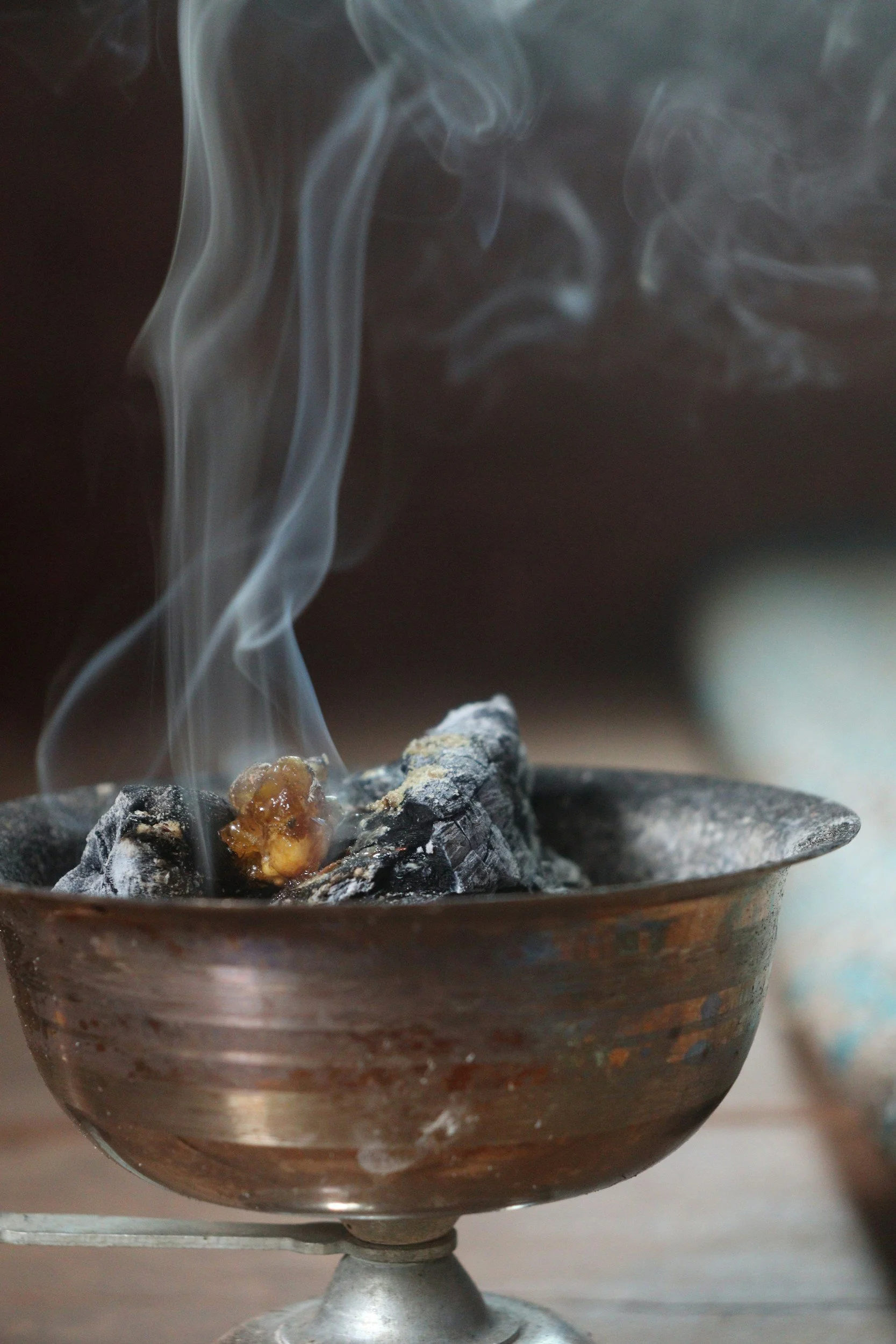
Long before electricity, people understood the power of smoke. It drifted through funeral halls, temple ceilings, plague-ridden streets, forest rituals, and candlelit ceremonies where someone hoped the unseen world might actually be listening. Resin crackled over hot charcoal while prayers rose beside it, carried upward in spirals no one could quite explain.
Inside this chamber are the histories, myths, and ritual traditions surrounding incense, sacred woods, resins, and ceremonial smoke. Whether used for purification, mourning, meditation, protection, or simple atmosphere, smoke has always occupied that strange place between the physical world and whatever waits beyond it.
🜂 A
Agarwood (Oud)
Agarwood is not a substance the tree produces willingly — it forms only when the heartwood of Aquilaria trees becomes infected with a specific mold and responds by generating a dense, dark, extraordinarily fragrant resin as a defense. The result is the most expensive raw fragrance material in the world, traded since ancient times across Arabia, India, China, Japan, and Southeast Asia. In Islamic tradition oud is among the most sacred of incense materials, burned at mosques, at funerals, and at celebrations. Japanese kōdō — the way of incense — treats agarwood as its highest form. A material born from the tree's illness, valued for thousands of years at prices that have repeatedly made it a target of smuggling and poaching: agarwood is what happens when suffering produces something extraordinary.
full entry coming soon
Amber resin (as incense)
Fossilized tree resin — the same material sometimes containing prehistoric insects — burns with a warm, sweet, slightly vanillic smoke that has been used in ritual and domestic contexts across the Baltic, Mediterranean, and Middle East for millennia. Baltic amber was one of the most valuable trade goods of the ancient world, moving along the Amber Road from the Baltic coast to the Mediterranean in quantities sufficient to appear in Egyptian New Kingdom tombs. As an incense material it was considered warming, grounding, and protective — associated with solar energy, deep time, and the preserved past. Burning amber is, in a literal sense, burning millions of years of stored tree sap. That deserves more ceremony than it usually gets.
full entry coming soon
Asafoetida (Devil's Dung)
The dried resin of Ferula plants smells, when uncooked, precisely like its folk name suggests — a sulfurous, garlicky, aggressively unpleasant odor that disappears almost entirely when heated in cooking, where it transforms into something savory and essential in South Asian cuisine. In folk magic traditions across Europe and the American South, asafoetida was burned to drive away evil spirits, illness, and unwanted visitors — the logic being that nothing desirable would stay in the presence of that smell, including whatever was causing harm. It was also burned in protective smoke for newborns and the seriously ill. The same substance used in sacred Indian temple cooking and in American hoodoo banishing work demonstrates the full range of what a resin can be asked to do.
full entry coming soon
🜃 B
Benzoin resin
The balsamic resin tapped from Styrax trees in Southeast Asia and Sumatra produces a sweet, vanilla-adjacent smoke that has been used in European ceremonial magic as a purifying and consecrating incense since at least the medieval period. Benzoin appears in numerous grimoire incense formulas as a base or fixative — it holds other scents and extends them, which made it practically valuable and therefore ceremonially ubiquitous. In folk Catholic tradition it was burned alongside frankincense in domestic blessing ceremonies. As tincture of benzoin it was used in medicine as an antiseptic and preservative. The resin that preserves what it touches and fixes the scents around it made a natural symbol of memory, protection, and the holding of things in place.
full entry coming soon
Blood of the Dragon (Dragon's Blood resin)
Dragon's blood is the brilliant red resin produced by several unrelated plant species — Dracaena, Daemonorops, Croton — that happen to bleed the same dramatic color when cut. The name is ancient and the resin's ritual reputation proportionate to its appearance: used across Mediterranean, Arabic, and European magical traditions for protection, love, and the amplification of power in other workings. Medieval European artists used it as a pigment and varnish. Chinese medicine used it for wound healing. Western esoteric tradition prescribed it for inks, incenses, and protective sachets. The resin that looks like it came from something that doesn't exist has accumulated exactly the mythology you would expect from a substance with that color and that name.
full entry coming soon
🜄 C
Camphor
The white crystalline substance distilled from the wood of Cinnamomum camphora trees produces an intensely penetrating, medicinal smoke used across South Asian, East Asian, and Southeast Asian religious traditions with a consistency that suggests it was doing something genuinely effective. In Hindu puja camphor is burned at the end of the ceremony — the aarti flame using camphor tablets that burn completely without residue, leaving nothing behind, symbolizing the ego dissolving in divine presence. In Taoist and Buddhist temple practice camphor is burned for purification and protection. The same medicinal sharpness that clears congested airways seems, in ritual contexts, to be trusted to clear whatever else has accumulated in a space.
full entry coming soon
Cedar (as incense)
Cedar smoke carries one of the oldest documented ritual histories of any wood — the Cedars of Lebanon were so sacred and so valuable that their felling was a matter of international diplomacy in the ancient Near East, and cedar resin and wood appear in Mesopotamian ritual texts from the third millennium BCE. Native American traditions use cedar smoke for purification, protection, and prayer, often alongside or alternating with sage. In Egyptian tradition cedar resin was used in mummification. The Temple of Solomon was built from Lebanese cedar. A wood considered sacred enough to build the dwelling place of God, to preserve the bodies of the dead, and to carry prayers upward on smoke in a dozen unconnected traditions has earned its reputation through consistent application over a very long time. See also: Dried Herbs.
full entry coming soon
Charcoal (ritual burning)
The compressed charcoal disc designed for burning loose incense resins — self-lighting, maintaining a steady heat for thirty to sixty minutes — is the delivery mechanism that makes resin incense accessible outside of specialized temple contexts. Before the modern charcoal disc, incense was burned over live coals, in censers with hot ash beds, or in braziers maintained by dedicated practitioners. The charcoal tablet is therefore a democratizing technology: it brought frankincense and myrrh off the altar and onto the kitchen table, which is either a desacralization or an expansion of access depending on your perspective. Most working practitioners of any tradition consider it the latter and have moved on.
full entry coming soon
Copal
The sacred resin of Mesoamerican ritual — burned by the Aztecs, Maya, and their predecessors for thousands of years as an offering to the gods, a medium for prayer, and a material for making the invisible world temporarily present in the visible one. The word copal derives from the Nahuatl copalli, meaning simply "incense." Copal smoke was understood as food for the gods and as a vehicle that carried human prayers upward. In contemporary Day of the Dead practice copal smoke helps guide the returning spirits of the dead to their family altars. The Spanish colonizers who witnessed Aztec copal rituals recognized the smoke-and-prayer structure immediately — it looked, to Catholic eyes, uncomfortably familiar — and the comparison was not welcomed by either party.
full entry coming soon
🜁 D
[no entries]
🜂 E
Elemi resin
The soft, fresh-smelling resin tapped from Canarium luzonicum trees in the Philippines — citrusy, piney, faintly medicinal — was used by medieval European apothecaries and perfumers as a fixative and was included in Paracelsus's alchemical preparations. In the Philippines the trees that produce it are considered sacred by some indigenous communities, their resin harvested according to protocols that acknowledge the tree as something more than a resource. Elemi's scent is clean enough to smell like clarity itself, which made it a natural candidate for the kind of incense used in workings concerned with mental focus, protection during travel, and the maintenance of boundaries. It is less famous than frankincense and less dramatic than dragon's blood, which means it tends to do its work without attracting attention — a quality that has its uses.
full entry coming soon
🜃 F
Frankincense (Olibanum)
The Boswellia tree grows in some of the harshest terrain on earth — the rocky, arid hillsides of Somalia, Oman, Yemen, and Ethiopia — and produces, when its bark is wounded, a milky white resin that hardens into the translucent tears traded across the ancient world at prices comparable to gold. Frankincense appears in ancient Egyptian kyphi formulas, in Babylonian temple ritual, in the Hebrew Bible as a sacred offering, in the Magi's gifts at the Nativity, in Greek and Roman sacrificial fires, in Islamic tradition, in Ayurvedic medicine, and in the censers of Catholic, Orthodox, and Anglican liturgy continuously from antiquity to the present day. No other incense material has maintained unbroken ritual use across this many traditions across this much time. Frankincense is, by any reasonable measure, the most ritually significant aromatic substance in human history.
full entry coming soon
Fumigation (historical and ritual)
Before germ theory, smoke was medicine — specifically the medicine of purification, both physical and spiritual, in a framework that did not distinguish sharply between the two. Fumigation of sickrooms, of plague-infected streets, of birthing chambers, of spaces where the dead had been laid — the burning of strong-smelling woods and resins to drive out miasma, evil, infection, and spiritual contamination simultaneously. The fumigation of the Oracle's chamber at Delphi with laurel smoke is documented. The burning of sulfur through plague-struck cities is documented. The smoking of beehives to calm them is practical apiculture. The logic across all of them is the same: smoke changes what is in a space, and what it changes may include things that cannot be seen.
full entry coming soon
🜄 G
Galangal (as incense)
The rhizome of Alpinia galangal — a relative of ginger used extensively in Southeast Asian cooking — produces a spicy, camphoraceous smoke when burned that has been used in Hoodoo and rootwork tradition for court case work, luck, and protection, and in medieval European magical practice under the name Little John Chew Root. Galangal appears in the formulas of High John the Conqueror incense blends and in spell bags for legal matters and reversals of fortune. The same rhizome that adds warmth to Thai curry carries, in its smoke, a reputation for winning arguments with authority — which is a very specific quality to assign to a cooking spice, and suggests that someone paid close attention to what it seemed to do before writing it down. See also: Dried Herbs.
full entry coming soon
Galbanum
The pungent, green, slightly sulfurous resin of Ferula galbaniflua appears in the Hebrew Bible as one of the four sacred ingredients of the Temple incense — the ketoret burned twice daily on the golden altar in Jerusalem. Galbanum's inclusion puzzled later commentators, given that its raw smell is frankly unpleasant: earthy, bitter, and heavy in a way that frankincense and myrrh are not. The Talmudic explanation is that a prayer community cannot exclude its sinners, just as the sacred incense cannot exclude the unpleasant resin — the whole community rises together or not at all. Galbanum is the theological argument for inclusion made into smoke, which is either beautiful or the most elaborate justification for a difficult smell ever recorded.
full entry coming soon
🜁 H
Halmaddi
The semi-liquid resin of the Ailanthus malabarica tree — native to India — is the ingredient that gives traditional hand-rolled Indian incense its characteristic slow burn, slight moisture, and the specific quality of smoke that distinguishes Bangalore-style incense from all other forms. Halmaddi is hygroscopic, meaning it absorbs moisture from the air, which is why traditional Indian incense softens in humidity and why the smoke it produces is softer and cooler than the dry incense of other traditions. Its use has declined as production has industrialized and synthetic binders have replaced it — a practical substitution that most people who grew up with traditional Indian incense can smell immediately and cannot quite articulate what has been lost.
full entry coming soon
Helichrysum (Immortelle)
The golden everlasting flower of Helichrysum italicum retains its color and faint curry-like scent long after drying — which made it a flower of immortality, memory, and the preservation of what should not be allowed to fade. In ancient Greece immortelle was woven into garlands for the gods and placed in tombs. The dried plant burned as incense produces a warm, slightly medicinal smoke used in Mediterranean folk traditions for healing and remembrance. Contemporary herbalists value the essential oil for skin regeneration; ancient practitioners valued the whole plant for the way it refused to look dead even when it was. A flower named "immortal" that keeps its color through death deserves to be burned ceremonially at least once.
full entry coming soon
🜂 I
Incense (history of)
The word incense derives from the Latin incendere — to set on fire — and the practice it names is as old as controlled fire itself. The oldest known incense burners date to ancient Egypt around 3500 BCE, and chemical analysis of residues in Bronze Age Mediterranean sites has identified frankincense, myrrh, and other aromatics burned in ritual contexts thousands of years before the written records that describe them. Every major civilization that left archaeological evidence burned something aromatic in its sacred spaces. The reasons given vary — carrying prayer, feeding gods, purifying space, deterring demons, marking sacred time — but the act itself is constant. Smoke rising from intentional burning is, apparently, one of the things humans do.
full entry coming soon
Incense burners (history of)
The vessel designed to hold burning incense — protecting the surface beneath, directing the smoke upward, and in many traditions serving as a sacred object in its own right — appears in every culture that burned incense, in forms ranging from simple clay dishes to the elaborate hanging censers of Catholic liturgy to the bronze ding vessels of ancient China to the Japanese kōro to the Tibetan sang burner used in outdoor purification rituals. The incense burner is not merely functional; it is the frame within which the smoke becomes meaningful. An incense burner found in a burial context is evidence of ritual; an incense burner found in a kitchen is evidence of cooking. The same smoke means different things depending on the vessel it rises from.
full entry coming soon
Incense formulas (grimoire tradition)
Medieval and Renaissance grimoires specified incense formulas for specific ritual operations with the same precision they applied to planetary hours and magical seals — because the scent environment of a working was considered as essential as any other element. The Key of Solomon, the Grand Grimoire, and related texts prescribe different incense compositions for each planet, each spirit, and each type of work: Jupiter operations called for cedar, saffron, and storax; Saturn for sulfur and black poppy seeds; Mars for pepper, dragon's blood, and euphorbium. The formulas were not decorative suggestions. They were specifications, and deviating from them was understood as introducing error into the working the same way wrong words in a conjuration might.
full entry coming soon
🜃 J
Juniper (as incense)
Juniper smoke has been used for purification and protection across an extraordinary geographic range — from the indigenous peoples of North America who burned it alongside sage, to Tibetan ritual practice where juniper is the primary incense plant of outdoor sang offerings, to European folk tradition where juniper was burned in sickrooms and at funerals to prevent the spread of illness and spiritual contamination. The berries, wood, and needles all burn differently and were used for different purposes within traditions that knew the plant well enough to make those distinctions. In the Scottish Highlands juniper smoke was used to fumigate barns against disease at Hogmanay. A plant trusted with the health of livestock and the purification of the dead is a plant a community has decided to rely on. See also: Dried Herbs.
full entry coming soon
🜄 K
Kyphi (Egyptian sacred incense)
The most elaborate incense formula of the ancient world — a compound preparation of sixteen or more ingredients including honey, wine-soaked raisins, frankincense, myrrh, calamus, cassia, cinnamon, juniper, and various other aromatics — prepared according to ritual protocols while sacred texts were read aloud, and burned in Egyptian temples at sunset to honor the gods and ease the transition into night. Multiple ancient sources describe kyphi, and the ingredient lists differ enough between them to suggest that the formula was living rather than fixed — adapted by each temple according to available materials and tradition. Modern reconstructions have been attempted. None of them is definitively correct, which means the true kyphi remains, appropriately, a thing of the past that cannot quite be recovered.
full entry coming soon
Kōdō (Japanese way of incense)
One of the three classical Japanese arts alongside ikebana (flower arranging) and chadō (tea ceremony), kōdō developed in the Heian period among the aristocracy and was formalized as a distinct discipline by the 15th century. Practitioners do not say they smell incense — they say they "listen" to it, a vocabulary choice that treats fragrance as something requiring active, receptive attention rather than passive perception. Kōdō competitions involve identifying agarwood samples by scent alone, a skill requiring years of cultivation. The incense used is almost exclusively the finest agarwood and sandalwood. The ceremony is unhurried, silent, and structured by protocols as precise as any tea ceremony. It is the most formally developed relationship between humans and aromatic smoke in any tradition.
full entry coming soon
🜁 L
Labdanum
The dark, sticky resin of Cistus ladanifer — the rock rose of the Mediterranean — was historically harvested by combing it from the beards and legs of goats that had browsed on the plants, or by dragging a rake with leather tassels through the bushes in the heat of the day when the resin was most fluid. This detail appears in Herodotus and remains one of the more memorable methods of aromatic collection in the historical record. Labdanum has a rich, complex scent — dark, animalic, slightly leathery — that made it the closest available approximation of ambergris in perfumery before synthetic musks became available. In ritual use it was burned for grounding, protection, and the kind of deep, earthy connection to the material world that amber-forward scents have always signaled. See also: Botanical Oils.
full entry coming soon
🜂 M
Mastic resin
The resin of the mastic tree — Pistacia lentiscus, grown almost exclusively on the Greek island of Chios — has been harvested for over two thousand years and was considered by ancient physicians including Hippocrates and Dioscorides to be medicinally important. Greek and Roman texts describe mastic being burned as incense, chewed as the first recorded chewing gum, used in varnish, and added to wine as a preservative and flavoring. In Byzantine church tradition mastic was added to incense blends. Its clean, piney, faintly citrus scent was associated with clarity and with the Mediterranean basin's version of the sacred — warm, dry, bright rather than dark. Chios held a monopoly on mastic production serious enough that the Ottomans, after conquering the island, exempted it from the usual devastation specifically to preserve the harvest.
full entry coming soon
Mugwort (as incense)
Burned as incense rather than used as a culinary herb, mugwort produces a bitter, slightly medicinal smoke long associated with dreaming, divination, and the loosening of the boundary between ordinary consciousness and whatever lies adjacent to it. Mugwort was burned before scrying sessions, slept with under the pillow for prophetic dreams, and used in protective smoke for travelers in European folk tradition. In Japanese moxibustion — moxa — dried mugwort is burned directly on or near acupuncture points, a practice with a two-thousand-year documented history. The smoke of artemisia — the genus that includes mugwort, sagebrush, and wormwood — appears in ritual contexts across the Northern Hemisphere with enough consistency to suggest the plants were trusted for what they reliably seemed to do. See also: Dried Herbs.
full entry coming soon
Myrrh
Myrrh is a wound resin — it forms when the Commiphora tree is cut, bleeding from the injury and hardening into the bitter, complex tears that have been among the most traded aromatic substances in the ancient world. The wounding is necessary; a healthy tree produces no myrrh. This detail embedded itself into myrrh's symbolism: a substance born of injury, used to anoint the dead, present at the birth of Jesus and at his burial, associated across Middle Eastern and Mediterranean traditions with mourning, healing, and the sanctification of endings. Egyptian embalmers used it in mummification. Ancient physicians used it as an antiseptic. Modern research has confirmed genuine antimicrobial properties. The bitter resin that heals wounds, born from a wound, used for centuries to prepare the dead — myrrh has never carried a straightforward message.
full entry coming soon
🜃 N
Nag Champa
The most widely recognized incense scent in the Western world since the 1960s — a blend of sandalwood and the champak flower (Magnolia champaca) with halmaddi as the binding agent, produced in Bangalore and distributed globally through ashrams, head shops, and eventually every natural foods store on earth. Nag Champa was originally produced for temple use and ashram distribution; its global reach came through the Woodstock generation's encounter with Indian spiritual practice and the associations between its smell and meditation, spiritual seeking, and the particular atmosphere of the 1970s. It is now so culturally diffused that its smell functions as a shorthand for "spiritual space" for a significant portion of the Western population regardless of any specific tradition — a sacred scent that became a cultural reference before most people knew its name.
full entry coming soon
🜄 O
Onycha
One of the four ingredients of the biblical Temple incense — and the one whose identity has been debated by scholars for centuries. The Hebrew word shecheleth refers to something with a shell or hard covering, leading to interpretations ranging from a specific species of opercula (the shell-like covering of a sea snail) burned as incense, to a plant resin, to a form of storax or labdanum. The sea snail interpretation is supported by ancient sources describing an incense ingredient that smelled bad alone but contributed to the whole — burned opercula has an unpleasant odor much as galbanum does, and the same theological argument about the necessary inclusion of the unpleasant in sacred community applies. The mystery of what onycha actually was, remains genuinely open, which makes it a more interesting entry than a resolved one.
full entry coming soon
🜁 P
Palo Santo
The "holy wood" of South America — Bursera graveolens, native to Ecuador and Peru — was used by Andean peoples for centuries in ritual purification, healing ceremonies, and as an offering to spirits before its global popularization in the 2010s made it the most commercially successful South American ritual material since copal. Traditionally harvested only from naturally fallen trees after years of aging — the scent developing over time in the dead wood — sustainable palo santo is genuinely available, though the demand surge has complicated the supply chain considerably. The smoke is warm, sweet, and slightly citrusy in a way that is immediately arresting. The sustainability conversation around it is ongoing and worth including in any entry that takes the material seriously, which this one does.
full entry coming soon
Pine resin (as incense)
The sticky resin of pine trees was among the most accessible aromatic materials available to people across the Northern Hemisphere, which may explain its appearance in protective and purifying smoke traditions from Scandinavia to Japan to the indigenous peoples of North America. Pine resin burned in sickrooms, in animal enclosures during illness outbreaks, at thresholds during liminal seasons — the sharp, clean, antiseptic-adjacent smell of burning pine was trusted to do what other protective smokes did, with the significant advantage of being available to anyone near a pine forest. Pine forests are, it turns out, quite common, which democratized pine resin in ways that frankincense and myrrh never were.
full entry coming soon
Planetary incenses (astrological tradition)
The association of specific aromatic substances with each of the classical seven planets — Sun, Moon, Mercury, Venus, Mars, Jupiter, Saturn — is documented in medieval and Renaissance magical texts and forms the basis of Western ceremonial incense practice. Sun incenses include frankincense, cinnamon, and saffron; Moon incenses include jasmine, camphor, and white sandalwood; Saturn incenses include myrrh, civet, and sulfur. The system works through correspondence: the aromatic qualities of the substance should match the qualities of the planet, creating a sensory environment that amplifies the planetary force being invoked. Burning the wrong incense for a working was understood as introducing interference — like tuning to the wrong frequency.
full entry coming soon
🜂 Q
[no entries]
🜃 R
Resins (overview)
Plant resins are the wounds and defenses of trees — produced when bark is cut, insect-damaged, or diseased, as a response to injury that hardens on exposure to air and protects the underlying wood. That the substance born of a tree's damage should become humanity's most sacred aromatic material is either coincidence or a natural consequence of the qualities that injury produces: concentration, preservation, intensity. Resins do not decay the way leaves and flowers do. They preserve — insects in amber, prayers in smoke. The same chemistry that protects the tree from infection is the chemistry that carries incense smoke up from temple floors to ceilings. The wound and the sacred use are made of the same thing.
full entry coming soon
Rose incense (and attar)
The burning of dried rose petals, rosewater sprinkled on charcoal, or rose-based incense blends carries the rose's full symbolic weight — love, the divine feminine, the sacred heart, remembrance — into smoke. In Islamic tradition the rose is the most sacred flower, associated with the Prophet, and rose attar is considered the most noble of all fragrances, used in mosque incense and in religious ceremony. Sufi mystics used the rose extensively in poetry as a symbol of divine love, and burning rose incense in that context is participatory — the practitioner filling the space with the symbol of what they seek. Rosewater sprinkled on the faces of mourners appears in Iranian funeral tradition. The rose that symbolizes love in life does not stop working when someone dies.
full entry coming soon
🜄 S
Sacred smoke (overview)
The use of smoke in ritual contexts is so universal that it functions less as a cultural practice and more as a human constant — present in every tradition that has left evidence of intentional ceremony. The specific rationale differs: smoke carries prayer in some traditions, feeds gods in others, purifies space in a third, marks sacred time in a fourth. In many traditions all of these functions operate simultaneously without contradiction. What smoke does physically — it moves, it rises, it occupies space without substance, it makes visible what is otherwise invisible, it lingers after its source is extinguished — mirrors what ritual is asked to do: make the unseen present, mark a transition, leave something changed in a space after the ceremony ends.
full entry coming soon
Sandalwood
The slow-growing Santalum album tree of India and Australia produces a heartwood so dense with aromatic oil that it retains its fragrance for decades after cutting and centuries in some documented cases. Sandalwood has been central to Hindu ritual since ancient times — burned as incense, carved into sacred objects, ground into paste for devotional markings on the body, and used in funeral pyres where it was considered the most appropriate wood for the final fire of a person of standing. In Buddhist tradition sandalwood is associated with the Buddha himself and with the meditative qualities of its smoke: cooling, calming, clarifying. In Sufi poetry it appears as the tree that perfumes the axe that cuts it — giving fragrance to the thing that wounds it, which is either a model of generosity or a description of sandalwood's actual behavior, and possibly both.
full entry coming soon
Sage, white (as incense)
Salvia apiana — white sage, or sacred sage — is native to Southern California and Baja California and has been used in ceremony by the indigenous peoples of those regions for thousands of years. Its wide commercial adoption as a general-purpose purification incense from the 1980s onward has created genuine sustainability concerns in wild populations, led to extensive discussion of cultural appropriation, and produced a category of commercially sold "smudge sticks" that are entirely disconnected from the cultural context that developed the practice. The plant's smoke is genuinely powerfully antimicrobial — research has confirmed significant airborne bacterial reduction. What the plant does chemically and what the ceremony does spiritually are different questions, and the tradition that developed it deserves to be named when either one is discussed. See also: Dried Herbs.
full entry coming soon
Smoke cleansing — Buddhist tradition
Sang — outdoor smoke offerings burned on hilltops, rooftops, and before temples in Tibetan Buddhist practice — use juniper branches, fragrant grasses, and cedar as the primary materials, with offerings of grain, milk, and other foods sometimes added to the fire. The sang ritual purifies the environment, honors local spirits and protectresses, and creates merit. In Zen and other East Asian Buddhist traditions incense is burned continuously in temple spaces — the perpetual smoke marking the temple as a sacred environment and offering fragrance to the Buddha as a gesture of respect. The incense burned in Japanese Buddhist funerals carries the soul of the deceased; mourners burn it continuously until the cremation is complete.
full entry coming soon
Smoke cleansing — European folk tradition
Before the contemporary wellness industry adopted "smudging" as a catch-all term, European folk tradition had its own extensive smoke cleansing practices under different names: räuchern in German-speaking Alpine regions (still practiced at specific calendar dates), fumigation in English and Latin sources, and the various domestic customs of burning specific plants at seasonal thresholds to clear illness, bad luck, evil spirits, and whatever had accumulated in a space over winter. Alpine räuchern uses juniper, mugwort, pine resin, and other locally available materials burned on specific feast days — the Three Kings, Easter, Corpus Christi — in a tradition documented continuously since the medieval period and still practiced in Bavaria, Austria, and Tyrol.
full entry coming soon
Smoke cleansing — Indigenous North American traditions
Smudging — the burning of sacred plants for purification, prayer, and ceremony — is a practice with enormous variation across the hundreds of distinct Native American cultures, each with their own protocols, materials, and meanings. White sage is associated primarily with California and the Southwest; cedar with the Northwest and Plains; sweetgrass with the Plains and Great Lakes regions; tobacco across many traditions as the primary offering plant. The commercial adoption of "smudging" and white sage in particular by non-Native practitioners has been the subject of ongoing discussion about cultural respect, sustainability, and the difference between learning from a tradition and extracting from it. The practice itself is sacred and specific; the commercial category is neither.
full entry coming soon
Smoke cleansing — Islamic tradition
Bakhoor — wood chips or compressed blocks of agarwood, sandalwood, and resins mixed with oils and other aromatics — is burned on charcoal in incense burners (mabkhara) in homes, at celebrations, and at mosques across the Arab world and Muslim communities worldwide. The practice of passing bakhoor smoke through clothing and hair before occasions of importance is an act of preparation and blessing simultaneously. Oud is the most prized material, and the specific bakhoor blends of different regions carry cultural identity as much as fragrance — a Saudi bakhoor, a Yemeni blend, and an Emirati one are recognizably different. The Friday mosque is filled with oud smoke before prayer. The Prophet reportedly loved fragrance and instructed its use for purification and worship.
full entry coming soon
Smoke cleansing — Japanese tradition (Kōdō)
See: Kōdō. The Japanese relationship with aromatic smoke is the most formally elaborated in any culture — a tradition that developed from Chinese Buddhist incense practice into a distinct aesthetic and philosophical discipline. Beyond kōdō, incense is burned at Buddhist temples continuously, at Shinto shrines, in homes before family altars (butsudan), and at funerals where the continuous offering of incense is understood as company and sustenance for the departing soul. The specific protocol of receiving incense smoke in the hands and drawing it toward the face — used to receive the Buddha's merit from temple incense — represents a direct physical encounter with the sacred through its smoke rather than through any other medium.
full entry coming soon
Smoke cleansing — Mesoamerican tradition
See: Copal. The burning of copal resin in Mesoamerican ceremony is among the oldest continuously documented incense traditions in the Western Hemisphere, reaching back to at least 900 BCE in archaeological evidence and continuing in Day of the Dead practice, curanderismo, and indigenous ceremony today. Aztec temples burned copal continuously; the smoke rising from the Templo Mayor in Tenochtitlan was visible across the city. Different grades and colors of copal served different ritual purposes — white copal for the heavens, black for the underworld, gold for the sun. The Spanish attempt to replace copal with frankincense in colonial-era churches was only partially successful; many communities simply burned both.
full entry coming soon
Storax (Styrax)
The balsamic resin of Liquidambar orientalis — sometimes called Levantine storax or liquid storax — was one of the four sacred ingredients of the Hebrew Temple incense alongside frankincense, myrrh, and onycha. It appears in ancient Greek medical texts, in Roman ritual contexts, and in medieval European incense formulas where it contributed a sweet, balsamic warmth to compound blends. Storax was also burned to fumigate against plague and harmful spirits in early modern European medical practice. The confusion between storax and benzoin in historical texts — they share aromatic qualities and trade routes — has made sorting the historical record of one from the other an ongoing scholarly project. Both were trusted. Both worked. Whether they are always the same substance is less clear than the fact that they were used interchangeably.
full entry coming soon
Sweetgrass
Hierochloe odorata — holy grass, vanilla grass, Mary's grass — grows in the cool, moist meadows of North America, northern Europe, and northern Asia and produces, when dried, a sweet, grassy, faintly vanilla fragrance that has made it a sacred plant across every culture that has lived near it. In Plains and Great Lakes Native American traditions sweetgrass is braided and burned to invite good spirits, to welcome the positive after sage or cedar has cleared the negative. In Scandinavian tradition sweetgrass was strewn on church floors at midsummer. In Scottish tradition it was hung in homes for fragrance and blessing. The braid of sweetgrass is so characteristic of its ceremonial use that the form has become symbolic — the braid itself meaning ceremony, the fragrance meaning what ceremony is for.
full entry coming soon
🜁 T
Thurifery (the art of the censer)
The thurifer — the person who carries and operates the thurible in Catholic and Anglican liturgy — holds what is arguably the oldest liturgical office in continuous practice: the keeper of the sacred smoke, the one who ensures it reaches the altar, the congregation, and the sacred objects in the correct quantities and at the correct moments. The technique of swinging the thurible without spilling the charcoal or extinguishing the incense is a skill that takes practice; the timing of when to swing it during Mass is a knowledge that takes learning. A poorly handled thurible has disrupted more than one solemn ceremony. The thurifery tradition treats the management of sacred smoke as a discipline worthy of training, which it is.
full entry coming soon
Tobacco (as sacred incense)
Before tobacco became a global commercial crop and public health disaster, it was one of the most sacred plants in the Americas — the primary offering plant across dozens of indigenous North American traditions, used in ceremony, in treaty-making (the peace pipe), in healing, and as a direct offering to spirits and the divine. The pipe ceremony is not smoking in the recreational sense; the smoke is prayer made visible, and the pipe itself is a sacred object of considerable gravity. The 16th-century European encounter with tobacco separated the plant from its ceremonial context almost immediately and converted it into a trade commodity — a transformation that took roughly fifty years to be complete and that the traditions from which tobacco came have spent the subsequent centuries working around.
full entry coming soon
🜂 U
[no entries]
🜃 V
Vetiver (as incense)
The dried roots of Chrysopogon zizanioides produce, when burned, a heavy, earthy, smoky fragrance — darker and more anchoring than most plant-based incenses — that has been used in South Asian ritual tradition for centuries. Vetiver roots were woven into mats and screens in India that released their fragrance when dampened by monsoon rains, cooling rooms and filling them with a scent associated with the earth itself. In West African and Afro-Caribbean folk magic traditions vetiver roots appear in protective and money-drawing formulas. The darkness of the scent — genuinely rooted, genuinely earthy in a way that most "earthy" incenses only gesture toward — made it appropriate for grounding work, ancestor communication, and the kind of ceremony that takes place close to the ground rather than aimed at the sky.
full entry coming soon
🜄 W
Wood incenses (overview)
The burning of sacred woods — cedar, sandalwood, agarwood, palo santo, pine, cypress, birch, cherry — represents a distinct incense tradition from resin burning, producing a different quality of smoke: cooler, drier, more slowly fragrant, and often associated with the specific tree's symbolic meaning rather than the concentrated qualities of its resin. Sacred woods were burned in funeral pyres, in temple braziers, in domestic hearths at ritual moments, and on altar fires where the tree's living qualities were released into the ceremony through combustion. The wood smoke of a funeral pyre is different from the wood smoke of a hearth fire in every tradition that has both, even when the wood is the same.
full entry coming soon
Wormwood (as incense)
Artemisia absinthium — the bitter herb of absinthe — burns with a dark, medicinal, slightly hallucinogenic smoke that has been used in European folk magic for divination, spirit communication, and the summoning of visions since at least the medieval period. It appears in witch trial testimony as an ingredient in preparations used before spirit encounters. The association with Artemis — goddess of the moon, the hunt, and the threshold between worlds — is embedded in the plant's genus name and reinforced by its traditional uses: a plant of the crossroads, of liminal states, of the moments when the visible and invisible worlds are closest. The same compounds that make absinthe controversial make wormwood smoke effective at altering the quality of attention in a room. See also: Dried Herbs.
full entry coming soon
🜁 X
[no entries]
🜂 Y
Yerba Santa (as incense)
The sticky-leaved Eriodictyon californicum — "holy herb" in Spanish — was a sacred and medicinal plant for the indigenous peoples of California, used for respiratory complaints, as a ritual purification plant, and burned in ceremony. Spanish missionaries adopted both the name and some of the plant's uses, which is how it acquired "santa" in its common name. In contemporary folk magic practice yerba santa is burned for protection, healing, and the setting of boundaries — the sticky leaves that coat themselves in aromatic resin as a defense against insects making an obvious correspondence to a plant associated with protective boundaries. The folk magic use of a plant's actual survival strategy as a model for its magical application is one of the more elegant patterns in the botanical magic tradition.
full entry coming soon
🜃 Z
Zedoary (as incense)
The rhizome of Curcuma zedoaria — a relative of turmeric and ginger native to South and Southeast Asia — produces a camphoraceous, slightly bitter smoke that appears in medieval European incense formulas, in Ayurvedic fumigation practice, and in historical Arabic perfumery. It traveled along the same spice trade routes as frankincense and myrrh, arriving in Europe via Arab merchants and entering the grimoire incense tradition as a material for purification and for the dispelling of malefic influences. Zedoary is now rare enough in Western markets that most contemporary incense practitioners have never encountered it, which makes it the kind of ingredient that appears in historical formulas without being easily reconstructed — the lost note in a recipe that cannot quite be recovered. That is, perhaps, appropriate for an incense section. Some smoke only rises once.
full entry coming soon
Submit to the Archive
If you would like to suggest a topic or share a lead worth investigating, submit it to us for review. Click Here