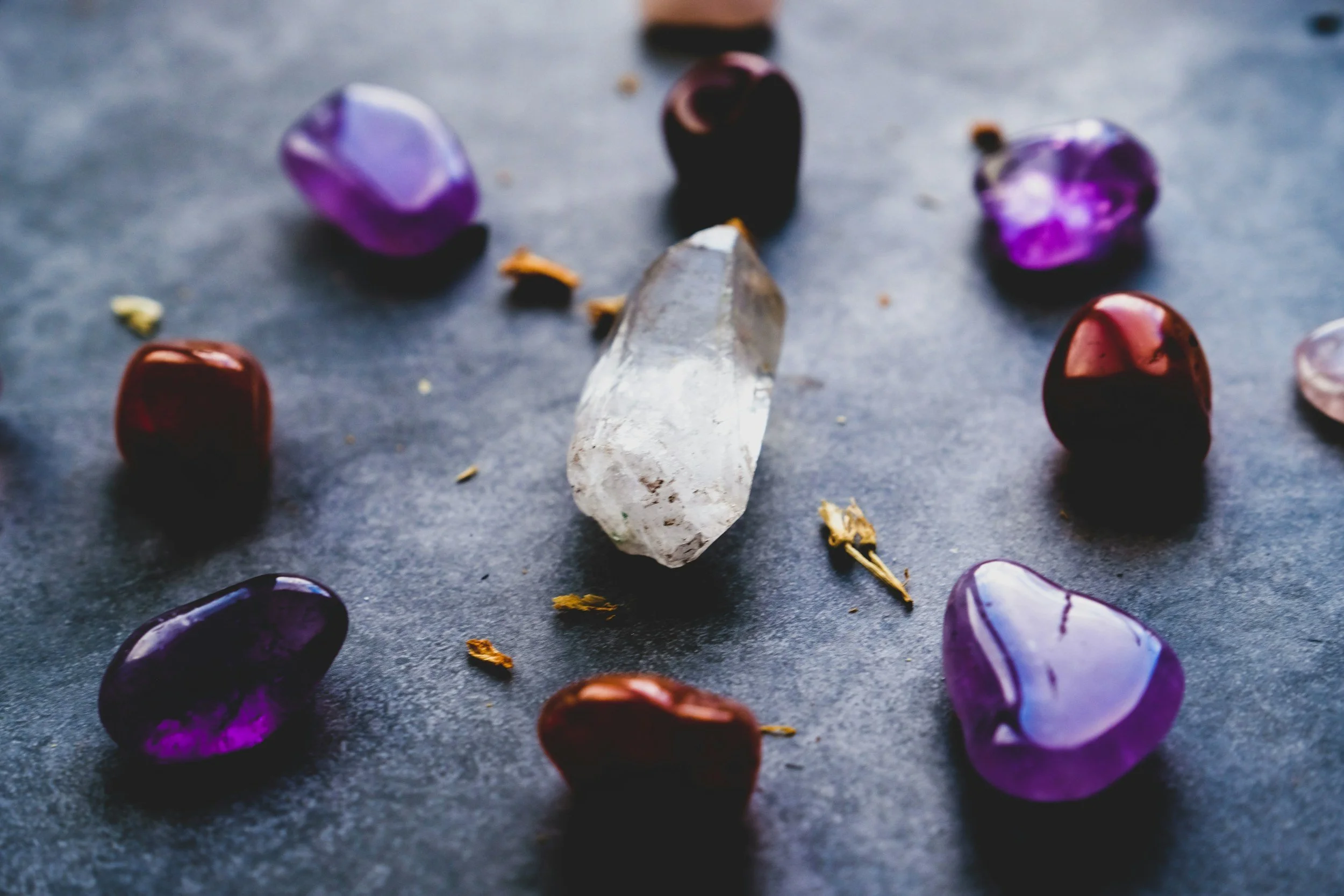
CRYSTALS AND STONES
Few things shimmer with as much allure — or stubborn mystery — as crystals. Born from earth’s pressure and patience, they are time itself, compacted into light. Across ages and continents, humans have knelt before their glinting faces: Egyptians carved lapis amulets to honor the gods, Celts wore amber for courage, and modern witches tuck quartz beneath their pillows to chase away bad dreams.
In this archive, you’ll find correspondences by color, element, and planetary rule — alongside notes on how to cleanse, charge, and attune your stones to your personal current of energy. Whether you approach crystals as sacred allies, geological wonders, or tools of intention, this library will teach you how to work with them respectfully, effectively, and enchantingly.
🜂 A
One of the oldest stones in the human decorative and protective record — agate beads have been found in Neolithic European burials and Egyptian tombs dating to 3500 BCE, and the stone appears in the breastplate of the Hebrew high priest. The banded chalcedony comes in an enormous range of colors and patterns, each variety carrying its own specific associations within the broader agate tradition: blue lace agate for gentle communication, fire agate for protection and vitality, moss agate for the garden and the slow work of growth, black agate for grounding and grief. What they share is the agate tradition's core quality: a stone that stabilizes, anchors, and holds steady what might otherwise drift. Correspondences: Earth element, Saturn and Mercury rulership depending on variety, grounding and protection.
The color-change chrysoberyl — green in daylight, red under incandescent light — was discovered in the Ural Mountains of Russia in 1830 and named for Tsar Alexander II, whose imperial colors happened to be green and red. A stone that changes its nature depending on the light that falls on it accumulated associations with duality, transformation, and the question of which version of a thing is real. In contemporary crystal practice alexandrite is associated with luck, creativity, and the integration of opposing forces within oneself — which is a reasonable interpretation of a stone that is genuinely two colors simultaneously, neither one more true than the other. Correspondences: Mercury rulership, Air and Water elements, transformation and balance.
Amber
Technically fossilized tree resin rather than a mineral, amber has been treated as a sacred stone since the Neolithic period — traded along the Amber Road from the Baltic coast to the Mediterranean, found in Egyptian New Kingdom tombs, worn by Norse warriors for courage and protection, and used in folk medicine as a cure for throat complaints across Northern Europe (because it was warm against the skin, which was read as life-giving). Amber that contains preserved insects — flies, ants, sometimes entire ecosystems in miniature — was considered particularly powerful, a window into deep time and evidence that the stone held what it touched. Correspondences: Sun rulership, Fire element, protection and vitality; also associated with ancestral memory and the preservation of what matters.
full entry coming soon
The purple quartz whose name derives from the Greek amethystos — "not drunk" — was worn as an amulet against intoxication in ancient Greece and Rome, the logic being that the wine-colored stone could absorb what wine did to the mind. Medieval bishops wore amethyst rings for its association with sobriety and spiritual clarity; the stone appears in the breastplate of the Hebrew high priest as one of the twelve tribal stones. In contemporary crystal practice amethyst is among the most versatile: associated with psychic development, dreamwork, protection during sleep, grief support, and the general category of clearing the mind sufficiently to hear what the quieter parts of oneself are saying. Correspondences: Jupiter and Neptune rulership, Water element, spiritual clarity and protection.
The natural combination of amethyst and citrine in a single crystal — purple and golden yellow occupying the same stone, meeting in a gradient that looks like a sunset in quartz — occurs naturally only in the Anahi mine in Bolivia, which has been producing it since at least the 17th century. A Spanish conquistador reportedly brought it to Europe as a wedding gift, which is either historically accurate or a story that someone felt the stone needed. In practice ametrine is used for the qualities of both its components simultaneously: the clarity and spiritual awareness of amethyst combined with the confidence and solar warmth of citrine. Correspondences: Jupiter and Sun combined rulership, Air and Water elements, balance and creative clarity.
Small, rounded nodules of natural obsidian glass — translucent at the edges when held to light — named for a legend of Apache women who wept for warriors killed by the U.S. Cavalry in the 1870s, their tears falling to earth and turning to stone. Whether the story is historically documented or an attribution attached after the name circulated, the legend gave Apache Tear its primary association: grief transmuted, tears held in stone, sorrow carried by the earth so the person need not carry it alone. In contemporary practice it is used for grief work, gentle emotional release, and the kind of protection that operates through compassion rather than hardness. Correspondences: Saturn rulership, Earth element, grief and gentle protection.
The pale blue-green beryl of seawater color has been associated with the ocean, with sailors' protection, and with clear communication since ancient Rome, where it was called aqua marina and sailors carried it for safe passage and to prevent seasickness. Medieval lapidaries associated it with courage and the sharpening of the intellect. In contemporary practice aquamarine is used for communication, clarity of expression, emotional courage, and the specific quality of calm that comes from knowing what you feel and being able to say it. The stone that helped sailors navigate open water became the stone that helps people navigate difficult conversations — a consistent metaphor across two thousand years. Correspondences: Moon and Neptune rulership, Water element, communication and emotional clarity.
The name comes from the Italian a ventura — by chance — referring either to the accidental discovery of the stone's glittery inclusion-heavy glass simulant in 18th century Venice, or to the stone's own associations with luck and fortunate accident. Green aventurine is the most common and most associated with opportunity, growth, and the kind of luck that arrives when you have done the preparation work and simply need the door to open. In folk practice it was carried by gamblers and placed in cash registers. In contemporary crystal work it is the stone of new beginnings and heart-centered confidence. Correspondences: Mercury and Venus rulership, Earth element, luck, opportunity, and the heart.
The deep, vivid blue copper carbonate mineral was ground into pigment by Egyptian, Greek, Roman, and Renaissance painters — the same stone that was a sacred material for visions and truth-speaking was also the blue in medieval illuminated manuscripts and European oil paintings until more stable pigments replaced it. Azurite was associated in ancient Egypt with wisdom, the third eye, and the sky realm of the gods. In Mesoamerican tradition blue stones including azurite were sacred to rain gods and sky deities. In contemporary practice azurite is used for psychic development, deep meditation, and the loosening of mental patterns that prevent clear perception. Correspondences: Jupiter and Venus rulership, Air and Water elements, psychic clarity and wisdom.
🜃 B
The beryl family — emerald, aquamarine, morganite, heliodor, goshenite, and red beryl — is among the most gemologically significant mineral families, producing some of the most valued stones in human history from the same basic aluminum beryllium silicate structure colored differently by trace impurities. Green chromium produces emerald; iron produces aquamarine and heliodor; manganese produces morganite. The medieval lapidary tradition treated different beryls as related but distinct, each carrying the beryl family's core associations with clarity, vision, and the sharpening of perception alongside the specific qualities of its color. Scrying mirrors made from beryl — the original crystal ball substitute — were called "berils" in medieval English, giving us the word "beryl" applied to the stone. Correspondences: Neptune and Moon rulership, Water element, vision and clarity.
Black tourmaline (Schorl)
The most common tourmaline and the one with the most extensive protective reputation — black tourmaline generates a weak electrical charge when heated or pressurized (piezoelectricity), which was noticed early enough to give it the Dutch name aschentrekker, "ash drawer," because it attracted ash and dust through static electricity. This electrical property fed directly into its protective associations: a stone that actively repelled things was a stone for protection. In contemporary practice black tourmaline is the most widely used protective stone, placed at doorways, carried on the body during difficult situations, and used to create energetic boundaries. Correspondences: Saturn rulership, Earth element, protection and grounding; specific association with EMF shielding in contemporary practice.
full entry coming soon
The dark green chalcedony flecked with red jasper inclusions that look, unmistakably, like drops of blood has been one of the most consistently powerful stones in the Western magical tradition since antiquity. Medieval Christian legend held that bloodstone formed at the Crucifixion, drops of Christ's blood falling on green jasper at the foot of the cross — a story that gave the stone enormous devotional significance and made it a common material for carving scenes of the Passion. Ancient Greek and Roman tradition associated it with the sun (heliotrope — sun-turner) and used it for wound healing, blood disorders, and the stopping of hemorrhage. In contemporary practice it is used for courage, vitality, and justice work. Correspondences: Mars rulership, Fire and Earth elements, courage and blood health.
Boji stones
The iron-based concretions found in Kansas — one smooth (female), one rough (male), used in pairs — are a 20th century crystal tradition rather than an ancient one, their properties and pairing practice developed by contemporary practitioners rather than inherited from historical sources. They are included here because they demonstrate how crystal lore continues to develop: new stones enter the tradition, acquire associations through use and attribution, and become genuinely embedded in contemporary practice within a generation. Boji stones are used for balancing polarities, grounding, and pain relief in the hands of practitioners who work with them regularly enough to have developed reliable personal relationships with the stones. Correspondences: Saturn and Earth rulership, grounding and polarity balance.
full entry coming soon
🜄 C
Calcium carbonate in crystalline form — one of the most common minerals on earth, the primary component of limestone, marble, chalk, and seashells — comes in an extraordinary range of colors (optical calcite, orange calcite, blue calcite, green calcite, mangano calcite, Iceland spar) each carrying distinct associations within a shared framework of gentle amplification and emotional clarity. Iceland spar — optical calcite — was used by Norse navigators as a sunstone for navigation, able to locate the sun through overcast skies through its double-refraction of polarized light. This has been confirmed by modern physics as a genuinely effective navigational technique. Correspondences vary by color; shared properties include amplification, clarity, and the softening of emotional calcification.
The warm red-orange chalcedony was among the most sacred stones of ancient Egypt — worn by the dead to ensure safe passage, placed in burial amulets of the highest significance, and associated with the blood of Isis. Islamic tradition holds that Muhammad wore a carnelian ring on his right hand, giving the stone a sacred status in Islamic jewelry tradition that continues today. Ancient Mesopotamian cylinder seals were carved from carnelian; Roman signet rings used it. In contemporary practice carnelian is associated with creativity, courage, motivation, and the specific warmth of confidence that moves from idea into action. Correspondences: Sun and Mars rulership, Fire element, vitality and creative action.
The pale blue strontium sulfate crystal — named for its sky color — is associated almost universally in contemporary practice with angelic communication, serenity, and the quieting of anxious thought. It is a relatively fragile stone (it fades in direct sunlight and dissolves slowly in water) that requires careful handling, which practitioners tend to interpret as evidence that it operates at a delicate frequency requiring equal care. Found in large geode formations in Madagascar, Ohio, and Sicily, celestite clusters are kept in rooms for their calming atmosphere rather than carried on the body. Correspondences: Neptune and Mercury rulership, Air element, angelic communication and mental calm.
The microcrystalline quartz family — encompassing agate, carnelian, chrysoprase, bloodstone, onyx, sardonyx, and jasper — is the most diverse and historically widespread family in the stone archive. Chalcedony itself, in its plain blue-white form, was used in ancient Mesopotamia for cylinder seals, in Greek and Roman rings and amulets, and is one of the twelve stones of the Hebrew high priest's breastplate. Its associations center on communication, calm, and the steady quality of a stone that neither excites nor agitates but simply holds its ground. Correspondences: Moon rulership, Water element, calm communication and emotional balance.
The blue-green copper silicate mineral associated with the goddess in multiple ancient traditions — found in the copper mines of ancient Egypt and the American Southwest, its color matching the blue-green that ancient Mediterranean cultures associated with water, healing, and the divine feminine. Cleopatra reportedly wore chrysocolla jewelry, and the stone was used in Egypt for carving small devotional figures. In contemporary practice chrysocolla is associated with communication, feminine wisdom, emotional healing, and the specific kind of empowerment that comes from speaking truth calmly and being heard. Correspondences: Venus and Mercury rulership, Water element, feminine wisdom and clear communication.
Chrysoprase
The apple-green chalcedony colored by nickel rather than iron — one of the rarest and most valued of the chalcedony family — was Alexander the Great's favorite stone, reportedly worn in his belt during battle. Medieval European tradition held that a thief sentenced to death could escape the noose if they held a chrysoprase in their mouth — a quality associated with the stone's general luck-bringing and truth-obscuring properties. In contemporary practice chrysoprase is associated with joy, abundance, and the heart — the green stone that connects the earth's prosperity to the heart's capacity to receive it. Correspondences: Venus rulership, Earth and Water elements, joy and abundance.
full entry coming soon
Natural citrine — yellow quartz colored by iron — is considerably rarer than the heat-treated amethyst sold as citrine in most commercial settings, which is a distinction worth noting because the lore developed around a stone that was primarily the natural version. Natural citrine does not accumulate negative energy in the same way that many stones are believed to — it is self-cleansing in the crystal tradition, which made it particularly practical for merchants who kept it in their cash drawers for prosperity. The Merchant's Stone: sunny, warm, associated with abundance, confidence, and the solar principle of putting energy out and drawing abundance back. Correspondences: Sun and Mercury rulership, Fire element, abundance and personal power.
Cleansing methods (stone)
The practice of cleansing stones — clearing accumulated energies before use or after difficult work — varies by tradition and by stone, since not all cleansing methods are safe for all materials. Moonlight cleansing is safe for almost everything and particularly appropriate for lunar-ruled stones. Smoke cleansing (incense or herb bundles) is universally safe. Running water cleanses but dissolves soft or porous stones including selenite, halite, and malachite. Salt can damage polished surfaces and soft stones. Sunlight fades amethyst, rose quartz, celestite, and fluorite. Burying in earth is effective but should be done carefully with fragile specimens. Sound — singing bowls, bells, tuning forks — is safe for all stones and works through vibration rather than physical contact. The method chosen should suit both the tradition and the stone.
full entry coming soon
Copper (as sacred metal)
The first metal worked by humans — copper tools predate bronze by thousands of years — copper was sacred to Venus and Aphrodite across Mediterranean traditions (the island of Cyprus, primary source of ancient copper, gave both the metal and the goddess their association). In folk medicine copper bracelets for arthritis are documented continuously from ancient to modern practice; the anti-inflammatory effect of copper absorbed through skin is supported by some research. In esoteric tradition copper conducts and amplifies, making it a natural material for magical tools that direct energy. Ayurvedic medicine stores water in copper vessels for its antimicrobial properties, which are genuine and documented. Correspondences: Venus rulership, Water element, love, healing, and conduction of energy.
full entry coming soon
Coral
The calcium carbonate skeletons of marine organisms — red coral most prized, also white, pink, and black — have been used as protective amulets since the ancient Mediterranean, where coral was believed to ward the evil eye, protect children, and stop bleeding. Roman children wore coral amulets; it was considered one of the strongest protective materials available for the young and vulnerable. In Tibetan Buddhist tradition red coral appears in sacred jewelry alongside turquoise and lapis. In Italian folk tradition the coral horn (cornicello) remains one of the most widely worn protective amulets. The sustainability crisis surrounding coral collection makes this a stone the archive covers as history and tradition rather than as a material to acquire. Correspondences: Mars and Venus rulership, Water element, protection especially of children.
full entry coming soon
🜁 D
The hardest natural material — carbon compressed over billions of years into crystalline form — was called adamas in Greek: unconquerable, indestructible. Indian tradition knew diamonds for over three thousand years before European awareness of them; Hindu texts describe diamonds as belonging to Indra and carrying the thunderbolt's power. The European tradition of diamond engagement rings dates to the 1477 betrothal of Mary of Burgundy, and was substantially reinforced by De Beers' 1947 marketing campaign "A Diamond is Forever" — one of the most successful advertising slogans in history, which created and then normalized a tradition barely a century old. The diamond's actual ancient associations are with invincibility, clarity, and the divine light that passes through without being captured. Correspondences: Sun rulership, Fire element, invincibility and clarity.
The deep blue aluminum silicate mineral — sometimes called the "patience stone" or the stone of self-discipline — is named for the French paleontologist Eugène Dumortier and has no ancient folk history to draw on, its associations developed entirely within contemporary crystal practice. It is used for mental organization, patience with long-term projects, the reduction of stubbornness, and the specific quality of ordered thinking that sustained difficult work requires. The fact that it has accumulated a specific and consistent set of associations within a few decades of widespread use in the crystal community demonstrates that the process of meaning-making around stones is ongoing rather than historical — the archive is always being written. Correspondences: Saturn and Mercury rulership, Air element, patience and mental clarity.
🜂 E
The green beryl sacred to Venus, Aphrodite, and the Aztec goddess Chalchiuhtlicue — one of the most valued stones in virtually every ancient culture that had access to it. Egyptian emeralds from Cleopatra's mines in the Eastern Desert were distributed as royal gifts; the Aztec rulers wore emerald-encrusted headdresses; Islamic tradition held that emerald was the stone of paradise. Medieval lapidaries associated it with prophecy, truth-telling, and the detection of lies — it was believed to shatter in the presence of falsehood. Hermes Trismegistus's Emerald Tablet, the foundational text of Western alchemy, derives its name from the tradition that divine wisdom was inscribed on a green stone. Correspondences: Venus rulership, Earth and Water elements, love, truth, and prophetic vision.
The dark green to pistachio-colored silicate mineral whose name derives from the Greek for "addition" — its crystal structure adds an extra layer — has accumulated associations with amplification, attraction, and the specific uncomfortable quality of receiving more of whatever you are already experiencing. Contemporary practitioners note that epidote tends to intensify the predominant energy of the person working with it: more of what you bring, returned to you amplified. This makes it excellent for positive states and inadvisable during grief or anxiety without awareness of what it is doing. A stone that amplifies before it transforms is a stone requiring honesty about what you are bringing to it. Correspondences: Earth element, amplification and manifestation.
Ethical sourcing (crystals)
The crystal industry has a supply chain problem that the industry has been slow to address and consumers are increasingly asking about. Most crystals reach Western markets through complex chains of small-scale mining operations, middlemen, and importers in which the original extraction conditions — labor practices, environmental impact, community benefit — are largely invisible by the time the stone reaches a retail display. Problematic mining conditions are documented in Congo (for coltan and tourmaline), in Madagascar, Myanmar, and parts of South America. Ethical sourcing requires asking where a stone was mined, by whom, and under what conditions — questions that most vendors cannot answer. The archive covers this not to discourage but to inform: a stone that cost someone's health or safety to extract does not begin its relationship with its new owner neutrally.
full entry coming soon
🜃 F
The mineral that gave the word "fluorescence" to science — fluorite glows under ultraviolet light in colors distinct from its daylight appearance — comes in purple, green, blue, yellow, clear, and multicolored banded forms, each variety carrying its own specific associations while sharing the family's reputation for mental clarity and the organization of chaotic thought. Called the "Genius Stone" in some contemporary traditions for its specific usefulness during study, complex projects, and the kind of sustained mental effort that requires holding multiple considerations in alignment simultaneously. Fades in prolonged sunlight. Correspondences: Mercury and Neptune rulership, Air element, mental clarity, focus, and psychic awareness.
Fossil (as sacred material)
Ammonites, belemnites, shark teeth, petrified wood, and other fossils have been used as sacred, protective, and magical objects across cultures for as long as people have found them. Ammonites — the coiled spiral shells of ancient cephalopods — were called shaligrams in Hindu tradition and understood as the embodiment of Vishnu, gathered from the Gandaki River in Nepal and worshipped on home altars. In English folk tradition, coiled ammonites were called "snakestones" and believed to be petrified snakes, sold as cures for snakebite. Fossil shark teeth were called "tongue stones" and carried as protective amulets against poison. Objects this old are understood as carrying the condensed time of the earth itself — which is, in geological terms, exactly what they are. Correspondences: Saturn rulership, Earth element, ancestral connection and deep time.
full entry coming soon
🜄 G
Garnet
The deep red pyrope garnet — most familiar, most associated with the stone's primary reputation — was called carbunculus in Latin and believed to glow in the dark like a burning coal, illuminating the darkness for its bearer. Noah's ark, in certain Talmudic traditions, was lit by a great garnet. Garnets were placed in graves across multiple ancient cultures and worn by warriors going to battle. The full garnet family includes green tsavorite, orange spessartine, purple almandine, and the remarkable color-change properties of some rare varieties — but the red garnet's association with life force, passion, devotion, and the willingness to act on what matters has defined the stone's tradition for millennia. Correspondences: Mars rulership, Fire element, passion, vitality, and committed devotion.
full entry coming soon
Gold (as sacred metal)
The metal that does not tarnish — that keeps its brilliance indefinitely without effort — made gold the universal symbol of the divine, the eternal, and the incorruptible across virtually every culture that had access to it. The Sun's metal in Western astrological tradition, gold was used for divine images, temple decoration, royal regalia, sacred vessels, and the most important amulets specifically because it could not be corrupted by time. Alchemists sought to make gold not only because of its monetary value but because making gold meant understanding the principle of incorruptibility — the philosopher's stone was a means to gold as a means to understanding the eternal. The metal's actual chemical stability was the physical basis of its metaphysical significance. Correspondences: Sun rulership, Fire element, divinity, incorruptibility, and solar power.
full entry coming soon
🜁 H
Halite (rock salt)
Crystalline sodium chloride — salt in its mineral form — sits at the intersection of the culinary, the medicinal, the preserving, and the deeply sacred in ways that no other mineral quite matches. Himalayan pink halite, Bolivian rose halite, and salt lamps are contemporary forms of a stone used in ritual purification, food preservation, covenant-sealing, and protective circles since before written records. Salt lamps are believed to release negative ions that improve air quality — the research on this is modest — but the practice of keeping salt in a room as a purifying and protective substance has roots considerably older than ionization theory. The mineral form of the substance that seals covenants, preserves the dead, and draws a circle of protection deserves its place in any stone archive. Correspondences: Earth element, purification and protection.
full entry coming soon
Hematite
Iron oxide — the mineral that gives Mars its red color, that stains ochre paintings in prehistoric caves, that was ground into cosmetic pigment in ancient Egypt and used for funeral rites across the ancient world. Hematite's name derives from the Greek haema, blood, for the red it produces when ground. Its polished silver-gray surface reflects, imperfectly, which made it an early mirror material and associated it with the ability to see clearly without distortion. In contemporary practice hematite is among the most widely used grounding stones — heavy, cool, metallic, anchoring — placed at the feet during energy work to connect the practitioner to the earth. Correspondences: Saturn and Mars rulership, Earth element, grounding, protection, and strength.
full entry coming soon
Howlite
The white calcium borosilicate mineral with gray veining — soft, matte, and readily dyed to imitate turquoise (dyed howlite is the most common turquoise substitute in mass market jewelry) — has its own unassuming associations with patience, calm, and the reduction of anxiety independent of what it is usually sold as. The distinction between genuine howlite and dyed howlite-as-turquoise matters for the practitioner who is working with turquoise specifically and receiving howlite instead — which happens more often than the labels suggest. The archive covers both: howlite in its own right for its calm and patience associations, and the identification question for those who want to know what they actually have. Correspondences: Moon rulership, Air element, calm, patience, and open-mindedness.
full entry coming soon
🜂 I
Iolite (Cordierite)
The blue-violet silicate mineral with strong pleochroism — appearing different colors (violet, blue, gray, yellow) depending on the angle of view — was called "water sapphire" historically and is believed by some researchers to be the Viking sunstone: a crystal capable of locating the sun through overcast skies by analyzing polarized light, used for navigation before magnetic compasses were available. The evidence for this is intriguing and not fully resolved. In contemporary practice iolite is associated with inner vision, the third eye, and the navigation of one's inner landscape with the same precision a Viking navigator sought in the external one. Correspondences: Saturn and Neptune rulership, Air element, vision, navigation, and inner clarity.
full entry coming soon
Iron (as sacred metal)
The metal hostile to fairies, repellent to evil spirits, protective against curse and malevolence in European folk tradition — and sacred to Mars, associated with war, surgery, and the forge in classical tradition. The folk belief that iron repels supernatural forces likely derives from the Iron Age's disruption of older Bronze Age cultures: iron was the new technology, the human world asserting dominance over the older wildness that predated it. Iron horseshoes over doors, iron nails in thresholds, iron scissors left open under cradles to protect newborns — the folk magic applications all use iron's symbolic quality as the metal of the human-made world against what the human world had not yet learned to master. See also: Symbolarium — Iron (protective properties of). Correspondences: Mars rulership, Fire element, protection and strength.
full entry coming soon
🜃 J
Jade (Jadeite and Nephrite)
Two distinct minerals share the name jade — jadeite and nephrite — united by their extraordinary toughness (harder to break than most stones despite not being the hardest) and by China's five-thousand-year relationship with the stone that makes the Chinese jade tradition the most elaborate single-stone tradition in human history. Jade was the stone of heaven, of imperial authority, of the five virtues (benevolence, wisdom, courage, justice, and purity), of immortality — jade burial suits sewn from thousands of pieces were prepared for Han dynasty royalty in the belief that jade could preserve the body from decay. The Aztec tradition held jade more valuable than gold. New Zealand Maori hei-tiki jade figures are ancestral talismans. Correspondences: Venus and Jupiter rulership, Earth element, protection, nobility, and longevity.
full entry coming soon
Jasper (family overview)
The opaque, patterned chalcedony that comes in red, yellow, brown, green, blue, and polychrome forms — each with its own name and distinct tradition — is one of the oldest stones used by humans, found in Paleolithic tool-making sites and Neolithic ceremonial contexts worldwide. Red jasper appears in the breastplate of the Hebrew high priest. Picture jasper carries landscape-like inclusions that look like painted desert scenes. Fancy jasper blends multiple colors in swirling patterns. Ocean jasper comes only from a small coastal deposit in Madagascar, accessible only at low tide. What the jaspers share is the tradition of sustained, nurturing support — the stone family associated with care, endurance, and the qualities of the earth that sustain without drama. Correspondences: Earth element, Saturn rulership for darker forms, nurturing and endurance.
full entry coming soon
Jet
Fossilized driftwood compressed over millions of years into a dense, black, lightweight material that takes a high polish and generates static electricity when rubbed — jet was worked into jewelry and amulets in the British Neolithic, traded across Roman Europe from its primary source in Whitby, Yorkshire, and became the defining material of Victorian mourning jewelry after Queen Victoria wore it throughout her forty years of widowhood following Prince Albert's death. Jet's association with protection, grief, and the drawing off of negative energy runs from its Neolithic protective use through to contemporary practice essentially unchanged — a material trusted for five thousand years to absorb and protect remains trusted for the same purposes. Correspondences: Saturn rulership, Earth element, protection, grief, and the absorption of negative energy.
full entry coming soon
🜄 K
Kunzite
The pale pink to violet spodumene — named for gemologist George Frederick Kunz, who first described it in 1902 — is one of the newer stones in the archive, without ancient folk tradition but with a consistent contemporary reputation for heart healing, emotional vulnerability, and the specific kind of opening that follows grief or protective closure around the heart. It fades in prolonged sunlight, which practitioners note as appropriate for a stone associated with the kind of delicate emotional states that also need to be protected from too much intensity too quickly. A stone that cannot be left in the sun is a stone for the work done in softer light. Correspondences: Venus and Pluto rulership, Water element, heart healing and emotional opening.
full entry coming soon
Kyanite
The blue aluminum silicate mineral with a distinctive bladed crystal structure — found in blues from pale sky to deep indigo, also in green, black, and orange forms — is notable in contemporary crystal practice for being one of the stones said to neither accumulate negative energy nor require cleansing, which makes it an unusual working material in a tradition heavily concerned with energetic maintenance. Blue kyanite is associated with communication, specifically with the alignment between what one thinks, what one feels, and what one says — the stone for closing the gap between inner experience and outer expression. Correspondences: Mercury and Jupiter rulership, Air element, communication and alignment.
full entry coming soon
🜁 L
Labradorite
The feldspar mineral whose spectacular play of iridescent color — blue, green, gold, copper, purple — appears and disappears as the stone moves in light, called labradorescence after the Labrador peninsula where it was first described by European observers in 1770, though the Inuit peoples of the region had used and valued it for far longer. Inuit legend held that the aurora borealis had been trapped in the coastal rocks, and a warrior had struck them with his spear to free most of it — what remained inside the rocks became labradorite. In contemporary practice labradorite is the stone of the magic practitioner specifically — associated with the veil between worlds, psychic awareness, and the protection of the aura. Correspondences: Uranus and Moon rulership, Air element, magic, protection, and inner knowing.
full entry coming soon
Lapidary tradition (overview)
The lapidary — a text describing the properties and correspondences of stones — is one of the oldest genres of written knowledge, with roots in ancient Mesopotamian and Egyptian stone lists and a continuous tradition of European production from the classical period through the Renaissance. The most influential medieval lapidary is the Lapidarium of Marbode of Rennes (c. 1090), which described sixty stones and their properties in verse and was copied and translated throughout Europe for centuries. Lapidaries combined geological observation, medical application, astrological correspondence, and magical use without distinguishing between them — the same entry would describe a stone's color, its medical uses, its planetary ruler, and the circumstances under which it worked best as a single integrated account. The contemporary crystal book is the lapidary tradition's direct descendant.
full entry coming soon
Lapis Lazuli
The deep blue metamorphic rock flecked with gold pyrite — the night sky in stone — was the most valued blue pigment of the ancient and medieval world (ultramarine, ground from lapis, was more expensive than gold and reserved for painting the Virgin Mary's robe) and one of the most sacred stones of ancient Egypt. Lapis lazuli was mined in the Badakhshan region of Afghanistan for over six thousand years and traded across the ancient world from Mesopotamia to the Indus Valley. Egyptian gods were painted lapis blue; lapis amulets protected the dead; the funeral mask of Tutankhamun is inlaid with it. In Sumer it was the stone of the heavens, the night sky made portable. Correspondences: Jupiter and Saturn rulership, Air and Water elements, divine wisdom, truth, and the night sky.
full entry coming soon
Lead (as ritual metal)
The metal of Saturn — heavy, dull, toxic in sustained exposure — was the alchemist's prima materia: the base substance from which gold might be made through the great work of transformation. Lead's astrological association with Saturn made it the natural material for Saturn-ruled magical operations: binding, limitation, the slowing of processes, and cursing. Ancient curse tablets (defixiones) found across the Roman world were inscribed on thin lead sheets and thrown into wells, buried at thresholds, or deposited in graves — lead holding the curse in the cold, heavy, Saturnine way that iron held protection. The same metal that anchored curses in the ancient world weighed down the fishing nets that fed ancient communities. Saturn provides through restriction, which is the metal's gift and its warning. Correspondences: Saturn rulership, Earth element, binding, transformation, and weight.
full entry coming soon
Lepidolite
The lilac to purple mica mineral that contains natural lithium — the same element used in psychiatric medication for mood stabilization — and has accumulated, with some justification, a reputation for calming anxiety, supporting emotional equilibrium, and helping with sleep. The lithium content is real; whether it can be absorbed in meaningful quantities through skin contact with the stone is not clearly established. What is clear is that practitioners who work with lepidolite report consistent results that match its reputation, which is either pharmacological, energetic, or the result of working with a stone while genuinely believing in what you are doing — all of which are legitimate mechanisms in a tradition that has never required one to work to the exclusion of the others. Correspondences: Jupiter and Neptune rulership, Water element, calm and emotional balance.
full entry coming soon
🜂 M
Malachite
The green banded copper carbonate — intense, concentric, unmistakable — was one of the most important stones of ancient Egypt, where it represented the fertile green of the Nile floodplain and the regenerative power of the goddess Hathor. The Field of Malachite was the Egyptian name for paradise. Malachite was ground as a cosmetic pigment (the green eye makeup of Egyptian painting) and as an artist's pigment in European painting. It is toxic in powdered form — copper carbonate dust should not be inhaled — which means the same stone applied to the eyes in ancient Egypt was somewhat alarming by modern standards and effective as both cosmetic and eye treatment. In contemporary practice malachite is used for transformation, protection, and the amplification of whatever energy is present — which requires clarity about what energy you are bringing. Correspondences: Venus rulership, Earth element, transformation and heart protection.
full entry coming soon
Meteorite (iron)
Metal that fell from the sky — iron meteorites were the first source of worked iron available to cultures that had not yet developed smelting, and the consequence is that sky iron appears in the most sacred and prestigious objects of the Bronze Age: the iron dagger in Tutankhamun's tomb, the iron beads of ancient Egyptian predynastic burials, the sacred Chintamani stone of Buddhist tradition (possibly a meteorite). Inuit peoples used iron meteorites as a source of tool metal for centuries. A stone that arrives from beyond the atmosphere carries a provenance that no earthly material can match — it is literally from elsewhere, which has always been understood as making it more powerful than what stays. Correspondences: Mars and Uranus rulership, Fire element, cosmic connection and strength.
full entry coming soon
Moldavite
The glassy green tektite formed from a meteorite impact in the Bohemian region of the Czech Republic approximately 14.8 million years ago — technically neither a stone nor a metal but a natural glass formed from terrestrial material melted and transformed by extraterrestrial impact — has become the most intensely hyped stone in contemporary crystal practice, associated with rapid transformation, spiritual acceleration, and an initiation-like intensity that practitioners describe variously as extraordinary and destabilizing. The hype has produced both genuine accounts of powerful experiences and a significant counterfeiting problem: most moldavite sold online is glass. Genuine moldavite is identifiable by specific inclusions, surface texture, and locality. The real stone's effect, in the experience of those who have worked with it, generally matches its reputation. The fake stone's effect matches what you bring to a piece of glass. Correspondences: Uranus and Pluto rulership, transformation and rapid change.
full entry coming soon
Moonstone
The feldspar mineral whose adularescence — a floating, billowing glow that moves beneath the surface as the stone moves — made it one of the most widely sacred stones in human history. In Hindu tradition moonstone is sacred and auspicious, formed from solidified moonbeams; it is one of the stones of the navaratna (nine gemstones) used in sacred jewelry and astronomical talismans. Roman tradition held that moonstone contained the image of the moon and changed with the lunar cycle. In contemporary practice moonstone is associated with intuition, the lunar cycle, feminine energy, and the emotional attunement that increases with the willingness to be moved by what is actually happening rather than what one expected. Correspondences: Moon rulership, Water element, intuition, the divine feminine, and lunar cycles.
full entry coming soon
Morganite
The pale pink beryl — named for financier J.P. Morgan, who donated a significant gem collection to the American Museum of Natural History — carries no ancient tradition and its contemporary reputation for divine love, compassion, and emotional healing developed relatively recently in the crystal community. It is included not to apologize for its recent origin but because it demonstrates that Venus-ruled, pink, heart-associated stones tend to accumulate heart-healing associations regardless of whether anyone has decided to assign them — the color and the correspondence arrive at the same destination through different routes. Morganite is what happens when a stone is pretty enough, pink enough, and available enough that enough people begin working with it. Correspondences: Venus rulership, Water element, divine love and compassion.
full entry coming soon
🜃 N
Nuummite
One of the oldest minerals on Earth — Nuummite from Greenland is approximately three billion years old, among the most ancient stone material available in the contemporary market — composed of interlayered amphibole minerals that produce a strong iridescent play of gold, red, and blue across a black ground. The Inuit peoples of Greenland used it for tool-making and as a sacred material; its modern metaphysical reputation is as a stone of deep self-knowledge, shadow work, and the confrontation of what has been suppressed or denied. A stone three billion years old brought to bear on the most recent and personal human problems is either appropriate or absurd, depending on how you feel about the relationship between geological time and individual psychology. Correspondences: Pluto and Saturn rulership, Earth element, shadow work and ancient wisdom.
full entry coming soon
🜄 O
Obsidian
Volcanic glass — formed when lava cools too quickly for crystalline structure to develop — has been used as a tool-making material since the Paleolithic, its fracturing into reliably sharp edges making it the primary surgical and hunting tool of cultures worldwide that had access to volcanic sources. The Aztec god Tezcatlipoca, lord of darkness, night, and the sky, was associated with obsidian; his name means "smoking mirror" and his obsidian mirror was used for divination and to see hidden truths. John Dee's scryer Edward Kelley used an obsidian mirror, still held at the British Museum. In contemporary practice obsidian — especially black obsidian — is one of the most intensely protective and truth-revealing stones available, used for shadow work, psychic protection, and the kind of mirror that shows what is actually there rather than what you want to see. Correspondences: Pluto and Saturn rulership, Earth element, truth, protection, and the shadow self.
full entry coming soon
Onyx
The banded chalcedony — black onyx most familiar, though genuine onyx is banded black and white — has been used for cameos, seals, and protective amulets since antiquity. Medieval lapidaries were ambivalent about it: some praised it for protection and strength; others warned it caused bad dreams, conflict, and general misfortune. Arabian tradition held that onyx placed near a sleeping pregnant woman would cause premature labor; children in China were reportedly not allowed to wear it. The stone that protects the warrior and disturbs the sleeper is doing the same work in both cases — it heightens, intensifies, and brings to the surface what was present and unacknowledged. In contemporary practice it is used for strength, endurance, and the processing of grief. Correspondences: Saturn rulership, Earth element, strength, protection, and grief.
full entry coming soon
Opal
The stone that contains all colors simultaneously — its play-of-color (not to be confused with iridescence) produced by the diffraction of light through microscopic silica spheres arrayed in a regular pattern — has been associated with both extraordinary luck and extraordinary misfortune depending on the tradition. Roman tradition placed opal at the peak of all gems, containing as it did the fire of ruby, the purple of amethyst, the green of emerald. The reputation for bad luck developed in the 19th century, partly through Sir Walter Scott's novel Anne of Geierstein (1829) in which an enchanted opal brings misfortune to its owner. The opal's actual tradition before Scott is one of the most celebrated. The century after is one of the most unfortunate. Both belong in the full entry. Correspondences: Moon and Neptune rulership, Water element, amplification and emotional intensity.
full entry coming soon
🜁 P
Pearl
Not a mineral but a biological product — concentric layers of nacre deposited by a mollusk around an irritant — pearl has been among the most valued luxury materials in human history and the only one that requires a living creature to be harmed in its extraction (culturing reduces but does not eliminate this). Sacred to moon goddesses and water deities across cultures, pearls appear in Hindu tradition as sacred tears of the divine, in Islamic tradition as the stones of paradise, in Roman tradition as the ultimate symbol of wealth and decadence. Caligula's horse was given pearl ornaments; Cleopatra famously dissolved a pearl in vinegar and drank it to win a bet about extravagance. Natural pearls are now extraordinarily rare. Correspondences: Moon rulership, Water element, purity, wisdom, and the beauty that arises from sustained difficulty.
full entry coming soon
Peridot
The yellow-green olivine gemstone called "gem of the sun" by ancient Egyptians, mined on the volcanic island of Zabargad (St. John's Island) in the Red Sea for over three thousand years. The Egyptians believed it protected against evil spirits especially at night, and some scholars believe that many of the "emeralds" of the ancient world — including those of Cleopatra's legendary collection — were actually peridot. Medieval European tradition held that peridot set in gold protected against night terrors, and the stone's association with warding nightmares and negative spiritual influence is consistent across its full tradition. Correspondences: Sun and Venus rulership, Earth element, protection, abundance, and the warding of nightmares.
full entry coming soon
Planetary stone correspondences
The association of specific stones with each of the classical seven planets — and the three outer planets added by modern astrology — forms the structural backbone of Western gem magic tradition, documented in lapidaries, in Picatrix, in Cornelius Agrippa's Occult Philosophy, and in the Vedic navaratna system. Sun: diamond, amber, sunstone, citrine. Moon: moonstone, pearl, selenite, clear quartz. Mercury: agate, fluorite, aventurine. Venus: emerald, rose quartz, malachite, copper. Mars: garnet, bloodstone, red jasper, iron, ruby. Jupiter: sapphire, lapis lazuli, amethyst, tin. Saturn: obsidian, jet, onyx, hematite, lead. The system is not universally agreed upon — different sources assign different stones — but the framework itself is stable enough to use as an organizational principle for working with intention.
full entry coming soon
Pyrite
Fool's gold — the iron sulfide mineral that frustrated every 16th century prospector in the American West who mistook it for the real thing — has been used as a protective and prosperity stone since the Inca, who polished it into mirrors for divination and used it in ritual contexts with the same reverence their descendants bring to other metals. Pyrite generates sparks when struck with iron, making it one of the earliest fire-starting materials and giving it an association with the spark of intelligence and the generation of warmth. In contemporary practice pyrite is used for manifestation, confidence, and the assertion of willpower — the stone that looks like gold but is harder, that looks valuable but requires the intelligence to recognize real value. Correspondences: Sun and Mars rulership, Fire element, willpower, abundance, and protection.
full entry coming soon
🜂 Q
Quartz, clear
Silicon dioxide in its purest form — the most abundant mineral on earth's surface, found on every continent, in almost every geological environment — has been the most universally used stone in human history precisely because of its availability and its extraordinary properties. Quartz generates electricity under pressure (piezoelectricity) and oscillates at a precise and reliable frequency that makes it the basis of modern electronics, from quartz watches to radio oscillators. In the stone tradition it is the universal amplifier, the stone that intensifies the properties of whatever surrounds it, the clear mirror that neither adds nor subtracts. Crystal balls are quartz. Shamanic crystal quartz from the Americas is understood as a living spirit ally. The stone that runs modern civilization and the stone tucked under a witch's pillow are the same mineral doing the same thing at different scales. Correspondences: All planetary rulers, all elements, amplification and clarity.
full entry coming soon
Quartz, rose
The pale pink quartz colored by titanium, iron, or manganese inclusions — the stone of love in virtually every crystal tradition that includes it — has been carved into love tokens since ancient Egypt and Rome, where it was believed that Eros or Cupid brought rose quartz to earth as a gift of love for humanity. The myth was probably applied to a stone already in use for its color associations, but it served to formalize what the color already communicated: pink, gentle, warm, the stone of the heart rather than the passions. In contemporary practice rose quartz is the entry point for most people beginning to work with stones — accessible, gentle, associated with self-love, romantic love, and the kind of compassion that begins with oneself and extends outward. Correspondences: Venus rulership, Water element, love, compassion, and the heart.
full entry coming soon
Quartz, smoky
Clear quartz irradiated by natural radiation from surrounding granite — the brown-gray-black coloring a result of the same geological processes that produce radioactive environments, at levels entirely safe for handling — has been associated across cultures with grounding, protection, and the transmutation of negative energy. The Scots called it cairngorm, after the mountains where it is found in quantity, and set it in the handles of ceremonial dirks and brooches. Ancient Egyptians carved it into protective amulets. In contemporary practice smoky quartz is the complement to clear quartz: where clear amplifies everything equally, smoky grounds, anchors, and specifically addresses what needs to be moved down and out rather than elevated. Correspondences: Saturn and Earth rulership, Earth element, grounding and transmutation.
full entry coming soon
🜃 R
Rhodochrosite
The pink to red manganese carbonate mineral — banded in cream and rose like a geological rose garden — is called the Inca Rose because it was found in the silver mines of Argentina long worked by the Inca, who believed it was the petrified blood of their ancient kings and queens. The stone's association with love and compassion comes partly from its color and partly from this mythology: royal blood preserved in stone, the past becoming material present. In contemporary practice rhodochrosite is used specifically for healing old emotional wounds, reclaiming the self after loss, and the kind of self-love that requires confronting rather than bypassing what was painful. Correspondences: Venus rulership, Water and Fire elements, emotional healing and self-love.
full entry coming soon
Ruby
The red corundum — colored by chromium, the same element that makes emeralds green — was called ratnaraj in Sanskrit: king of precious stones. Hindu tradition placed ruby at the center of the navaratna, the nine sacred gems; Buddhist tradition describes the city of the gods as paved with it. Marco Polo described the ruby of the King of Ceylon as so large it could not be bought for the wealth of an entire city. Medieval European lapidaries held that ruby predicted misfortune by darkening in color — the stone that warned its owner of approaching danger. In contemporary practice ruby is associated with life force, passion, courage, and the blood's energy — the stone of vital engagement with the conditions of one's life. Correspondences: Sun and Mars rulership, Fire element, vitality, passion, and protection.
full entry coming soon
🜄 S
Sapphire
The blue corundum associated with wisdom, divine favor, and the heavens since antiquity — the Ten Commandments were held in some traditions to have been written on sapphire tablets; medieval bishops wore sapphire rings to indicate their spiritual authority; the Persians believed the sky was blue because the earth rested on an enormous sapphire whose reflection colored the heavens. In medieval European lapidary tradition sapphire was the stone of the soul, protecting it from envy and attracting divine blessing. In contemporary practice sapphire is used for wisdom, spiritual clarity, truth-speaking, and the kind of mental discipline that distinguishes knowledge from wisdom. Correspondences: Jupiter and Saturn rulership, Air element, wisdom, truth, and divine favor.
full entry coming soon
Selenite
The crystalline form of gypsum — named for Selene, goddess of the moon — is a soft, pearlescent mineral that cleaves into flat plates and wands, grows in remarkable cave formations (the Cave of the Crystals in Chihuahua, Mexico contains selenite crystals over ten meters long), and dissolves slowly in water, which means it cannot be cleansed with water and should never be left in rain. In contemporary practice selenite is one of the most widely used stones for space clearing, alignment, and — like kyanite — said not to accumulate negative energy. Selenite wands are used to sweep the aura; selenite placed on other stones is said to cleanse them. Whether or not one accepts the mechanism, selenite's pearlescent light-catching quality makes it one of the most visually appropriate stones for a space that is intended to feel clear and calm. Correspondences: Moon rulership, Air and Water elements, clearing, alignment, and lunar energy.
full entry coming soon
Shungite
The black carbon-based mineraloid from the Karelia region of Russia — approximately two billion years old, containing fullerenes (complex carbon molecules) in a form found nowhere else on earth — has been used medicinally since the 17th century, when Peter the Great ordered soldiers to carry shungite to purify their drinking water, a use confirmed as effective by its genuine antibacterial properties. In contemporary practice it has been widely marketed for EMF protection, a claim that the research does not clearly support but that practitioners report benefits from, possibly through the placebo-adjacent mechanism of having a stone one trusts for protection. The water purification property is real. The EMF claim is contested. Both deserve honest treatment. Correspondences: Saturn and Earth rulership, Earth element, purification and grounding.
full entry coming soon
Silver (as sacred metal)
The Moon's metal — reflective, cool, associated with feminine energy, intuition, and the tides — has been worked into sacred objects, currency, and protective amulets since ancient times with an unbroken continuity matched only by gold. Silver kills werewolves and repels vampires in European folk tradition (silver's antimicrobial properties killing what the folk tradition categorized as monstrous). Mirrors were traditionally made of silver (the silver behind the glass). Silver was used in Ayurvedic medicine, in ancient wound treatment, and in modern medical dressings for its documented antimicrobial effects. The protective tradition and the medical tradition are, as usual in this archive, drawing on the same real property through different explanatory frameworks. Correspondences: Moon rulership, Water element, protection, intuition, and lunar energy.
full entry coming soon
Sodalite
The deep blue sodium aluminum silicate mineral — often confused with lapis lazuli, distinguished by its white calcite veining and the absence of pyrite — was called the "Poet's Stone" in some traditions for its associations with communication, truth, and the alignment between what is thought and what is spoken. The Aztecs brought it from Canada to Mexico in trade routes documented archaeologically long before European contact. In contemporary practice sodalite is used for logical thought, honest self-examination, and the reduction of defensiveness that allows genuine communication. A stone associated with truth in multiple traditions whose primary visual distinction from lapis is its freedom from the gold that lapis carries — the stone of truth without the ornamentation of status. Correspondences: Mercury rulership, Air element, truth, logic, and clear communication.
full entry coming soon
Sugilite
The rare purple manganese silicate — found in significant quantities only in the Kalahari manganese field of South Africa, discovered as a gemstone quality material only in 1979 — accumulated its contemporary reputation as a stone of spiritual protection and love with remarkable speed. It is associated with the violet ray of spiritual protection, with the light of higher consciousness, and with the specific kind of loving boundaries that protect sensitive people from absorbing others' energies. A stone found less than fifty years ago with a tradition that feels older than it is: this is how tradition is made when people work with something consistently and compare notes honestly about what they find. Correspondences: Saturn and Jupiter rulership, Fire element, spiritual protection and love.
full entry coming soon
Sunstone
The aventurescent feldspar — copper-based inclusions producing a glittery, warm, metallic flash across orange to red to gold — may be the legendary Viking sunstone used for navigation alongside iolite, since feldspar with strong optical properties can locate the sun through cloud cover. The Norse Saga of King Olaf references a sunstone used for navigation; archaeological discovery of a roughly worked feldspar in a Viking-era shipwreck has not resolved the question but has kept it open. In contemporary practice sunstone is associated with the solar qualities: warmth, vitality, leadership, and the self-expression that comes from knowing one's worth without requiring external confirmation. Correspondences: Sun rulership, Fire element, joy, vitality, and personal sovereignty.
full entry coming soon
🜁 T
Tanzanite
The blue-violet zoisite mineral found only in a small area of Tanzania near Mount Kilimanjaro — discovered in 1967, making it the newest major gemstone in the world — is included here as an example of how quickly a new stone can accumulate both commercial significance and spiritual reputation. Named by Tiffany & Co., who recognized its commercial potential immediately, tanzanite became the most successfully marketed new gemstone of the 20th century. In the Maasai tradition of the region, blue stones carry special protective significance for newborns; tanzanite is sometimes given to new mothers. In contemporary crystal practice it is associated with spiritual awakening and the integration of higher perception into everyday life. Correspondences: Neptune and Saturn rulership, Air element, spiritual awareness and integration.
full entry coming soon
Tiger's Eye
The fibrous quartz pseudomorph after crocidolite — the silky, banded, golden-brown stone whose chatoyancy (cat's-eye effect) produces a moving, alive quality under light — was carried by Roman soldiers for courage and protection in battle, and is associated with the watchful, patient attention of the predator who sees clearly and moves only when the moment is right. In Egyptian tradition the optical effect was read as the eye of Ra, the sun god watching through the stone. In contemporary practice tiger's eye is used for confidence, discernment, and the grounding of scattered energy into focused will. The red variant (formed by natural heating) is associated with passion and motivation; the blue variant (hawk's eye) with wider perspective. Correspondences: Sun and Mars rulership, Earth element, courage, clarity, and focused will.
full entry coming soon
Tin (as ritual metal)
The metal of Jupiter — expansive, lucky, associated with abundance and the principle of growth — tin was essential to the Bronze Age as the component that transformed copper into bronze, and its scarcity (workable tin deposits are rare) made it a valuable trade commodity for millennia. Jupiter's metal was correspondingly associated with prosperity, legal success, generosity, and the expansive, fortunate quality that Jupiter governs astrologically. In practical folk magic tin is used for Jupiter workings: made into seals, used in prosperity workings, and understood as the material that amplifies and expands what it is applied to. Less dramatic than gold or iron, tin does its work quietly and dependably, which is very Jovian of it. Correspondences: Jupiter rulership, Air and Fire elements, abundance and expansion.
full entry coming soon
Tourmaline (family overview)
The boron silicate mineral family that comes in more colors than any other gemstone — black (schorl), pink to red (rubellite), green (verdelite), blue (indicolite), watermelon (green outside, pink inside), bi-color, parti-color, and the color-change varieties of rarer forms. What the tourmalines share is piezoelectricity and pyroelectricity — they generate electrical charge under pressure and temperature change — which gave them their earliest Western name: aschentrekker, the Dutch term for ash-drawer, because a warm tourmaline attracts dust and ash through static electricity. This electrical property underpins the full tradition's protective and energetically active reputation. Each color carries distinct associations; the family as a whole is associated with protection, energy work, and the active direction of intention. Correspondences vary by color; Earth element shared across the family.
full entry coming soon
Turquoise
The blue-green copper aluminum phosphate mineral — one of the most cross-culturally sacred stones in human history — was valued by the ancient Egyptians (Sinai turquoise in the earliest dynastic jewelry), the Aztecs (who covered ritual objects in turquoise mosaic), the Navajo and other Southwestern Native American peoples (for whom it remains central to ceremonial life and cultural identity), the Persians (for whom it was the national stone), and the Tibetans (who combined it with coral and silver in traditional jewelry). The word turquoise comes from the French for "Turkish," because the Persian stone reached Europe via Turkey. A stone this widely sacred in this many unconnected traditions has done more than look appealing — it has been trusted for at least seven thousand years to carry something that people in very different circumstances needed to carry. Correspondences: Venus and Neptune rulership, Water element, protection, healing, and truth.
full entry coming soon
🜂 U
Uvarovite
The emerald-green calcium chromium garnet — the rarest and most intensely colored of the garnet family, growing in tiny druzy crystals that are rarely large enough to facet — carries the garnet family's associations with passion and vitality in the green register of Venus and the heart. Too small to set as individual stones, uvarovite is used in its druzy form as clusters — the glittering green surface of a small stone that looks like crushed emeralds under light. In contemporary practice it is associated with prosperity, heart opening, and the specific quality of abundance that comes from gratitude for what is already present. A stone too small to cut into a gem that is still among the most beautiful in the archive has something to say about value and scale. Correspondences: Venus rulership, Earth element, prosperity and heart-centered abundance.
full entry coming soon
🜃 V
Variscite
The pale green aluminum phosphate mineral — softer and more matte than turquoise, which it superficially resembles — has been used in jewelry since the Neolithic period in Europe; variscite beads appear in Copper Age Spanish burials. Its contemporary associations with calm, compassion, and the quieting of anxiety are recent enough to be traced to specific books rather than ancient tradition. It is included here as evidence that the crystal tradition is not purely inherited — it is also being made, right now, by practitioners who work with stones and record what they find. Some of what they find matches what the ancients would have recognized. Some of it is genuinely new. Variscite's tradition is mostly new, and that is not a disqualification. Correspondences: Venus rulership, Water element, calm and emotional support.
full entry coming soon
🜄 W
Watermelon tourmaline
The tourmaline variety that grows with a pink core and green outer layer — sliced in cross-section, it looks precisely like its name — is associated in contemporary practice with the integration of masculine and feminine energies, the balancing of heart and will, and the reconciliation of opposites within a single stone. Nature making something that looks like a watermelon slice inside a crystal is the kind of coincidence that the doctrine of signatures was designed to notice and work with. Whether or not one accepts the doctrine's logic, watermelon tourmaline's color combination maps cleanly onto the tradition of pink for the heart and green for the growth that surrounds and protects it. Correspondences: Venus rulership, Water and Earth elements, balance of opposites and heart integration.
full entry coming soon
🜁 X
[no entries]
🜂 Y
[no entries]
🜃 Z
Zircon
The oldest mineral on Earth — zircon crystals from the Jack Hills of Western Australia have been dated to 4.4 billion years, within 150 million years of the planet's formation — is also one of the most commonly mistaken stones in the contemporary market, where it is frequently confused with cubic zirconia, a synthetic diamond simulant that has no geological relationship to natural zircon whatsoever. Natural zircon is a genuine gemstone with a history in Asian lapidary tradition extending at least a thousand years; blue zircon appears in medieval European gem records. A stone this old in geological terms carries the associations one would expect: deep time, the foundations of things, the clarity that comes from having been formed before almost anything else on earth existed. Correspondences: Saturn and Sun rulership, Earth element, grounding, clarity, and connection to deep time.
full entry coming soon
Zoisite (and Anyolite)
The calcium aluminum silicate mineral that includes tanzanite in its family also produces ruby zoisite (anyolite) — the dramatic combination of deep green zoisite with red ruby inclusions and occasional black hornblende — found in Tanzania and used in Maasai healing traditions. In contemporary practice ruby zoisite is associated with the integration of passion (ruby) and growth (zoisite) — the fiery life force held within a living, expanding container. The stone that closes this archive is one that does not resolve into a single meaning but holds two distinct minerals together in a single matrix, each retaining its own character while the combination becomes something neither could be alone. The archive works the same way: each entry distinct, the whole greater than the sum of its entries, every section a different stone in the same setting.
full entry coming soon
Submit to the Archive
If you would like to suggest a topic or share a lead worth investigating, submit it to us for review. Click Here