ALL INCENSE AND RESINS
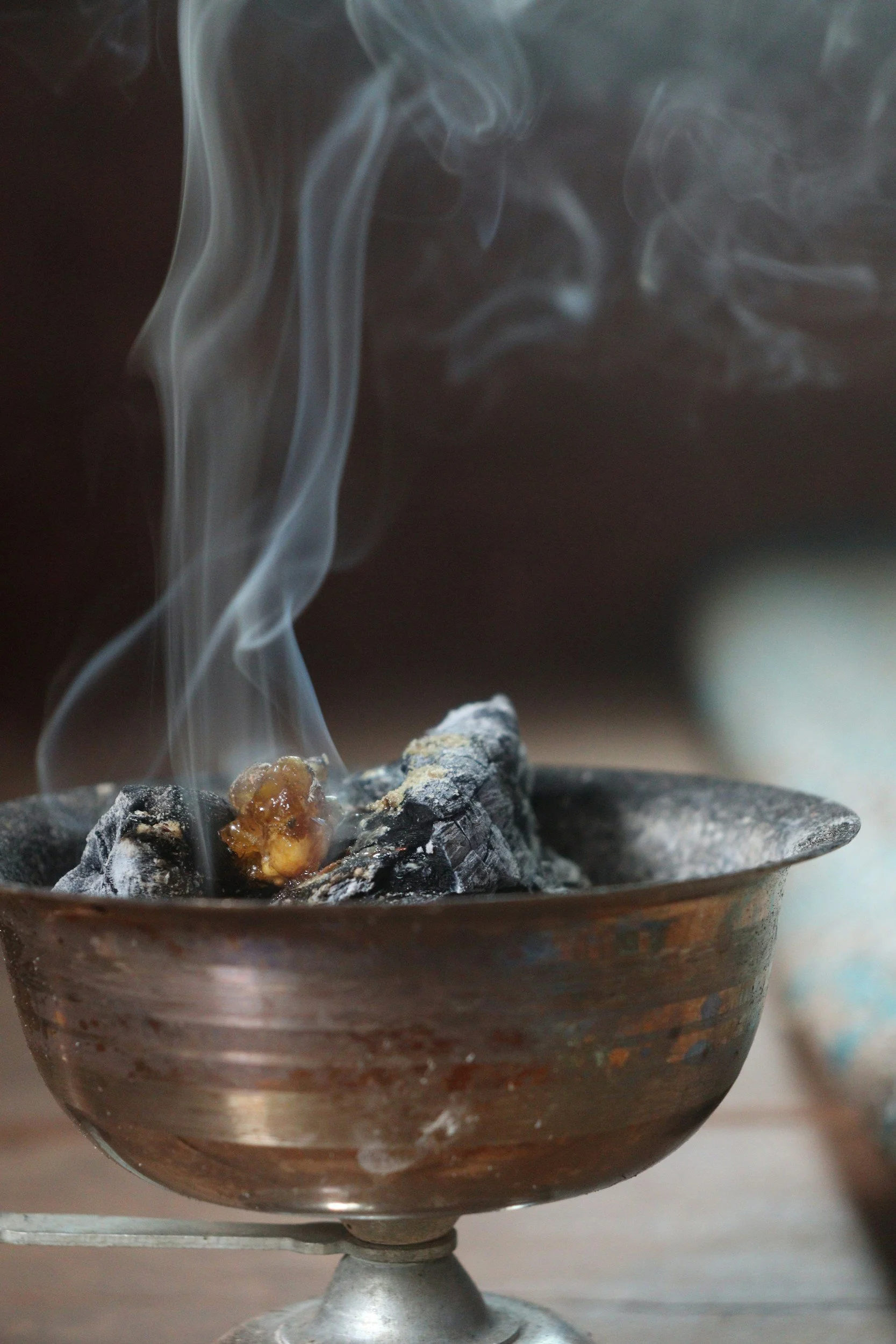
Long before electricity, people understood the power of smoke. It drifted through funeral halls, temple ceilings, plague-ridden streets, forest rituals, and candlelit ceremonies where someone hoped the unseen world might actually be listening. Resin crackled over hot charcoal while prayers rose beside it, carried upward in spirals no one could quite explain.
Inside this chamber are the histories, myths, and ritual traditions surrounding incense, sacred woods, resins, and ceremonial smoke. Whether used for purification, mourning, meditation, protection, or simple atmosphere, smoke has always occupied that strange place between the physical world and whatever waits beyond it.
🜂 A
Amber Resin (fossilized tree resin, various species)
True amber — fossilized tree resin millions of years old, the kind found set in jewelry and occasionally containing preserved insects — is not the same material as the "amber" incense sold in most metaphysical shops, which is typically a blended compound resin (often combining labdanum, benzoin, and vanilla) formulated to approximate amber's warm, honeyed scent without burning actual fossilized material. Both versions carry a folk reputation for protection and grounding, though the fossil itself has additionally been used across multiple traditions as a protective amulet worn rather than burned, valued as much for its ancient origin as for any scent it carries.
full entry coming soon
🜃 B
Benzoin Resin (Styrax benzoin)
Warm, sweet, and vanilla-toned, benzoin resin has been used since antiquity both as incense in its own right and as a fixative to extend and stabilize the scent of other resins burned alongside it — a practical role that made it a near-constant background presence in temple and ceremonial incense blends across multiple traditions without always being individually named or credited. In folk magic practice it's burned for purification and to consecrate ritual tools before their first use, its gentle sweetness intended to soften and prepare rather than to banish forcefully.
full entry coming soon
🜄 C
Camphor (Cinnamomum camphora) ⚠️
Sharp, cooling, and immediately dispersive, camphor smoke has been used across Chinese, Japanese, and Ayurvedic ritual tradition for rapid, forceful cleansing — the incense equivalent of a cold shock, used when a space needs to be cleared quickly rather than gently coaxed. Camphor is toxic if ingested even in small quantities, and burning it in poorly ventilated spaces can cause irritation or illness with prolonged exposure, a caution worth taking seriously given how commonly it's sold in unmarked incense blocks without dosage guidance.
full entry coming soon
Cedar (Cedrus spp. / Juniperus spp., regionally variable)
Cedar smoke has marked sacred and protected space across an unusually wide geographic range — burned in ancient Mesopotamian and Egyptian temple ritual, used in Chinese and Japanese incense tradition, and central to numerous Native American smudging and purification practices specific to individual nations. Its dry, resinous scent is consistently tied to protection, purification, and the marking of consecrated boundaries, a rare case of a scent carrying nearly identical symbolic weight across traditions that developed the association independently of one another.
full entry coming soon
Copal (Bursera spp.)
The Mesoamerican counterpart to Old World frankincense, copal has been burned in Mexican and Central American ceremony for millennia, offered to deities, used in purification ritual, and still burned today at Day of the Dead altars to guide spirits home with its scent. Harder and pine-like when compared to frankincense's softer profile, copal carries a distinct sacred weight in its regions of origin that's worth recognizing on its own terms rather than treating as a simple frankincense substitute.
full entry coming soon
🜁 D
Dragon's Blood Resin (Dracaena spp. / Daemonorops spp.)
Despite the name, dragon's blood resin comes from several unrelated plant genera across different continents, unified only by producing a deep red sap when the bark is cut — a visual dramatic enough to inspire the same evocative name independently in multiple trading cultures. Burned to intensify and accelerate other workings, dragon's blood is rarely used alone in folk magic tradition; its primary role is as a booster, added to protection, love, or banishing blends specifically to strengthen whatever else is already being worked.
full entry coming soon
🜂 E
[no entries]
🜃 F
Frankincense (Boswellia sacra)
Harvested from trees native to the Arabian Peninsula and Horn of Africa, frankincense has been burned in religious ceremony for over five thousand years — present in ancient Egyptian temple ritual, prescribed in the Hebrew Torah's incense formula, and carried by the Magi in Christian tradition as a gift befitting divinity. Its consistent presence across nearly every major incense tradition in the ancient Mediterranean and Near East makes it one of the least contested sacred materials in this entire archive.
full entry coming soon
🜄 G
[no entries]
🜁 H
[no entries]
🜂 I
[no entries]
🜃 J
[no entries]
🜄 K
[no entries]
🜁 L
Loban (Indian Benzoin / Styrax spp.)
A South Asian resin closely related to benzoin, loban is burned across Hindu, Muslim, and folk healing traditions on the Indian subcontinent for protection, purification, and the warding off of the evil eye, often used in postpartum and infant protection rituals specifically. Its warm, slightly medicinal sweetness places it in the same general family as its Southeast Asian benzoin relative, though the two carry distinct regional identities and shouldn't be treated as fully interchangeable.
full entry coming soon
🜂 M
Myrrh (Commiphora myrrha)
Paired with frankincense since antiquity — the two resins traded along the same ancient caravan routes and gifted together at the Nativity — myrrh carries a darker, more grounded register than its brighter counterpart, historically central to Egyptian embalming practice and used across multiple traditions to honor and prepare the dead. In ritual use it's burned for protection, banishing, and communication with ancestors, doing quietly heavier work than frankincense's more celebratory reputation.
full entry coming soon
🜃 N
[no entries]
🜄 O
Opoponax (Sweet Myrrh / Commiphora guidottii)
Sometimes called sweet myrrh for its softer, more honeyed profile compared to true myrrh, opoponax has a long history in perfumery as a warm base note and a lesser-known but genuine presence in ancient Mediterranean incense recipes, referenced by Dioscorides among other classical sources. Its magical use tends to mirror myrrh's — grounding, protection, ancestor work — but with a gentler hand, chosen when a working calls for depth without myrrh's heavier, more solemn weight.
full entry coming soon
🜁 P
Palo Santo (Bursera graveolens) (sourcing caution — sacred to Indigenous South American traditions; seek sustainably and ethically harvested sources rather than wild-stripped wood)
"Holy wood," burned across Ecuador, Peru, and the broader Andean and Amazonian region for cleansing and protection, palo santo's sweet, citrus-tinged smoke comes from wood that must fall naturally and age for years before it develops its characteristic fragrance — a slow process that sustainable harvesters respect and that commercial over-demand in the global wellness market has increasingly threatened. Its popularity outside its traditions of origin has outpaced most buyers' awareness of where and how it's actually meant to be sourced.
full entry coming soon
🜄 Q
[no entries]
🜁 R
[no entries]
🜂 S
Sandalwood (smoke form) (Santalum album) (sustainability caution — heavily overharvested; seek certified or plantation-grown sources)
Burned as incense across Hindu and Buddhist tradition for meditation, consecration, and the honoring of the dead, sandalwood's soft, warm smoke carries the same sacred weight in its combusted form as it does as oil, historically incorporated into funeral pyres specifically for its purifying properties. Wild sandalwood populations have declined seriously enough that responsibly sourced material is an increasingly important distinction for anyone burning it regularly rather than occasionally.
full entry coming soon
Storax (Styrax officinalis)
An ancient Mediterranean incense resin referenced in Greek and Roman religious texts, storax was used in temple offerings alongside frankincense and myrrh, though it has faded considerably from common use compared to its more famous companions. Its balsamic, slightly floral sweetness made it a favored fixative in older incense compounds, and its relative obscurity today says more about shifting trade routes over the centuries than about any decline in the resin's actual quality or usefulness.
full entry coming soon
Sweetgrass (Hierochloe odorata) (sacred specifically to many Native American and First Nations traditions — approach with cultural awareness rather than as a generic "cleansing herb")
Braided and burned for purification and to invite in good spirits and positive energy, sweetgrass holds specific ceremonial significance within the traditions it originates from, and its widespread commercial adoption into general "cleansing kit" products has often stripped that context away entirely. Unlike many resins in this archive, sweetgrass is a genuine grass rather than a tree exudate, braided while still green and dried slowly so the braid holds its shape and releases a sweet, vanilla-like scent when burned.
full entry coming soon
🜃 T
[no entries]
🜄 U
[no entries]
🜁 V
[no entries]
🜂 W
White Sage (Salvia apiana) (sourcing and cultural caution — overharvested from wild populations; sacred and specific to Native American traditions, particularly Indigenous Californian communities)
Burned ceremonially within the traditions it originates from, white sage's popularization as a generic "smudging" product in the broader wellness market has driven significant wild overharvesting in its native range, a pattern that sits uncomfortably alongside its sacred status to the communities who have used it longest and with the most specific protocol. Garden-grown or cultivated sources, where available, are a meaningfully different choice than wild-harvested bundles sold without any acknowledgment of the plant's origin or significance.
full entry coming soon
🜃 X
[no entries]
🜄 Y
[no entries]
🜁 Z
[no entries]
Submit to the Archive
If you would like to suggest a topic or share a lead worth investigating, submit it to us for review. Click Here