The Fires of Beltane: Need-Fire, Bone-Fire, and the Ritual Architecture of May
The fires of Beltane were not decorative.
This needs to be said plainly, because the modern instinct — especially for a festival so associated with celebration, with dancing, with the exuberance of early summer — is to treat the bonfires as atmosphere. As backdrop. As the picturesque feature of an otherwise joyful gathering. They were not. The Beltane fire was the most technically demanding, most ritually precise, and most consequentially serious act of the entire festival. Everything else — the flowers, the feasting, the driving of cattle to summer pastures — was organized around it.
The fire was the point. The fire was the technology. And understanding what it was actually doing, what the people who built it and lit it and walked through its smoke understood it to be doing, changes the entire character of the festival. Beltane was not a party with a bonfire. It was a fire ritual with a party attached — a communal act of purification, protection, and cosmic alignment that happened to also involve music, food, and the relief of surviving another winter.
The Need-Fire: Starting From Nothing
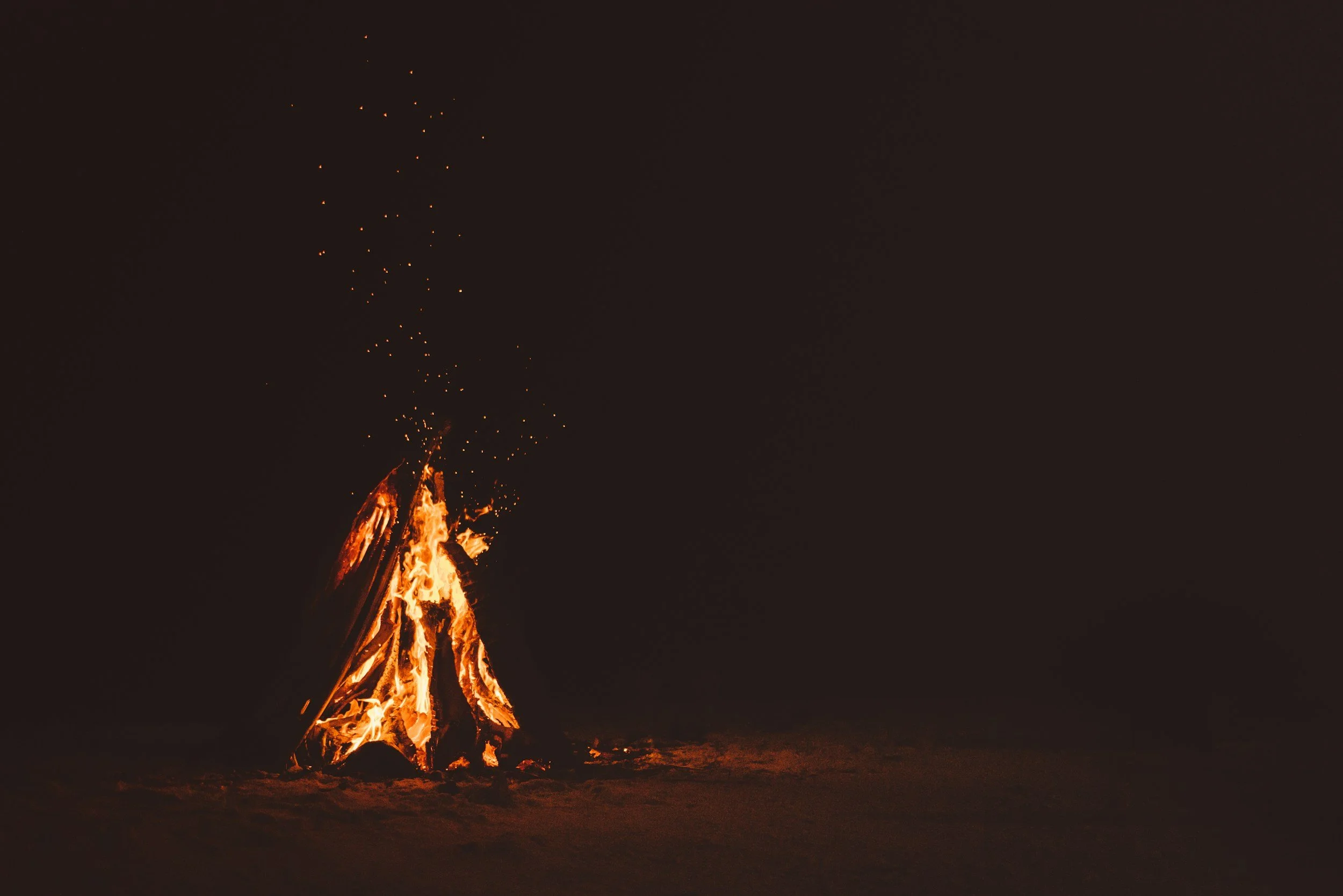
The most significant and most demanding of Beltane's fire traditions was the teine éigin — the need-fire, sometimes called the forced fire or the friction fire. On Beltane eve, across Ireland and Scotland in the historical record, every domestic fire in the community was extinguished. Every hearth went cold. Every candle was snuffed. The entire community was, for a brief period, dark.
Then, on the hilltop — at the highest point of the landscape, the place where the worlds came closest — a new fire was kindled from scratch by friction. No carried flame, no preserved ember from the old fire, no shortcut. The new fire had to be made from nothing: wood rubbed against wood, the ancient method, until the spark caught the tinder and the tinder caught the kindling and the kindling became the fire that would relight the world.
The method was precise and the personnel carefully chosen. In Scottish Highland accounts from the eighteenth and nineteenth centuries — collected by folklorists who were documenting practices already fading from common use — the need-fire required a specific number of men (accounts vary: nine, twenty-seven, eighty-one — always a multiple of nine), all of whom had to be married, and all of whom had to work the wood with bare hands. The friction was typically produced by turning a wooden axle within a wooden wheel, or by the older method of a bow-drill, until the heat built to the point of ignition. The process could take a significant portion of the night.
"The difficulty was the point. A fire that could be made easily was not the same thing as a fire that had been wrenched from the cold of the world by the sustained effort of a specific community of people on a specific night. The need-fire was earned. Its power came from what it had cost."
When the need-fire caught, the community fire was lit from it on the hilltop. Then torches were carried from the hilltop fire down to the village, where every domestic hearth was relit from the communal flame. Every fire in the community, on Beltane night, burned with the same fire — a fire that had been made new, made clean, made from nothing by their own hands.
This was not merely symbolic. In a world without reliable veterinary medicine, where disease could move through a cattle herd or a human community with devastating speed and little warning, the annual extinguishing and renewal of fire was a genuine public health practice dressed in ritual language. The smoke of the need-fire was understood to purify — and smoke does purify, does repel insects, does have antimicrobial properties. The renewal of fire was also the renewal of the community's relationship to its own most essential technology. You cannot take fire for granted if you have spent a night without it and earned its return.
The Two Fires: Between and Through
The most dramatic and most widely documented of Beltane's fire traditions was the driving of cattle between two fires — a practice recorded in Irish annals, in Scottish Highland accounts, in Welsh sources, and in the observations of early modern travelers who witnessed surviving versions of the custom in the seventeenth and eighteenth centuries.
Two great bonfires were built close enough together that it was possible — just possible — for cattle to be driven through the gap between them. The smoke that filled that gap was the purifying agent: it moved over and around the animals, carrying away disease, driving off the parasites and spirits of misfortune that had accumulated through the winter months, preparing the herd for the summer pastures where their health and productivity would determine the community's survival through the following winter.
People followed the cattle. The passage between the fires was not reserved for livestock — humans moved through as well, bending low into the smoke, walking deliberately through the gap, submitting themselves to the same purification that the animals had received. Children were carried through. The elderly were supported through. Those who were sick or who had experienced particular difficulty in the preceding year were brought through with special attention. The fire did not distinguish. Everything that needed the new season to be different from the old one walked between the flames.
Picture a hillside in County Roscommon on the eve of May, sometime in the eleventh century. The two fires have been burning for hours — they are enormous now, head-height, throwing heat so intense that the gap between them shimmers and warps the air. The cattle go first, reluctant, pressed forward by the herdsmen, the whites of their eyes visible. They move through in a rush, tails up, emerging on the other side with their coats damp from the heat and smoke. Then the people follow. Families together, the grandmother leaning on her grandchild's arm, both of them ducking into the smoke, coughing, emerging on the summer side of the fires with their eyes streaming and their lungs full of the new fire's breath. Someone is laughing. Someone else is crying, though it may be the smoke. The fires roar. The night smells of cattle and hawthorn and burning wood and something else — something that belongs to this night specifically, that has no other name. Beltane. The bright fire.
May Day Across Europe: The Tradition Beyond Ireland
The fire traditions of Beltane are Celtic in their most specific documented forms, but the festival's logic — the great fire at the midpoint of spring, the communal gathering, the symbolic passage from the cold half of the year into the warm — appears across Northern and Western Europe in forms that share too much to be coincidental.
In Germany and Scandinavia, Walpurgisnacht — the eve of May 1st, the feast day of St. Walpurga — was marked by bonfires on the hilltops and by the understanding that witches gathered on the mountaintops on this night, riding to their great sabbath on the Brocken or other high places. The bonfires were lit partly in celebration and partly in protection — the same dual function as the Beltane fires. The noise and light of the community fire drove away the dangerous things that gathered at the threshold of summer.
In Sweden, Valborg — still celebrated today — brings communities together around enormous bonfires on April 30th, the singing of spring songs, the burning of the old winter. University towns throughout Scandinavia observe it with particular enthusiasm, the bonfires on the riverbanks lighting the faces of thousands of people who have come together, instinctively, at the moment when the cold is finally finished and summer is genuinely possible.
In the British Isles, May Day traditions that survived into the modern period included the lighting of fires on the hilltops, the gathering of dew from the fields at dawn (believed to have exceptional beauty and healing properties when collected on May morning), and the going out into the woods at midnight on May Eve — going a-Maying — to gather flowers and green branches for the decoration of homes and the maypole.
"May Day is the festival that survived everything — the Reformation, the Puritan suppression, the Industrial Revolution, two world wars. It survived because the need it meets is too fundamental to be argued or legislated out of existence: the need to mark the moment when summer becomes real, when the long effort of winter is officially finished, when the community comes together not to endure but to celebrate."
The Maypole: The World Axis at the Center of the Village
The maypole is among the most recognizable and most persistently misunderstood of Beltane's symbols. Its critics — and it has had critics since at least the seventeenth century, when Puritan writers described it with remarkable hostility — have focused on its phallic symbolism, which is present and not accidental. Its defenders have sometimes responded by denying the symbolism entirely and insisting on the maypole as innocent folk custom. Both miss the point.
The maypole is the axis mundi — the world axis, the pole at the center of the world around which everything turns. In the cosmologies of virtually every culture that developed one, the world has a center point, a vertical axis connecting the earth to the sky, the human world to the divine. In Norse mythology it is Yggdrasil, the World Tree. In Hindu cosmology it is Mount Meru. In the shamanic traditions of Siberia and Central Asia it is the cosmic pillar that the shaman climbs to reach the upper world. The maypole is this structure brought down to the village scale — the axis of the local world, the center around which the community organizes itself at the moment of the year's turning.
The ribbons that the dancers weave around it — each dancer moving in the opposite direction from the one beside them, the ribbons interweaving in a pattern that tightens as the dancers spiral inward — create a visible record of the community's movement around its own center. The dance is a cosmological act: the community weaving itself into relationship with the axis of its world, marking the moment of midsummer passage with the most literal possible enactment of collective circular movement.
The phallic symbolism is not separate from this. The pole planted in the earth is the meeting of sky and ground, the vertical thrust of growth into the upward world, the same energy that drives everything blooming at Beltane: the insistence of life upward, the directional force of the season. Beltane has never pretended to be modest about this energy. It has always been the festival of desire as well as fire — the desire of the living world for more life, more warmth, more growth.
Bealtainn in Scotland: The Specific Ritual Record
✦ ✦ ✦
While general Beltane fire customs are documented across the Celtic world, Scotland provides some of the most specific and richly detailed accounts of the ritual's actual practice — particularly the Bealltainn customs documented in the Scottish Highlands and Islands by eighteenth and nineteenth century observers.
The Scottish custom of the Beltane cake — sometimes called the bonnach Bealltainn — adds a dimension of communal divination to the fire ritual that is specific to this tradition and worth examining in detail. A cake was made for the Beltane gathering, marked into pieces, with one piece — or one portion of the crumbling, char-marked cake — designated as the forfeit piece. The pieces were distributed by lot, concealed in a bonnet so that no one could choose. The person who drew the forfeit piece was the cailleach Bealltainn — the Beltane carline, the Beltane hag — and was subjected to a mock death, leaped over three times by the company, and subjected to ritual teasing throughout the remainder of the evening.
The Beltane carline was a ritual scapegoat — not harmed, but symbolically marked as the one who carried the community's accumulated misfortune out of the old year and into the fire. The mock death was the death of winter, the death of the past year's difficulty, the death of whatever the community needed to leave behind. The person who drew the forfeit was not unlucky. They were performing a necessary function: dying on behalf of the community so that the community could cross into summer clean.
This practice echoes across European cultures in ways that suggest a very ancient common root: the ritual sacrifice, the scapegoat, the figure who bears the weight of the community's accumulated harm and dies — symbolically or, in older practice, literally — so that the others can be freed. At Beltane, this function had been thoroughly humanized and ritualized to the point of playfulness. The carline was teased and leaped over. They were not harmed. But the memory of what the gesture meant — what it had once cost — remained in the structure of the ritual, preserving the knowledge even when the knowledge was no longer fully conscious.
The fires are out now. The embers are cold. The cattle are in the summer pastures, and the community has passed through the smoke into the warm half of the year.
But the need-fire remembers how to start. It always does.
Every Beltane, somewhere, someone makes fire from nothing. And the new season begins.